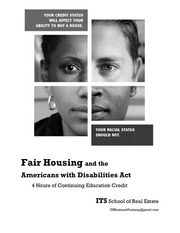
Fair Housing and the
Americans with Disabilities Act
4 Hours of Continuing
ontinuing Education Credit
ITS School of Real Estate
ITSBusinessTraining@gmail.com
ITSBusinessTraining@
�
This Workbook is the property of
ITS School of Real Estate
ITSBusinessTraining@Yahoo.com
School # 1537
Course # 6817
September 2011
1st Edition
�
�
Learning Objectives…
This four (4) hour course for continuing education credit is designed
not only to help you meet your required educational requirements, but also
to examine the Federal laws as a collective whole that strive for consumer
equality in both choices and opportunities. Often when we discuss fair
housing issues, we focus on overt discrimination. Although this in
abundant in our society, a far more common situation is the quiet and often
effective limiting of a consumers choices and opportunities by a real estate
professional.
We will first look at the fair housing laws, and work through case
studies of situations where real estate professional have both succeeded
and failed. Secondly, we will look at the American with Disabilities Act. We
will look at how the ADA affects your real estate office both as an employer
and as a professional. Finally we will look at the Federal antitrust laws and
discuss how these laws are also created and intended to protect consumer
choices and how the real estate profession through its conduct can limit
these consumer choices.
I hope you enjoy this study and take something away from this
course. These Federal laws are to ensure that your clients have every
possible choice and opportunity presented to them. We must all work hard
every day to make sure our habits, our own preferences, and even our
opinions stay out of our professional responsibilities.
Workbook materials by John Wilkinson
�
Fair Housing Law and AntiAnti-Trust Legislation
It is necessary to do a full and thorough review of both the Fair Housing
Laws and the Anti-Trust laws because in the realities of day to day practice, it is
easy to unintentionally violate these laws without malice or fault. These laws
cover such a wide range of issues, nearly every advertising, marketing, and
employment decision a Realtor makes must be proofed to determine if the
advertising or marketing is in compliance with these standards.
Let’s first look at the Fair housing laws…
It must first be noted, the Federal Fair Housing laws are not found in a
single work of legislation. The current law we have to today is a compilation of
multiple laws and judicial interpretations. The law has taken baby steps for over
150 years to arrive at the current interpretations we have today.
�
1866: The Civil Rights
Rights Act of 1866
This single piece of legislation marked the beginning of the federal
government’s attempt to ensure housing equality for all of its citizens. Passed in
the months following the conclusion of the Civil War, the congress declared “All
citizens of the United States shall have the same right in every state and territory
as is enjoyed by white citizens thereof to inherit, purchase, lease, sell, hold, convey
real and personal property.” This piece of legislation created Fair Housing’s first
protected class…Race.
1962: Executive Order No. 11063
This Presidential Order signed into law by President John F Kennedy
prohibited discrimination in housing credit practices of both the FHA and VA
loan programs. This order cleared the way for the Creation of the ECOA which is
the Equal Credit Opportunity Act. This act was passed by Congress and
prohibited discriminatory practices in credit granting and determination.
1968: Title VIII of the Civil Rights Act
This is by far the most sweeping and comprehensive part of today’s Fair
Housing Laws. Title VIII created multiple “protected classes” including race,
color, religion, or national origin. This act declared it was unlawful to
discriminate against these protected classes when selling or leasing residential
property. It must also be noted, that Title VIII did allow for some limited
circumstances and situations that were exempt from compliance of Title VIII.
1974: Housing and Community Development Act
This act was an extension of the policies set down by the 1968 Title VIII
with the addition of another protected class. For the first time, sex was added as a
protected class. This act made it unlawful to use gender as a defining or
determinant factor in housing decisions.
�
1988: Fair Housing Amendment
Amendment Act of 1988
Like the 1974 act, with this legislation Ronald Reagan signed into law
policy that created two addition protected classes. “Handicapped” and “familial
status” are the final two protected classes.
The “handicapped” class requires further explanation. A handicap is a
physical or mental impairment. This includes having a history of or being
regarded as having an impairment that substantially limits one or more of an
individual’s like activity.
For example an AIDS patient would be protected under this protection, but
a drug abuser would be excluded.
The “familial status” class is another class that creates confusion in the
minds of many. This classification basically protects against discrimination of
families with children. Technically, familial status refers to the presence of one
or more individual who not yet reached the age of 18 and who live with either a
parent or guardian.
With the exception of housing intended and property designated for older
persons (See official FHA guidelines for more details), all properties must be
made available to families with children under the same terms and conditions as
to anyone else.
�
Discriminatory Housing Practices:
Federal Fair Housing Laws prohibit the following discriminatory acts…
1. Refusing to sell, rent, or negotiate with any person or otherwise making a
dwelling unavailable to any person
“This is a 1 bedroom apartment; there is just not any room for you and
your three kids”
2. Changing terms, conditions, or services for different individuals as a means of
discrimination
This could be as simple as requiring a credit check for minority applicants
while you skip this step for white applicants.
3. Practicing discrimination through any statement or advertisement that
restricts the sale or rental of residential property
“No Kids” or
“Adults Only”
4. Representing to any person, as a means of discrimination, that a dwelling is
not available for sale or rental.
Testers have been known to test landlords with different applicants to see if
the landlord will make a “rented” property available to non minority
applicants .
5. Making a profit by inducing owners of housing to sell or rent because of the
prospective entry into the neighborhood of persons of a particular protected class
See Blockbusting in the pages to follow
�
6. Altering the terms or conditions for a home loan to anyone in any MLS, Real
Estate Broker’s Organization, or other facility related to the sale or rental of
dwelling as a means of discrimination.
See Redlining in the sections to follow
7. Denying people membership in any MLS, Real Estate Broker’s Organization, or
other facility related to the sale or rental of dwelling as a means of
discrimination.
This is discrimination by Realtors and firms against other Realtors who are
members of a minority group or protected class
Exemptions to Fair Housing Laws…
1. The sale or rental of a single family home is exempted when the home is
owned by an individual who does not own more than three such homes at one
time, when a broker or salesperson is not used. If the owner is not living in the
dwelling at the time of the transaction or was not the most recent occupant, only
one such sale by an individual is exempt from the law within any 24 month
period.
2. The rental of rooms or units is exempted in an owner-occupied one-family to
four family dwelling.
3. Dwelling units owned by religious organizations may be restricted to people of
the same religion if membership in the organization is not restricted on the basis
of race, color, national origin, handicap, or familial status.
4. A private club that is not open to the public may restrict the rental or
occupancy of lodgings to its members as long as the lodgings are not operated
commercially.
�
5. Housing intended for older persons is exempted from the familial status
classifications if…it is occupied solely by persons 62 years of age and older; or
80% of its units are occupied by at least one person 55 or older and meets certain
guidelines.
Housing Violations by the Real Estate Professional
Professional
Blockbusting…
The fair housing guidelines prohibit agents from using panic peddling
commonly known in the real estate profession as blockbusting, to sell homes or
induce owners to sell. This practice is used to create a sense of urgency or panic
in the mind of homeowners by making representations regarding the entry or
possible entry of a protected class. The suggestion is commonly made that the
home values and safety of the area which likely be compromised.
Steering…
This is the practice of channeling members of a particular protected class
or group into any area on the assumption that a particular area has or does not
have members of the same protected class. Steering is often subtle and can be
done unintentionally by a careless agent. This practice effectively limits the
choices of the homebuyer and limits potential buyers for a home that is for sale
in other areas.
Redlining…
The practice of refusing to make loans or issue insurance policies in
specific areas without regard to the economic qualifications of the applicant is
known as redlining. This policy often targets an area that has a high
concentration of at least one minority group.
�
Fair Housing Questions…
What are the seven protected classes?
1. Race
2. Religion
3. National Origin
4. Color
5. Sex
6. Handicapped
7. Familial Status
1866 legislation created the first protected class. What was it?
Race
What classes were created by the landmark Title VIII legislation in 1968?
Color, religion, or national origin
In what year was “sex” added as a protected class?
�
What were the final two classes added to the group of seven?
Handicapped and Familial Status
After reviewing the discriminatory practice action #1, would a landlord with
20 rent houses be guilty of a discriminatory action if he or she did not
return the phone calls of interested applicants if the applicants name
indicated a possible clue to the applicant’s ethnic background? Do you
believe that a landlord can be discriminatory with simple inaction verses an
open and visible act?
Yes, by making the home seem unavailable for rent
The deciding factor is race or color
This effectively is “changing terms or conditions”
Why does it matter that the landlord own and operates “20” rental
properties?
Exemption # 1
�
After reviewing discriminatory practice action #2 , the use of credit scoring
is an accepted and common means of screening applicants, but what would
be a unacceptable use of this credit scoring when screening applicants?
Setting multiply standards
Not checking majority groups
Charging ONLY minority groups for the testring low scores for majority
groups
Publishing results of scores
After reviewing discriminatory practice action #3, can a landlord advertise
an apartment for rent and expressly prohibit….”no single women”?
No, this violates two protected classes…. Sex and Familial status
�
After reviewing discriminatory practice action #4 , give an example of this
type of discrimination.
Using racial or ethnic clues to dismiss an applicant
In person statement a home is already rented
Preferential treatment of an application over a more qualified minority
applicant
After reviewing discriminatory practice action #5 , what is another name for
this?
Blockbusting
After reviewing discriminatory practice action #6 , what is another name for
this?
Redlin
ing
After reviewing discriminatory practice action #7 , can a broker’s hiring
decisions be regulated by the Fair Housing Laws….?
Yes or No
�
After reviewing the exemptions to the Fair Housing rules, can a church
limit the rental of a church owned home to member of its congregation?
Yes or No
What condition is put upon this exemption?
Church membership must not be limited or exclude
Members of a protected class
The Fair Housing Laws allow exemptions for Housing unit intended for
and marketed to older clients. What are the conditions put upon this
exemption?
Housing intended for older persons is exempted from the familial status
classifications if…it is occupied solely by persons 62 years of age and older;
or 80% of its units are occupied by at least one person 55 or older and meets
certain guidelines.
�
Don’t get caught
NOT knowing the rules!!!
Advertising Guidelines…
In the real estate profession, agents will be asked daily to create, insert, or
distribute some form of marketing or advertisement. Each and every one of these
advertisement must be carefully vetted to assure compliance with Fair Housing
standards.
“No printed or published advertisement of pro
property
perty for sale or rent can
include language that indicates any discriminatory preference or limitation,
regardless of how subtle the choice of words.”
What are Considered Advertisements?
Advertisements include flyers, brochures, billboards, mailings, radio, TV
ads, newspapers and magazines, signs, business cards, and statements.
�
The Specific FHA Advertising Statutes
In 1972 HUD Advertising Regulations where put into effect… 24 CFR Part 109
In 1989 much more detail interpretations were provided, such as…
Section # 804 of the federal fair housing law states it is against the law to
“make, print, or publish any notice, statement, or advertisement, with respect to
the sale/ rental of a dwelling that includes any preference, limitation or
discrimination based on race, color, religion, sex, handicap, familial status, or
national origin, or handicap.
In addition to these limitations, all advertisements for housing, including
lending, should contain the Equal Housing Opportunity slogan or logo according
to HUD regulations. At all times, it must be clear and legible and at least equal
in size to other logos appearing in the advertisement.
Who may sue under FHA guidelines?
A lawsuit alleging a fair housing violation can be filed by any individual
who was deterred in their housing search on suffered emotional injury, any of the
fair housing organizations, and the federal government.
When a suit is filed by an individual, the courts have the options of
awarding the plaintiff compensatory damages, punitive damages, and/or specific
performance. It is also important to note that the judge can order the defendant
to pay the plaintiffs’ legal and attorney’s fees. Jury awards for plaintiffs have
reached as high as two million dollars in some jury trials.
If the federal government files a FHA suit, the plaintiff (US Gov.) alleges
that the defendant is operating under a “pattern or practice” of discriminatory
behavior, or the case poses “general public importance.” The courts look for a
pattern of discriminatory behavior, not for single indiscretions.
In addition to monetary damages, the courts can assess a civil penalty in
the amount of $50,000 for a first offense, and $100,000 for an additional offense.
�
Human Model Advertising…
A picture is not
just a picture
One of the most controversial and subjective sections of the HUD Fair
Housing Advertising regulations is the topic of “Human Models.”
If models are used in display adverting campaigns
campaigns,, the models should be clearly
definable as reasonably representing majority and minority groups in the
metropolitan area, both sexes, and when appropriate, families with children.
Models when used should portray persons in an equal social setting and indicate
to the general public that the housing is open to all without regard to race, color,
religion, sex, handicap, familial status, or national origin, and is not for the
exclusive use of one group.
Although very subjective, the intention is to prevent the reader or viewer
from interpreting the housing as exclusive to one particular group, or portraying
a preference to a group.
�
What is an advertising “Campaign” ?
In the provided regulation on the previous page, I highlighted the word
“campaign”. When does using a human model photo become a campaign and
become subject to these regulations? The answer is not so simple…
The use of human model photos must be viewed in the totality of the
whole advertising for a particular client. A recurring weekly ad that has two
white males in workout attire over a three month period can be argued to be a
campaign stating a preference for acceptable applicants. Whereas, this same
photo used 25% of the time and mixed with photo of families and minority group
models would not be discriminatory. The photo of two white males, is not
discriminatory, the long term repeated use of this photo is what the crosses the
line.
This is not to say that an advertising campaign is determined only by the
length or by the number of times it is run. A single ad for a housing community
with 100 residents grouped in front of the gated entrance could be considered an
advertising campaign is some cases. What if the picture is entirely made up of
white residents? What message is sent to minority applicants by 100 white
residents standing at the gate? The issue with this example is the overall mass of
human models and not the number of times the as has run. A licensee should try
to use images with diversity of race, gender, and economic situations.
Let’s add a twist to this example…
What if you are selling a number of homes in a gated community and your
ads link or encourage the potential buyer to visit this community’s webpage. The
webpage’s opening image is the 100 residents at the gate picture that we
discussed before. This picture is not of human models, but of the actual residents
at this year’s annual barbeque.
Does this make a difference? Does it matter that you did not post the
picture? Is your advertisement discriminatory with the inclusion of this website
or photo?
�
The answer is subjective. In my opinion, the website link should be
excluded, some would disagree. The reality is that situations like these will be
part of the real estate profession’s struggle to comply with these rules. In the
following pages we discuss strategies for firms and agents to have answers for
these questions and plan for the times when legal counsel is necessary.
The next issue we must discuss in the study of “human model” advertising
is this concept of Metropolitan Area.
Area The racial makeup of an advertising
campaign’s area is not to be limited to the subdivision, suburb, or even the town
in which you focus your real estate marketing. The racial makeup of your
advertising is to include the groups represented in your greater metropolitan area
as an inclusive whole. If your live, work, and market exclusively in the Smallville
community that is 98% white and use human models that are white… 98% of the
time, you are not representing your greater metropolitan area, but rather you are
representing a small subset and continuing to reinforce the racial patterns that
are already in effect.
Following this same line of reasoning, the use of a single income bracket
can also pose a discriminatory intent or unintended effect. The price of a listing
must not have an effect on the decisions and use of human models… The
representation of the greater metropolitan area is the standard to be modeled.
Selective Placement of Advertising
The HUD regulations make it clear that real estate professionals are not to
engage in advertising campaigns that target one particular group by using an
already targeted media source. The reality is that in some industries a targeted
market is common and good business. In a heavy Hispanic area, a Hispanic radio
station may be rated as number one, whereas, that same radio station is rated last
in the rural community twenty miles to the east. The HUD regulations do not
suggest that an agent should not utilize these targeted media outlets. It does
require that agent these outlets as part of a campaign and not as a selective
marketing tool.
�
For Example:
Example Using the scenario from above, If John sells homes in both the
rural town of Smallville and the next-door and heavily Hispanic town of
Mediumville, his advertising must be consistent and not steer potential buyers.
John cannot only place an ad on the Hispanic Radio station after listing a home
in Mediumville and in contrast only place an ad on the Morning Farm Show
when he list a home is rural Smallville. This advertising would limit the
exposure of the homes to John’s intended audience and reinforce the current
racial patterns.
It is important to note, the HUD does not intend to deter the real estate
professional from using niche or technical adverting outlets to promote unique
properties or services. For example, if agent Jane is selling a working dairy farm
with 200 milk cows, Jane is likely to limit her adverting to farming or dairy
industry magazines. In this example, Jane has limited and focused her audience
by profession and not a protected class.
In contrast, the open and intentional targeting of a protected class may be
necessary to comply with a required affirmative action campaign. Under the
respective federal laws and regulations for hiring, employment, or integration
and diversity goals; employment or housing campaigns may intentionally focus
the efforts toward attracting a particular minority. As employers, a broker may
be asked or even expected to follow different guidelines for the placement of
his/her advertising for new agents than for his/her traditional advertisements.
The complexity of this issue requires the use of a skilled professional or attorney.
Affirmative Action issues cannot be addressed in detail and the use of qualified
profession is suggested for those who face these situations.
Acceptable References and Preference Given to Minority Groups
Senior Complex:
Complex The HUD allows for the limited use of housing and
subsequent advertising that limits housing to those 55+. Given the complexity of
these rules, please use the HUD guidelines and consult with a qualified broker
when working with these properties.
�
Handicap Access: Although it would be a clear violation to state that a
home is not intended or welcoming of wheel chairs or handicapped prospects, the
HUD does not want to imply that a home with improvements or features that
such as handicap access, special bathroom facilities, or ramps should not be
featured as valuable improvements. These improvement may only be of value to
a select few, but the inclusion of these in an advertisement is not considered
discriminatory.
Roommates… Gender Restrictions: The HUD makes a clear exception to
its policies when a person is advertising for shared living space. The key is to
remember that the exception requires SHARED living space. This exception
allows for the requirement that an applicant be a specific gender. This exception
allows only for exclusion of one gender, not for any particular race or familial
status
SWF seeks same for roommate. 2 bed – 2 bath
$500 a month + ½ utilities
This ad would be in violation because the add states a clear preference for white
and single.
�
Equal Housing Opportunity Symbol
HUD regulations require that all advertisements for sale, rental, or
financing of Real Estate should contain and Equal Housing Opportunity or EHO
symbol. This symbol represents the professions goal and responsibility to
promote equality and fairness in the housing market. The exact rules and
specifics of what, where, and how big the symbol should be can be found in the
HUD regulations-Section D. Here are some basic guidelines.
1. The logo is to be included in all advertisements… Print, Radio, and TV.
Obviously, a radio advertisement would include the slogan vs. the symbol.
Whereas, a TV advertisement could use the slogan or a prominent logo during
the TV spot, and print media should use the slogan or symbol according the size
rules in Section D.
2. The logo or slogan should be a visible and prominent part of the
advertisement of equal font size of other parts of the ad, and if other logos are
used such as MLS, Realtor “R”, the EHO symbol should be of the same size.
�
Broker and Firm obligations under the Law…
1. All advertisements by the firm or by affiliates should be screened for
discriminatory content or questionable or misleading content.
2. Create firm policy, preferable in a written manual that creates an atmosphere
of equality and awareness of fair housing issues.
3. Promote, encourage, and police completion of training requirements and
training goals
4. HUD specifically requires that your firm’s nondiscrimination policy be
distributed to each employee and client..
1st Each employee will be given a printed policy manual
2nd Your firm will post its manual or statement of policy in a visible and
open location where clients will be made aware and are able to examine
further.
3rd It is suggested that all clients be given a written policy statement when
entering into a listing or buyer agency agreement with your firm.
Let’s Review your Firm’s Fair Housing Policy Manual
Each firm is asked to maintain a Fair Housing Policy Manual, and this
manual gives the firm an opportunity to work through advertising guidelines,
detail training requirements and goals. Answer those sticky “What-Ifs” in
advance and be prepared for the inevitable problems that will arise. This manual
will also help the firm limit its liability by requiring the broker and agents to
work through theses issues and make all those involved aware of the rules and
the firm’s policies. Finally for some firms who want to expand the content, this
manual can act as a roadmap for how to deal with agents who refuse to comply
with Fair Housing regulations.
�
1. Does your firm have a commitment to equal professional service to each and
every person who walks through your doors? If we go one step father, do you
have a written policy and training for how to deal with first time customers or
new leads?
2. Is floor duty assigned evenly? Are new phone contacts screened and then
assigned at the discretion of the receptionist, or are all calls assigned with a
predetermined policy or order? Are minority agents given minority client leads
at a higher rate than non-minority agents? Are these questions covered in your
firm’s policy manual?
3. How often is the firm’s Fair Housing Policy Manual reviewed? It is solely at
the discretion of broker or owner? Is the review a group process? Is agent
participation allowed?
4. Does your policy have guidelines for when an agent should involve the firm’s
broker or seek legal counsel? Does the firm have a welcoming atmosphere for
asking Fair Housing related questions? Is your firm’s broker available enough to
supervise the firm’s advertisement submissions? Are these tasks delegated to
another agent in the firm?
5. Who has the override authority in your firm if an advertisement is found to be
in violation? Is it only the broker, other agents, or office staff?
6. If an agent is having problems and has submitted or using advertising that is
in violation of Fair Housing guidelines. Does you firm have a corrective/punitive
policy for how to deal with such problems? Does your firm have a termination
policy?
7. How often are the FHA and HUD laws and regulations reviewed for changes?
Whose responsibility is it to stay on top of these changes?
8. Do customers, clients, and agents have access to decision makers if they have
concerns or have been victim of some sort of discrimination? Does your policy
statement have contact information?
�
9. Does your firm use qualification questions when working with first time leads?
Are these questions standardized? Are they used all the time, or only with
perceived income levels? Does your firm have training on the use of
qualification questions?
10. When asked to search for homes without being given a price range, does you
firm use an objective equation to determine an acceptable range (such as
payment not more than 25% of net monthly income) or is this a subjective call.
11. Are records kept to show which properties were shown? The search criteria
that was used? The specific search requests made by the client?
12. Are all incoming calls answered with a standardized response to common
questions? Is there training on how to answer incoming calls?
13. Does your firm have a goal of hiring and employing a diverse workforce?
�
Fair Housing Case Studies
Case #1
P.R. Hall vs. L------ Realty
April 9th 2002
Realtor P.R. Hall was awarded $100,000 by a court in Alabama after claiming to
be a subject of her employer’s discrimination, L------- Realty. Realtor Hall, a black
woman, claimed that her broker and firm acted with intent to steer her black clients and
limited her access to new leads from white clients. She alleges that her broker intended
to use her to service the communities black clients and use his white staff to service his
white clients.
“This verdict signals to real estate agents that they are protected by Fair housing
Laws just as much as their clients”
“ Real Estate Agents play a large role in perpetuating real estate segregation”
Leslie Proll NAACP
First, what do think of Mrs. Proll’s comment that Real Estate Agents play a large role in
perpetuating real estate segregation? Do you agree? Explain
What specifically has Realtor Hall accused her employer of ?
�
What specifically did L------ Realty’s broker do wrong?
What can a firm do to prevent this type of discrimination from happening to its agents?
What are four policy ideas that could be used by your firm to equally distribute leads
among the agents?
1.
2.
3.
4.
�
Case #2 Answering Racially Biased Questions
This case involves a rental specialist in Florida who was contracted to lease a
property for her clients. Realtor X showed the house to a qualified black couple who
was showing real interest in the property. After the showing, Realtor X was contacted
by the clients who asked how the showing went. The Realtor was eager to tell them
that she had a very good prospect and expected a signed lease within days. The clients
then asked if the prospects were black, the Realtor informed them that they were. The
client gave the Realtor strict instructions to not allow the lease to go forward. Realtor X
contacted the potential renters and informed them that the property was no longer
available. Realtor X then informed her broker about the incident, the broker
immediately terminated his agency relationship with the clients.
The HUD’s administrative law judge found the property owners to be in violation
and ordered them to pay $70,000 in damages to the complainant and a $10,000 civil
penalty. The judge also found that by answering an inappropriate question as to the
couple’s race, the Realtor facilitated the discrimination. The Realtor was fined $100.
The broker was not punished or fined in any way because he immediately terminated
the agency relationship.
What is the lesson to be learned from this case?
What did the Broker do right?
�
Case #3: No kids Allowed
HUD Formal Charge: In March 2008, Cheryl Lee Brill and Wally Wetherbee, a
Realtor and Administrator for Re/Max, advertised for rent on Craigslist a house owned
by respondent Velna Marti Irrevocable Income Trust. The ad stated, “This is an
immaculate spacious three bedroom house for rent…NO cats, dogs, or children please.”
Two families with children responded to the advertisement. When they mentioned they
had kids, Wetherbee refused to show them the property, saying the owner would not
rent to people with kids. The house was later rented to three men without children.
How is this a Fair Housing Violation?
When your client asks you to discriminate, what do you say?
If your client refuses to accept Fair Housing rules, what do you do?
�
Case #4: Sexual Harassment by a Realtor
On January 29th 2009, the United States Department of Justice filed a Fair
Housing suit against two Michigan real estate professionals for sexual harassment. The
complaint detailed a history of sexual harassment against female tenants by an agent.
This complaint alleges unwanted sexual advances, entering into the unit of female
tenants without permission, granted housing benefits differently based on gender. The
complaint has also placed liability upon the broker/owner for lack of supervision and or
corrective measures. It is alleged that the broker knew of the misconduct and failed to
act.
How is sexual harassment covered by the HUD’s Fair Housing Policy?
What should be in every firm’s employee policy guidelines involving allegations of sexual
harassment?
What can a broker do to limit his/her potential liability from claims like this one?
�
Case #5: Deviation from Industry or Firm Norm
Sometimes discrimination by a real estate professional can be very subtle and
hard to detect. One such example is the “double standard”. When a Realtor has an
establish practice, and deviates from this standard for minorities, discrimination has
occurred.
This case involves a home sale in late 2000 on the eastern shore of Long Island.
The Realtor, a long time professional, entered into contract with a black man to sell one
of his client’s homes. The potential buyer was somewhat surprised by the Realtor’s
request for a very high earnest money deposit, and demand for financing proof within 5
days. The potential buyer complied, but began to research the area norms and even the
Realtor’s normal earnest money request. A pattern of racial discrimination soon
appeared.
How is this a Fair Housing Violation?
What is the best Strategy to combat such a discrimination claim?
Do you have to request the same amount of Earnest money every time?
�
Americans
Americans with Disabilities Act
The Americans with disabilities act prohibits discrimination on the basis of
disability and in the areas employment, by State and local government, or in
public accommodations, commercial facilities, transportation, and
telecommunications.
What is a disability?
An individual with a disability is defined by the ADA as a person who has a
physical or mental impairment that substantially limits one or more major life
activities, or a person who is perceived by others as having an impairment. The
ADA does not specifically name all of the impairments that are covered. It is first
important to note that the disability can be solely in the mind of the person who
is engaging in some form of discrimination. This may at first seem to be counterintuitive, but discrimination upon one individual by another is not determinant
upon the victim’s actual impairment. Secondly, the ADA is not in the business of
listing or judging actual disabilities. The standard is set for zero tolerance for
actual or perceived discrimination. There is not a website that lists all the
accepted disabilities.
�
In 2008 congress made several changes to the ADA guidelines and
provided more clarity on several issues. First, a major life activity is said to be…
-
Caring for Oneself
-
Performing Manual Tasks
-
Seeing
-
Hearing
-
Eating
-
Sleeping
-
Walking
-
Standing
-
Lifting
-
Bending
-
Speaking
-
Breathing
-
Learning
-
Reading
-
Concentrating
-
Thinking
-
Communicating
-
Working
The determination of whether or not an impairment substantially limits a
major life activity must be made without regard to the corrective effects of
medical aids, medicine, assistive technology, and reasonable technology. For
example, a person who has lost his or her leg and is able to walk and work with a
prosthetic leg, this individual is still considered to be disabled. Secondly, a man
or woman who is required to take an antidepressant or some other kind of mental
aid drug is considered to be disabled if the use of this drug allows them to work
when they could not work without the drug.
•
An exception to this rule is corrective eyewear, a person who is able to
wear glasses and correct their vision problems will no longer be considered
disabled.
�
Example of Recognized Disabilities
-
Blindness
-
Deafness
-
Paralysis
-
Muscular Dystrophy
-
HIV Infected
-
Mental Retardation
-
Emotional Illness
Reasons that are not acceptable for an ADA discrimination claim
-
Homosexuality or Bisexuality
-
Transvestitism or Transsexualism
-
Pedophilia
-
Exhibitionism
-
Voyeurism
-
Sexual Behavior Disorder
-
Compulsive Gambling
-
Kleptomania
-
Pyromania
-
Psychiatric problems cause by illegal drug use
Who must follow ADA Guidelines?
1. Employers with more than 15 employees
2. All State and Local Governments
3. Most private businesses that provide accommodations, goods, or services to
the public
4. Public Services and Transportation.
�
ADA Title I: Employment
Title I requires employers with 15 or more employees to provide qualified
individuals with disabilities an equal opportunity to benefit from the same
opportunities available to others. This ensures the workplace takes advantage of
the skills and abilities that the disabled persons have to offer, while protecting the
disabled.
It is important to note that the act requires employers to give QUALIFIED
disabled workers and equal chance at employment. This idea of qualified will be
addressed as we talk about hiring standards and essential job functions.
This act requires employers not use discrimination is hiring practices by
establishing non discriminatory hiring practices and by the use of “reasonable
accommodations” for a disabled workers.
Title I complaints must be filed within 180 day from the date of
discrimination. These complaints are filed with the EEOC, the Equal
Employment and Opportunity Commission. If the complainant wishes to enter
into a private lawsuit against the employer, the individual must receive a “right to
sue” from the EEOC before filing suit.
NonNon-Discriminatory Hiring Standards
1st Establish “Essential Functions” of the listed job opening
This can be a required educational level
This can be a required number of years work experience
This could be a required Industry certifications… such as a C.P.A.
This can be a physical requirement… The ability to lift 50 lbs
2nd Ensure that these “Essential Functions” are actually job related and business
necessity. The courts have often ruled that job requirements that are not bona
�
fide necessities have often been used as acts of discrimination against both
disabled and other protected classes.
One example of note is a case where a job opening required a college
degree to be a safety inspector in a factory. All the necessary training was
provided and paid for by the plant after the new employee was hired. The courts
ruled that this requirement was not a bona fide requirement, but was rather an
attempt to limit the number of minority applicants in the applicant pool in an
area where whites had a higher percentage of college degrees.
3rd
Determine if “Reasonable Accommodation” would allow the disabled person
to meet these standards.
-Making facilities accessible
-Providing adaptive hardware
- Hiring readers and interpreters
- Providing part-time or modified work schedules
These adaptations are not expected to create an undue financial or logistical
burden upon the business or employer. This issue of “undue” hardship is
subjective and left to the courts and legal counsel.
Title II: State and Local Governments
Title II does not just cover employment practices by the state and local
governments, but rather covers all activities of these governments regardless of
size or receipt of federal funding.
Title II requires that state and local governments give those people with
disabilities an equal opportunity to benefit from all of their programs, services,
and activities. This can be public education, employment, transportation,
recreation, health care, social services, courts, and voting procedures.
�
In addition, these state and local governments must follow specific
construction guidelines for any new construction or significant alternation of
existing structures. These guideline help provide facilities that are conducive to a
handicap or disabled workforce. These guidelines do not require state or
government buildings to be torn down or remodeled if they are not in
compliance nor do they consider routine maintenance to be an alteration, but
rather create a proven plan for building styles and aids for future construction.
Although not required to remodel a noncompliant structures, whenever possible,
a government function that is housed in a noncompliant structure that can be
moved without unreasonable hardship is expected to be moved to a compliant
structure.
In addition to governmental entities, public transportation falls under the
domain of Title II. As with new government building construction, any new
vehicle or equipment purchases, or newly acquired leased vehicle or equipment
must meet specific guidelines for ADA compliance. Older or grandfathered in
equipment is subject to the same “reasonable accommodation” standard for
adaptation to help address the needs of disabled persons.
Complaints against state and local governments, public transportation
entities are filed with the United States Department of Justice.
Title III: Public
Public Accommodations
Title III covers both businesses and not-for-profits. Public accommodations
are private businesses that own, lease, or operate businesses such as restaurants,
retail stores, hotels, movie theaters, private schools, or doctor’s offices.
These businesses must comply with the same basic principles found in both
fair housing and ADA guidelines against discrimination or exclusion of any of
the seven protected classes. In addition, these businesses must meet construction
rules for new construction similar to Title II, but often not as strict, to be ADA
compliant. As with title II, when a business’s facilities are not in compliance or
�
form barrier or problem for a disabled person or worker, if correction of this
problem does not create an undue hardship, removal or adaption is expected.
Examples of ADA adaption or new construction standards include:
1. Halls, doors, and bathrooms should be wide enough for wheelchairs
2. Grab bars in toilet and bathing areas
3. Light switches, alarm panels, and thermostats at an appropriate height.
4. Larger retail stores or business may be asked to installed automated
door openers
In the real estate profession or for those of us who operate or represent
landlords, this can often mean the construction of a wheel chair ramp,
installation of bathroom grip bars, or various other adaptations. This does not
mean tearing down a two story home and rebuilding a single level home.
Title III is enforced by actions brought by both the United States
Department of Justice and by lawsuits from private individuals.
�
Antitrust Legislation…
How to get fired in
3 easy steps
It may seem unusual to cover antitrust violations in a Fair Housing course,
but in reality these Federal laws are often intertwined and violation of one set of
laws can often lead to violation in the others. At their core, both Fair Housing
and Antitrust law are tasked with protecting the public by allowing the equality
of choices in the real estate market. Whether it is steering a minority to a certain
area of town or by firms segmenting markets, the end result is a market where
individuals have had their choices limited by a real estate professional.
The federal Sherman Antitrust Act and Clayton Antitrust Act both prohibit
monopolies, business combinations, and conspiracies that unreasonably restrain
trade. The purpose of this legislation is to ensure that competition between firms
will drive innovation and ensure multiple choices for the consumers. These
choices will in turn keep prices at a fair and sustainable level. The purpose of this
legislation is NOT to keep prices low. The Antitrust laws do not take profits or
�
business policies into account, these laws only regulate the way competitors
interact.
A monopoly is the presence of a single firm that has unchecked control
over an industry leaving the consumer without a reasonable option of getting the
goods or services needed from another source. This lack of competition allows
the monopoly to disregard consumer wants and needs and operate solely to their
benefit.
In reality, the creation of a monopoly in the real estate market is unlikely.
The ease in establishing a firm and the number of agents make competition in
the market likely and at times very extreme. This extreme competition leads
some agents down a very dangerous road. In an attempt to secure a niche market
or avoid excessive negotiation to acquire listings, some agents try to carve out
their own little market or band together with other realtors and build a “firm”
wall and establish a “set” commission rate.
This banding together between competing firms is known as collusion, and
it is illegal. First, it must be emphasized that this is collusion between
independent firms or agents of competing firms. An individual firm’s own agents
can work together and develop a business plan that limits what homes it is
willing to market. It can set a policy for commission rate structures, a firm can
decide not to use commission rates… You may not agree with their decision, but
each firm operates independently. On the eighth day, the Lord did not create 6%
commissions as a holy truth. The market sets the individual rates for service,
service type, or general location.
Price Fixing…
Illegal price fixing occurs when brokers conspire to set prices for the
services they perform. This can be commission rates or management fees. This
prevents those prices from being set by competition in an open market.
�
Allocation of Customers or Markets…
This is an illegal agreement between competing brokers to not compete
with each other by segmenting the market into customers for one or the other.
This can be by price, geographic area, type of service, or any other agreement
that limits the customer’s choice of firms.
Group Boycotting…
This type of antitrust violation by firms or individual agents is by far the
most common and has plagued the Tennessee real estate industry in recent years.
Group boycotting is an organized or mandated policy to withhold cooperation
with a competing firm on some basis; this could be a dispute over pricing or
commission payment structure. The creation of many new types of real estate
firms in recent years has created tension among the traditional firms and the new
styles of firms that may offer discount services, flat fee services, or MLS listing
alone for a fee. The temptation is very real and present to ignore and not show
homes from firms that may not pay you as high of a cooperating commission.
When this temptation turns into an unwritten company or group policy, an
antitrust violation has occurred.
A serious lack of education and training on this subject has led to open
discrimination of non-traditional firms. You must be vigilant to ensure your
fiduciary duties as an agent are not compromised and your client is shown every
possible home within their criteria range. The client’s home selection must not
be limited by industry politics and inter-industry squabbling.
�
�
�
�
�
�
�
�
�
 Historical archive . public document