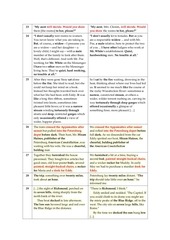
Correspondences between the texts of
The Very Young Mrs. Poe by Cothburn O’Neal
and
The Raven’s Bride by Lenore Hart
KEY:
Text in bold: verbatim words and strings.
Text in red: verbatim strings confirmed as being exclusive to these
two texts in the entire 15-million-volume corpus of Google Books.
No.
O’NEAL (Crown, 1956)
HART (St. Martin’s Press, 2011)
1
[...] making puppet motions with her
hands and repeating the words to a
gamesong they had been playing [...]
[...] making the sweeping hand motions that
went along with our last shared song [...]
2
A stranger was sitting...before the empty
fireplace, talking to Granny Poe, who
was propped up on her couch as usual.
Granny Poe was propped up on her settee
by the fire, a sight which I'd expected.
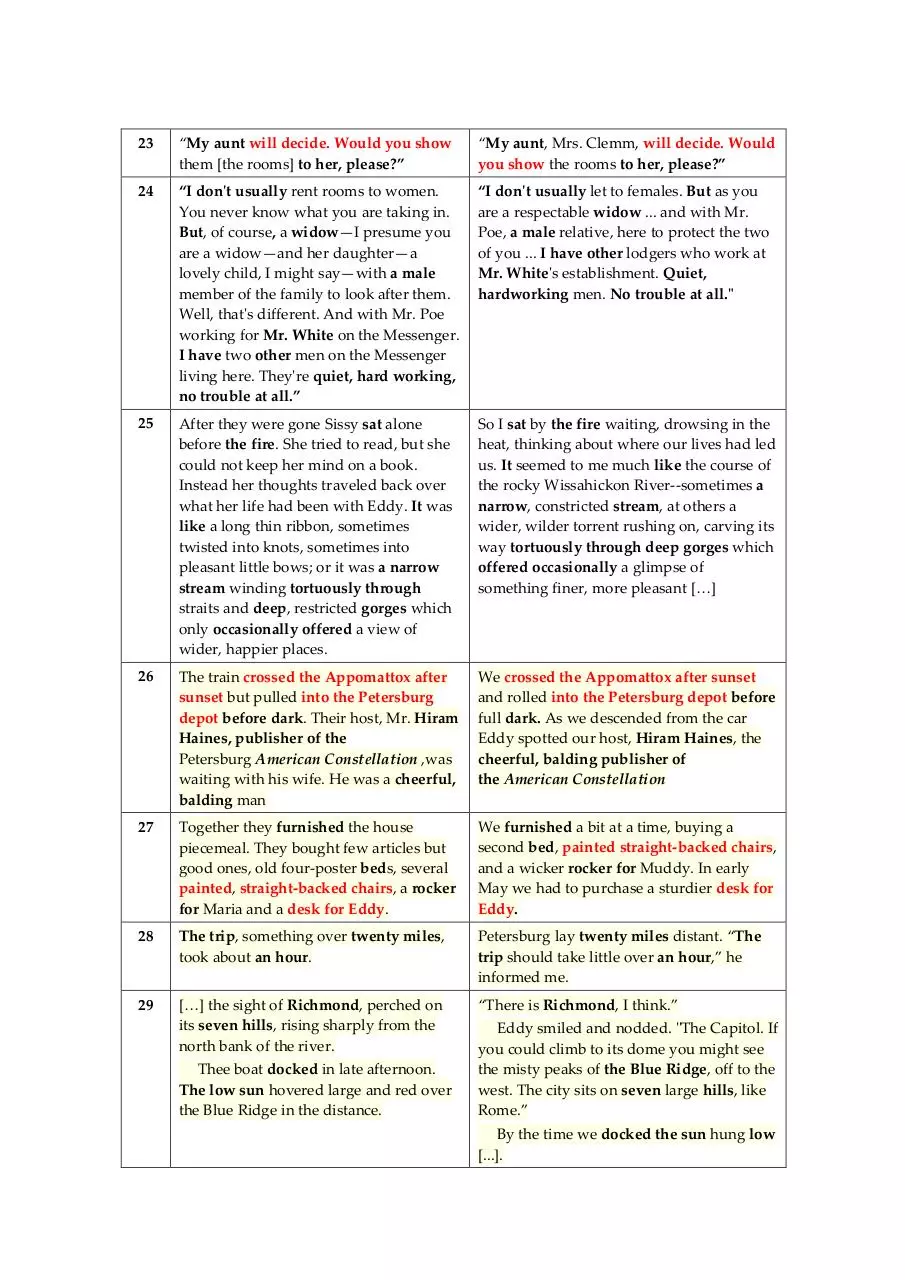
3
"I hope Eddy gets a letter...I'd feel better
[...] if he had had some word from Mr.
White."
"I do wish Eddy had received another letter
from Mr. White.”
4
Sissy felt like hugging her mother. But it
was such a public place, so many people
around [...] That would look childish.
For a moment I wanted to cling to my
mother [...] But people were thronging all
around us. Such behavior would look so
childish [...]
5
[Virginia] turned to look out across the
basin toward Federal Hall
I turned away to look out across the basin
toward Federal Hall.
6
The docks [...] looked like a forest bare of
leaves, the tall masts and spiky yards of
the Baltimore clippers standing naked,
resting between trips to Brazil. Scuttling
in and out among the bigger hulls, little
skipjacks and bug-eyes brought cargoes
of terrapin and oysters and crabs fresh
from the waters of the Chesapeake to the
vats and tubs of the fish markets along
the wharf.
Clipper ships were moored there, tied up
like sleek, exhausted horses, resting
between dashes to Brazil and New York
and Cuba. Their tall naked masts and spiky
yards were bare of sails, their snarl lines a
thick forest without leaves. Smaller craft
scooted in and out. Timber rafts wallowed
along, while skipjacks and bugeyes coasted
in, carrying in their shallow wooden bellies
piles of black duck and terrapins and
muskrat. Or crates and barrels of
Chesapeake Bay oysters and crabs and blue
crabs. These would be flung, battered but
still living after a hard voyage, into display
crates and copper cooking vats and steel
tubs, or onto blocks of ice from New
England, in the various fish markets along
the wharf.
�
7
[Eddy's] plain black suit amid the
colorful clothes [...] was all to his
advantage. His fine head and scholarly
demeanor set him apart
Eddy's black sack coat, black trousers [...]
his broad pale forehead [...] set him apart to
advantage.
8
[...] there was no one on the pier to see
them off, since they had already said
good-bye to the family. Sissy waved
anyway...she could wave farewell to
Baltimore.
There was no one to say good-bye and see
us off...we'd already written or called on the
few family and friends left in Baltimore....I
waved from my spot at the rail...'She's
waving good-bye to Baltimore,' he said...
9
The boat from Norfolk to Richmond was
smaller and slower than the one they
had boarded in Baltimore. The trip up
the James River was more leisurely, too
[...]
The boat we boarded in Norfolk to
continue on to Richmond was smaller and a
good deal slower than the Baltimore Line
steamer. Our trip up the James was more
leisurely too.
10
Beyond [...] the confluence of the
Appomattox, the James grew narrower
and wound in great loops around
Bermuda Hundred.
Beyond the confluence of the Appomattox,
the James grew narrower and wound in
great loops around Bermuda Hundred.
11
[Describing Mrs Poore’s boarding house]
[Describing Mrs Poore’s boarding house]
She has a large house. There's always
room.
It's a large house. There's always space.
12
The docks were busy, and the wagonette
was held up now and then by dray
wagons loaded with hogsheads of
tobacco and sacks of flour and cornmeal.
Sometimes an empty collier's wagon
rumbled toward the coal yards [...]
farther upstream.
Our wagonette was nearly empty, but the
docks were very busy. We would lurch
forward, only to stop for a dray loaded with
sacks of flour and cornmeal, or an empty
collier's wagon rumbling [...] toward the
coal yards upstream.
13
“This is Capitol Square,” he said. “Mrs.
Poore's house is the next one here on
Bank Street.” They turned into the yard
of a large two-story brick house with a
Greek portico fronting in the square. The
half-paned front door revealed a well
lighted hallway inside. Eddy climbed the
steps and opened the door without
knocking, just as though he still lived
there.
"Capitol Square,” he said. “Mrs. Poore's is
the next house on Bank Street.” We turned
into the yard of a two-story brick structure
with a whitewashed Greek portico facing
the neatly-planted square. Within lay a
wide, well-lighted hall. Eddy opened the
door without even ringing a bell or
knocking. "Well, he used to live here,” I
whispered.
�
14
There was a wait, then the sound of a
door opening upstairs. “What was that,
Tom?” a voice shrilled.
“I say Mr. Poe is back—”
“That's what I thought you said,” the
voice interrupted. “Well, you can tell
him I don't have a vacancy and I'm not
likely to have one.” The door slammed
shut […]
“She doesn't have a vacancy,”
[Cleland] said with a grin. Eddy looked
helplessly from Tom to Maria to Sissy
and back to Tom. “What are we to do?”
he asked, of anybody.
A door creaked shrilly on protesting hinges
upstairs, and an equally high voice called
down, “What was that, Tom?”
“I said Edgar Poe is back, and he—”
“That's what I thought you said,” the
woman shouted. “Well, you can tell him for
me, I do not have lodgings for him, and am
not likely to have any now or later!” The
hinges squealed derisively as the door
slammed again...
Cleland turned back, avoiding our eyes.
“Ah, well, It seems my mother-in-law has
no vacancy here just now.”
Eddy stared at him helplessly. “But I—
then what are we to do?”
15
"I wanted to say good night,” [Eddy]
said [...]. He pecked [Mrs. Clemm] on the
cheek. Then he kissed Sissy on the lips.
There was no liquor on his breath.
Perhaps that was what he wanted
known. He made no explanations. No
one asked him where he had been or
what he had been doing. He looked tired,
haggard [...].
"I wanted to say good night,” Eddy
muttered [...]. He came around and kissed
my mother's cheek, then moved to my side
and pressed his mouth to mine [...] He did
not explain, and I did not ask where he'd
been [...] he looked gaunt and hollow and
tired. “It's good to come home to such love
and beauty,” he whispered […] There'd
been no taint of liquor on his breath.
Perhaps that was why he'd kissed me full
on the mouth, in front of my mother
16
He asked permission of the half-dozen
lady passengers to bring them aboard. “If
you ladies don't object,” he said, “I will
close my eyes to company rules and
allow the groom to sit in the ladies' coach
with his lovely bride.” [...] [Sissy] felt that
she passed inspection[...] It was difficult
to determine the age of a young lady,
especially if she were reasonably well
filled out and modestly veiled. “I must
ask you not to smoke, Mr. Poe,” the
conductor warned in parting. “Smoking
is restricted to the gentleman's car on the
rear.”
“Going to flout company rules, folks, and
seat you all in the second coach.” He
grinned at Eddy. “Already cleared it with
the ladies aboard.” When we climbed up no
one looked askance or asked how old I was.
Of course, if a female is veiled and
reasonably well filled out, it's hard to tell
her exact age anyhow. The conductor left
after admonishing the groom, “Smoking is
restricted to the gentleman's car at the rear,
sir.” [...]
“Thank you,' Eddy said. “I seldom
smoke.”
“Thank you for the information,” he
said. “In any case, I seldom smoke.”
�
17
As the train pulled out of the depot and
onto the bridge across the James River,
Eddy pointed out Gamble's Hill rising to
the right above the State Armory and the
ironworks situated on the banks of the
canal. He shouted the names into her ear.
But when the train stopped for a few
minutes outside Manchester, just across
the river, they were both mute again.
As we chugged away from the confines of
Richmond, Eddy leaned over and shouted
the names of landmarks into my ear:
'Gamble's Hill. The State Armory, there.
Oh--and the Tredegar Iron Works.' By the
time we stopped briefly at Manchester, on
the opposite side of the James River, he'd
fallen silent again, either out of names or
out of breath.
18
Sissy was sure that she could smell the
blossoms in spite of the wood smoke
which funneled out of the locomotive
stack and sometimes swirled around the
ladies' coach, stinging her eyes and
bringing on fits of coughing. Whenever
anything seemed to mar her comfort
Eddy's eyes would become filled with
anxiety, but she would smile, and, if the
ladies were not looking, reach for his
hand and give it a reassuring squeeze.
Sometimes smoke swirled around inside
the car like an evil genie, stinging our eyes
and making us cough. Whenever that
happened Eddy bent to me with concern,
until I smiled and shook my head to let him
know I was fine.
19
“Welcome to Petersburg,” Mr. Haines
said jovially.
“Welcome to Petersburg, Mrs. Poe” he
[Haines] boomed.
20
“Did the trip tire you, Mrs. Poe?” Mrs.
Haines asked as her husband clucked the
horses into motion.
"Hiram Haines asked whether the trip had
tired me out.
“No. I enjoyed it very much.”
During the rare moments the ladies
weren't looking our way, I'd slide a hand
along the seat behind the swell of my skirts,
capture Eddy's fingers, and give a quick
squeeze.
“No, not a bit,' I assured him.
“Of course. Imagine my asking a bride
if a train trip tired her on her wedding
day. They didn't have trains when I was
married. We rode all day in a stagecoach.
But I don't think I was tired either.”
Mrs. Haines laughed. “Pshaw. She can't
possibly be tired, Mr. Haines. Remember
back when we wed? There were no trains
then so we rode all day long on a
stagecoach to our honeymoon cottage. And
yet I was not fatigued, not one little bit!”
21
The house, near the southeastern corner
of the Capitol grounds, was very much
like Mrs. Poore's, set back on a wide
lawn with the same Greek portico, the
same half-glazed doors. Tom entered
without knocking, as Eddy had done […]
Mrs. Yarrington's looked so much like Mrs.
Poore's […] The same neat square of clipped
yard and long painted portico, the same
half-glazed doors, and Thomas swept in
without knocking as if he lived there as
well.
22
“Mr. Poe is assistant editor of
the Southern Literary Messenger,” Tom
went on. “He has been staying with us,
but now that his aunt and cousin have
come to live with him, Mrs. Poore doesn't
have room for all three of them. We
thought you might—.”
“Mr. Poe is, ah, assistant editor at
the Southern Literary Messenger, and—
well, my mother-in-law hasn't room for, uh,
the three of them. So we thought you
might.”
“No doubt she thought that Tom's ‘we’
had included Mrs. Poore as well.”
This was very clever, for that we made it
sound as if Mrs. Poore herself had sent and
thus approved of us.
�
23
“My aunt will decide. Would you show
them [the rooms] to her, please?”
“My aunt, Mrs. Clemm, will decide. Would
you show the rooms to her, please?”
24
“I don't usually rent rooms to women.
You never know what you are taking in.
But, of course, a widow—I presume you
are a widow—and her daughter—a
lovely child, I might say—with a male
member of the family to look after them.
Well, that's different. And with Mr. Poe
working for Mr. White on the Messenger.
I have two other men on the Messenger
living here. They're quiet, hard working,
no trouble at all.”
“I don't usually let to females. But as you
are a respectable widow ... and with Mr.
Poe, a male relative, here to protect the two
of you ... I have other lodgers who work at
Mr. White's establishment. Quiet,
hardworking men. No trouble at all."
25
After they were gone Sissy sat alone
before the fire. She tried to read, but she
could not keep her mind on a book.
Instead her thoughts traveled back over
what her life had been with Eddy. It was
like a long thin ribbon, sometimes
twisted into knots, sometimes into
pleasant little bows; or it was a narrow
stream winding tortuously through
straits and deep, restricted gorges which
only occasionally offered a view of
wider, happier places.
So I sat by the fire waiting, drowsing in the
heat, thinking about where our lives had led
us. It seemed to me much like the course of
the rocky Wissahickon River--sometimes a
narrow, constricted stream, at others a
wider, wilder torrent rushing on, carving its
way tortuously through deep gorges which
offered occasionally a glimpse of
something finer, more pleasant […]
26
The train crossed the Appomattox after
sunset but pulled into the Petersburg
depot before dark. Their host, Mr. Hiram
Haines, publisher of the
Petersburg American Constellation ,was
waiting with his wife. He was a cheerful,
balding man
We crossed the Appomattox after sunset
and rolled into the Petersburg depot before
full dark. As we descended from the car
Eddy spotted our host, Hiram Haines, the
cheerful, balding publisher of
the American Constellation
27
Together they furnished the house
piecemeal. They bought few articles but
good ones, old four-poster beds, several
painted, straight-backed chairs, a rocker
for Maria and a desk for Eddy.
We furnished a bit at a time, buying a
second bed, painted straight-backed chairs,
and a wicker rocker for Muddy. In early
May we had to purchase a sturdier desk for
Eddy.
28
The trip, something over twenty miles,
took about an hour.
Petersburg lay twenty miles distant. “The
trip should take little over an hour,” he
informed me.
29
[…] the sight of Richmond, perched on
its seven hills, rising sharply from the
north bank of the river.
“There is Richmond, I think.”
Thee boat docked in late afternoon.
The low sun hovered large and red over
the Blue Ridge in the distance.
Eddy smiled and nodded. "The Capitol. If
you could climb to its dome you might see
the misty peaks of the Blue Ridge, off to the
west. The city sits on seven large hills, like
Rome.”
By the time we docked the sun hung low
[...].
�
30
Eddy [...] was spending one evening a
week at informal meetings of kindred
spirits at the Falstaff Hotel and an
afternoon or two at Barrett’s Gymnasium.
At the former he enjoyed the company of
such men as […] the artist Thomas Sully,
who painted his portrait in a very
Byronesque pose.
Eddy began spending one evening a week
at the Falstaff Hotel, at an informal
gathering of writers and reviewers and
artists. […]
31
Mr Thomas was appointed to a clerkship
in the Treasury Department by
President Tyler [...]
[...] Frederick Thomas, who’d just secured a
clerkship in the Treasury Department,
under President Tyler’s new
administration.
32
The Haines place appeared large in the
dusk. The garden was well-kept and
fragrant. The house itself was spacious,
lighted softly by candles but mostly with
whale-oil lamps […]
In the dusk, the house seemed even larger,
and very well-kept. A sweet musky
perfume of jasmine drifted from the walled
side-garden. Inside, the rooms were lit with
the golden glow of both candles and whaleoil lamps.
33
Two stevedores appeared to check the
markings on the Poe baggage and hoist it
aboard. A few minutes later the purser
took his place at the top of the
gangplank; and at a signal from the
ship's bell, the passengers began to go
aboard.
Stevedores came to check the markings on
our trunks, then hoisted them aboard.
There was a plaster bust of Mozart on a
pedestal near the garden window. A
single picture of Haydn hung in the panel
over the large Chickering grand piano. A
music cabinet, the harp, a flute and a
violin lying on a practice table, and some
hand-carved music stands were all the
room contained besides chairs which
players or listeners might arrange to suit
their convenience.
A plaster Mozart brooded from a pedestal
between the tall windows which overlooked
a formal garden. [...] A Chickering grand
piano draped with a tapestry held a silver
candelabra […].
34
The artist Thomas Sully, also a member,
came one day to our house to paint an oil
portrait of Eddy. “It makes you look
Byronish,” I said [...].
"There's the purser," said Eddy, pointing
at a uniformed man at the top of the
gangplank [...].
At last the bell sounded and we
assembled to board.
On a practice table flanked by music
stands waited a small harp, two violins with
bows, a flute, a conductor’s baton, a
metronome and a stack of sheet music. […]
The only other furnishings were a dozen
straight-backed chairs with upholstered
seats, which players and audience could
arrange as they wished.
�
 Historical archive . public document