Broadband / CHIRP Transducers
Technical Information
When Your Living Depends on Finding Fish...
Advantages of Thru-Hull Transducers
Rely on Airmar’s new broadband transducers for the ultimate fishing mission. Whether you’re a commercial
fisherman, charter captain, or tournament angler, there’s a new game in town! CHIRP transducers enable bottom
detection down to 3,000 m (10,000’) with 5 to 10 times greater detail and resolution so precise it’s possible to
distinguish between individual baitfish, game fish, and underwater structures. One transducer delivers up to
115 kHz of total bandwidth in just one installation, saving customers time and money.
When thru-hull transducers are installed with a High-Performance Fairing, the transducer face is parallel to the waterline
resulting in a beam that is vertically oriented for maximum echo returns and the best possible performance. The fairing
compensates for hull deadrise and reduces turbulence over the transducer face, which allows tracking at speeds over 30
knots (35 MPH). This installation, when mounted in clean water (forward of propellers and running gear), produces the most
effective signal return since nothing on the vessel interferes with the transducer’s active surface. Thru-hull transducers will
work with any engine type: inboard, outboard, or I/O.
Airmar…it’s what’s under your boat.
Advantages of Tilted Element™ Transducers
The CHIRP Difference
Traditional marine fishfinders operate at discrete frequencies such as 50 kHz and 200 kHz, use relatively
short-duration transmit pulses, and use narrowband sonar transducers. In contrast, CHIRP (compressed
high-intensity radar pulse) uses a precise sweep pattern of many frequencies within a long-duration transmit pulse
from a broadband transducer, so the equivalent sound energy transmitted into the water is 10 to 1,000 times
greater than a conventional marine fishfinder. The echo energy returning to the transducer, superior to that
generated by a conventional transducer, is then processed by the fishfinder’s DSP (digital signal processing)
computer and displayed in ultra-sharp detail on the display. The combination of CHIRP, a broadband transducer,
and the fishfinder’s DSP, results in dramatically better fish and bottom detection, superior depth capability, and
significantly better performance at speed.
Does YOUR Fishfinder CHIRP?
Only CHIRP/Spread Spectrum sounders using Airmar broadband transducers can operate as a CHIRP fishfinder
system. When Airmar’s new transducer is paired with a broadband fishfinder, the result is 5 to 10 times greater
sensitivity and performance than current fishfinder technology. Packed with exclusive technology like
Transducer ID® and newly engineered piezoceramic elements, Airmar transducers are über sensitive and designed
to automatically sweep frequency bands from 28 kHz to 210 kHz with no tuning necessary. As a result, all targets
detected in the entire bandwidth will be seen on the display rather than only what is identified in traditional
frequencies at 50 kHz and 200 kHz.
Unique Transducer ID®
Airmar’s Transducer ID feature measures and stores the operating parameters for each transducer. This enables the fishfinder
to automatically configure itself to the transducer being used. The embedded microcontroller continuously monitors ceramic
operating temperatures inside the transducer, enabling closed loop control of power output. The transducer’s profile
can be presented on the display showing beamwidth coverage as a function of frequency. Stored data also assists with
troubleshooting, warranty or any required information about the transducer.
Quality “Q” Value
Q is a measure of bandwidth and the rise and fall times of target echoes. Airmar Q values range from 1.6 to 30, depending
on the model. Competitive transducers have an average Q of 25 to 30. The lower the “Q” number, the less ringing in the
transducer and the better the performance—improved individual fish separation along with bottom imaging in rapidly
changing water depths such as ledges and offshore canyons. All Airmar CHIRP transducers have a Q of 3 or less.
Model
Operation Under Low-Frequency CHIRP Mode.
180
dB(1)
175
Incredible resolution
at low-frequency.
170
P
R
I
H
C
Tilted Element transducers are low-profile housings that protrude less than 6.35 mm (0.25”) outside of the hull. Rather than
using a high-performance fairing block to correct for the hull deadrise, the ceramic element is tilted inside the transducer at
either a fixed 12° or 20° angle, accommodating hull deadrise angles up to 24°. When installed to the hull, the tilted feature
provides built-in deadrise compensation, aiming the beam vertically which results in strong echo returns and accurate depth
readings. Tilted element transducers are an ideal solution for fast, trailered, sportfishing vessels where a thru-hull transducer
with a High-Performance Fairing cannot be installed.
Airmar’s complete line of twenty-four (24) CHIRP transducers are available in seven (7) different mounting options
to accommodate almost any hull design. CHIRP transducers are available at Gemeco Marine Accessories
www.gemeco.com and Airmar EMEA www.airmar.com/emea. Visit www.AIRMAR.com for a list of
CHIRP-ready transducers.
Transmit Voltage Response (TVR)
ine !
h
c
a
M
g
n
findi
ducer.
s
h
n
s
a
i
r
t
F
d
s
n
a
e ri o u
roadb
b
S
R
a
A
o
IRM
A
de r t
n
n
a
u
f
o
use o
ur S
o
e
h
Y
t
de
ith
a
w
r
e
g
l
Up possib
Only
B744V (baseline)**
B765
Q / Bandwidth
LF
HF
28 / 1.8 kHz
31 / 6.7 kHz
2 / 35 kHz
2 / 80 kHz
Roundtrip Sensitivity*
LF
HF
1 times
1 times
25 times
20 times
B60(baseline)**
B75
B175
28 / 1.8 kHz
2 / 35 kHz
2.5 / 20 kHz
1 times
25 times
280 times
31 / 6.7 kHz
2 / 80 kHz
2 / 80 kHz
CHIRP TECHNOLOGY
• 5 to 10 times greater detail and resolution
• 10 to 1,000 times more energy on targets
• Precise separation between baitfish and game fish
• Superior performance in noisy environments
• Improved bottom tracking at high boat speeds
1 times
20 times
150 times
DEEPER.
BROADER.
.
R
E
R
A
E
L
C
TECHNOL
G
N
I
G
AN
GAME CH
All roundtrip sensitivity data is based on the Figure of Merit (FOM) and the transducer bandwidth relative to the B744V or B60 models.
**Commonly used non-CHIRP transducers.
*
See Theory of Operation for a complete understanding of transducer terminology and operation. www.airmar.com
OGY.
165
160
120
140
160
180
200
Frequency (kHz)
220
www.airmar.com
Broadband
Non-Broadband
©Airmar Technology Corporation
Screen shot courtesy of Simrad®.
SmallBoatProductsCHIRP_BR_rA
10/10/11
As Airmar constantly improves its products, all specifications are subject to change without
notice. All Airmar products are designed to provide high levels of accuracy and reliability,
however they should only be used as aids to navigation and not as a replacement for
traditional navigation aids and techniques. Xducer ID® is a registered trademark of Airmar
Technology Corporation. Other company or product names mentioned in this document
may be trademarks or registered trademarks of their respective companies, which are not
affiliated with Airmar.
Small Boat Products
Thru-Hull & Tilted Element™
Screen shot courtesy of Garmin®.
�
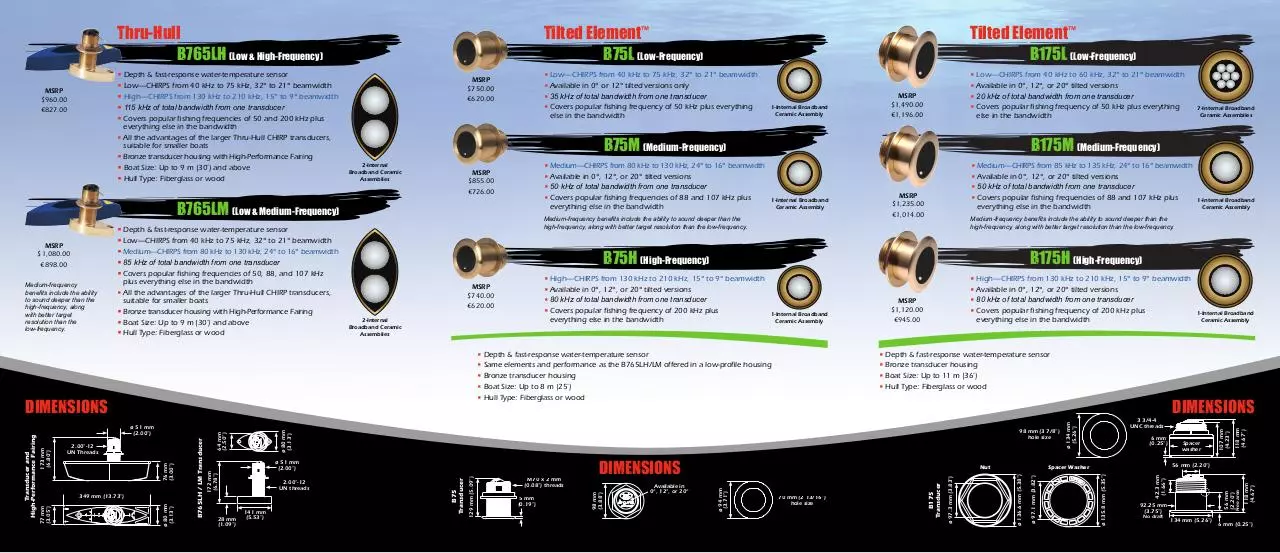
1-Internal Broadband
Ceramic Assembly
• High—CHIRPS from 130 kHz to 210 kHz, 15° to 9° beamwidth
• Available in 0°, 12°, or 20° tilted versions
• 80 kHz of total bandwidth from one transducer
• Covers popular fishing frequency of 200 kHz plus
everything else in the bandwidth
MSRP
$1,120.00
€945.00
Spacer
washer
118 mm
(4.67”)
6 mm
(0.25”)
DIMENSIONS
92.25 mm
(3.75”)
No draft
134 mm (5.26”)
118 mm
(4.67”)
56 mm (2.20”)
Spacer Washer
Free area
ø 97.3 mm (3.83”)
70 mm (2 13/16”)
hole size
B175
Transducer
5 mm
(0.19”)
Available in
0°, 12°, or 20°
Nut
ø 94 mm
(3.71”)
129 mm (5.09”)
141 mm
(5.53”)
M70 x 2 mm
(0.08”) threads
DIMENSIONS
3 3/4-4
UNC threads
107 mm
(4.23”)
ø 80 mm
(3.13”)
64 mm
(2.50”)
172 mm
(6.78”)
2.00”-12
UN threads
1-Internal Broadband
Ceramic Assembly
• Depth & fast-response water-temperature sensor
• Bronze transducer housing
• Boat Size: Up to 11 m (36’)
• Hull Type: Fiberglass or wood
98 mm (3 7/8”)
hole size
ø 51 mm
(2.00”)
28 mm
(1.09”)
Medium-frequency benefits include the ability to sound deeper than the
high-frequency, along with better target resolution than the low-frequency.
56 mm
(2.20”)
2-Internal
Broadband Ceramic
Assemblies
1-Internal Broadband
Ceramic Assembly
B175H (High-Frequency)
• High—CHIRPS from 130 kHz to 210 kHz, 15° to 9° beamwidth
• Available in 0°, 12°, or 20° tilted versions
• 80 kHz of total bandwidth from one transducer
• Covers popular fishing frequency of 200 kHz plus
everything else in the bandwidth
MSRP
$740.00
€620.00
B75
Transducer
ø 80 mm
(3.13”)
349 mm (13.73”)
B765LH / LM Transducer
76 mm
(3.00”)
173 mm
(6.80”)
2.00”-12
UN Threads
MSRP
$1,235.00
€1,014.00
B75H (High-Frequency)
• Depth & fast-response water-temperature sensor
• Same elements and performance as the B765LH/LM offered in a low-profile housing
• Bronze transducer housing
• Boat Size: Up to 8 m (25’)
• Hull Type: Fiberglass or wood
ø 51 mm
(2.00”)
77 mm
(3.05”)
1-Internal Broadband
Ceramic Assembly
• Medium—CHIRPS from 85 kHz to 135 kHz, 24° to 16° beamwidth
• Available in 0°, 12°, or 20° tilted versions
• 50 kHz of total bandwidth from one transducer
• Covers popular fishing frequencies of 88 and 107 kHz plus
everything else in the bandwidth
ø 97.1 mm (3.82”)
plus everything else in the bandwidth
• All the advantages of the larger Thru-Hull CHIRP transducers,
suitable for smaller boats
• Bronze transducer housing with High-Performance Fairing
• Boat Size: Up to 9 m (30’) and above
• Hull Type: Fiberglass or wood
B175M (Medium-Frequency)
Medium-frequency benefits include the ability to sound deeper than the
high-frequency, along with better target resolution than the low-frequency.
DIMENSIONS
Transducer and
High-Performance Fairing
• Medium—CHIRPS from 80 kHz to 130 kHz, 24° to 16° beamwidth
• Available in 0°, 12°, or 20° tilted versions
• 50 kHz of total bandwidth from one transducer
• Covers popular fishing frequencies of 88 and 107 kHz plus
everything else in the bandwidth
MSRP
$855.00
€726.00
7-Internal Broadband
Ceramic Assemblies
42.3 mm
(1.66”)
2-Internal
Broadband Ceramic
Assemblies
• Depth & fast-response water-temperature sensor
• Low—CHIRPS from 40 kHz to 75 kHz, 32° to 21° beamwidth
• Medium—CHIRPS from 80 kHz to 130 kHz, 24° to 16° beamwidth
• 85 kHz of total bandwidth from one transducer
• Covers popular fishing frequencies of 50, 88, and 107 kHz
Medium-frequency
benefits include the ability
to sound deeper than the
high-frequency, along
with better target
resolution than the
low-frequency.
1-Internal Broadband
Ceramic Assembly
MSRP
$1,490.00
€1,196.00
B75M (Medium-Frequency)
B765LM (Low & Medium-Frequency)
MSRP
$1,080.00
€898.00
• Low—CHIRPS from 40 kHz to 60 kHz, 32° to 21° beamwidth
• Available in 0°, 12°, or 20° tilted versions
• 20 kHz of total bandwidth from one transducer
• Covers popular fishing frequency of 50 kHz plus everything
else in the bandwidth
ø 136.6 mm (5.38”)
everything else in the bandwidth
• All the advantages of the larger Thru-Hull CHIRP transducers,
suitable for smaller boats
• Bronze transducer housing with High-Performance Fairing
• Boat Size: Up to 9 m (30’) and above
• Hull Type: Fiberglass or wood
• Low—CHIRPS from 40 kHz to 75 kHz, 32° to 21° beamwidth
• Available in 0° or 12° tilted versions only
• 35 kHz of total bandwidth from one transducer
• Covers popular fishing frequency of 50 kHz plus everything
else in the bandwidth
98 mm
(3.88”)
MSRP
$960.00
€827.00
MSRP
$750.00
€620.00
Tilted Element™
B175L (Low-Frequency)
ø 135.8 mm (5.35”)
• Depth & fast-response water-temperature sensor
• Low—CHIRPS from 40 kHz to 75 kHz, 32° to 21° beamwidth
• High—CHIRPS from 130 kHz to 210 kHz, 15° to 9° beamwidth
• 115 kHz of total bandwidth from one transducer
• Covers popular fishing frequencies of 50 and 200 kHz plus
Tilted Element™
B75L (Low-Frequency)
ø 134 mm
(5.26”)
Thru-Hull
B765LH (Low & High-Frequency)
6 mm (0.25”)
�
Broadband / CHIRP Transducers
Technical Information
When Your Living Depends on Finding Fish...
Advantages of Thru-Hull Transducers
Rely on Airmar’s new broadband transducers for the ultimate fishing mission. Whether you’re a commercial
fisherman, charter captain, or tournament angler, there’s a new game in town! CHIRP transducers enable bottom
detection down to 3,000 m (10,000’) with 5 to 10 times greater detail and resolution so precise it’s possible to
distinguish between individual baitfish, game fish, and underwater structures. One transducer delivers up to
115 kHz of total bandwidth in just one installation, saving customers time and money.
When thru-hull transducers are installed with a High-Performance Fairing, the transducer face is parallel to the waterline
resulting in a beam that is vertically oriented for maximum echo returns and the best possible performance. The fairing
compensates for hull deadrise and reduces turbulence over the transducer face, which allows tracking at speeds over 30
knots (35 MPH). This installation, when mounted in clean water (forward of propellers and running gear), produces the most
effective signal return since nothing on the vessel interferes with the transducer’s active surface. Thru-hull transducers will
work with any engine type: inboard, outboard, or I/O.
Airmar…it’s what’s under your boat.
Advantages of Tilted Element™ Transducers
The CHIRP Difference
Traditional marine fishfinders operate at discrete frequencies such as 50 kHz and 200 kHz, use relatively
short-duration transmit pulses, and use narrowband sonar transducers. In contrast, CHIRP (compressed
high-intensity radar pulse) uses a precise sweep pattern of many frequencies within a long-duration transmit pulse
from a broadband transducer, so the equivalent sound energy transmitted into the water is 10 to 1,000 times
greater than a conventional marine fishfinder. The echo energy returning to the transducer, superior to that
generated by a conventional transducer, is then processed by the fishfinder’s DSP (digital signal processing)
computer and displayed in ultra-sharp detail on the display. The combination of CHIRP, a broadband transducer,
and the fishfinder’s DSP, results in dramatically better fish and bottom detection, superior depth capability, and
significantly better performance at speed.
Does YOUR Fishfinder CHIRP?
Only CHIRP/Spread Spectrum sounders using Airmar broadband transducers can operate as a CHIRP fishfinder
system. When Airmar’s new transducer is paired with a broadband fishfinder, the result is 5 to 10 times greater
sensitivity and performance than current fishfinder technology. Packed with exclusive technology like
Transducer ID® and newly engineered piezoceramic elements, Airmar transducers are über sensitive and designed
to automatically sweep frequency bands from 28 kHz to 210 kHz with no tuning necessary. As a result, all targets
detected in the entire bandwidth will be seen on the display rather than only what is identified in traditional
frequencies at 50 kHz and 200 kHz.
Unique Transducer ID®
Airmar’s Transducer ID feature measures and stores the operating parameters for each transducer. This enables the fishfinder
to automatically configure itself to the transducer being used. The embedded microcontroller continuously monitors ceramic
operating temperatures inside the transducer, enabling closed loop control of power output. The transducer’s profile
can be presented on the display showing beamwidth coverage as a function of frequency. Stored data also assists with
troubleshooting, warranty or any required information about the transducer.
Quality “Q” Value
Q is a measure of bandwidth and the rise and fall times of target echoes. Airmar Q values range from 1.6 to 30, depending
on the model. Competitive transducers have an average Q of 25 to 30. The lower the “Q” number, the less ringing in the
transducer and the better the performance—improved individual fish separation along with bottom imaging in rapidly
changing water depths such as ledges and offshore canyons. All Airmar CHIRP transducers have a Q of 3 or less.
Model
Operation Under Low-Frequency CHIRP Mode.
180
dB(1)
175
Incredible resolution
at low-frequency.
170
P
R
I
H
C
Tilted Element transducers are low-profile housings that protrude less than 6.35 mm (0.25”) outside of the hull. Rather than
using a high-performance fairing block to correct for the hull deadrise, the ceramic element is tilted inside the transducer at
either a fixed 12° or 20° angle, accommodating hull deadrise angles up to 24°. When installed to the hull, the tilted feature
provides built-in deadrise compensation, aiming the beam vertically which results in strong echo returns and accurate depth
readings. Tilted element transducers are an ideal solution for fast, trailered, sportfishing vessels where a thru-hull transducer
with a High-Performance Fairing cannot be installed.
Airmar’s complete line of twenty-four (24) CHIRP transducers are available in seven (7) different mounting options
to accommodate almost any hull design. CHIRP transducers are available at Gemeco Marine Accessories
www.gemeco.com and Airmar EMEA www.airmar.com/emea. Visit www.AIRMAR.com for a list of
CHIRP-ready transducers.
Transmit Voltage Response (TVR)
ine !
h
c
a
M
g
n
findi
ducer.
s
h
n
s
a
i
r
t
F
d
s
n
a
e ri o u
roadb
b
S
R
a
A
o
IRM
A
de r t
n
n
a
u
f
o
use o
ur S
o
e
h
Y
t
de
ith
a
w
r
e
g
l
Up possib
Only
B744V (baseline)**
B765
Q / Bandwidth
LF
HF
28 / 1.8 kHz
31 / 6.7 kHz
2 / 35 kHz
2 / 80 kHz
Roundtrip Sensitivity*
LF
HF
1 times
1 times
25 times
20 times
B60(baseline)**
B75
B175
28 / 1.8 kHz
2 / 35 kHz
2.5 / 20 kHz
1 times
25 times
280 times
31 / 6.7 kHz
2 / 80 kHz
2 / 80 kHz
CHIRP TECHNOLOGY
• 5 to 10 times greater detail and resolution
• 10 to 1,000 times more energy on targets
• Precise separation between baitfish and game fish
• Superior performance in noisy environments
• Improved bottom tracking at high boat speeds
1 times
20 times
150 times
DEEPER.
BROADER.
.
R
E
R
A
E
L
C
TECHNOL
G
N
I
G
AN
GAME CH
All roundtrip sensitivity data is based on the Figure of Merit (FOM) and the transducer bandwidth relative to the B744V or B60 models.
**Commonly used non-CHIRP transducers.
*
See Theory of Operation for a complete understanding of transducer terminology and operation. www.airmar.com
OGY.
165
160
120
140
160
180
200
Frequency (kHz)
220
www.airmar.com
Broadband
Non-Broadband
©Airmar Technology Corporation
Screen shot courtesy of Simrad®.
SmallBoatProductsCHIRP_BR_rA
10/10/11
As Airmar constantly improves its products, all specifications are subject to change without
notice. All Airmar products are designed to provide high levels of accuracy and reliability,
however they should only be used as aids to navigation and not as a replacement for
traditional navigation aids and techniques. Xducer ID® is a registered trademark of Airmar
Technology Corporation. Other company or product names mentioned in this document
may be trademarks or registered trademarks of their respective companies, which are not
affiliated with Airmar.
Small Boat Products
Thru-Hull & Tilted Element™
Screen shot courtesy of Garmin®.
�
 Historical archive . public document