The Nullification of Randomness
Sequentially Linked Gamma-Ray Bursts
A Method for Unification
Charles Fleischer
2012
ABSTRACT
In order to nullify the property of randomness perceived in the dispersion of gamma-ray bursts
(GRB’s) we introduce two new procedures. 1. Create segmented groups of sequentially linked
GRB's and quantify the resultant angles. 2. Create a segmented group of sequentially linked
GRB's and select a GRB that is located in a position that is equidistant from two or more GRB's
of the same group, by using the selected GRB as the origin for a circle so that the circumference
of said circle intercepts the location of two or more GRB's of the same group.
1. Introduction
The study of GRB’s requires orbiting satellites with scintillating sensor systems that respond
when activated. The engineers and scientists who designed and launched them into orbit are
the giants on whose shoulders all who study GRB’s stand.
The spacecraft: Vela -1962
Compton Gamma-Ray Observatory with
The Burst and Transient Source Experiment (BATSE)- April 1991
Wind-Konus –November 1994
BeppoSAX -April 1996
The High Energy Transient Explorer (HETE-2)- October 2000
The International Gamma-Ray Astrophysics Laboratory (INTEGRAL) - October 2002
Swift- November 2004
Suzaku (Astro-E2)- July 2005
AGILE -April 2007
Fermi- June 2008.
1
�
GRB’s are the most luminous explosions in the universe. Following the initial release of Gamma
radiation is an afterglow, a subsequent emission of diminished electromagnetic energies, Xrays, ultra-violet, visible light, infra-red, microwaves and radio waves.
Since their serendipitous discovery in 1967 and the first unclassified scientific paper in 1973
(Klebesadel et al.) much has been discovered about their behavior yet the true nature of this
cosmic phenomena still remains an elusive mystery without a single conclusive explanation
regarding the nature of their origin. In 1993 Nemiroff wrote a paper that listed more than 100
models to explain the origins of GRB’s. They included a comet falling into a white dwarf
(Schlovskii 1974), an asteroid falling into a neutron star (Newman 1980) and the evaporation of
a primordial black hole (Cline et al. 1992).
GRB’s were initially divided into two fundamental categories based on the duration of each
burst. Those under 2 seconds were referred to as short GRB’s, (SGRB’s) those over two seconds
were called long GRB’s (LGRB’s) (Kouveliotou et al. 1993). In 1998 Horvath suggested there
might also be a third grouping with a duration between long and short (Mukherjee et al. 1998).
Some scientists conclude that the LGRB’s are created by the collapse of massive stars (Woosley
& Bloom 2006; Hjorth et al. 2003; Stanek et al. 2003). Others conclude LGRB’s are driven by the
merger of compact objects (Kluzniak & Ruderman 1998; Rosswog et al. 2003).
Some say the origin of SGRB’s are due to the merger of compact binary objects, neutron stars or
black holes (Eichler et al. 1989; Narayan et al. 1992). Some say the compact binaries were formed
in primordial binaries (Belcynski et al. 2002), some say they were formed dynamically in dense
cluster cores (Davies 1995; Grindlay et al. 2006).
Some say the afterglow is explained by the synchrotron emission of accelerated electrons
interacting with the surrounding medium (Piran 2005; Meszaros 2006; Zhang 2007). Some say
the burst emission area is penetrated by a globally structured magnetic field (Spruit et al. 2001;
Zhang and Meszaros 2002; Lyutikov et al. 2003), or possibly by Compton drag of ambient soft
photons (Shaviv and Dar 1995; Lazzati et al. 2004), or the combination of a thermal component
from the photosphere and a non thermal component (Ioka et al. 2007). Some question if the
outflow jet is collimated (Zhang et al. 2004; Toma et al. 2005).
It is difficult to find any realm of scientific research that has generated so many different
hypotheses. What is needed is a new understanding regarding the origin of GRB’s, one that
encompasses the totality of all GRB’s into a unified system of related events.
2. Distribution and Duration
To effectively determine the presence of randomness it is necessary to observe the celestial
location for the position of every GRB. Evaluating GRB sky distribution patterns played an
important part in determining that GRB’s originate outside of our galaxy. (Zhang & Meszaros
2
�
2004; Fox et al. 2005; Meszaros 2006). If they were emanating from our galaxy we would have
expected to see a concentration of GRB’s along the galactic plane of the Milky Way. But we did
not the GRB’s were distributed randomly in an isotropic manner all across the universe sky
map (Meegan et al. 1992). For the first 30 years most scientists agreed on the idea that GRB’s
were distributed randomly in an isotropic manner (Paczynski 1991a; Dermer 1992; Mao &
Paczynski 1992a; Piran 1992; Fenimore et al. 1993 Woods & Loeb 1994; Paczynski & Xu 1994).
In 1999 Balazs et al. found that there were differences in the level of randomness that correlated
to the duration of each GRB, whereby the short and intermediate bursts showed a higher level
of non randomness than the long bursts. The same findings were validated by Meszaros et al.
2000 and Litvin et al. 2001. In 2003 Meszaros & Stocek reported that even the long bursts might
display patterns indicating anisotropic distribution.
The differentiation between long and short GRB’s became a bigger issue with the appearance of
GRB 060505 and GRB 060614 because they have characteristics associated with both long and
short GRB’s (Fynbo et al. 2006; Della Valle et al. 2006; Gal-Yam et al. 2006).
In 2008 Vavrek et al. presented a paper “Testing the Randomness in the Sky-Distribution of
Gamma-Ray Bursts”. For their study they divided the GRB’s detected by BATSE into 5 groups:
short1, short2, intermediate, long 1 and long2. Using Monte Carlo simulations they employed
three different methodologies to test for randomness: Voronoi tessellation, minimal spanning
tree and multi-fractal spectra. They determined that the short and intermediate groups deviated
significantly from being fully random and that the long groups did not.
In 2010 O.V.Verkhodanov et al. presented the paper “GRB Sky Distribution Puzzles” They
utilized GRB information from BATSE and BeppoSAx with data from the WMAP (Wilkson
Microwave Anisotropy Probe) to correlate GRB distribution with peaks in the Cosmic
Microwave Background (CMB). They found correlations between GRB positions and the CMB
equatorial coordinate system but could not understand the mechanism of the correlation.
3. Sequence and Time
For the present study the author utilized the group of GRB’s beginning with GRB 040827A (six
GRB’s before the SWIFT era) and ranging up to present day. The information regarding the
occurrence and location of the GRB’s for this study was made possible by Sonoma State
University and is presented at http://grb.sonoma.edu/.
This information including the galactic co-ordinates and the time and date for each burst is
presented on an interactive sky map where the location of each burst is indicated as a circular
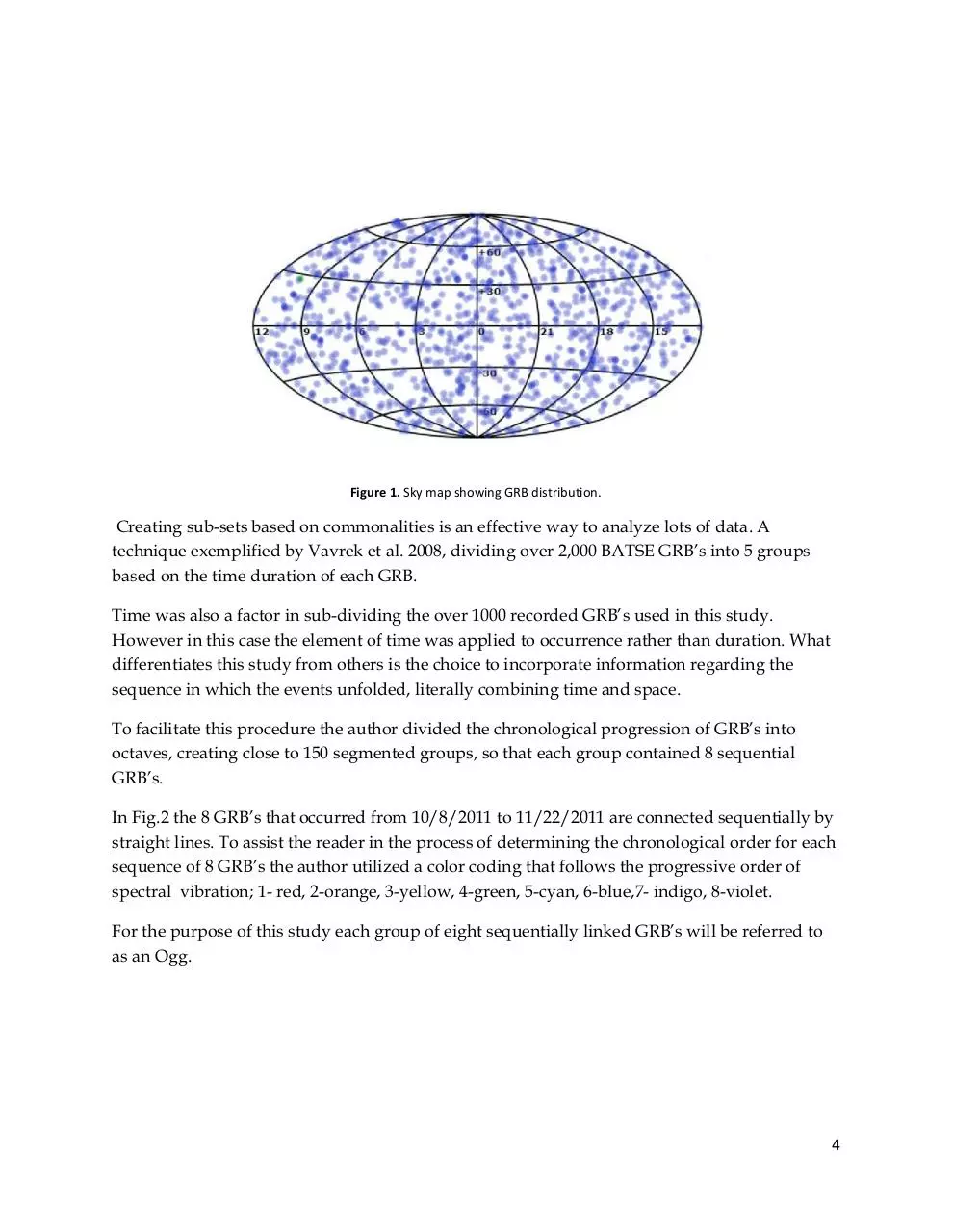
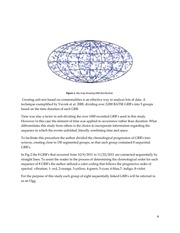
blue dot. The sky map provides a clear visual understanding of the position for each GRB.
3
�
Figure 1. Sky map showing GRB distribution.
Creating sub-sets based on commonalities is an effective way to analyze lots of data. A
technique exemplified by Vavrek et al. 2008, dividing over 2,000 BATSE GRB’s into 5 groups
based on the time duration of each GRB.
Time was also a factor in sub-dividing the over 1000 recorded GRB’s used in this study.
However in this case the element of time was applied to occurrence rather than duration. What
differentiates this study from others is the choice to incorporate information regarding the
sequence in which the events unfolded, literally combining time and space.
To facilitate this procedure the author divided the chronological progression of GRB’s into
octaves, creating close to 150 segmented groups, so that each group contained 8 sequential
GRB’s.
In Fig.2 the 8 GRB’s that occurred from 10/8/2011 to 11/22/2011 are connected sequentially by
straight lines. To assist the reader in the process of determining the chronological order for each
sequence of 8 GRB’s the author utilized a color coding that follows the progressive order of
spectral vibration; 1- red, 2-orange, 3-yellow, 4-green, 5-cyan, 6-blue,7- indigo, 8-violet.
For the purpose of this study each group of eight sequentially linked GRB’s will be referred to
as an Ogg.
4
�
Figure 2 An Ogg starting with GRB 111008A and ending on GRB 111022B. 10/8/2011 to 11/22/2011
The 1-red GRB is linked to the 2-orange GRB. The2- orange GRB is linked to the 3-yellow GRB.
The 3-yellow GRB is linked to the 4-green GRB. The 4-green GRB is linked to the 5-cyan GRB
The 5-cyan GRB is linked to the 6-blue GRB The 6-blue GRB is linked to the 7-indigo GRB.
The 7-indigo GRB is linked to the 8-violet GRB. This procedure results in the creation of a figure
with 8 colored dots linked sequentially by 7 lines.
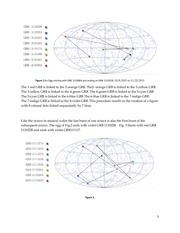
Like the octave in musical scales the last burst of one octave is also the first burst of the
subsequent octave. The ogg of Fig.2 ends with violet GRB 111022B. Fig. 3 Starts with red GRB
111022B and ends with violet GRB111117.
Figure 3.
5
�
Fig.4 The ogg begins with red GRB 111117A and ends with GRB 111207A.
Figure 4
Figure 5
Fig.5 The ogg begins with red GRB 111207A and ends with violet GRB 111215B. Fig. 6 The ogg
begins with red GRB 111215B and ends with violet GRB 120107A.
6
�
Figure 6
If the distribution of GRB’s were random then the size of the angles formed by linking eight
sequential bursts would range from 1 to 180 degrees. However this is not the case, the size of
the angles created by the linking of eight sequential bursts consistently skew to smaller angles.
Linking 8 non sequential GRB’s creates the pattern in Fig.7.
Figure 7. Non sequential GRB’s
7
�
Fig.8. shows another linking of 8 non sequential GRB’s this kind of linear pattern is never seen
when linking 8 sequential GRB’s.
Figure 8
Fig.9 shows the 8 sequentially linked GRB’s that occurred from 2/1/09 to 2/22/09. Beginning
with red GRB 090201A and ending with GRB 090222A.
Figure 9. An Ogg beginning with GRB 090201A and ending with GRB 090222A
Fig.9 thru Fig. 28 presents some examples of the 140 oggs generated for this study. Like all the
oggs created they demonstrate the propensity to form smaller angles, as a proof of non
randomness. Presenting the entirety would create a volume of significant size. To see all the
oggs created for this study a catalog has been created at http://tinyurl.com/7r3x53f.
8
�
Figure 10. An Ogg starting with GRB 090222A and ending with GRB 090304A.
Figure 11. An Ogg starting with GRB 060814A and ending with GRB 060912A.
9
�
Figure 12. An Ogg starting with GRB 070611A and ending with GRB 070707A.
Figure 13. An Ogg starting with GRB 110604A and ending with GRB 110715A.
10
�
Figure 14. An Ogg starting with GRB 110807A and ending with GRB 110820B.
Figure 15. An Ogg starting with GRB 090709A and ending with GRB 090718A.
11
�
Figure 16. An Ogg starting with GRB 100802A and ending with GRB 100901A.
Figure 17. An Ogg starting with GRB 110915B and ending with GRB 111008A.
12
�
Figure 18. An Ogg starting with GRB 090728A and ending with GRB 090812A.
Figure 19. An Ogg starting with GRB 090307B and ending with GRB 090319A.
13
�
Figure 20. An Ogg starting with GRB 081119A and ending with GRB 081127A.
Figure 21. An Ogg starting with GRB 041226A and ending with GRB 050128A.
14
�
Figure 22. An Ogg starting with GRB 081223A and ending with GRB 081230A.
Figure 23.An Ogg starting with GRB 090815C and ending with GRB 090828A.
15
�
Figure 24. An Ogg starting with GRB 050528A and ending with GRB 050712A.
Figure 25. An Ogg starting with GRB 070110A and ending with GRB 070208A.
16
�
Figure 26. An Ogg starting with GRB 061007A and ending with GRB 061110A.
Figure 27. An Ogg starting with GRB 090812A and ending with GRB 090815C.
17
�
Figure 28. An Ogg starting with GRB 040827A and ending with GRB 041218A.
4. Equidistant GRB’s
The following figures feature a GRB that is positioned at a location that is equidistant from two
or more bursts in the same ogg. Using the ogg from Fig. 28 to demonstrate this property Fig.29
uses blue GRB 04112A as the origin of two concentric circles. The smaller circle intersects cyan
GRB 04106A and indigo GRB 041217A, the larger circle touches green GRB 041015A and violet
GRB 041218A.
Figure 29. The Ogg starting with GRB 040827A and ending with GRB 041218A. Using the blue dot GRB 041211A as a center
point for two concentric circles.
18
�
Fig.30 Using the same ogg with cyan GRB 041016A as the center point the smaller circle
intersects blue GRB 041211A and green GRB 041015A the larger circle passes through red GRB
040827A and indigo GRB 041217A.
Figure 30
In Fig. 31 the orange GRB 040924A is equal distant to the yellow GRB 041006A and the cyan
GRB 041016A (small circle) and to the green GRB 041015A and the violet GRB 041218A. Fig. 32
uses the indigo GRB 041217A as the origin for 2 circles. The smallest intersects the orange GRB
040924A and the cyan GRB 041016A. The larger circle intersects the violet GRB 041218A and the
green GRB 041015A
Figure 31
19
�
Figure 32
Figure 33
Fig.33 uses the ogg from Fig.2 With the green GRB 111017A as the origin we see it is equidistant
from the blue GRB 111020A and yellow GRB 111016A as well as the indigo GRB 111022A and
violet GRB 111022B.
20
�
Figure 34. An Ogg starting with GRB 090222A and ending with GRB 090304A.
The ogg in Fig.34 has 4 examples of a GRB being equidistant from other GRB’s in the sequence.
Fig.35 The cyan GRB 080905A is equidistant from the green GRB 080904A, the red GRB 080828A
and the indigo GRB 080905c. In Fig.36 red GRB 080828A is equidistant from blue GRB 080905B
and violet GRB 080906A. In Fig.37 blue GRB 080905B is equidistant from cyan GRB 080905A
and yellow GRB 080830A. In Fig.38 yellow GRB 080830A is equidistant from indigo GRB
080905c and cyan GRB 080905A.
Figure 35
21
�
Figure 36.
Figure 37
22
�
Figure 38
Fig.39 has 4 examples of a GRB being equidistant from other GRB’s in the sequence. Fig.40 red
GRB 100901A is equidistant to cyan GRB 100906A and blue GRB 100909A. Fig.41. cyan GRB
100906A is equidistant to yellow GRB 100905A and indigo GRB 100910A. Fig.42 violet 100906A
is equidistant orange GRB 100902A and green GRB 100905A. Fig.43 indigo 100906A is
equidistant red GRB 100901A and green GRB 100905A.
Figure 39. An Ogg starting with GRB 100901A and ending with GRB 100915A.
23
�
Figure 40
Figure 41
24
�
Figure 42
Figure 43
25
�
5. Linking Sequential Oggs
Expanding on the idea of one burst being equidistant to the location of two other bursts the
author created a new pattern by combining three sequential oggs Fig.44, Fig.45, and Fig.46.
Figure 44. This ogg begins with GRB 100316D and ends with GRB100413A.
Figure 45.This ogg begins with GRB 100413A and ends with GRB 100424A.
26
�
Figure 46. This ogg begins with GRB 100424A and ends with GRB 100513A.
The results can be seen in Fig.47. The pattern consists of 22 sequential bursts (beginning with
GRB 100316D and ending with GRB 100513A) and the 21 lines that link them. This combination
of three Oggs will be referred to as a throgg.
Figure 47. A throgg indicating the location of 22 sequential gamma ray bursts numbered from 1-22.
Fig.51 to Fig.73 shows each GRB from 1-22 as the center point for the creation of concentric
circles. The circles are labeled alphabetically A being the smallest. The box indicates by number
which GRB’s are intersected by each circle. This demonstration of non randomness is
astonishing.
27
�
Figure 48. Using 1 (GRB 100316D) as the center of a series of concentric circles labeled A,B,C,D,E,and F. Each circle intersects
two GRB’s that are identified by number from 1-22.
28
�
Figure 49.Using 2 (GRB 100322A) as the center of a series of concentric circles labeled A,B,C,D,E,and F. Each circle intersects
two or more GRB’s that are identified by number from 1-22.
29
�
Figure 50. Using 3 (GRB 100322B) as center point creates of a series of five concentric circles labeled A,B,C,D and ,E. Each circle
intersects two GRB’s that are identified by number from 1-22.
30
�
Figure 51.. Using 4 (GRB100324A) as the center of a series of concentric circles labeled A,B,C,D,E,and F. Each circle intersects
two GRB’s that are identified by number from 1-22.
31
�
Figure 52. Using 5 (GRB 100325A) as the center of a series of concentric circles labeled A,B,C,D and E. Each circle intersects two
or more GRB’s that are identified by number from 1-22.
32
�
Figure 53. Using 6 (GRB 100401A) as the center of a series of concentric circles labeled A,B,C,and D. Each circle intersects two
GRB’s that are identified by number from 1-22.
33
�
Figure 54. Using 7 (GRB 100413B) as the center of a series of concentric circles labeled A,B,C,D and E. Each circle intersects two
or more GRB’s that are identified by number from 1-22.
34
�
Figure 55. Using 8 (GRB 100413A) as the center of a series of concentric circles labeled A and B. Each circle intersects two or
more GRB’s that are identified by number from 1-22.
35
�
Figure 56. Using 9 (GRB 100414A) as the center of a series of concentric circles labeled A and B. Each circle intersects two GRB’s
that are identified by number from 1-22.
36
�
Figure 57. Using 10 (GRB 100415A) as the center of a series of concentric circles labeled A,B,C,D,E,and F. Each circle intersects
two or more GRB’s that are identified by number from 1-22.
37
�
Figure 58. Using 11 (GRB 100418A) as the center of a series of concentric circles labeled A and B. Each circle intersects two
GRB’s that are identified by number from 1-22.
38
�
Figure 59. Using 12 (GRB 100420A) as the center of a series of concentric circles labeled A, B, C and D. Each circle intersects two
or more GRB’s that are identified by number from 1-22.
39
�
Figure 60. Using 13 (GRB 100423A) as the center of a series of concentric circles labeled A, B, C. Each circle intersects two
GRB’s that are identified by number from 1-22.
40
�
Figure 61. Using 14 (GRB 100423B) as the center of a series of concentric circles labeled A, B, C. Each circle intersects two GRB’s
that are identified by number from 1-22.
41
�
Figure 62. Using 15 (GRB 100424A) as the center of a series of concentric circles labeled A, B, C . Each circle intersects two
GRB’s that are identified by number from 1-22.
42
�
Figure 63. Using 16 (GRB 100425A) as the center of a series of concentric circles labeled A, B, C and D. Each circle intersects two
GRB’s that are identified by number from 1-22.
43
�
Figure 64. Using 17 (GRB 100427A) as the center of a series of concentric circles labeled A and B. Each circle intersects two
GRB’s that are identified by number from 1-22.
44
�
Figure 65. Using 18 (GRB 100503A) as the center of a series of concentric circles labeled A and B. Each circle intersects two
GRB’s that are identified by number from 1-22.
45
�
Figure 66. Using 19 (GRB 100504A) as the center of a series of concentric circles labeled A, B, C. Each circle intersects two GRB’s
that are identified by number from 1-22.
Figure 67. Using 20 (GRB 100508A) as the center of a series of concentric circles labeled A, B, C. Each circle intersects two or
more GRB’s that are identified by number from 1-22.
46
�
Figure 68. Using 21 (GRB 100511A) as the center of a series of concentric circles labeled A, B, C and D. Each circle intersects two
GRB’s that are identified by number from 1-22
47
�
Figure 69. Using 22 (GRB 100513A) as the center of a series of concentric circles labeled A, B, C. Each circle intersects two GRB’s
that are identified by number from 1-22.
48
�
Figure 70
Fig.70 is a circle with 22 divisions. Each division represents one of the 22 sequential GRB’s in the
throgg from Fig.47. The lines from each number radiate to the GRB’s that are equidistant from
it. There are 175 examples of GRB’s at equal distant positions.
49
�
Figure 71
Fig.71 features another example of a throgg. This throgg is constructed by linking the three
sequential oggs that range from GRB 050717A to GRB 050906. July 17, 2005 to September 6,
2005. The origin of the circle is violet 8, GRB 050803A. It is equidistant from (14, 15) A circle,
(18 , 21) B circle, (10,13) C circle, (17,22) D circle, (2,20) E circle, (1,11,16) F circle, (7,19) G circle,
(5,6) H circle.
Like the throgg in Fig. 47 each of the 22 sequential GRB’s is equidistant to other GRB’s in the
sequence.
50
�
 Historical archive . public document