OVERVIEW OF LAL TEST TECHNOLOGY
Endotoxin Testing: The rabbit fever test was the standard FDA-approved test
for endotoxins (pyrogens) until the approval of the LAL test by the FDA in the
1980's. The LAL test became the assay of choice for bacterial endotoxins
worldwide because of its specificity, simplicity and remarkable sensitivity.
The Horseshoe Crab: Limulus Amebocyte Lysate reagent is prepared from
the circulating blood cells of the horseshoe crab (Limulus polyphemus). This
procedure does not harm the donors which are returned to their natural ocean
environment.
Development of LAL: As early as 1885 W.H. Howell of Johns Hopkins
University described the clotting of Limulus blood; however, it was not until the
1950s that Dr. Frederick Bang identified endotoxin as the causative agent for
clotting. The gel-clot LAL technology was pioneered in the 1960s and early 70s
by a team of Johns Hopkins scientists, Dr. Bang, Dr. Jack Levin and Dr. James
F. Cooper (founder of Endosafe). Dr. Cooper's research in 1969-1971
demonstrated that the LAL test was much more sensitive than the rabbit test and
that LAL reactivity (gelation and increased opacity) correlated with endotoxin
concentration and biological activity. Dr. Cooper's publication in 1975 showed
that endotoxin contamination caused aseptic meningitis in patients following
intrathecal administration of radioactive drugs for nuclear cisternography. The
products causing adverse reactions when injected into cerebral spinal fluid had
passed the rabbit test, but Dr. Cooper showed that the same products gave
positive results when tested for endotoxin by the new method.
Charles River Products: Endosafe® LAL is distributed throughout the world.
In addition to traditional gel-clot LAL, Endosafe provides a full range of
�
quantitative LAL products utilizing novel colorimetric and turbidimetric assay
systems.
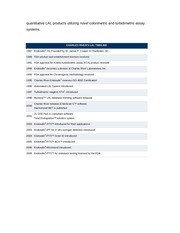
CHARLES RIVER'S LAL TIMELINE
1987 Endosafe®, Inc.Founded by Dr. James F. Cooper in Charleston, SC
1989 FDA product and establishment licenses received.
1991 FDA approval for Kinetic-turbidimetric assay (KTA) product received
1994 Endosafe® becomes a division of Charles River Laboratories, Inc.
1994 FDA approval for Chromogenic methodology received
1995 Charles River Endosafe® receives ISO-9002 Certification
1996 Automated LAL System introduced
1997 Turbidimetric reagent, KTA2, introduced
1998 Biotrend™ LAL database trending software released
2000
2001
Charles River releases EndoScan-V™ software
Harmonized BET is published
21 CFR Part 11 compliant software
Total Endogration™ robotics system
2003 Endosafe®-PTS™ introduced for R&D applications
2003 Endosafe®-IPT for in vitro pyrogen detection introduced
2004 Endosafe®-PTS™ Gram ID introduced
2005 Endosafe®-PTS™ BCA™ introduced
2006 Endosafe® Microtrend introduced
2006 Endosafe®-PTS™ for endotoxin testing licensed by the FDA
�
 Historical archive . public document