In-Depth Analysis of Delegate Binding for Ron Paul
Delegates to the 2012 GOP National Convention
Version 1, May 14, 2012
By Mark Laurence Donald Emerson,
acting in his personal, non-corporate capacity as a Nevada citizen,
and as a delegate at the recent Nevada State Republican Convention
SacredCampaign@gmail.com
The concept of “Delegate Binding” means delegates to Presidential National
Conventions can be “bound” to vote for a particular candidate on the first ballot for a
presidential nominee, even if that candidate is not their choice, and even if doing so is
against their conscience.
Some Ron Paul Delegates to the 2012 GOP National Convention may be faced
with a decision as to whether to abide by or rebel against Delegate Binding on the first
ballot. Additionally, Ron Paul Delegates may need to decide how to speak to others
about Delegate Binding, including at the time of admission to the convention and during
pre-first-ballot debates. This Analysis looks deeply into the Delegate Binding issue. I
am hopeful it might help delegates to make these decisions. I also hope it might be useful
to high-level Ron Paul strategists, particularly given strategic shift just announced today.
I humbly submit this document to be of service to Ron Paul, his campaign, our
nation and our world, which is in an advanced state of emergency at the hands of tyrants.
Any errors herein are my own. I apologize for the length — it would take too long to
make it shorter. Comments, rebuttals and corrections are welcome and appreciated.
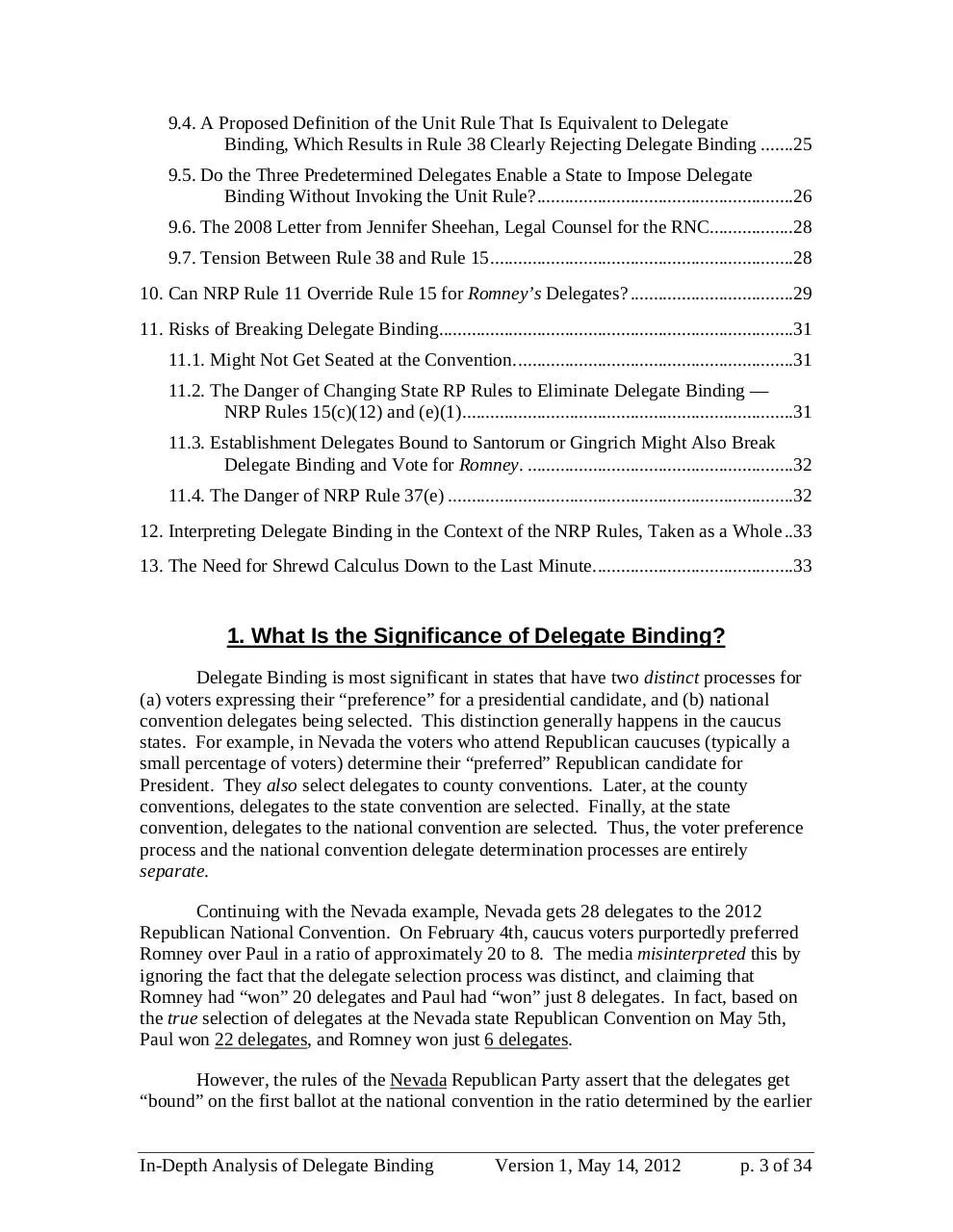
Table of Contents
1. What Is the Significance of Delegate Binding?...............................................................3
2. Rules Governing the Republican National Convention...................................................4
2.1. No State or Federal Law Governs the Convention .................................................5
2.2. State Laws Observed or Avoided by the NRP Rules..............................................5
2.3. State RP Rules Observed or Avoided by the NRP Rules .......................................6
3. Does a Delegate Have a Right of Free Speech at the National Convention? ..................6
3.1. Parliamentary Control of Certain Kinds of Delegate Speech and Conduct Is
Reasonable and Necessary. ................................................................................7
3.2. Coercing Delegates to Vote Against Their Conscience Is an Abomination to
Liberty................................................................................................................8
3.3. Parliamentary Rules of Order Are Non-Discriminatory; Delegate Binding Is
Discriminatory. ..................................................................................................8
In-Depth Analysis of Delegate Binding
Version 1, May 14, 2012
p. 1 of 34
�
3.4. An Interesting Hypothetical Example Involving Polygamy...................................9
3.5. The Republican Party Took the Lead in Abolishing Slavery. Delegates Are
Not Slaves. .......................................................................................................10
4. Does a Delegate Have a “Duty to Obey” Delegate Binding?........................................10
4.1. No Delegate Is Under Any Contract.....................................................................10
4.2. Are Delegates Under a Pledge? ............................................................................11
4.3. Does a Delegate Have a Duty to Cast the Wisest Vote in the Best Interests of
the United States? ............................................................................................11
4.4. Who Will Be Harmed If a Delegate Breaks the Binding? ....................................12
4.5. What Are the Consequences If a Delegate Breaks the Binding?..........................12
5. Is Delegate Binding Ever a Good Thing? ......................................................................13
5.1. Shielding from Party Bosses.................................................................................13
5.2. The Will of the People — Group Consciousness .................................................13
5.3. Why Hasn’t Romney Won More Loyal Delegates? .............................................14
5.4. The People Will Have the Final Say in November...............................................15
6. NRP Rules 15(a) and (c)(1) — The Basis of Delegate Binding ....................................15
7. NRP Rules 29 and 40 — One “Vote” per Delegate.......................................................17
8. NRP Rule 32 — Suspension of the Rules......................................................................18
9. NRP Rule 38 — Rejecting the “Unit Rule”...................................................................19
9.1. Useless Definitions of the “Unit Rule” That Are Too Vague...............................19
9.1.1. Mat Larson’s Definition of the “Unit Rule” ................................................19
9.1.2. Merriam Webster ’s Definition of the “Unit Rule” .....................................20
9.2. Five Reasonable, Well-Supported Definitions for the “Unit Rule”......................21
9.2.1. Unit Rule Definition One — Whole State Convention Delegates...............21
9.2.2. Unit Rule Definition Two — Congressional District Convention
Delegates....................................................................................................23
9.2.3. Unit Rule Definition Three — County Voters in Senatorial Election .........23
9.2.4. Unit Rule Definition Four — Electoral College ..........................................24
9.2.5. Unit Rule Definition Five — Binding Dissenting Minorities in the
Delegate Selection Process ........................................................................24
9.3. Does the Word “Bound” in Rule 38 Have the Same Meaning as the Words
“Bound” and “Bind” in Rules 10, 13, 14, 15 and 16? .....................................24
In-Depth Analysis of Delegate Binding
Version 1, May 14, 2012
p. 2 of 34
�
9.4. A Proposed Definition of the Unit Rule That Is Equivalent to Delegate
Binding, Which Results in Rule 38 Clearly Rejecting Delegate Binding .......25
9.5. Do the Three Predetermined Delegates Enable a State to Impose Delegate
Binding Without Invoking the Unit Rule?.......................................................26
9.6. The 2008 Letter from Jennifer Sheehan, Legal Counsel for the RNC..................28
9.7. Tension Between Rule 38 and Rule 15.................................................................28
10. Can NRP Rule 11 Override Rule 15 for Romney’s Delegates? ...................................29
11. Risks of Breaking Delegate Binding............................................................................31
11.1. Might Not Get Seated at the Convention............................................................31
11.2. The Danger of Changing State RP Rules to Eliminate Delegate Binding —
NRP Rules 15(c)(12) and (e)(1).......................................................................31
11.3. Establishment Delegates Bound to Santorum or Gingrich Might Also Break
Delegate Binding and Vote for Romney. .........................................................32
11.4. The Danger of NRP Rule 37(e) ..........................................................................32
12. Interpreting Delegate Binding in the Context of the NRP Rules, Taken as a Whole ..33
13. The Need for Shrewd Calculus Down to the Last Minute...........................................33
1. What Is the Significance of Delegate Binding?
Delegate Binding is most significant in states that have two distinct processes for
(a) voters expressing their “preference” for a presidential candidate, and (b) national
convention delegates being selected. This distinction generally happens in the caucus
states. For example, in Nevada the voters who attend Republican caucuses (typically a
small percentage of voters) determine their “preferred” Republican candidate for
President. They also select delegates to county conventions. Later, at the county
conventions, delegates to the state convention are selected. Finally, at the state
convention, delegates to the national convention are selected. Thus, the voter preference
process and the national convention delegate determination processes are entirely
separate.
Continuing with the Nevada example, Nevada gets 28 delegates to the 2012
Republican National Convention. On February 4th, caucus voters purportedly preferred
Romney over Paul in a ratio of approximately 20 to 8. The media misinterpreted this by
ignoring the fact that the delegate selection process was distinct, and claiming that
Romney had “won” 20 delegates and Paul had “won” just 8 delegates. In fact, based on
the true selection of delegates at the Nevada state Republican Convention on May 5th,
Paul won 22 delegates, and Romney won just 6 delegates.
However, the rules of the Nevada Republican Party assert that the delegates get
“bound” on the first ballot at the national convention in the ratio determined by the earlier
In-Depth Analysis of Delegate Binding
Version 1, May 14, 2012
p. 3 of 34
�
caucus vote, meaning 20 delegates are “bound” to vote for Romney. Delegate Binding
can best be understood by sorting Nevada’s 28 delegates into four categories based on
who they actually support, and who they are bound to — the 14 delegates in the lower
left bold box are bound against their will:
Nevada has 28
national delegates
Actually support
Romney
Actually support
Ron Paul
By Caucus
Bound to
Romney
Bound to
Ron Paul
By State
Convention
6 delegates
0 delegates
6
14 delegates
8 delegates
22
20
8
28
Of the 20 bound to Romney, 6 will be the delegates who actually support
Romney, but the other 14 will be Ron Paul supporters who the establishment will attempt
— via Delegate Binding — to coerce into voting for Romney on the first ballot.
Similar situations exist in many other states.
In states where national convention delegates are elected directly by the voters
(such as many states with primary elections), Delegate Binding is less significant
because, in general, the delegates elected in a particular jurisdiction (e.g. a congressional
district) are those who support the candidate who won the primary in that jurisdiction.
However, after becoming delegates, they might be persuaded to change their minds and
become Ron Paul supporters. And yet, they will still be bound to vote for Romney on
the first ballot.
2. Rules Governing the Republican National Convention
The Republican Party consists of the National Republican Party (“NRP”), the
state Republican Party (“State RP”) in each state, and thousands of local Republican
Parties. Each has its own rules, and many hold conventions.
The NRP is generally governed by the national conventions. But between
conventions, it is governed by the National Republican Committee (“NRC”).
At this time, the NRP, including both the NRC and the 2012 Republican National
Convention, is governed by The Rules of the Republican Party As Adopted by the 2008
Republican National Convention September 1, 2008 and Amended on August 6, 2010 by
the Republican National Committee (“NRP Rules”). The amendment only affected Rule
15(b) regarding the timing of early primaries and caucuses. The convention is also
governed by the Call for the Republican National Convention issued on December 31,
2011 by the RNC, which quotes all NRP Rules pertaining to the convention, and gives
the delegate counts for each state.
In-Depth Analysis of Delegate Binding
Version 1, May 14, 2012
p. 4 of 34
�
2.1. No State or Federal Law Governs the Convention
The Republican Party is not a government agency, and it has the right to make its
own rules free from government interference. To a very great extent, the NRP Rules
trump state and federal law.
When states have enacted laws that interfered with the rule-making process of the
Republican Party (or of the Democratic Party), the United States Supreme Court has held
such laws as unconstitutional because they violate the party’s right of freedom of speech.
In Tashjian v. Republican Party of Connecticut (1986) 479 U.S. 208, 107 S.Ct. 544, the
High Court struck down a Connecticut law that prevented the Republican Party from
permitting independent voters to vote in the Republican primary. In California
Democratic Party v. Jones (2000) 530 U.S. 567, 120 S.Ct. 2402, the U.S. Supreme Court
struck down a California ballot proposition that would have created a blanket primary in
which voters could vote for any candidate regardless of voter's or candidate's party
affiliation.
Moreover, the U.S. Supreme Court has held that there is a “large public interest in
allowing the political processes to function free from judicial supervision,” O'Brien v.
Brown (1972) 409 U.S. 1 at 4, 92 S.Ct. 2718 at 2720. Regarding the selection and
admission of delegates to the national convention, “the availability of the convention as a
forum to review the recommendations of the Credentials Committee” largely eliminates
the need for intervention of the courts. Id.
In short, the government has very little business regulating how political parties
select their candidates.
In my humble opinion, this means that we — as Republicans generally, and
specifically the Ron Paul delegates to the national convention — have substantial amount
of power in interpreting the NRP Rules for ourselves.
In the next two subsections I will explore the very limited impact that state laws
and State RP rules have on the Republican National Convention — some are observed,
others are avoided.
2.2. State Laws Observed or Avoided by the NRP Rules
Consistent with the above-cited U.S. Supreme Court cases, the Republican
National Convention is not governed by any state or federal law unless the NRP Rules
expressly provide for observing such a law. For example, NRP Rule 15(a)(2) provides
one of four methods by which delegates can be determined, where state law is observed:
(2) To the extent not provided for in the applicable Republican Party
rules of a state, in accordance with any applicable laws of a state,
insofar as the same are not inconsistent with these rules;
In-Depth Analysis of Delegate Binding
Version 1, May 14, 2012
p. 5 of 34
�
On the other hand, some NRP Rules describe a situation where state law shall not
be observed, which means such law is avoided. For example, NRP Rule 15(c)(3)
provides:
(3) No state law shall be observed that permits any person to
participate in a primary delegate and alternate delegate selection
process that also permits that person at the same primary to participate
in the choosing of nominees of any other party for other elective
office.
In effect, the NRP Rules are “picking and choosing” what state laws to observe
and what state laws to avoid.
Significantly, the “picked” laws are used solely to incorporate the procedures
they define — and not because of any “teeth” in such laws. This means that “violation”
of state laws cited in the NRP Rules will have no penal consequences — nobody will be
arrested or prosecuted for any criminal violation of such laws.
2.3. State RP Rules Observed or Avoided by the NRP Rules
Similarly, the Republican National Convention is not governed by any State RP
rules unless the NRP Rules expressly provide for observing such rules. For example,
NRP Rule 2(a) provides:
Where the rules adopted by a state Republican Party provide a method
of election of the national committeeman and the national
committeewoman, they shall be elected pursuant to such method.
On the other hand, some NRP Rules describe a situation where State RP rules
shall not be observed, which means such rules are avoided. For example, NRP Rule
11(b) provides:
(b) No state Republican Party rule or state law shall be observed that
allows persons who have participated or are participating in the
selection of any nominee of a party other than the Republican Party,...
to participate in the selection of a nominee of the Republican Party for
that general election. No person nominated in violation of
In effect, the NRP Rules are “picking and choosing” which State RP rules to
observe and which ones to avoid.
3. Does a Delegate Have a Right of Free Speech at the National
Convention?
We will consider two forms of speech at the convention — (a) addressing the
convention at the microphone, and (b) voting. The former is the topic of parliamentary
procedure, the latter is a matter of individual choice.
In-Depth Analysis of Delegate Binding
Version 1, May 14, 2012
p. 6 of 34
�
3.1. Parliamentary Control of Certain Kinds of Delegate Speech and
Conduct Is Reasonable and Necessary.
Without parliamentary procedure, a large body of contentious people will
accomplish nothing at all. Parliamentary procedure brings order to large gatherings. It is
the work of genius. It enables large assemblies to get things done in an orderly manner,
without wasting everyone’s time and getting nothing done.
NRP Rule 30, entitled “Rules of Order,” provides:
The Rules of the House of Representatives of the United States shall
be the rules of the convention, except that the current authorized
edition of Robert’s Rules of Order: Newly Revised (“Robert’s Rules of
Order”), shall be the rules for committees and subcommittees of the
convention, insofar as they are applicable and not inconsistent with the
rules herein set forth; provided, however, that the convention may
adopt its own rules concerning the reading of committee reports and
resolutions.
This means the parliamentary procedure rules that apply to delegate conduct at the
convention are those of the U.S. House of Representatives (“US House Rules”),1 “insofar
as they are applicable and not inconsistent with” the rest of the NRP Rules.
In my humble opinion, this is reasonable and necessary (except as to certain
provisions of NRP Rule 15 discussed below). It is reasonable and necessary for
delegates to conduct themselves in accordance with parliamentary rules for making
motions and amendments to motions, asking questions, debating, manner of voting, etc.
If a delegate or small group of delegates “revolts” from the parliamentary rules — e.g. by
insisting on making a new motion when an existing motion is still pending on the floor —
it will disrupt the process and force the entire convention to deal with the disruption and
waste a lot of people’s time.
Numerous additional NRP Rules address order at the convention, and thereby
reasonably govern delegate conduct. NRP Rule 31 limits the length of time a delegate
may speak on any question to five minutes. NRP Rule 32 defines how to suspend the
parliamentary rules. NRP Rule 33 addresses platform resolutions. NRP Rule 34
addresses minority reports from convention committees. NRP Rule 35 addresses motions
to lay on the table. NRP Rule 36 addresses motions to call the question. All of these
rules reasonably govern delegate conduct, and such a set of rules is necessary for the
convention to get anything done at all.
1
The US House Rules for the current (112th) Congress can be downloaded in pdf format here:
http://www.google.com/url?sa=t&rct=j&q=us%20house%20of%20representatives%20rule%20xv&source
=web&cd=2&ved=0CFgQFjAB&url=http%3A%2F%2Fclerk.house.gov%2Flegislative%2Fhouserules.pdf&ei=8LquTDcLuWliQKJ7YT4Aw&usg=AFQjCNHBQnuXH5JShtTU491ngiye3Bm49Q&cad=rja
In-Depth Analysis of Delegate Binding
Version 1, May 14, 2012
p. 7 of 34
�
3.2. Coercing Delegates to Vote Against Their Conscience Is an
Abomination to Liberty.
Voting is a form of speech. What about a rule that controls speech by forcing a
delegate to vote against his/her conscience on a particular matter?
Delegate Binding attempts to do just that. At the 2012 convention, intense
pressure will be focused on many staunch Ron Paul delegates to vote against their
conscience for Romney, Santorum or Gingrich on the first ballot for President.
As discussed above, the NRP Rules regarding parliamentary procedure are based
upon and expressly reference the Rules of the U.S. House of Representatives. And
nothing in the House Rules forces any congressman to vote in a particular way on any
matter.
Indeed the U.S. Constitution makes speech on the floor of the House privileged,
not only regarding voting, but regarding any other form of speech:
for any speech or debate in either house, they shall not be questioned
in any other place. (Article 1, Section 6, ¶ 1)
This means a congressman can defame someone on the floor of the House or Senate with
impunity. It means a congressman cannot be sued civilly or prosecuted criminally for any
vote or other speech made on the House floor. Indeed, the longstanding status quo is for
a congressman to make a campaign promise to voters that he/she will vote a certain way
on something and then break that promise when actually voting on the House floor! But
the above-quoted clause from the U.S. Constitution makes it entirely legal for a
congressman to break his/her campaign promises. The only potential consequence is
getting voted out of office at the next election.
Freedom of speech is central and crucial to any form of liberty. The right to vote
is likewise central and crucial to any form of liberty. Depriving a delegate of his/her
free-speech right to vote by his/her conscience, and forcing him/her to instead vote for a
candidate he/she abhors, is, in my opinion, an abomination to liberty.
3.3. Parliamentary Rules of Order Are Non-Discriminatory; Delegate
Binding Is Discriminatory.
Parliamentary rules of order apply to all delegates equally. No group or subgroup
is singled out as to who is entitled to make motions, participate in debate, raise points of
order, information and personal privilege, and (except on the first Presidential ballot)
vote.
Parliamentary rules of order do not discriminate on the basis of race, religion,
country of origin, gender, sexual orientation, economic status, geographical region, state,
county, congressional district, or political beliefs.
In-Depth Analysis of Delegate Binding
Version 1, May 14, 2012
p. 8 of 34
�
In striking contrast, Delegate Binding is blatantly discriminatory. In my view, it
discriminates against certain delegates who based on their political beliefs, and also based
on their state and/or congressional district.
Delegates who happen to get caught on the wrong side of the binding — either in
their state at large, or in their congressional district — are forced to throw their voting
power behind a candidate they abhor.
In principle, this is no different than forcing a devout Buddhist to take
communion at a Catholic church. Or forcing a heterosexual to engage in homosexual
activity. Or forcing blacks to use a different restroom than whites.
3.4. An Interesting Hypothetical Example Involving Polygamy
Consider an absurd but fascinating example. Mormons and Utahans are have a
history of embracing polygamy. In 1851 U.S. President Millard Fillmore appointed
Brigham Young as the first Governor of Utah Territory. At the time of his appointment ,
Young had 44 wives (he subsequently married an additional 11 women). Several decades
later when Utah became a state in 1896, polygamy was a hotly debated issue, and one of
the conditions imposed by Congress for granting Utah statehood was that a ban on
polygamy be written into the state constitution.
However, Ron Paul staunchly supports getting the government out of marriage,
which would open the way for the practice of polygamy (for those so inclined by mutual,
freely given consent) not only in Utah but throughout the United States. Furthermore,
Mitt Romney is a Mormon!
Now, what if the NRP Rules included the following hypothetical rule?
On any motion before the convention to amend the platform to repeal
bigamy laws and/or to encourage polygamy, all delegates from the
State of Utah shall vote “Nay.”
Suppose such a motion were to come before the convention, and the Chair were to
instruct the Sergeant at Arms to carefully watch the Utah delegation to enforce the rule.
Suppose when the Chair says, “All in favor say Aye,” numerous delegates from many
states, including many from Utah, all shout “Aye.” Should the Chair order the Sergeant
at Arms punish the Utah delegates who broke the rule by voting “Aye” by removing them
from the convention hall but not punish the delegates from other states who also voted
“Aye”?
This hypothetical rule unreasonably discriminates against certain delegates (i.e.
those from Utah who favor polygamy) by forcing them to vote against their conscience,
while leaving other delegates (i.e. those not from Utah who also favor polygamy) free to
vote by their conscience.
This hypothetical example very closely approximates the situation presented by
Delegate Binding, which forces certain delegates (i.e. Ron Paul delegates who are
In-Depth Analysis of Delegate Binding
Version 1, May 14, 2012
p. 9 of 34
�
“bound” to vote for Romney, Santorum or Gingrich on the first ballot) to vote against
their conscience for Romney, while permitting other delegates (who are not bound to
Romney, Santorum or Gingrich) to vote for Ron Paul with their conscience.
3.5. The Republican Party Took the Lead in Abolishing Slavery. Delegates
Are Not Slaves.
Historically, the Democratic Party was the party that supported slavery. The
Republican Party was the party of the abolitionists, who wanted liberty for everyone,
including the black slaves. The first Republican President was Abraham Lincoln, who
was largely responsible for ending slavery.
The essence of slavery is one person (the “master”) forcing another person (the
“slave”) to do things against his/her will. Slavery laws imposed a “duty” on a slave to
obey his/her master.
That is precisely what Delegate Binding does — it enables party bosses (the
“master”) to force delegates (as “slaves”) to vote against their will.
Delegates are not slaves.
4. Does a Delegate Have a “Duty to Obey” Delegate Binding?
The purpose of the U.S. Constitution is to protect this nation from tyranny. It
worked for about a century. But gradually the tyrants figured out how to get around it,
and today our Constitution is hanging by a very thing thread.
Central to the rise of tyranny within the United States as been the indoctrination
of children and adults — by government schools, the media, the corporate work culture,
income tax, excessive regulations, law enforcement, etc. — with the notion that they have
a “duty to obey.” The one centrally unified lesson taught in our educational system, from
pre-school through graduate school, is “do as you’re told” — in other words, “obey.”
Pre-schoolers learn to obey their teachers’ instructions, even if the instructions are
ridiculous. Grad-schoolers learn to obey the instructions of the funding sources for the
grants they receive (or their professors receive), even when it means they will have to
falsify scientific results.
Blind obedience is an abomination to liberty. It is precisely the opposite of what
George Washington and his army fought for.
And so, does a delegate have a “duty to obey” Delegate Binding?
4.1. No Delegate Is Under Any Contract.
It takes four elements to make a contract: (1) parties capable of contracting (this
excludes minors and insane people), (2) a lawful purpose (this excludes a murder
contract), (3) consideration (each party must get something from the other), and (4)
In-Depth Analysis of Delegate Binding
Version 1, May 14, 2012
p. 10 of 34
�
consent (each party must give his/her consent, by signing or by handshake or otherwise).
The word “agreement” is legally synonymous with “contract.”
If a person makes a contract to do something, then the person has a duty to do that
thing under the contract. If Mary makes a contract with John for John to repair the
gaping holes in the roof of her house in exchange for $1,000, and she pays the money to
him in advance, then he has a contractual duty to fix the roof (or refund the money). If
John fails to fix the roof and fails to refund the money, then Mary can sue him in court
for breach of contract.
However, delegates to the national convention are not parties to any contract. No
agreement exists between a delegate and the party bosses, or between a delegate and
anyone else. A delegate is elected and accepts the position. In accepting the position, the
delegate does not agree to do or not do any particular thing. Nobody can sue a delegate
in any court for breach of contract based on what the delegate did or did not do at
convention.
Accordingly, Delegate Binding does not arise from any contract.
4.2. Are Delegates Under a Pledge?
A pledge is entirely different than a contract. A pledge has none of the four
elements of a contract. A pledge is simply a promise to do or not do something.
Suppose John promises Mary he will fix her roof, and then Mary relies on that
promise by going away on a one-month vacation without making arrangements for
someone else to repair the roof. But John fails to repair the roof. While Mary is gone,
there is a huge rainstorm, and when she comes back her house is flooded. Mary can sue
John in court for promissory estoppel.
In some states, delegates are required — before being elected as delegates — to
pledge (i.e. promise) to vote for a particular candidate on the first ballot. In those
situations, voters are entitled to rely on such pledges/promises. If the delegate then
breaks the pledge, the voters have been harmed, albeit a suit for promissory estoppel is
unlikely.
But here in our Ron Paul campaign, I am not aware of any delegates who have
actually pledged their support to any other candidate. And if any have done so, then it
seems to me they should vote for that candidate on the first ballot.
4.3. Does a Delegate Have a Duty to Cast the Wisest Vote in the Best
Interests of the United States?
“I have sworn on the altar of God eternal hostility against every form of tyranny
over the mind of man.” — Thomas Jefferson
In-Depth Analysis of Delegate Binding
Version 1, May 14, 2012
p. 11 of 34
�
“If once the people become inattentive to the public affairs,... Congress and
Assemblies, Judges and Governors, shall all become wolves. It seems to be the law of our
general nature, in spite of individual exceptions.” — Thomas Jefferson
In my humble opinion, the highest duty of each delegate is to protect the United
States from tyranny. This takes wisdom. It also takes strength to resist tyrannical
influences to coerce the wise delegate into supporting tyranny.
In my humble opinion, every U.S. President over the past century has been a
puppet of the elite tyrants (with the possible exceptions of two who where shot, Kennedy
and Reagan, the latter of whom became more puppetlike after the shooting). The tyranny
is destroying America. Ron Paul is patently not their puppet!
What is the higher duty for a delegate — obeying Delegate Binding? Or casting
the wisest vote in the best interests of the United States to save our nation from tyranny?
4.4. Who Will Be Harmed If a Delegate Breaks the Binding?
It appears that Romney and the establishment he represents might be “harmed” if
breaking Delegate Binding results in Romney losing the nomination. These people are
all puppets of the elite tyrants, and the tyrants will most definitely be harmed, as they
should be.
What about all the sleeping voters who believe all the media hype and, like sheep,
voted for Romney? Will they be “harmed” if Ron Paul is elected and makes America
great again? I don’t think so — I think they will be blessed. Their egos might have to
experience a “rude awakening,” but the truth is always healthy in the long term, even if
painful in the short term. Shattering false beliefs might “harm” falsehood, but I don’t
think it harms any voting citizen!
4.5. What Are the Consequences If a Delegate Breaks the Binding?
Delegate Binding is a creature of the NRP Rules, which “pick and choose” certain
state laws and State RP rules. Delegates are not under any legal or contractual obligation
to obey Delegate Binding.
In the extremely unlikely event that the establishment retaliates against any
delegate who break the Delegate Binding by a malicious criminal prosecution or a
malicious civil lawsuit, the delegate will have powerful legal defenses. As for criminal
prosecution, there is no law that requires a delegate to obey Delegate Binding, because
Delegate Binding is a creature of the NRP Rules — not a creature of any law with
criminal penalties. As for a civil lawsuit, there is no contract to sue on, nor (to my
knowledge) is there any pledge to sue on, nor can they prove any damages.
What they could and might do, however, is to make threats and maybe jail a few
delegates to make a good example. For myself, I would rather go to jail than renege on
my duty as a citizen to resist tyranny.
In-Depth Analysis of Delegate Binding
Version 1, May 14, 2012
p. 12 of 34
�
“The tree of liberty must be refreshed from time to time, with the blood of patriots
and tyrants. It is its natural manure.” — Thomas Jefferson
However, while retaliation against individual delegates seems unlikely, breaking
Delegate Binding poses certain risks to Ron Paul winning the nomination, as discussed
below in Section 11. Risks of Breaking Delegate Binding.
5. Is Delegate Binding Ever a Good Thing?
In my opinion, if delegates are dishonest, then binding them to vote for an honest
candidate might be a good thing. But that’s not what we have here.
What we have are honest delegates supporting an honest candidate — Ron Paul.
In my opinion, binding honest delegates to vote for a dishonest candidate is evil.
5.1. Shielding from Party Bosses.
It is my understanding that the concept of Delegate Binding originated as a goodfaith attempt to solve an entrenched problem where evil party bosses were controlling
political conventions, both Republican and Democratic. Delegates who wished to vote
for one candidate got coerced into voting the way the bosses said to vote, and they did so
even though the voters who sent them to convention wanted a different candidate.
Delegate Binding attempted to solve this problem by shielding delegates from the
pressure of the bosses at convention. Delegate Binding eliminated the influence of the
bosses, at least on the first ballot.
Here, however, the situation is reversed — the bosses want Delegate Binding, and
Ron Paul delegates want to break the binding.
5.2. The Will of the People — Group Consciousness
One argument in favor of Delegate Binding is that it causes the first ballot at the
national convention to more accurately reflect the will of the People.
But what, precisely, is the “will of the People” here? And which People?
As used in the Preamble of the U.S. Constitution, “We the People” refers to the
nation as a whole. And it is We the People whose interests are at stake in a presidential
election.
However, the number of people who vote in the caucuses and primaries is much
smaller than the number who vote in the November general election. According to 2012
caucus and primary voter turnout statistics in 36 states thus far, as reported by George
Mason University2, only three states had turnouts greater than 20%. Fifteen states had
turnouts between 10% and 20 %. Eighteen states had turnouts below 10%. The average
2
http://elections.gmu.edu/Turnout_2012P.html (viewed May 12, 2012)
In-Depth Analysis of Delegate Binding
Version 1, May 14, 2012
p. 13 of 34
�
by my calculation from these statistics is just 10.1% of eligible voters have voted in the
2012 caucuses and primaries. In striking contrast, the nationwide voter turnout for the
general presidential election in November 2008, as also reported by George Mason
University3, was 61.6% of eligible voters!
In my opinion, a major factor underlying the low caucus/primary voter turnout is
that many (perhaps most) people are so numbed and dumbed by the media that the can’t
really see much difference between the candidates. Most people know these politicians
are a bunch of liars and that their campaign speeches are not to be trusted. But they are
ignorant about Ron Paul. They are asleep about Ron Paul.
Does the sleepy vote by a turnout of just 10.1% of the sleepy people eligible to
vote truly reflect the Will of We the People?
Is this truly the Group Consciousness of We the People?
Should delegates be bound based on the will of just 10.1% of the sleepy people
eligible to vote?
Or is the group consciousness of We the People more accurately reflected by
those who are awake and aware?
And what about the group consciousness of the delegates at the national
convention? It would appear that they might be more awake than the voters in general.
Is their group consciousness reflected by Delegate Binding?
5.3. Why Hasn’t Romney Won More Loyal Delegates?
According to the NRP Rule 13(a)(2), each state gets three predetermined
delegates — the state’s national committeeman, national committeewoman and chairman
of the state’s Republican Party (“Three Predetermined Delegates”). The remaining
delegates are determined by, caucuses, primaries and state conventions.
If Delegate Binding is a good thing, then why is such a disparity developing
between (a) the vote percentages Romney has (purportedly) won in the caucuses and
primaries, and (b) the number of loyal delegates he has won?
For example, in the Maine Republican caucuses, Romney (purportedly) won 39%
of the vote, while Ron Paul (purportedly) won 35% of the vote.4 But Ron Paul has now
captured 100% of Maine’s 21 non-predetermined delegates5.
3
http://elections.gmu.edu/Turnout_2008G.html (viewed May 12, 2012)
4
http://hosted.ap.org/dynamic/files/elections/2012/by_state/ME_Page_0211.html?SITE=CSPANELN&SEC
TION=POLITICS (viewed May 12, 2012)
5
http://www.latimes.com/news/nationworld/nation/la-na-ron-paul-maine-20120507,0,2466313.story
(viewed May 12, 2012)
In-Depth Analysis of Delegate Binding
Version 1, May 14, 2012
p. 14 of 34
�
And in Nevada, Romney (purportedly) won 50% of the vote, while Ron Paul
(purportedly) won only 19% of the vote.6 And yet Ron Paul has now captured 22 of
Nevada’s 25 non-predetermined delegates.7
If Delegate Binding is a good thing, then why, on the delegate front, has Ron Paul
trounced Romney in states like Maine and Nevada?
Could it be that most Romney voters are, in reality, not so loyal? Did they vote
for Romney based on media hype rather than any kind of deep personal commitment to
Romney and ignorance about Ron Paul? Did they believe all the media hype that Ron
Paul “can’t win”? Are many of them starting to wake up to the truth about Ron Paul? If
so, will Delegate Binding serve such voters, who are just now waking up?
5.4. The People Will Have the Final Say in November.
Ultimately, the Republican Party is just that — it’s a party. It nominates one
candidate for President. It does not elect the President.
Delegate Binding is nothing more than a rule that influences what candidate the
Republican Party nominates.
Ultimately, the People will have the final say in November — at least to the
extent that establishment efforts to rig the vote counting process can be thwarted.
6. NRP Rules 15(a) and (c)(1) — The Basis of Delegate Binding
Delegate Binding arises from NRP Rule 15, and from the State RP rules and state
laws it references.
The words “bind” and “bound” appear throughout Rule 15. The first part, Rule
15(a), states that the binding of delegates shall be (1) according to State RP rules, or (2)
according to state law, or (3) a combination of both, or (4) by Rule 15(d), which is to
hold conventions in each congressional district:
(a) Order of Precedence.
Delegates at large and their alternate delegates and delegates from
Congressional districts and their alternate delegates to the national
convention shall be elected, selected, allocated, or bound in the
following manner:
6
http://hosted.ap.org/dynamic/files/elections/2012/by_state/NV_Page_0204.html?SITE=CSPANELN&SEC
TION=POLITICS (viewed May 12, 2012)
7
http://www.washingtonpost.com/blogs/the-fix/post/ron-paul-wins-majority-of-nevadadelegates/2012/05/06/gIQA1An15T_blog.html (viewed May 12, 2012)
In-Depth Analysis of Delegate Binding
Version 1, May 14, 2012
p. 15 of 34
�
(1) In accordance with any applicable Republican Party rules
of a state, insofar as the same are not inconsistent with these
rules; or
(2) To the extent not provided for in the applicable Republican
Party rules of a state, in accordance with any applicable laws of
a state, insofar as the same are not inconsistent with these rules;
or
(3) By a combination of the methods set forth in paragraphs
(a)(1) or (a)(2) of this rule; or
(4) To the extent not provided by state law or party rules, as set
forth in paragraph (d) of this rule.
This seems to observe Delegate-Binding State RP rules and Delegate-Binding
state laws.
The next part, Rule 15(b), mentions the word “bind” in 15(b)(1), but its purpose is
only the timing of caucuses, primaries and state conventions.
After that, Rule 15(c) makes numerous general comments about “elections or
selections of delegates,” of which 15(c)(1), (7) and (12) include the words “bind” or
“bound.”
Rule 15(c)(1) describes five different “manners” for Delegate Binding:
(1) Delegates and alternate delegates to the national convention may
be elected, selected, allocated, or bound only in one of the following
manners:
(i) by primary election;
(ii) by the Republican state committee, where specifically
provided by state law;
(iii) by state and Congressional district conventions;
(iv) by any method consistent with these rules by which
delegates and alternate delegates were elected, selected,
allocated, or bound to the most recent Republican National
Convention from that state;
(v) by Rule No. 13 (a)(2) of these rules.
The last of these five mentions Rule 13 (a)(2), which provides for the Three
Predetermined Delegates from each state.
In-Depth Analysis of Delegate Binding
Version 1, May 14, 2012
p. 16 of 34
�
Rule 15(c)(7) uses the word “binding” but does no more than to encourage the
participation of the military in the Republican Party process.
Additional references to Delegate Binding are made in Rule 15(c)(12) and Rule
15(e), which are discussed below in section 11. Risks of Breaking Delegate Binding.
7. NRP Rules 29 and 40 — One “Vote” per Delegate
NRP Rule 29(a) states that each delegate gets one “vote”:
(a) Each delegate to the convention shall be entitled to one (1) vote...
NRP Rule 40(d) states that the Presidential nomination is determined by a
majority of “votes”:
When at the close of a roll call any candidate for nomination for
President of the United States or Vice President of the United States
has received a majority of the votes entitled to be cast in the
convention, the chairman of the convention shall declare that the
candidate has been nominated.
What, exactly, is a “vote”? The word “vote” is not defined in the NRP Rules.
According to Black’s Law Dictionary, Sixth Edition, the word “vote” is defined as
follows:
Suffrage; the expression of one’s will, preference, or choice,
formally manifested by a member of a legislative or deliberative body,
or of a constituency or a body of qualified electors, in regard to the
decision to be made by the body as a whole upon any proposed
measure or proceeding or in passing laws, rules or regulations, or the
selection of an officer or representative.
According to the online version of The American Heritage Dictionary of the
English Language, the word “vote” is defined as follows:
1. a. A formal expression of preference for a candidate for office or for
a proposed resolution of an issue: Let's decide the matter by vote.
Where is there any room in the definition of “vote” for Delegate Binding that
forces a delegate to cast a “vote” that is patently not his/her “will, preference or choice”?
In-Depth Analysis of Delegate Binding
Version 1, May 14, 2012
p. 17 of 34
�
8. NRP Rule 32 — Suspension of the Rules
One strategy for overcoming Delegate Binding is to suspend the rules on Delegate
Binding. NRP Rule 32 provides:
A motion to suspend the rules shall always be in order, but only when
made by authority of a majority of the delegates from any state and
seconded by a majority of the delegates from each of five (5) or more
other states severally.
This means it takes six states to make a motion to suspend the rules — one state to
move, and five states to second. Each state must do so based on the internal vote of a
majority of its delegates. It seems clear that Ron Paul will control the internal votes of at
least six states, such as Nevada and Maine, so making such a motion is doable.
Rule 32 does not, however, state the number of votes needed to pass such a
motion. Rather, as quoted above, NRP Rule 30 provides that “The Rules of the House of
Representatives of the United States shall be the rules of the convention,” which means,
in my view, that we must look to the House Rules to see the number of votes to pass a
motion to suspend the rules. House Rule XV provides:
Suspensions
1. (a) A rule may not be suspended except by a vote of two-thirds of
the Members voting, a quorum being present. The Speaker may not
entertain a motion that the House suspend the rules except on
Mondays, Tuesdays, and Wednesdays and during the last six days of a
session of Congress.
(b) Pending a motion that the House suspend the rules, the Speaker
may entertain one motion that the House adjourn but may not entertain
any other motion until the vote is taken on the suspension.
(c) A motion that the House suspend the rules is debatable for 40
minutes, one-half in favor of the motion and one-half in opposition
thereto.
This is consistent with Robert’s Rules of Order.
It might be difficult or impossible to attain a two-thirds vote of the delegates. But
in the event that a motion to suspend the rules is made, I would suggest, as a first draft,
that it take the following form, and be made by the chairman of the delegation from the
moving state:
Pursuant to Rule 32, the Great State of _______, by concurrence of a
majority of its delegates, hereby moves to suspend any and all
provisions of The Rules of the Republican Party concerning — and
In-Depth Analysis of Delegate Binding
Version 1, May 14, 2012
p. 18 of 34
�
only those provisions concerning — the binding of delegates at this
convention to vote for a particular candidate on the first roll-call ballot
for the Republican Party’s nomination for President of the United
States, including, without limitation, suspending all delegate-binding
provisions of Rule 15 and all applicable delegate-binding provisions
referenced by Rule 15 that are found in the rules of any state
Republican Party, in the laws of any state, or anywhere else.
9. NRP Rule 38 — Rejecting the “Unit Rule”
NRP Rule 38 talks about delegates NOT being bound:
No delegate or alternate delegate shall be bound by any attempt of any
state or Congressional district to impose the unit rule.
I will talk about what an “attempt” might be below. But first, we must ask the
following question:
What is “the unit rule”?
There is no definition of “unit rule” in the NRP Rules.
9.1. Useless Definitions of the “Unit Rule” That Are Too Vague.
In this section, I reject two purported definitions of “unit rule” because they are
simply too vague to be precisely understood.
9.1.1. Mat Larson’s Definition of the “Unit Rule”
Mat Larson, who is evidently a Ron Paul delegate to the national convention, has
posted a video8 on dailypaul.com entitled, RNC Cheats Ron Paul And "the Unit Rule"
Unbinds All Delegates! (the “Larson Video”). In the video he states (at 2:16):
The unit rule basically means they can tell you who to vote for.
Mat immediately continues, “That is not true guys.” With all due respect to Mat, his
definition of “unit rule” is vague and imprecise. Who is “they”? And what, precisely,
does it mean for “them” to “tell you who to vote for”? Moreover, Mat’s definition is
unsupported by any authority. It appears that he just made it up. And I’m all for creating
our own interpretations, as I myself do below, but I think we should do so precisely and
with a full understanding of the context we are in and what potential rebuttals and
counterattacks we may face.
8
http://www.dailypaul.com/230824/rnc-cheats-ron-paul-and-the-unit-rule-unbounds-all-delegates (viewed
May 12, 2012).
In-Depth Analysis of Delegate Binding
Version 1, May 14, 2012
p. 19 of 34
�
After some discussion of Rule 15 and whether it “takes precedence” over Rule 38,
Mat states (at 2:57):
But the unit rule is the perfect example on how we don’t even have to
abstain from voting, guys, on the first ballot. You can vote on your
conscience...
In my humble opinion, Mat’s interpretation of Rule 38 is dangerously naïve. As
discussed below in Section 11. Risks of Breaking Delegate Binding, if delegates blindly
proceed based on Mat’s vague definition, it could potentially ruin Ron Paul’s chance at
securing the nomination. A more careful look at the meaning of “unit rule” as well as a
more carefully reasoned interpretation of Rule 38 are needed.
9.1.2. Merriam Webster ’s Definition of the “Unit Rule”
The online version of the Merriam Webster Dictionary9 defines “unit rule” as
follows:
a rule under which a delegation to a national political convention casts
its entire vote as a unit as determined by a majority vote
This definition refers to a “delegation” and makes no reference to any
geographical unit. But what is a “delegation”?
Each state has an overall “delegation.” Each congressional district has a
“delegation.” Ron Paul has delegates in each state, who can be called a Ron Paul
“delegation.” Likewise with Mitt Romney. And these politically affiliated “delegations”
are entirely different from the geographical “delegations.”
Thus, with in a state, we have an overall state “delegation,” several congressional
district “delegations,” a Ron Paul “delegation” and a Mitt Romney “delegation.” To
which of these “delegations” does the Merriam Webster definition of “unit rule’ apply?
A blogger called “neverquit” posted an article on DailyPaul.com entitled,
UPDATE : 5-11 Urgent : Ben Swann And Mat Larson Are Wrong About RULE 38 And
Delegates Being Unbound Based On RNC Rules10 (“Neverquit Blog”) in which he or she
quotes Merriam Webster’s definition “unit rule”:
To debate this rule you must first understand what the UNIT RULE IS
This is defined very clearly in your state bylaws as well as the meriam
websters dictionary. UNIT RULE MEANS : :
9
http://www.merriam-webster.com/dictionary/unit%20rule (viewed May 14, 2012).
http://www.dailypaul.com/230881/urgent-ben-swann-and-Mat-larson-are-wrong-about-38-and-delegatesbeing-unbound-based-on-rnc-rules (viewed May 14, 2012).
10
In-Depth Analysis of Delegate Binding
Version 1, May 14, 2012
p. 20 of 34
�
A rule under which a delegation to a national political convention casts
its entire vote as a unit as determined by a majority vote.
With all due respect to Neverquit, I disagree that this definition if clear. And
without a clear definition of “delegation,” the Merriam Webster definition seems to me to
be too vague for the purpose of interpreting Rule 38.
9.2. Five Reasonable, Well-Supported Definitions for the “Unit Rule”
I will now present five reasonable definitions of the “unit rule,” each based on
some kind of authority. I have stated them here in concise, parallel language so they can
be readily compared with one another:
Unit Rule Definition One. A majority of the delegates from a state
bind a minority of dissenting delegates from that state to vote with the
said majority.
Unit Rule Definition Two. A majority of the delegates from a
congressional district bind a minority of dissenting delegates from that
congressional district to vote with the said majority.
Unit Rule Definition Three. In a senatorial election, a majority of the
voters in a county cause the votes of a minority of dissenting voters in
that county to be counted for the candidate favored by the said
majority.
Unit Rule Definition Four. A majority of the voters in a state bind, in
a presidential election, all of the electors from that state to vote in the
electoral college with the said majority.
Unit Rule Definition Five. A majority of the voters at any stage of the
delegate selection process bind a minority of dissenting voters to vote
with the majority.
There might be other definitions as well that are based on authority. My Westlaw
subscription is limited to California and Ninth Circuit cases, plus the U.S. Supreme
Court. If anyone has a nationwide Westlaw subscription, more references to “unit rule”
will undoubtedly be found in case law.
In the following five subsections, I will discuss each of the five definitions in turn.
9.2.1. Unit Rule Definition One — Whole State Convention Delegates
Unit Rule Definition One. A majority of the delegates from a state
bind a minority of dissenting delegates from that state to vote with the
said majority.
In-Depth Analysis of Delegate Binding
Version 1, May 14, 2012
p. 21 of 34
�
This definition is supported by the online version of The American Heritage
Dictionary of the English Language, where “unit rule” is defined as follows:
A rule of procedure at a national political convention under which a
state's entire vote must be cast for the candidate preferred by a
majority of the state's delegates.
And according to Dictionary.com (Based on the Random House Dictionary, ©
Random House, Inc. 2012), the “unit rule” is defined as follows:
a rule whereby a state's delegation votes as a unit, not recognizing
minority votes within the delegation.
These two definitions are both based on the delegates from a whole state voting as
a unit. In other words, under the “unit rule,” if a whole state has 25 delegates and 13 of
them support candidate A, while the other 12 support candidate B, then all 25 of the
state’s delegates must vote for candidate A.
The 1880 Republican national convention nominated James Garfield, who
became the 20th President of the United States. According to Wikipedia,11 the most
contentious question at that convention was whether or not to apply the “unit rule,” which
was understood back then to apply to entire states. If the unit rule were applied, then exPresident Ulysses S. Grant would easily win. If the unit rule were not applied, then there
would be a deadlock.
In my view, the “unit rule” as understood and discussed back in 1880 was Unit
Rule Definition One. Significantly, it says nothing about who the voters favored — it
only applies to delegates. It is my understanding that back then there was no Delegate
Binding as we understand it today — delegates were not “bound” by the results of
caucuses or primaries. Once the delegates were chosen by the voters, however that might
have happened, the delegates did whatever they wanted at the convention. The “unit
rule” was an attempt to force the delegates from each state to vote with the majority in
that state.
Prior to the start of the 1880 convention, James Garfield stated, “I regard it [the
unit rule] as being more important than even the choice of a candidate.” Ultimately, the
unit rule — in the form of Unit Rule Definition One — was rejected. 35 deadlocked
ballots ensued until Garfield emerged the winner on the 36th ballot.
Evidently, NRP Rule 38 descended from the aftermath of the 1880 convention,
because Rule 38 seems consistent with the decision at that convention to reject the Unit
Rule Definition One.
Remember, Unit Rule Definition One says nothing about any Delegate Binding
created by the voters at caucuses or in primaries.
11
http://en.wikipedia.org/wiki/1880_Republican_National_Convention#cite_note-p27-47 (viewed May 12,
2012).
In-Depth Analysis of Delegate Binding
Version 1, May 14, 2012
p. 22 of 34
�
Interestingly, if Rule 38 were suspended and Unit Rule Definition One were
applied, then it would actually work in Ron Paul’s favor in some states. For example, in
Nevada, Ron Paul has 22 delegates and Romney has 6 delegates. 22 is a clear majority.
Hence, if the unit rule were enforced statewide and all delegates were forced to vote with
the majority, then Ron Paul would get all 28 Nevada votes, and Romney would get 0!
9.2.2. Unit Rule Definition Two — Congressional District Convention
Delegates
Unit Rule Definition Two. A majority of the delegates from a
congressional district bind a minority of dissenting delegates from that
congressional district to vote with the said majority.
The best authority on this is Rule 38 itself, which not only rejects the “unit rule”
as applied to entire states, but also as applied to congressional districts.
At the national convention, each congressional district gets 3 delegates. If Unit
Rule Definition Two were applied at the congressional district level, and 2 of the 3
delegates supported candidate A but the third delegate supported candidate B, then all
three votes must be for candidate A.
Unit Rule Definition Two says nothing about any Delegate Binding created by the
voters at caucuses or in primaries.
Newscaster Ben Swann of Fox 19 in Cincinnati made a video report12 entitled,
RNC Lawyer Says All Delegates Are Unbound! (the “Swann Video”). In the video he
states (at 0:41):
So what is the unit rule? Well that rule requires that all delegates from
one state or congressional district are required or bound to vote as a
unit.
This seems to be combination of Unit Rule Definitions One and Two.
9.2.3. Unit Rule Definition Three — County Voters in Senatorial Election
Unit Rule Definition Three. In a senatorial election, a majority of the
voters in a county cause the votes of a minority of dissenting voters in
that county to be counted for the candidate favored by the majority.
This county-level rule is supported by Reynolds v. Sims (1964) 377 U.S. 533 at
588, 84 S.Ct. 1362 at 1395, where the U.S Supreme Court makes reference to “the use of
Georgia's county unit rule in the election of United States Senators.” This appears to be a
county-level application of the concept, but it is unrelated to convention delegates.
12
http://libertyvlogger.com/ron-paul/rnc-lawyer-says-all-delegates-are-unbound/ (viewed May 14, 2012).
In-Depth Analysis of Delegate Binding
Version 1, May 14, 2012
p. 23 of 34
�
9.2.4. Unit Rule Definition Four — Electoral College
Unit Rule Definition Four. A majority of the voters in a state bind, in
a presidential election, all of the electors from that state to vote in the
electoral college with the said majority.
This definition is what happens in the electoral college when “winner take all”
laws in most states provide for a candidate who gets merely a majority of votes to take all
the electoral votes.
The use of the term “unit rule” in connection with the electoral college is made in
Williams v. Virginia State Board of Elections (E.D. Va. 1968) 288 F.Supp. 622, affirmed
without comme
...
 Historical archive . public document