"
TRAINING BULLETIN
TITLE:
Rollcall Training - City law Director's letter
Open Firearm
Effective Date:
April 10, 2012
No. 12-06
All personnel (to include Reserves) are required to read the City Law Director's letter, dated
April 9, 2012, attached, Re: Legal opinion regarding the ability of an Ohio peace officer to
temporarily stop and handcuff a person that is carrying an open firearm in a public place.
A copy of the letter and sign off sheet are also posted in the Communication Center.
This training must be accomplished by April 28.
After read ing the letter, please initial the posted sign off sheet in rollcall.
Atch : Letter, April 9, 2012
Issued by:
Lt. Swafford
Posted:
Remove:
/
April 10, 2012
April 28, 2012
�
PICKREL, SCHAEFFER AND EBELING
A LEGAL PROFESSIONAL ASSOCIATION
VDClKlTTElUNGTOW£R
oI<l_n1 MAIN STREET
OAYTON. OHIO 454 23·2700
9371223-1130
FACSIMILE 9371223-0339
l. MIC!-tA£l 9lY
~B.CARTE R
JOHN E . Cl.OIJGlool
J
gmcdonald@Pselaw.com
R . PETER FINIIE
JAMES l. JACOBSON'
April 9, 2012
JAMES W . I<Ell EIiE R
JOSHVAM.I(lN
MICHELE l . IIING'
JOSEPH P. MAfTERA)
GERAlD l. MCOOl'Co'.l.D
2
DAVID H. MONTGOMERY
.JOf.J M. ROSEMEYER
MICHAEL W. SIoNDNER
Douglas Knight
Vandalia Police Chief
245 J.E . Bohanan Drive
Vandalia, OH 45377
"'-""'I B. SCHAEFFER
DONALD G. SC HWEllER
JEFFREY S. SENNEY
Dear Chief Knight :
MATTI-IEWC. SORG
WlfTl.i€WD . STOK£I..v"
ANDREW C. STOIV<R
PAUL J . WINTERK.O.l. TER
PAUl. E. ZIMMER
IRA H. THOMSEN
AliSON N. SACIICNHEIM
SHAHRZAD p . At.lEN
' ..... -.-InFLandMi
'
_ - '_
-"N
•_
InY
.....
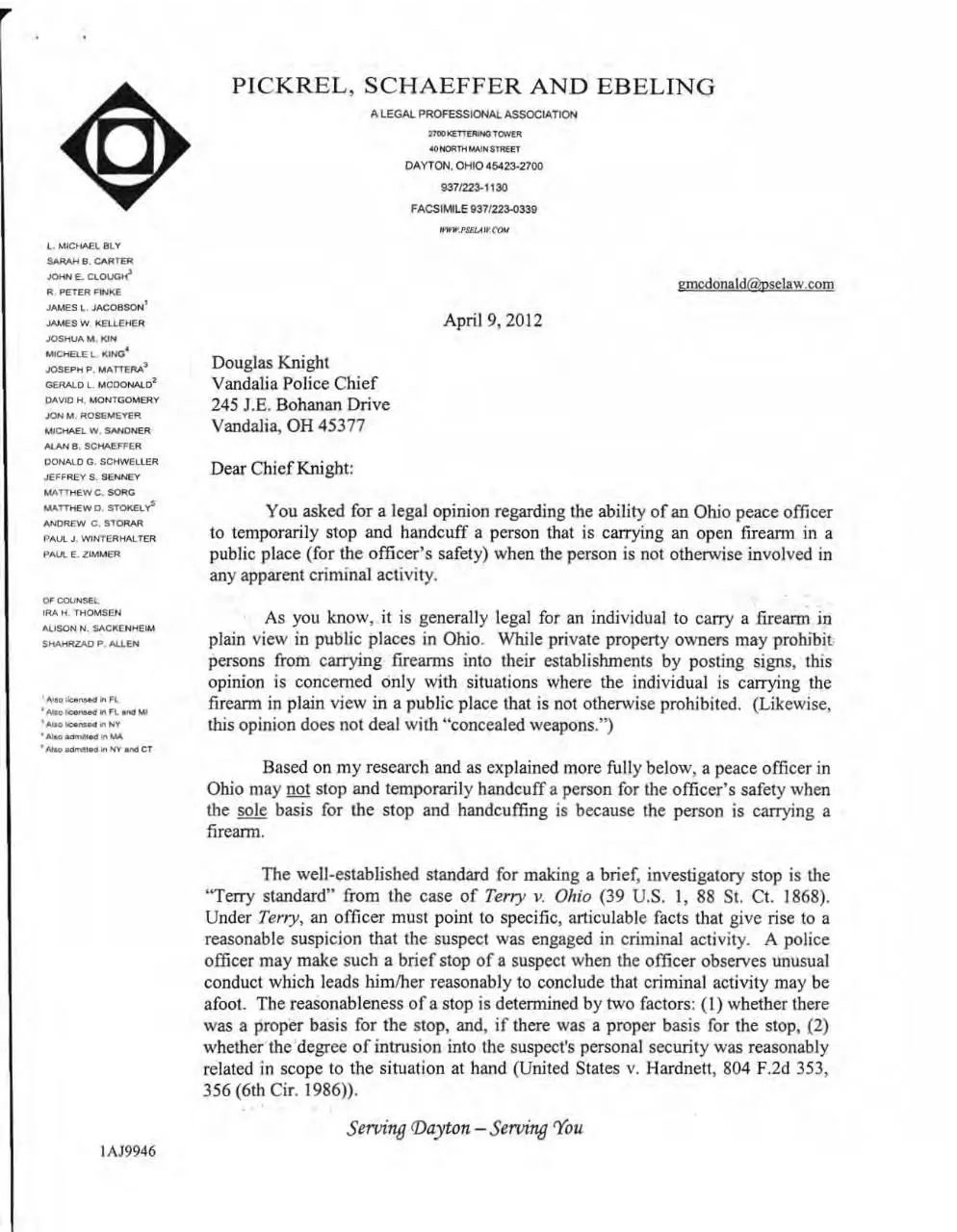
You asked for a legal opinion regarding the ability of an Oruo peace officer
to temporarily stop and handcuff a person that is carrying an open fireann in a
public place (for the officer 's safety) when the person is not otherwise involved in
any apparent criminal activity.
As you know, it is generally legal for an individual to carry a fireann iIi
plain view in public places in Ohio. While private property owners may prohibi t
persons from carrying fireanns into their establishments by posting signs, this
opinion is concerned only with situations where the individual is carrying the
fireann in plain view in a public place that is not otherwise prohibited. (Likewise,
lru s opinion does not deal with "concealed weapons.")
• ...... _ I n NY and CT
Based on my research and as exp lained more fully below, a peace officer in
Ohio may not stop and temporarily handcuff a person for the officer's safety when
the sole basis for the stop and handcuffing is because the person is carrying a
fireann .
The well-established standard for making a brief, investigatory stop is the
"Terry standard" from the case of Terry v. Ohio (39 U.S. 1, 88 SI. Ct. 1868).
Under Terry, an officer must point to specific, articulable facts that give rise to a
reasonable suspicion that the suspect was engaged in criminal activity. A police
officer may make such a brief stop of a suspect when the officer observes unusual
conduct which leads himlher reasonably to conclude that criminal activity may be
afoot. The reasonableness of a stop is detennined by two factors: (I) whether there
was a proper basis for the stop, and, if there was a proper basis for the stop. (2)
whether'the 'degree of intrusion into the suspect's personal security was reasonably
related in scope to the situation at hand (United States v. Hardnett, 804 F.2d 353,
356 (6th Cir. 1986)).
Serving !Dayton - Servi"fJ 'You
lAJ9946
�
Douglas Kni ght, Vandalia Police Chief
April 9, 2012
Page 2.
The issue here is whether under Ohio law, the mere presence of a person with an
unconcealed fireann in a public place absent any other factor can constitute conduct which leads
an officer to conclude criminal activity is afoot. As noted above, the answer to that is no . There
must be more than simply carrying a firearm . The officer must have some other reason, (other
than "the suspect was carrying a fireann in public") to j ustify the stop. Note I state under "Ohio
law." That is because, other states have laws that may prohibit or limit ones right to carry a
weapon in public. Accordingly. in those states, an officer observing a person that is carrying a
gun openly may have justification to make a Terry stop.
I was unable to find an Ohio case that specifically stated that there must be more than
merely displaying a fireann to justify a stop. I did find several cases from other jurisdictions that
have open carry laws simi lar to Ohio that I discuss later.
It is important to note that the stopping and handcuffing of a person that is carrying a gun
in public in Ohio is permitted when there are other circumstances involved that would meet the
Terry standards. One such circumstance is when the person carrying the gun can be cited for
disorderly conduct (a crime under R. C. 2917.11 which provides that no person shall reckl essly
cause alann to another by creating a condition that presents a risk of physical hann to person or
property). An example of this is found in the recent case of Butcher v. Cuyahoga Fall, (20 II
U.S. Dis! LEXIS 136315).
On April 13, 2010, Matthew Butcher was detained by Cuyahoga Falls police officers.
Th ere is no dispute that at the time of his detention, Butcher was openly carrying a rifle and a
handgun in fro nt of the entrance to a Walgreens phannacy. The officers responded to the area
after receiving a dispatch reporting that there was a male in that area carrying weapons. The
officers approached Butcher wi th their guns drawn and ordered him to the ground. Butcher was
then handcuffed and the officers took possession of hi s weapons. Butcher remained detained for
approximately 35 minutes, during which time the officers investi gated Butcher and hi s
moti vations. Upon determining that Butcher was in lawful possession of the fireanns and had no
intent to commit any crime, Butcher was released and his weapons were returned to him.
Subsequently, Butcher filed a law suit asserti ng that hi s detention violated his First,
Second, and Fourth Amendment rights and constituted false impri sonment and assault and
battery. The court ruled in favor of officers because both officers had reason to believe that
Butcher had or was engaged in disruptive conduct and provoked a disturbance.
Citing a Wisconsin court deci sion, the federal district court in Butcher po inted out that no
reasonable person would dispute that walking into a retail store openly carrying a fireann is
highly disruptive conduct which is virtually certain to create a disturbance. This is so because
when employees and shoppers in retail stores see a person carrying a lethal weapon, they are
likely to be frightened and possibly even panic. Many employees and shoppers are likely to
think that the person with the gun is either deranged or about to commit a felony or both and it is
almost certain that someone will call the police. And when police respond to a "man with a gun"
IAJ9946
�
Douglas Knight, Vandalia Police Chief
Apri l 9, 2012
Page 3.
call, they have no idea what the anned individual's intentions are. The volati lity inherent in such
a situation could easi ly lead to someone being seriously injured or killed.
While it may appear that this case permits an officer to detain a person merely for
carrying a gun in public, that is not the case. In Butcher, the conduct of Mr. Butcher caused store
employ·ees to become frightened and to notify their managers. The managers also became
frightened and called the police, as did at least on citizen. The responding officers clearly had
reason to believe that the Mr. Butcher' s conduct ofloitering outside of a drug store with both a
hand gun and a rifle, provoked a disturbance and constituted disorderly conduct in violation of
the law. The court pointed out that when police respond to a "man with a gun" call, they cannot
know that person's intentions and such a situation could easily lead to someone being harmed .
As noted above, there are cases from other jurisdictions that directly address the issue of
stopping a person solely because helshe is carrying a weapon in public. An example, is the
United States District Court for the District of New Mexico case of Matthey A. St. John v.
McColley, et 01. 653 F. Supp. 2d 1155.
Matthew St. JOM was escorted out of a movie theater and patted down by officers
responding to a call from the theater manager that an individual, (S1. JOM), had entered the
theater wearing a holstered handgun. The theater manager requested that officers remove Mr. St.
John because he was making customers upset. Upon searching Mr. S1. John, no contraband or
additional weapons were found and a police database check revealed that he possessed the gun
lawfu lly. The officers then told Mr. St. John that he could return to the movie ifhe left the gun
in his tlUck. The entire incident lasted approx imately 30 minutes and it was reported that at all
times Mr. St. John was "respectfUl and cooperative."
Mr. St. John subsequently sued claiming that he was subjected to an unreasonable seizure
when the officers removed him from the theater and that he was subj ected to an unreasonable
search when Defendants patted him down.
The court found based on the facts (not set forth in this summary), that Mr. St. John's
seizure was unreasonable in that the officers lacked a justifiable suspicion that Mr. S1. John had
committed a crime, was committing a crime or was about to commit a crime. (The lead officer
involved conceded that he did not observe Mr. St. JOM committing any crimes and that he
arrived at the theater with the suspicion that Mr. St. John was merely "showing a gun. tt) The
court also found that there was no reason to believe that a crime was afoot, pointing out that
"when they found him, Mr. St. John was peacefully sitting through the previews for his second
movie of the day."
The St. John case is clearly distinguishable from the Butcher case in that in S1. JOM, the
officers had no basis for believing that anyone's safety was at ri sk. In St. John, the police simply
received a report that an individual was carrying a fireann in a location where individuals could
lawfully carry fireanns. They received no indication that Mr. 81. John was behaving
suspiciously or in a threatening manner. Moreover, when the officers arrived, they found Mr. S1.
iAJ9946
�
..
Douglas Knight, Vandalia Police Chief
Apri19.2012
Page 4.
John sitting peaceably in the theater preparing to watch a movie. Unlike with Butcher, the
officers had no basis for believing that Mr. St. John's use of the weapon was likely to become
criminal, cause a public disturbance or pose a threat to safety. Nor did anyone seem particularly
alarmed by Mr. St. John's weapon.
The court stated "Mr. St. John's lawful possession ofa loaded firearm in a crowded place
could not, by itself, create a reasonable suspicion sufficient to justify an investigatory detention."
It went on to say "Because New Mexico law allows individuals to openly carry weapons in
public, and Mr. St. John had done nothing to arouse suspicion, create tumult or endanger
anyone's well-being, there were no articulable facts to indicate either criminal activity or a threat
to safety. Accordingly, Defendants' seizure of Mr. St. John violated his Fourth Amendment
rights.
Likewise in the case of United States v. Ubi/es. 224 F.3d 213 (3rd Cir. 2000). the Third
Circuit found that an individual's lawful possession of a firearm in a crowded place did not
justify a search or seizure. In Ubi/es, officers seized Mr. Ubiles during a crowded celebration
after they received a tip that he was carrying a gun. Officers did so even though no applicable
law prohibited Ubi les from carrying a firearm during the celebration. Holding that the search
violated Ubiles' Fourth Amendment rights, the court noted that the situation was no different
than if the informant had told officers "that Ubiles possessed a wallet ... and the authorities had
stopped him for that reason." Nor, the court continued, could the officers rely on the fact that
Ubiles possessed the weapon while in a crowd.
The Tenth Circuit has also dealt with thi s question. In United Siaies v. King, 990 F.2d
1552 (10th Cir. 1993) the Tenth Circuit found that an investigatory detention initiated by an
officer after he discovered that the defendant lawfully possessed a loaded firearm lacked
sufficient basis because the fireann alone did not create a reasonable suspicion of criminal
activity. In King, an A lbuquerque police officer seized and searched King when, concerned that
King's honking would cause an accident , he approached King's vehicle and observed a loaded
firearm under King's thigh . Recognizing that King was allowed to carry a loaded, concealed
firearm in hi s vehicle under New Mexico law, the court explained that--in light of the legality of
King's actions--permitting such detentions would render the Fourth Amendment functionally
meaningless. The court stated:
In a state such as New Mexico, which permits persons to lawfully carry fireanns, the
government's argument [that the officer's investigatory detention of defendant was
justified by concern for his safety and the safety of bystanders] would effectively
eliminate Fourth Amendment protections for lawfully armed persons. Moreover, the
govemment's "reasonableness" standard would render toothless the additional
requirement that the scope and duration of detention be carefully tailored to its
underlying justification. For example, if a police officer's safety could justify the
detention of an otherwise lawfully armed person, the detention could last indefinitely
because a lawfully anned person would perpetuall y present a threat to the safety of the
officer.
lA19946
�
Douglas Knight, Vandalia Police Chief
April 9, 2012
Page 5.
This same rational could easily apply to Ohio where the legislature has expressly stated in
the Ohio Revised Code section 9.68:
"The individual right to keep and bear arms, being a fundamental individual right that
predates the United States Constitution and Ohio Constitution, and being a
constitutionally protected right in every part of Ohio, the general assembly finds the need
to provide unifonn laws throughout the state regulating the ownership, possession,
purchase, other acquisition, transport, storage, carrying, sale, or other transfer of firearms,
their components, and their ammunition. Except as specifically provided by the United
States Constitution, Ohio Constitution, state law, or federal law, a person, without further
license, pennission, restriction, delay, or process, may own, possess, purchase, sell,
transfer, transport, store, or keep any firearm, part of a firearm, its components, and its
ammunition."
If the initial stop is not justified, (under Terry) then a subsequent handcuffing, in the
absent of any intervening reason, would likewise not be pennitted. Courts have ruled that in the
course of a justified Terry stop that the police are entitled to take reasonable measures to ensure
their own safety, including handcuffing, should the situation warrant it, State v. Boykins (1999
Ohio App. LEXIS 5048). However, the facts and circumstances must warrant the use of
handcuffs. If there is no risk, the "officer safety" rationale will not apply, State v. Mills, Medina
(2002 Ohio 7323). Along with the officer safety rationale, handcuffing may also be used to
prevent flight, Slale v. Pickell (2000 Ohio App. LEXIS 3484). But there must be a reasonable
basis to believe that the suspect will try to get away before handcuffing to prevent flight would
be justified. Accordingly, the mere fact that a person is in open possession of a fireann, without
more, will not be the basis for handcuffing the person under an "officer safety" rationale.
Based on the above it is my opinion that in Ohio a peace officer may not stop and
temporarily handcuff a person when the sole basis for the stop is because the person is carrying a
fireann openly in a public place.
Very truly yours,
PICKREL, SHAEFFER &
GLMllap
C:
Rob Anderson
IAJ9946
LING 0., LPA
�
 Historical archive . public document