,
.
.'
"
TRAINING BULLETIN
TITLE:
Roll Call Training - Open or Concealed
No. 12-08
Carry of a Firearm on Public and Private Property
Effective Date: May 1, 2012
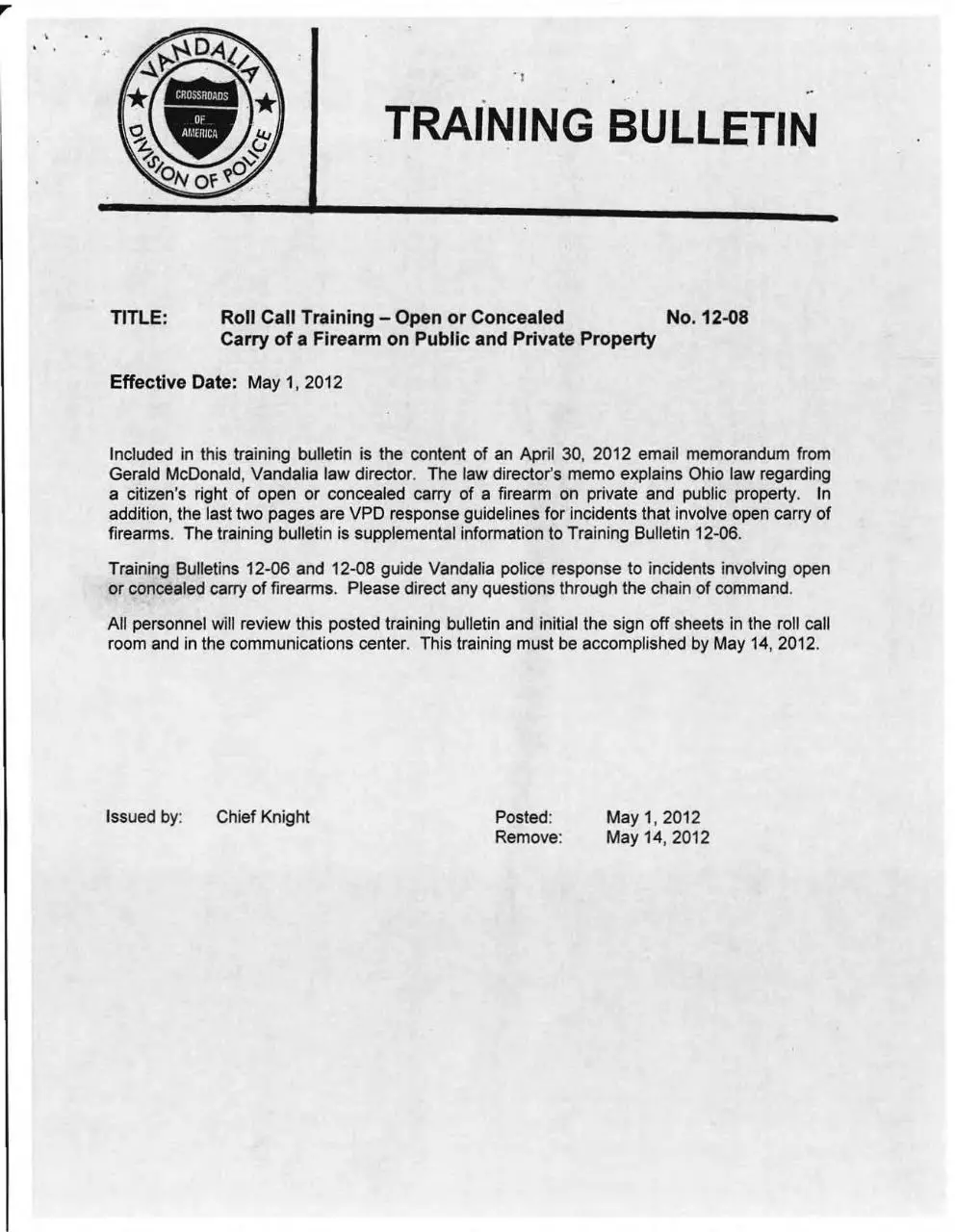
Included in this training bulletin is the content of an April 30, 2012 email memorandum from
Gerald McDonald, Vandalia law director. The law director's memo explains Ohio law regarding
a citizen's right of open or concealed carry of a firearm on private and public property. In
addition, the last two pages are VPD response guidelines for incidents that involve open carry of
fireanns. The training bulletin is supplemental information to Training Bulletin 12-06.
Training Bulletins 12-06 and 12-08 guide Vandalia police response to incidents involving open
or concealed carry of firearms. Please direct any questions through the chain of command .
All personnel will review this posted training bulletin and initial the sign off sheets in the roll call
room and in the communications center. This training must be accomplished by May 14, 2012.
Issued by:
Chief Knight
Posted:
Remove :
May 1, 2012
May 14, 2012
�
r
The text below is an email memorandumfromGeraldMcDonald. Vandalialawdirector.to
Vandalia's chief of police on April 24, 2012. The memorandum explains Ohio law regarding
concealed or open carry of a firearm on private and public property in Ohio. The information is
supplemental to VPD Training Bulletin 12-06.
[To:] Chief Knight:
In a recent telephone call you asked for some clarification on where a private person (i.e. not a
police officer) can lawfully carry a weapon on the ir person in a public or private place. For
purposes of this memo, I have broken your question down to two different situations. The first
being, where can one carry a concealed weapon? The second being, where can one carry an
open weapon?
CONCEALED WEAPONS:
In 2004 the General Assembly enacted a licensing procedure for handgun owners in Ohio. (See
R.C . 2923.125). R.C . 2923.126(A) provides that a ticensed handgun owner may carry a
concealed handgun anywhere in this state except as provided in R.e. 2923.126(8) and (e).
R.e. 2923.126(8) sets forth specific locations where certain licensed handgun owner may not
carry a concealed handgun which include:
(1)
A police station, jail , workhouse , or other detention facility, or an airport passenger
terminal, facilities for the care of mentally ill persons;
(2)
A school safety zone ;
(3)
A courthouse or another building or structure in which a courtroom is located;
(4)
Any premises or open air arena for which a 0 liquor permit has been issued if the
licensee carrying the concealed handgun is consuming beer or intoxicating liquor or under the
influence of alcohol or a drug of abuse;
(5)
Any premises owned or leased by any public or private college , university, or other
institution of higher education, unless the handgun is in a locked motor veh icle or the licensee is
in the immediate process of placing the handgun in a locked motor vehicle ;
(6)
Any church, synagogue, mosque, or other place of worship, unless the church,
synagogue, mosque, or other place of worship posts or permits otherwise;
(7)
A child day-care center, and with certain exceptions, a type A family day-care home, a
type 8 family day-care home, or a type e fam ily da y-care home;
(8)
An aircraft that is in, or intended for operation in, foreign air transportation , interstate air
transportation , intrastate air transportation , or the transportation of mail by aircraft;
(9)
Any building that is owned by this state or any political subdivision of this state, and all
portions of any building that is not owned by any governmental entity listed in th is division but
that is leased by such a governm ental entity listed in this division ;
(10)
A place in which federal law prohibits the carrying of handguns.
R.C . 2923.126(C) (1) and (C) (3) allow private employers and landowners to prohibit concealed
weapons on their property as they deem fit by posting a sign. (subject to certain exception).
�
,.
Thus, it appears that if a person has a license to carry a concealed weapon he can carry it
anywhere except the ten (10) places designated above , and except for posted private property.
OPEN CARRY
For the most part the above law is specific to concealed carry. In other words , while a person
may be prohibited from carrying a concealed weapon in a public building under 2923.126(8) (9) ,
he would not necessarily be prohibited from having an open weapon in a public building.
However, some sections of Chapter 2923 apply to open carry as well as concealed carry
weapons. For example , R.e. 2923.126(C) allows private employers and landowner to prohibit
persons ~from carrying firearms or concealed firearms~ on private land by posting a sign.
(Subject to certain exceptions.) Likewise , 2923.123 makes it illegal to have a firearm in a
courthouse, or in another building or structure in which a courtroom is located. (Based on this , it
appears that one cannot carry a firearm , either concealed or open , into the Vandalia Justice
Center).
While a private property owner can post a sign that prohibits that person from carrying such
firearm on the private land, and the State can prohibit firearms in certain area , a City cannot
prohibit open carry firearms on its property (public property).
tn the 2006 case of Ohioans for Concealed Carry, Inc. v. City of Clyde , 120 Ohio SI. 3d 96 the
court looked at a municipality's ability to regulate handgun possession on its own property by
persons possessing a valid permit to carry a concealed handgun. In 2004, the city of Clyde
passed and ordinance that prohibited handguns in it parks, "irrespective of whether such person
has been issued a license to carry a concealed handgun pursuant to Ohio R. C. 2923.125".
Ohioans for Concealed Carry , Inc. filed a law suit to strike down the ordinance and had some
success in the lower courts. While the case was making its way through the courts , however,
the General Assembly enacted R.C. 9.68, which emphasized the "fundamental individual right"
to "keep and bear arms" and expressed the legislature's further desire to provide uniform laws
throughout the state regulating the ownership and possession of firearms. R.C. 9.68(A) also
provides that except as specifically provided by the United States Constitution, Ohio
Constitution, state law, or federal law, a person, without further license, may possess or keep
any firearm . As pointed out by the State Supreme Court in the Clyde case, "the General
Assembly, by enacting R.C . 9.68(A) , gave persons in Ohio the right to carry a handgun unless
federal or state law prohibits them from doing so. A municipal ordinance cannot infringe on that
broad statutory right.
M
Thus, it is pretty well established that a local municipality cannot enact an ordinance that
prohibits the open carry of weapons in public places. However, the "state" can impose laws
restricting the open carry . In addition to the state law authorizing private parties to post no carry
signs and prohibit firearms on private property , and the prohibition against firearms in buildings
with courts , the state has also regulated possession of firearms in other specific places. For
example , R.C. 1547.69 (vessels) , RC . 2921.36 (detention and mental health facilities) , RC .
2923.121 (liquor establishments), and RC. 2923.122 (school zones) .
Unless the state has specifically prohibited a person from having a firearm in a particular place,
that person may openly carry a weapon. If the State has indicated that a person may not have a
concealed weapon in a given area , then that person cannot have the weapon concealed , but
presumably can carry the weapon openly .
�
,..
Vandalia Division of Police
Response Guidelines for Incidents or Calls for Service Involving Open or Concealed
Carry of a Firearm
Dispatcher Responsibility
•
Do not communicate any bias, express personal opinion, or offer advice to citizens
regarding co ncealed or open carry of firearms.
•
Do not attempt to explain Ohio law regarding concealed or open carry of firearms.
•
Gather [and communicate to the responding officer(s)] as much descriptive information
as possible from the cailer about the person and circumstances that prompted the call to
police.
o Make all reasonable efforts to obtain personal information from the caller
o Obtain physical description and direction of travel of the person in question
a Is the armed person acting abnormally, violently, or in a suspicious manner (if so,
how)? Trespassing? Intoxicated? Accompanied by another person?
o What kind of weapon? Long gun or handgun? How is the individual carrying the
firearm?
o Does the reporting person wish to be contacted?
•
Ask whether the individual is on public or private property.
•
Dispatch one officer and, whenever possible, the sergeantlAWS. The responding officer
may request a back-up officer if the sergeantlAWS is unavailable.
Responding Officer Responsibility
•
As always, be professional. Common sense, discretion and good judgment must
prevail.
•
Approach all calls for service with safety in mind.
•
Open carry of a firearm in Ohio is legal absent a specific ORC prohibition.
•
Some of the specific ORC firearm proh ibitions include a person 's possession of a
weapon while under disability; use of a weapon while intoxicated; possession of a
weapons in violation of a protection order; trespass with a firearm on private property
when the property is posted to prohibit firearms ; or improper handling of a firearm in a
motor vehicle (unless the person has a concealed carry permit).
•
Consensual conversation with a person engaged in open carry of a firearm is permitted.
�
•
A non-consensual conversation , or Terry stop, is not justified unless an officer
reasonably believes (and can articulate) from the totality of the circumstances that a
crime has or is about to occur. Document all factors that provide the basis for a Terry
stop.
•
Do not communicate any bias, express personal opinion, or offer advice to citizens
regarding concealed or open carry of firearms.
•
A Vandalia police officer may not stop an individual solely for reason of the person 's
open carry of a firearm. Officer statements about possible charges of inducing panic
and/or disorderly conduct to a person exercising a lawful right to openly carry a firearm
are inappropriate.
•
Seizing an individual's firearm when that person is not under arrest may be regarded as
evidence of a non-consensual stop.
•
An officer may ask someone for identification, but cannot demand such information
unless the officer reasonably suspects (and can articulate) that the person has
committed, is committing, or is about to comm it a criminal offense [ORC 2921 .29J.
Otherwise the individual has a right to refuse to disclose personal information and may
walk away.
•
Activate the patrol car video/audio recorder during the contact with an armed citizen .
Turn the patrol car's AM/FM radio off. Failure to silence the AM/FM radio may
inadvertently diminish the quality and value of the audio recording .
•
Be aware that an officer's words and actions are frequently recorded by others.
•
As with every other call for service, add descriptive comments to the CFS record in the
absence of an offense report.
�
 Historical archive . public document