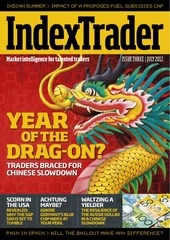
INDIAN SUMMER > IMPACT OF A PROPOSED FUEL SUBSIDIES CAP
IndexTrader
Market intelligence for talented traders
ISSUE THREE | JULY 2012
YEAR
OF THE
DRAG-ON?
TRADERS BRACED FOR
CHINESE SLOWDOWN
SCORN IN
THE USA
REVEALED:
WHY THE S&P
500 IS SET TO
TUMBLE
ACHTUNG
MAYBE?
IGNORE
GERMANY’S BLUE
CHIP INDEX AT
YOUR PERIL
WALTZING A
YIELDER
THE RESILIENCE OF
THE AUSSIE DOLLAR
IN A CHINESE
SLOWDOWN
PAIN IN SPAIN > WILL THE BAILOUT MAKE ANY DIFFERENCE?
�
�
Contents
IndexTrader | Issue 3 | July 2012
TRADER TALK
2-8 the latest news, diary dates,
views and statistics
COMPANIES
10-11 Scorn in the USA
Joe McGrath asks whether the
S&P 500 is now inevitably on a
descent from its recent highs
13 The pain in Spain
Now the second wave of
Spanish bank stress testing has
been delayed until September,
Joe McGrath asks whether
traders should avoid the market
altogether
14-15 Achtung maybe
Rob Langston investigates why
traders are turning to Germany’s
blue chip index
ECONOMIST
16 Absorbing the Greeks
John Redwood explains what to
expect in the weeks ahead
WEALTH
18-20 Tools of the trade
Charlie Thomas investigates
how the man on the street can
save more efficiently
CURRENCIES
22-25 Waltzing a yielder
Elizabeth Pfeuti asks whether
contagion from China is likely to
continue to weigh heavily on
the the Aussie Dollar
FEATURES
27 Take it as read
Alessio Rastani explains the
2 | IndexTrader | July 2012�
most basic of contrarian trading
principles – the ‘Stupid Test’
40 Not invincible
Stephanie Kretz offers a
different take on Germany’s
financial strength and its
eurozone ‘responsibilities’
ECONOMICS
28 An Indian summer
With India struggling to juggle
its priorities, James Redgrave
considers the impact of a
rumoured cap on fuel subsidies
coupled with inflationary
worries
BLOW YOUR BONUS
30-33 Kevin Rose identifies
some treats for the budding
audiophile
COMMODITIES
34-35 Big trouble in
brittle China
With China having to slash
interest rates last month and
data for manufacturing and
industrials continuing to
disappoint, Joe McGrath smells
an opportunity for brave traders
37 A volatile future
Jennifer Lowe asks whether
exchange-traded notes
necessarily offer the best
approach
TECHNOLOGY
38-39 Five favoured forums
Readers’ trading websites
of choice
THE PIT
Level Guide
BEGINNER
Suitable
for
individuals
that are completely
new to trading
INTERMEDIATE
Suitable for
individuals
with some
trading knowledge
EXPERT
Suitable
only for
individuals
with significant
trading experience
ALL
Suitable
for all
48 IndexTrader’s gossip page
www.index-trader.co.uk
�
IndexTrader:
No bailouts
for brokers
With the term ‘bailout’ being the
watchword of the moment, it is
unsurprising to find traders
applying it more to countries
than to their every day affairs.
But the fierce economic
storm playing out globally isn’t
just putting countries at risk,
it is also affecting companies.
Stockbrokers, financial institutions and banks are
not immune.
Over the past 12 months we have already seen the
collapse of Pritchards Stockbrokers, MF Global UK and
Worldspreads and this has had a domino effect
throughout the sector, affecting clients and business
partners who used white-labelled offerings from these
providers.
Despite this, we rarely see brokers marketing their
services by their financial standing or solvency levels.
This may well be because it doesn’t pull in the punters
as effectively as claims about the lowest spreads or the
highest number of product options. I suppose we can’t
blame the brokers for that.
However, the man on the street would do well to look
a little closer at the companies with whom he deals,
particularly given that the financial strength of some
providers can be considerably different to others.
It’s great for the industry and for consumer choice
that we have seen so many new start-ups in the trading
market in recent years, but it also means that investors
must be careful. In other markets, since the collapse of
Northern Rock and Lehman Brothers, organisations
have been keen to highlight their solvency ratios.
And yet, in the trading arena, investors are still too
keen to put their buckets of cash with providers without
doing even the basic level of due diligence. It is for this
reason that IndexTrader will be taking a closer look at
providers over the coming issues and encouraging you,
the reader, to do the same.
We would love to hear any stories about instances
where you have decided against trading with an
individual business and your reasons why.
It may sound like shutting the door after the horse
has bolted, but the noise on this important theme has
quickly died down despite three high profile cases in
rapid succession. If you think there is nothing to be
learnt from these companies, then think again. After
all, you can bet your bottom dollar that the 15,000
Worldspreads customers affected by the chaos will
have other ideas.
US employment
figures set to
remain weak
Employment data coming out of the US on Thursday (5 July)
will make for uncomfortable reading, according to economists.
The US Jobless Claims and ADP Employment reports have
been widely tipped to underline recent fears about the US
economy, highlighted last week in the Nielsen report which
cited slowing employment growth as American’s main reason
for a loss of consumer confidence.
The report found that consumer sentiment dropped five
points to “87” in the second quarter of 2012. A reading of 100
or less shows consumer pessimism about the US economic
outlook for the months ahead.
Within the report, it showed that just a third of Americans
were now optimistic about their job prospects for the rest of
the year.
Added to this, the US Labor Department last week reported
a hike in applications for unemployment benefit, with the
number of individuals on benefits now at a nine month high.
This followed the last non-farm payrolls declaration which
included a significant rise of the long-term unemployed – out
of work for 27 weeks or more – from 5.1 million in April to
5.4 million in May. This figure accounted for 42.8% of all of
those unemployed.
Joe McGrath – joe@index-trader.co.uk
Editor, Indextrader
2 | IndexTrader | July 2012�
www.index-trader.co.uk
�
Trader Talk
UK on brink of AAA downgrade
warns broker boss
The UK’s much-prized AAA credit rating is
on course to be downgraded, according to
the director of private client stockbroker
Rowan Dartington.
Andrew Morris, managing director of the
group’s Signature brand, said politics and
economics are once again on a collision course
meaning we are entering an era that puts the
country’s AAA status at risk.
He wrote: “The most recent flight to safety
has compounded the problems of the risk
averse as we face an ever shrinking global pool
of ‘safe’ sovereign debt.
“As demand has swamped supply, yields
have tumbled. Rating agencies have again
sought to keep us aware of the risks by only
last week announced a further downgrading
of the UK’s main banks. I sense it is only going
to be a matter of time before our nation’s debt
position is again under review.
“Austerity measures look like being around
for the foreseeable future and only time will
tell whether we will witness 30 years of hurt.”
Morris explained that the job of balancing
the UK’s books continues to prove an
unpopular challenge for the coalition
government and that this is only likely to
get worse.
Most traded
currency pairs
June 2012
UK Traders
1
AUD / USD
GBP / USD
USD/CAD
4 USD/JPY
5 EUR/CHF
2
3
US Traders
1
EUR / USD
AUD / USD
EUR / JPY
4 GBP/USD
5 USD/JPY
2
3
He added: “Whilst the UK can hold its
head up high and take comfort from not being
part of the euro, clearly we are not immune
from the difficulties of our near neighbours.
With a comprehensive solution proving
ever elusive and the risks of major fallout
across [the] eurozone looming large, where
are the safe havens?
“Austerity measures were never going to be
popular to implement but against a backdrop
of a faltering economy and the scale of the
global challenges we are facing, a series of
bold measures are being considered, with a
review of housing benefits being the latest.”
Russian Traders
1
EUR / USD
2
GBP / USD
3
EUR/JPY
4
AUD/USD
5
XAU/USD
Source: Forex Club /
CMC Markets
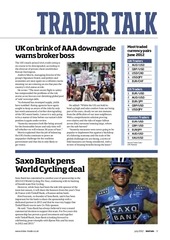
Saxo Bank pens
World Cycling deal
Saxo Bank has committed to another year of sponsorship in the
2013 UCI World Cycling Pro Tour, continuing with its backing
of Danish team Riis Cycling.
However, while Saxo had been the sole title sponsor of the
team last season, it will share the honours from this year’s Tour
de France with Tinkoff Bank, a Russian online bank.
Kim Fournais, co-founder of Saxo Bank, said it has been
important for the bank to share the sponsorship with a
dedicated partner in 2013 and that he was very happy that
Tinkoff Bank was its new Co-Title sponsor.
He said: “Saxo Bank has always believed it was a sound
commercial decision to support this team. For five years this
sponsorship has proven a good investment and together
with Tinkoff Bank, Saxo Bank is looking forward to
celebrating great triumphs with Bjarne Riis and his team
in 2012 and 2013.”
www.index-trader.co.uk�
July 2012 | IndexTrader | 3
�
Trader Talk
IndexTrader
TRADING DIARY
2 JULY 6 JULY
(All times British Summer Time)
Monday 2 July 2012
0900hrs German PMI Manufacturing Index
0900hrs European PMI Manufacturing Index
0930hrs British CIPS/PMI Manufacturing Index
1000hrs European Unemployment Rate
1500hrs US ISM Manufacturing Index
Tuesday 3 July 2012
0530hrs Australian RBA Announcement
0900hrs British Consumer Credit
0930hrs British M4 Money Supply
0930hrs British Mortgage Approvals
1000hrs European PPI
GFT Markets joins
forex price war
GFT Markets has become the latest broker to
slash its minimum spread costs for trading
FX as market competition continues to grow.
The brand’s cheapest spread will now
start at 0.6pts for the EUR/USD, AUD/USD
and USD/JPY pairs as the company makes a
concerted effort to attract new customers
based on an aggressive price structure.
In announcing the changes, GFT told
IndexTrader that it has witnessed a 50%
increase in EUR/USD transactions over the
past six months as its clients look to trade
around the ongoing sovereign debt crisis
in Europe. Martin Slaney, director of global
product management at GFT Markets, said
the steady stream of high profile
fundamental announcements concerning
the future of the eurozone has resulted in
some defined price action and delivered
some excellent trading opportunities for
spread betters.
He added: “Our reduced spreads on key
FX pairs provide customers with an optimal
position to capitalise on current and future
developments.”
GFT Markets offers 120 different
currency pairs, including more exotic
crosses such as USD/RON (US Dollar/
Romanian Lei) and SEK/PLN (Swedish
Krona/Polish Zloty).
1500hrs US Factory Orders
Wednesday 4 July 2012
0230hrs Australian Retail Sales
0700hrs Tullow Oil Trading Update
0900hrs Home Retail Group AGM
0900hrs German PMI Services Index
0900hrs European PMI Services Index
0930hrs British CIPS/PMI Services Index
1000hrs European GDP
1000hrs European Retail Sales
Thursday 5 July 2012
0900hrs Babcock International AGM
0930hrs British New Car Registrations
1100hrs German Manufacturers’ Orders
1200hrs Bank of England Announcement
1245hrs European ECB Announcement
1315hrs US ADP Employment Report
1330hrs US Jobless Claims
1500hrs US ISM Non-Manufacturing Index
1600hrs US EIA Petroleum Report
Friday 6 July 2012
0745hrs French Merchandise Trader Report
0930hrs British Producer Price Index
1100hrs German Industrial Production
1330hrs US Employment Situation Report
1330hrs Canadian Labour Force Survey
4 | IndexTrader | July 2012
Fat Prophets
launches online
trading seminars
Fat Prophets – the stocks and shares research
group – has launched a new online service to
teach investors about market trends and
trading techniques.
The company’s Virtual Trading Room is a
daily service, starting at 11am, which allows
participants to join a trading community to
share views on a micro level and learn more
about individual markets.
Educational sessions are offered by Fat
Prophets’ head trader David Thang, who has
worked for several high profile investment
groups including Goldman Sachs and
BNP Paribas.
Thang explained that, during the sessions,
traders would be offered access to real-time
computer screens of the Fat Prophets’ traders.
He said: “Each participant is helped through
the complexity of possible trading strategies
and current trends. Additionally, the Fat
Prophets’ traders bring their own technical
analysis of the markets, including insights into
stock indices, currencies and commodities.”
Those interested in finding out more can do
so at www.fatprophets.co.uk.
www.index-trader.co.uk
�
Trader Talk
PYX Markets’ users
can create
their own bespoke
asset options to suit
their trading
requirements
and can limit risk
exposure
PYX Markets
unveils Options
Trading Platform
PYX Markets – the company formerly
known as CityOdds – has launched a
Digital Options trading platform to
the consumer market.
The newly rebranded outfit will
offer traders digital option trading on
a wide range of individual assets and
indices such as the FTSE 100,
Barclays, BP, Gold, Oil and currency
pairs such as USD/GBP.
Richard Hutchinson, chief
executive officer of PYX Markets, said
the company’s “mission” has been to
create a comprehensive eTrading
platform that limits risk while
delivering defined returns and
real-time pricing.
He explained: “We chose Rule
Financial to develop the application
for us, as their consultants have an
established pedigree in development
of real-time eTrading platforms,
working with the world’s leading
financial institutions.”
PYX Markets’ users can create
their own bespoke asset options to
suit their trading requirements
and can limit risk exposure while
being able to receive a maximum
return of up to 2,000% from
each trade.
PYX Markets allows users to trade
in the final hour before markets close
and has no explicit commissions on
trades. The application is suitable for
both retail and institutional use,
allowing traders to set their own
strike price.
TRADER NOTES:
Automated trading
David Cooney, chief executive
officer of Mahi FX, gives his
view on automated trading:
“A significant advantage of
automated strategies is their
decision-making is entirely
explicit and you can determine
exactly why a decision was taken. This is never the
case with human decision-making.
The determinism of automated strategies also
allows for back testing. Run a given price series
through a given trading model and you will get the
same set of trades. That is also never going to be
true of humans. That predictability allows for
statistically rigorous testing of both the strategy
and its parameters.
However, the difficulty is this may just better
perfect your models explanation of the past - the
classic problem of over-fitting, adding large
numbers of explanatory variables and then solving
for an unstable combination of parameters, when
your objective, of course, is to resolve a model to
predict the future.
For this to work, you will generally need a fairly
simple strategy. Simple models are not good at
incorporating context, and therein lies the Achilles
heel. Humans will be aware of an unscheduled
news conference, the content of which may swamp
the model’s signal; the model cannot be.
Automated strategies do have the advantage of
taking the emotion out of trading. But humans can
mitigate against the emotional challenges of
trading by controlling their trade size.”
S&P launches Shariah index
covering 19 countries
Standard & Poor’s has put together a new
index, designed to measure the
performance of the 50 leading Shariahcompliant companies from the member
states of the Organisation of Islamic
Cooperation (OIC).
The S&P/OIC COMCEC 50 Index consists
of the largest 50 stocks from 19 countries:
Bahrain, Bangladesh, Ivory Coast, Egypt,
Indonesia, Jordan, Kazakhstan, Kuwait,
Lebanon, Malaysia, Morocco, Nigeria,
Oman, Pakistan, Qatar, Saudi Arabia,
Tunisia, Turkey and the UAE.
Stocks are selected in accordance with
Shariah law and must have a minimum
three-month average daily value traded
www.index-trader.co.uk�
(ADVT) of US $1 million at each
rebalancing reference date.
To enhance portfolio diversification, at
least one stock but no more than eight from
each country or territory must be included
in the index.
Alka Banerjee, vice president at S&P
Indices, said demand for Shariah-compliant
investing solutions and interest in the
equity markets of Islamic countries has
increased in recent years.
She added: “The S&P/OIC COMCEC 50
Shariah is unique in that it encapsulates in
one index the performance of Shariahcompliant stocks from Islamic countries
located throughout the world.”
July 2012 | IndexTrader | 5
�
TRADER TALK
Students trade their way to
a 66% profit in eight months
A team of sixth former s at an International
College in Spain have won an annual
investment competition run by stockbroker
The Share Centre, making a 65.8% profit in
eight months.
Students at The International College in
Marbella, Spain beat 53 schools across
Europe, turning their £1,500 investment
into £2,486 over the period beating
Cardinal Langley Roman Catholic School in
Manchester who managed a commendable
39.9% trading gain.
Sheridan Admans, investment research
manager at The Share Centre (pictured),
said the team’s strategy focused on gaining
exposure to the high beta natural resources
sector which paid off very well.
He explained: “The sector is considered
fairly risky as the success of the small
mining and oil companies that are primarily
involved in exploration lies on what an
exploration yields, which could be nothing.
“The team’s biggest returns came from
smaller commodity stocks that focused on
exploring for just one or a few commodities.
However, they did have exposure to the
safer, larger, more diversified miners, such
as BHP Billiton and Xstrata.”
The team successfully used stop losses
and limit orders to close their positions and
its most profitable trade was in Bellzone
Mining, an explorer of iron ore deposits in
West Africa.
Admans added: “The share price has been
trending down since the beginning of 2011,
falling from highs of around 200p to now at
around 18p. However, the team of students
bought in at an interim bottom price and
sold through a stop loss after a quick rally;
giving them at nice profit of £400. Overall, a
very high risk strategy and use of investment
tools in a volatile market paid off.”
Sheridan Admans
IndexTrader
TRADING DIARY
9 JULY – 13 JULY
(All times British Summer Time)
Monday 9 July 2012
0230hrs Chinese Consumer Price Index
0230hrs Chinese Producer Price Index
0700hrs German Merchandise Trade
2000hrs US Consumer Credit Report
Tuesday 10 July 2012
0745hrs French Industrial Production
0900hrs Italian Industrial Production
0930hrs British Industrial Production
0930hrs British Merchandise Trade
1245hrs US NFIB Small Business
Optimism Index
1245hrs US ICSC Goldman Store Sales
1315hrs Canadian Housing Statistics
Wednesday 11 July 2012
0050hrs Japanese PPI
0050hrs Japanese Tertiary Index
0050hrs Bank of Japan Announcement
0230hrs Australian Home Loans
0700hrs German CPI
0900hrs J Sainsbury plc AGM
1330hrs US International Trade
1330hrs Canadian Merchandise Trade
1500hrs US Wholesale Trade
CFD broker and wife jailed
for insider dealing
Three people have been sent to jail, charged
with insider dealing. They were found guilty
of breaking section 52 of the Criminal Justice
Act 1993.
James Sanders, a director of Blue Index, a
specialist Contract for Difference (CFD)
brokerage, was sentenced to four years in
custody and disqualified as a director for five
years. His wife Miranda Sanders was sentenced
to 10 months in custody, while James Swallow, a
co-director of Blue Index, was also given 10
months. Confiscation and costs orders will be
dealt with at a later date.
Arnold McClellan, a senior partner in a large
US accounting firm was an ‘insider’ to a number
of mergers and acquisitions in US securities
listed on the NYSE and NASDAQ exchanges.
The prosecution case was that inside
information was leaked by Arnold McClellan,
Miranda Sanders’ brother in law, or her sister
Annabel McClellan, and passed to James and
Miranda Sanders who used the information to
6 | IndexTrader | July 2012
commit insider dealing in those US securities
between October 2006 and February 2008.
James Sanders also disclosed information to
others including James Swallow, who used that
information to commit insider dealing. In
addition, James Sanders encouraged clients of
Blue Index to trade in CFDs on the basis of that
inside information.
The total profits generated by the
defendants were approximately £1.9 million,
while the total profits generated by the clients
of Blue Index were approximately £10.2 million.
In passing sentence, Mr. Justice Simon said
they were “deliberate and calculated acts of
dishonesty” and that as directors of an FSA
authorised company Sanders and Swallow were
responsible for ensuring that “Blue Index
complied with its obligations to act honestly and
competently. In addition James Sanders was
head of compliance with additional obligation of
ensuring that there was no insider dealing. He
failed in that duty.”
1530hrs US EIA Petroleum Report
1900hrs US FOMC Minutes
Thursday 12 July 2012
0230hrs Australian Labour Force Survey
0630hrs French CPI
0700hrs CML British Regulated
Mortgage Survey
1000hrs European Industrial Production
1330hrs US Jobless Claims
1330hrs US Import and Export Prices
1900hrs US Treasury Budget
Friday 13 July 2012
0900hrs Italian CPI
1330hrs US Producer Price Index
1455hrs US Consumer Sentiment
www.index-trader.co.uk
�
TRADING CREDIT*
Receive £200 trading credit when
you open a NEW spread betting or
CFD trading account.
*Deposit £1000 and place 3 trades at £3 per point or more to
claim your £200 trading credit. Terms and Conditions apply.
www.cityindex.co.uk/200
�
Trader Talk
TD Direct
announces £20k
trading giveaway
Belfast sees house
prices tumble 45%
House prices in Belfast – the UK’s largest
area for contraction in economic activity
– have crashed by 45% between 2007
and 2012, according to new research.
The poll for the Halifax found that
Belfast now tops of the list of the largest
increase in benefits claimants over the
same period which saw the average price
tumble from £196,441 during the boom
year of 2007 to just £107,150 this year.
Blackpool was the second worst region
for the percentage increase in benefit
claimants over the same period, but
house prices there have only declined by
15% over the same period while
Kingston upon Hull, the third worst
region for claimants, saw a reduction
of 17%.
Martin Ellis, housing economist at the
Halifax, said the marked differences in
local economic performance across the
UK appear to have had a significant
IndexTrader
Conditions of supply: IndexTrader
shall not, without the permission of
the publishers first given, be lent, sold,
hired out or otherwise disposed of in a
mutilated condition or in any
unauthorised cover by way of trade, or
affixed to or as any part of a
publication or advertising, literary or
pictorial matter whatsoever.
IndexTrader is fully protected by
copyright and nothing may be printed
wholly or in part without permission.
8 | IndexTrader | July 2012�
impact on the house market over the
past decade.
He explained: “House price growth
has generally been stronger in the areas
that have seen the biggest increases in
economic activity. The best performing
areas have also been the most resilient in
terms of house prices during the
downturn since 2007.
“Looking forward, the pace at which
the UK economy recovers will be a key
determinant of the outlook for the UK
housing market. Similarly, those areas
that perform best in economic terms are
likely to fare best in terms of house price
movements.”
Inner London, the lowest region by
percentage change in benefit count
over the five-year period, saw high
prices fall 7%, while Cornwall (second
lowest) witnessed a house price decline
of 20%.
Directors
Joe McGrath – joe@index-trader.co.uk
Kevin Rose – kevin@index-trader.co.uk
Ed Tackas – ed@index-trader.co.uk
Editor
Joe McGrath – joe@index-trader.co.uk
Contributors
Rob Langston, Jennifer Lowe, Elizabeth Pfeuti, James
Redgrave, John Redwood, Kevin Rose, Charlie Thomas
Advertising
Ed Tackas – ed@index-trader.co.uk 07970 735054
TD Direct Investing is giving away £500 in
Amazon vouchers over the next month to
celebrate the launch of its new trading
application for Android-enabled mobile
phones and tablet devices.
Investors placing a trade through the
TD Trading App between now and
17 August 2012 will be entered into a
prize draw. The draw does not include
traders using the TD Financial Spread
Trading App.
Each day during the competition a name
will be drawn at random and awarded £500
in Amazon vouchers.
The application is free to download and
clients are able to track their portfolio,
place equity investment trades on 15
international markets and in nine different
currencies, obtain live quotes, create
watch lists and switch between their
linked accounts.
Stuart Welch, chief executive officer of TD
Direct Investing, said since the launch of the
company’s first application back in 2011, TD
has seen mobile overtake telephone as the
second most popular method of trading,
behind online.
He explained: “We see mobile technology
as a growth area and will be looking at even
more developments very soon. In the
meantime, the Android operating system is
becoming one of the preferred choices in the
smartphone market.”
Non-customers can also take advantage of
some of the apps’ features such as accessing
quotes with 15-minute delayed prices and
creating their own watch lists.
All articles and information featured in
IndexTrader are checked and verified for
accuracy but it should not be interpreted as
financial advice. Traders that wish to make
investment decisions are advised to make
further enquiries and consider taking
advice before executing any transaction.
IndexTrader is published by Pretty Good
Publishing Limited, 15 Bramley Close,
Waterlooville, Hampshire. PO7 7SU.
The magazine is printed in England by
Wyndeham Grange Printers, Butts Road,
Southwick, West Sussex. BN42 4E
www.index-trader.co.uk
�
FtSE 100
trade ftse 100
point
spread
also available
|
|
wall st
germany 30
franCe 40
trade today at
www.cityindex.co.uk/value-indices
*1 point spreads available during market hours on daily funded trades & daily future
spread bets and Cfds (excluding futures).
spread betting and Cfd trading can result in losses greater than your initial deposit.
*
�
Companies
Scorn in
the USA
L
Given recent employment data and July signalling the beginning
of the Q2 reporting season, Joe McGrath asks whether the
S&P 500 is now inevitably on a descent from its recent highs
ast month’s US Federal Reserve
decision to extend its ‘Operation Twist’
programme was significant. The move
to sell billions more of short-term bonds to
buy longer-term securities was a deliberate
reaction to a stream of disappointing
economic reports throughout June.
It is no surprise then that the general
consensus among day traders right now is
that the S&P 500 is heading downward
with only occasional upticks providing
nothing more than a selling opportunity.
However, as with any major economic
policy decisions in recent times, investors
will be keeping their eyes and their ears
open for a sniff of more monetary stimulus.
Trader’s
view:
Steven Mayne, managing
director of EGR Broking
Since the top at the
start of April, the S&P
500 has changed
trend on its weekly
time frame and we
can only really see
this playing out
negatively. Our current opinion is that
the market is going lower, with any rally
being seen as a selling opportunity.
The market’s sharp reversal after the
Spanish bailout highlights the ongoing
concern regarding the Eurozone crisis.
Recent comments from Bernanke
highlight that the Fed is willing to again
stimulate the US economy, but have not
given a clear signal on how and when it
will do this.
10 | IndexTrader | July 2012�
The recent decision by the Fed not to
immediately introduce a third round of
Quantitative Easing (QE3) has pulled the
rug from under those traders who were
certain that stocks would be supported by
central bank generosity.
Naturally, the decision has also extended
downside risk for equity markets, meaning
this month’s economic data and secondquarter results will be key. More data
disappointments will only increase this
downside risk still further.
John Kicklighter, senior currency
strategist at Daily FX, says it is only a matter
of time before QE3 is introduced, noting
that while government and central bank
support is not unique to the US, the Fed’s
stimulus efforts have consistently proven to
be the most influential.
He explains: “There are a number of big
investment houses that see a high probability
of additional easing from the central bank
and the broader market will generally
position alongside these projections.
“From an economic perspective, further
easing has significantly diminished
influence. The Operation Twist programme
has helped to lower long-term rates to
record lows; but the Fed can’t really do
much more to encourage employment,
lending and spending.”
Making a buck
With analysts in agreement on the
macro-economic position for the US as a
whole, how does this translate into trading
opportunities on the S&P 500 over the
coming month?
Steven Mayne, managing director of
bespoke stockbroker EGR Broking, says a
quick chart analysis (Table 1) shows that
the S&P 500 has hit its peak in the shortterm and is unlikely to go any higher over
the coming days.
He explains: “Looking at the daily graphs
we can see the negative divergence
between the price action, the RSI (Relative
Strength Index) and MACD (moving
average convergence/divergence), a good
sign that the recent top is significant and is
unlikely to be bettered in the short term.
“We have now seen the market come
down and find support at its 200-day
moving average. This is a key level for the
broad index, frequently becoming a support
and resistance level. A break back below
this will probably encourage traders to
remain selling the market and we would
expect a sharp decline.”
For traders seeking statistical data to
support any market decline, US
unemployment figures will continue to be
of note during the current volatility.
Michael Hewson, senior markets analyst
at CMC Markets, says the direction of
www.index-trader.co.uk
�
0.81%
S&P 500
(To 22 June 2012)
Source: FE Analytics
1 month
-4.5%
6.5%
3 months
4.6%
6 months
12 months
Table 1: The negative
divergence between the price
action, the RSI and MACD
Source: EGR Broking
1 day candles
S&P 500
Index
1400
1350
1300
Jan
Feb
Mar
Apr
May
Jun
18/06/12
11/01/12
80
40
20
0
Jan
Feb
11/01/12
Mar
Apr
May
Jun
18/06/12
‘The Operation Twist
programme has helped
to lower long-term
rates to record lows;
but the Fed can’t
really do much more
to encourage
employment, lending
and spending’
US Economic Data
July 2012
3 July 2012
1200 hrs US Motor Vehicle Sales
1245 hrs ICSC/Goldman Sachs Store Sales
1355 hrs US Redbook
1500 hrs US Factory Orders
4 July 2012
No data scheduled for release
5 July 2012
1200 hrs US MBA Purchase Applications
1200 hrs US Chain Store Sales
1230 hrs US Challenger Job Cut Report
1315 hrs US ADP Employment
1330 hrs US Jobless Claims
1500 hrs US ISM Non-manufacturing Index
1600 hrs EIM Petroleum Data Report
6 July 2012
1200 hrs US Monster Employment Index
1330 hrs US Employment Situation
www.index-trader.co.uk�
John Kicklighter, senior currency
strategist at Daily FX
employment trends are now one of the
main concerns, “....particularly the private
and non-farm payrolls reports, as well as
ISM and local manufacturing data, which
have been slipping back sharply recently.”
Slipping back they certainly did. The last
set of numbers released at the beginning of
last month showed a much weaker-thanexpected US employment report for May.
Non-farm payrolls rose by only 69,000.
While the numbers were up, this was a
figure that was massively below the
consensus forecast of a 150,000 gain.
Worse still, April’s previous 115,000 gain
originally announced was subsequently
reduced to a gain of only 77,000.
It is for this reason that Hewson’s
comments are echoed by many in the
broker market, including Daily FX’s John
Kicklighter who says that the June
non-farm payrolls due in early July will
likely stoke volatility but fail to really
contribute to trend as it comes in the wake
of the decisive Fed decision.
He says: “Beyond that, the first and
second weeks of July will start the Q2
earnings season. If we see a slowdown in
revenues aligned to slower growth, the
effort to unwind will grow more
prominent.”
Hewson adds that while the current
market direction will continue to be driven
predominantly by political considerations
than economic ones, this could be good
news for day traders.
He explains: “While this makes
investment decisions much trickier, day
traders do much better if their timing is
good. Choppy markets tend to be
traders’ markets which means that
longer-term traders tend to sit on the
sidelines more.”
July 2012 | IndexTrader | 11
�
investing made easy
It’s easier
than you think
As is investing for your future
Self-select:
SIPP
ISA
Fund and Share Account
Low-cost features include:
Online dealing £9.95
Great discounts for frequent
dealers and regular investors
An annual cash bonus of up to
0.5% on fund investments
No account charges
“Sippdeal, the best if you want to hold a
mix of funds and shares.”
Sunday Times 4 September 2011 (Research by candidmoney.com)
For full details of our charges,
discounts and online tools visit
www.sippdeal.co.uk
Sippdeal is part of A J Bell, one of the largest providers of investment and stockbroker services in the UK,
with assets under administration exceeding £16 billion.
The value of investments can go down as well as up
and you may not get back your original investment.
Sippdeal is a division of A J Bell Management Limited, part of A J Bell. A J Bell Management Limited is authorised and regulated by the Financial Services Authority.
A J Bell Securities is the plan manager of all of A J Bell’s Individual Savings Accounts (ISAs) and provider of A J Bell’s Dealing Account.
�
Photography: Pedro Rufo
Companies
The pain in Spain
T
Now the second wave of Spanish bank stress testing has
been delayed until September following an EU cash award,
Joe McGrath asks whether traders should avoid the
market altogether
he €100 billion cash injection that
Spain received to recapitalise its
ailing banks was more than the €62
billion that the government said it required.
However, the EU cash award is unlikely
to be an end to the matter with another
audit report of the country’s banks
scheduled for release at the end of this
month. Many believe this will reveal even
bigger scars than those which have already
been declared to the markets.
latest round of fundraising from the
Spanish Treasury. The country managed to
raise around €2.2 billion despite paying
inflated interest rates for the privilege.
With this in mind, it is possible to see why
there are conflicting views from
economists, traders and analysts as to what
might happen next.
Andrey Dirgin, head of research at Forex
Club, says this latest development could be
interpreted as a sign that the Spanish
‘you will need a strong sense of
both risk management and bravery if
you want to take on trading around
Portuguese and Spanish banks’
Joshua Raymond, chief market strategist at City Index
The fallout from property loans which
have turned sour and the ongoing decline of
residential and commercial property values
has resulted in a dangerous mix for the
banks of Spain and its neighbour Portugal.
And yet, despite the ongoing fears about
the exact amount required to boost the
Spanish economy, there appeared to be
voracious appetites from investors at the
www.index-trader.co.uk�
banking crisis could well be overexaggerated by both the media and
investors.
He says: “The government published the
results of the last banking sector audits
which showed that it might need €16-€25
billion of additional funding if economic
conditions stay as they are or a further
€51-€62 billion if GDP falls around 4%.
“This is well below the €100 billion that
was promised to be supplied. Nevertheless,
banking stocks in this sector will remain
under strong pressure and volatile as
market participants do not seem to be
convinced with these numbers.”
The issues affecting the Spanish banks
were due to be discussed at the ECOFIN
meeting at the time of going to press, but
most analysts were still keen to recommend
that any holders of Spanish banks may
want to remove them from their respective
portfolios.
As Dirgin explains: “If you keep catching
a falling knife eventually you will get cut.
Selling them short is just too late now.”
Forex Club’s head of research isn’t on his
own by any means. Joshua Raymond, chief
market strategist at City Index says it is time
that traders ‘stay clear’ of Spanish banks.
He says: “Spanish banks have been
incredibly volatile of late. Just taking BBVA
shares as one example, they lost 37.5% from
the start of February to the end of May, only
to bounce back 21% over the following
three weeks.
“That is an incredible amount of volatility
which is likely to unsettle even the most
seasoned of traders. As such, you will need
a strong sense of both risk management
and bravery if you want to take on trading
around Portuguese and Spanish banks.”
Raymond says that the ultimate piece of
the puzzle centres on recapitalisation and
the toxic loans in the property market.
After all, there is extremely high
unemployment in Spain – nearly one in
four adults and one in every two youths
are without jobs. Strict Spanish
austerity means that a turnaround in
these toxic assets is unlikely in the near
to medium term.
Raymond adds: “The publishing of
Spanish bank stress tests have helped
investors to gauge the scale of the issues
surrounding banks’ balance sheets but we
must also wait for a second phase of stress
testing to complete. These have been
delayed until September now.
“Sharp equity falls in banks always
typically attract sharks looking for a
bargain, but investors have likely learnt the
sharp lessons from the previous banking
crisis, typified by the Lehman failure.
“It may well be a case whereby one of the
best ways to speculate on these banks is
from short-term position trading,
attempting to take advantage of short and
sharp moves. Considering the weight of
uncertainty over Spanish banks right now,
short term position trading is also likely to
keep risks low, particularly if stop losses are
considered.”
July 2012 | IndexTrader | 13
�
Companies
Achtung
maybe
With the eurozone rarely out of the
headlines, Rob Langston investigates
why traders are turning to Germany’s
blue chip index to make their gains
W
hen it comes to Europe, the
conversation inevitably drifts to
the sovereign debt crisis and
stricken economies of southern Europe.
As the eurozone lurches from one crisis
to another, it has been difficult to know
whether it would survive or not.
Throughout it all, one country has stood
behind the currency bloc: Germany.
Germany has fared much better than its
partners, who have suffered greatly during
the current economic downturn. Its economy
has powered ahead since 2009, leaving other
major European economies behind.
The strength of the German economy can
be attributed to the performance of some of
its biggest companies, the top 30 of which
populate Germany’s blue-chip index, the
DAX. The index, launched in 1988, had a
market capitalisation of €549.5 billion in
May and includes a number of German
Performance of the
DAX 30 Index
What the graph shows: Performance of the
index between 23 May until 22 June 2012
6,500
6,250
blue-chip stocks that will be well-known
to many British investors. Companies such
as Adidas, BMW, E.ON and Volkswagen
all call the DAX home.
Despite having fewer constituents than
its British counterpart - the FTSE 100 - the
index represents around 70% of the market
capital authorised in Germany. The DAX, of
course, continues to be dogged by the
current economic conditions affecting
indices all around the world.
The index dropped by 8.7% during May
and by 5.5% in April but witnessed growth
of 2.1% during 2012 (to May 31). However,
compared with its European blue-chip
peers, it is still more robust. The French
CAC 40 index was down 8.7% in May, the
Spanish Ibex 35 14.4% lower and the
Italian FTSE MIB fell 17.8%.
“German stocks remain in a near-term
bearish trend,” explains City Index chief
market strategist Joshua Raymond.
“The 8.6% rally seen since the lows reached
at the start of June has been impressive
but the 1% losses seen (on Friday 22 June)
highlight a potential correction for the
DAX 30.
“Importantly the DAX has failed to breach
bearish trend resistance levels of around the
6,430 level and this failure is concerning for
the longevity of June’s recovery.”
Not immune
6,000
5,750
May ‘12
14 | IndexTrader | July 2012�
Jun ‘12
The extreme swings being witnessed in the
DAX in recent days is common to many
European indices, as the global economic
crisis rocks the markets. But Germany has
been knocked specifically by slowing
demand for its key industries, namely
technology, chemicals, automobiles and
pharmaceuticals.
Brenda Kelly, senior market strategist at
CMC Markets, says the closely-watched IFO
index of business confidence hit a two-year
low in June, following a similar decline in
May. She says: “This is clearly indicating
that the European growth driver is likely to
shrink in the second quarter.
“Taken in context along with the
shrinking of Germany’s private sector for
the second month running [it] is giving
weight to the fact that Germany is not
immune to the global slowdown, in
particular within emerging markets such as
China and of course the US.”
Kelly says bad news in the market has
kept alive expectations of an interest rate
www.index-trader.co.uk
�
levels and the potential for some element of
bondholders sharing the burden.”
At the end of March, Commerzbank had
€14.2 billion exposure while Deutsche Bank
had a €12.5 billion credit risk exposure.
Other potential headwinds relate to a
slowdown in manufacturers’ order books.
In May, manufacturing orders were double
the downbeat consensus forecast, dropping
by 1.9%, with weaknesses attributed to
capital goods and consumer & durable
goods, which could pose some challenges
for the German index with its large
exposure to the automobile sector.
Commenting on the German retail sales
growth for May, Tim Moore, senior
economist at Markit, says while consumer
spending had been weak so far during the
second quarter, summer sporting events
were likely to support growth. This is likely
“Bad news in the market has kept
alive expectations of an interest
rate cut by the European Central
Bank, which could lead to a shortlived rise in the DAX in July”
Brenda Kelly, senior market strategist at CMC Markets
year as it forecast an increase in sales and
earnings during the second half of the year,
targeting sales and income exceeding its
2011 record levels. It claimed the
resumption of production of crude oil in
Libya and growing volumes in the chemicals
business would support this growth.
Likely headwinds
cut by the European Central Bank, which
could lead to a short-lived rise in the DAX
in July. “As the rest of the world continues
to de-leverage, consumer spending and of
course investor confidence has ebbed,”
she explains.
The make-up of the index differs from the
resources-heavy FTSE 100 index. The
chemicals sector is the largest component of
the DAX, representing 21.9% of companies,
followed by the automobile sector with
13.2% and industrials with 12.1%.
The biggest constituent of the DAX index,
by market capitalisation, is chemicals
company BASF. The company put out a
bullish first quarter statement earlier this
www.index-trader.co.uk�
Traders looking to trade the top 30 German
companies should take note of the German
VDAX index which measures the volatility
of the DAX index. It has been at heightened
levels over the past three months as market
nervousness continues.
The timidity of investors is also
noteworthy in the flows of funds tracking
the German blue-chip index. According to
exchange-traded product provider iShares,
investors pumped US $4.3 billion into DAX
German equity funds during May, compared
with outflows of $5.1 billion in April.
The combined insurance and bank
sectors account for just 16.8% of the index,
but Brenda Kelly of CMC Markets warns
German banks could come under pressure
from the Spanish audit expected to be
completed in September.
She explains: “Spain’s bank audit in
September may serve to put pressure on
Germany’s banking sector due to exposure
to be tempered by ongoing eurozone
concerns, however.
Sportswear giant Adidas is set to
announce its first-half results in August and
will no doubt be buoyed by the London
2012 Olympics - as the official kit supplier
to a number of countries including Team
GB - and to the UEFA European Football
Championship.
It announced in June that it had broken
its record sales for football in any World
Cup or Euros year. Indeed, Adidas group
chief executive Herbert Hainer said the
company had got off to a “fast start” to
2012, in its first quarter results in May.
British Olympic kit supplier Adidas is
a constituent of the DAX 30
July 2012 | IndexTrader | 15
�
ECONOMIST | JOHN REDWOOD
ABSORBING
THE GREEKS
With a new Greek government and a European
economic slowdown on the cards, John Redwood
explains what to expect in the weeks ahead
In Euroland, most of the talk
is of recession. The weaker
countries are now in
recession, and the stronger
ones are slowing down. In the USA there
has just been an official downgrade in the
forecasts of economic growth for the
current year, though the USA remains the
best of the west.
In China, the slowdown the government
engineered last year to curb inflation is
still running its course. Commodity prices
are weak as investors anticipate less
growth and in some cases less output.
The authorities are united in wanting
more growth. In the USA the president is
keen to see faster growth ahead of his
election. The Fed has announced an
extension of its Twist programme,
designed to lower longer-term interest
rates to encourage more investment. Some
in the markets had hoped for another
phase of quantitative easing. Brazil has cut
her interest rates substantially over the
past year. China has begun some monetary
easing, with an interest rate cut and more
encouragement for bank lending.
In the UK, the chancellor and the
governor of the Bank of England have
jointly announced various additional
liquidity and borrowing programmes for
banks, in an effort to stimulate more
bank lending to the private sector.
There is also talk of relaxing some
regulatory constraints to allow banks
to use more of their cash resources for
riskier investments.
COSTLY BORROWING
The recent G20 summit flirted with a
bond-buying programme to get the cost of
Spanish and Italian state borrowing down.
16 | IndexTrader | July 2012
It was not confirmed, and there still seems
to be some German opposition.
Having all the main governments
willing for more growth is helpful. From
time to time their announcements will
stimulate investment enthusiasm to buy
riskier assets.
The reason equity markets are not
taking off on the back of it is that people
still fear the Euro crisis, and are aware
that the weaknesses in the banking system
limits the scope for the extra money to
reach the private sector projects which
could power growth.
The new Greek government does not
look very strong. The junior partners in it
are reluctant to commit fully. It will have
to demand changes to the loan
agreements, leading to the third Greek
rescue loan since the crisis began. I advise
caution. There remains considerable risk
in Euro area assets.
The Greek elections produced a result
that the Euro establishment wanted.
They were able to say that the parties wish
to stay in the Euro and that they were
happy to accept its disciplines. The reality
is somewhat different. All the main parties
and the majority of the Greek public wish
to stay in the Euro. But, under the pressure
of the election campaign the traditional
parties who will form the backbone of the
government said they wish to see a
renegotiation of the terms of the loan.
Now they will have to ask the EU for
some relaxation of the recently signed
second Greek loan agreement. The
arguments over this will not be helpful
for markets.
The seriousness of the Euro problem is
demonstrated by the continuing poor
performance of the Spanish and Italian
government bond markets. There are
continuing worries over banks in the Euro
system. Equity markets in those countries
have been made volatile and often bearish
by these developments. The European
Central Bank has to keep the banking
system liquid, as the interbank market is
no longer able to do this given the distrust
which stalks the markets in the weaker
areas and for the weaker banks.
More companies and individuals are
withdrawing money from the stressed
areas of the eurozone, compounding the
difficulties. The Euro authorities have to
inject enough cash and confidence into the
weakest parts of the system to make sure
there is no damaging run, and to ensure
the currency remains freely transferrable
at all times.
John Redwood is investment committee
chairman at Evercore Pan Asset
www.index-trader.co.uk
�
�
WealTh
Tools of
the trade
With the tax affairs of the rich and famous making
headlines in recent weeks, Charlie Thomas investigates
how the man on the street can save more efficiently
18 | IndexTrader | July 2012
PHOTOGRAPHY: FEATUREFLASH ©
T
ax efficiency has become something of a
dirty word in the past few weeks. Last
month, prime minister David Cameron
branded comedian Jimmy Carr “morally
wrong” for using a legal offshore account to
minimise the tax liability on his income.
It is strange that the PM should decide to
wade in on this debate. Previously, he told
reporters that he wasn’t prepared to discuss an
individual’s arrangements, when they probed
for his thoughts on Top Shop supremo Philip
Green’s tax affairs. Elsewhere, he also swerved
a similar question on the financial affairs of
Take That singer (and Tory supporter) Gary
Barlow, who had invested in a similar
scheme as Carr.
Still, there is one area where the
government and HM Revenue and Customs
(HMRC) agree that tax efficiency is good,
and that’s with your ISA.
This year’s total allowance lets
investors put £11,260 tax free, with a
maximum of £5,640 being allowed in a
cash ISA.
The remaining £5,620 can be put
into a stocks and shares ISA, but, given
the interest rate on cash ISAs is generally
poor in the current climate, savvy
investors may want to take advantage of the
rules which allow you to save the entire
£11,260 in a stocks and shares ISA.
The assets in which you can invest depend
on your choice of provider. Most will allow
unit trusts, open ended investment companies
(OEICs), investment trusts, funds and
government and corporate bonds.
Some also allow ETFs and ETCs. Investors
should be aware though that share-based
investments such as OEICs or unit trusts only
save you tax if you are a higher rate tax payer
or likely to pay capital gains tax. Interestbearing assets, such as corporate bonds are
tax-free, regardless of your tax band.
In order to attract your hard-earned cash,
many self-select stocks and shares ISA
providers are offering a series of bells and
whistles in the form of educational tools,
calculators, helplines and news updates – but
are they value for money?
Prime minister
David Cameron
branded comedian
Jimmy Carr “morally
wrong” for his tax
arrangements
�
FreQuencY First
First of all, decide how regularly you’d like
to transact, and the assets in which you’d
like to invest. Some providers will limit the
number of funds available to a core list,
while others will charge far more than their
peers for each transaction. Also, some
providers will charge you no initial fee, but
may impose investment costs.
For example, HSBC’s Invest Direct
account offers access to shares, gilts and
ETFs, but will charge you £12.95 in
commission per transaction, rising to
£29.95 if you transact on the telephone
(Although there is a frequent trader rate
for InvestDirect Plus account holders,
where after nine trades per calendar
quarter each trade is £7.95). As a customer,
you will be given access to research tools,
news articles, an ETF research centre,
a virtual portfolio tool and an email
alerts service.
AJ Bell’s Sippdeal meanwhile, provides a
free-of-charge service for regular investors
that choose to invest in the core 2,100 funds
online, every month. If a customer sells a
fund the standard online fee of £9.95 is
charged, which reduces to £4.95 for more
than 20 deals.
But for clients who invest off of the core
funds list, or choose structured products,
they will face a £12.50 custody charge per
quarter, and if they choose to invest using
the telephone rather than by going online,
the fee is £29.95 per deal.
Customers will receive investment
research and a news feed from Digital
Look, online illustration tools, technical
and regulatory updates, educational pieces
via email, access an online service for fund,
technical and general videos, and an online
technical centre.
Compare this with Standard Life’s
FundZone – a basic charging structure
which ranges from 0.2% annual
management charge (AMC) to 2.10% AMC
(the average is around 1.39%), but it doesn’t
allow you to invest in ETFs, corporate
bonds or gilts, and access to shares is only
available through mutual funds. Standard
Life’s bells and whistles include videos, a
fund selector tool, financial education
webpages and – unlike most providers – a
risk questionnaire designed to help you
choose the right investments.
If it is choice you’re after, Hargreaves
Lansdown has the most, with access to
more than 14,000 investments and 2,200 of
these are charge-free in terms of
investment. For 882 of the funds, a platform
fee of £1-2 a month is charged, but there’s
no inactivity fee, no fund trading charge
and no charge for documents. The only
other fees are charged by the fund
managers themselves, and as with
Standard Life, are based on AMC.
COMPANY
NUMBER OF FUNDS
AVAILABLE
CHARGES (LOWEST)
CHARGES (HIGHEST)
AlliAnce trust
sAvings
More than 1,500 funds from 44
fund managers
£1.50 monthly dealing charge or £6.95
for a single trade
£32.50 for postal or telephone dealing, or £40
for international telephone dealing
FidelitY
shArenetWOrK
More than 1,200 funds - Shares:
Any LSE listed share that is ISA
eligible, ETFs: Any LSE listed ETF
that is ISA eligible. No corporate
bonds or gilts
Featured funds have no initial charge.
Fidelity’s MoneyBuilder range of
funds all have 0% initial charge. All
Fidelity funds and Select List funds at
0% initial charge, plus TER between
0.1%-2.0%
Some funds charge up to 5% of amount
invested, but Fidelity will discount to 1.25% or
less if bought through its online supermarket.
ShareNetwork: online deals cost £9 a trade,
phone deals cost £18.50 a trade, account
administration fee is £5.10 a month.
hArgreAves
lAnsdOWn
14,149 investments. Funds - 3,307,
ETFs - 1,599, Bonds - 688, Gilts - 85,
Shares (UK) - 2,576, Shares (nonuk) - 5,534, investment trusts - 360
No charge for 2,200 funds, no account
fee for 2,480 funds, no inactivity
fee, no charge for statements. £1-2 a
month platform fee for some funds
AMC of some multi-managers can rise as high
as 2.8%
hsBc glOBAl
investMent
centre (Funds)
84 funds from 17 Fund
Management Groups (1)
No initial, platform or dealing fee.
Customer only charged AMC and
charges of fund
Possible high AMC, particularly with the more
esoteric options
hsBc investdirect
(shAredeAling)
Shares, gilts and ETFs
£12.95 commission if dealt online per
transaction
£29.95 commission for dealing on telephone
per transaction
selFtrAde
1,400 funds across 100 fund
managers. 17,000 shares available
including international shares. More
than 900 ETFs and ETCs available,
900 bonds and gilts and more than
500 investment trusts and 2,500
covered warrants
900 funds = no charge. Regular
investment service charges £1.50 per
trade which is executed monthly. A
frequent trader rate also reduces the
trading fee to £6 per trade if more
than 100 full commission trades
completed per quarter.
£12.50 per trade
the shAre centre
Access to more than 2,000
investment funds and all ISAeligible investments that can be
settled through CREST
For frequent dealers, quarterly fee
of £24.00 (incl VAT) but then £7.50
commission only, regardless of size of
deals. (2)
£1,000 deal value- £10 commission, £5,000
deal value - £50 commission, £11,280 deal
value - £112.80 commission
siPPdeAl isA
More than 2,300 investment funds
to choose from, unit trusts and
OEICs. (3)
More than 2,100 of them have no
initial charge. If the investor sells a
fund then the standard online fees
are charged at £9.95, which reduce to
£4.95 for over 20 deals. Annual fund
rebate of 0.5% on 1,200 funds.
Clients who invest off of SippDeal’s funds list,
or with structured products, have a £12.50
custody charge per quarter. Telephone deals
at £29.95 per deal.
stAndArd liFe
FundZOne
More than 1,900 from over 80 fund
managers - No ETFs, corporate
bonds or gilts. Shares only available
through mutual funds
0.2% AMC (4)
2.10% AMC
What the Table shows: (1) Funds available across the following sectors: Absolute return, Asia Pacific ex Ja
...
 Historical archive . public document