Israel
Jerusalem’s
secular revival
A new pluralistic
movement is gaining
traction in the capital
By Renee Ghert-Zand
20
THE JERUSALEM REPORT SEPTEMBER 9, 2013
�
MIRIAM ALSTER / FLASH 90
THE JERUSALEM REPORT SEPTEMBER 9, 2013
Stepping into The First Station,
Jerusalem’s renovated old train station 21
�
MARC ISRAEL SELLEM
Israel
F
or many, Jerusalem’s
newly restored train
station is a sign that the
city is getting back on
track. Located adjacent
to the trendy German
Colony
and
Baka
neighborhoods, and the
bustling Emek Refaim Street, and a center
for food, culture, and entertainment, The
First Station, as it is called, has a good
chance of being successful no matter what.
But what’s bringing it both intense attention
and strong attendance is the fact that it is
open on the Sabbath—not something that’s
business as usual in Jerusalem.
It hasn’t been business as usual; that is,
until now. Those who have been working
Shalom Hartman Institute, wrote recently
in The Jerusalem Post – namely “the need
to respect the primacy of democratic rules
in the public space, even if that means
restricting how one’s notion of Jewish law
should govern that space.”
“Who will come to shout, ‘Shabbos!’
when thousands of people are here?” Rabbi
Uri Ayalon counters. Ayalon is CEO of
Movement), an NGO of religious and
non-religious Jerusalemites working to
improve the quality of life for all of the
city’s residents and to combat extremism
and discrimination in the public sphere.
Ayalon speaks to The Jerusalem Report
last mayoral elections that brought the
non-Haredi Nir Barkat to power) to
restore religious pluralism, tolerance
and openness to an increasingly ultraOrthodox Jerusalem, see The First Station
as an important sign that their efforts are
paying off.
Others, although pleased that The First
Station is a popular destination, are wary
of declaring it or other such achievements
as signals that large parts of the Orthodox
community have internalized “the hard
but essential price of Jewish sovereignty,”
as Yossi Klein Halevi, senior fellow at the
at one of the cafés at The First Station. It
happens to be Landwer Café, a non-kosher
establishment that stays open on Shabbat.
All around are visitors who have come
to shop, eat at one of the station’s seven
restaurants and food outlets, view on-site
exhibitions, check out the children’s area,
or partake in one of the many activities
offered at the station, like Segway tours,
concerts and zumba dance classes.
An open air, musical Kabbalat Shabbat
service on Friday evening draws an
average of 400 people, and according to
spokesperson Noa Berger, all aspects of
The First Station remain open and active
on Friday nights and Saturdays, save for
22
THE JERUSALEM REPORT SEPTEMBER 9, 2013
The firsT sTaTion came
afTer mUch work was
done To change how
people perceive The
whole shabbaT issUe
the kosher dining establishments and the
retail shops.
With all the buzz, it is hard to imagine
that the building stood empty and boarded
up for 15 years, until its renovation was
completed last April. Even before its
hadn’t been very busy, with demand for
the rail route between Jaffa and Jerusalem
having drastically fallen off in the latter
part of the 20th century.
BUILT 120 years ago and inspired by
architecture, Jerusalem’s original train
station consisted of a two-story building
with one-story wings on either side of
it. It was almost identical to Jaffa’s train
station, only built with different materials.
Jerusalem-born Sephardi banker and
businessman Joseph Navon managed to
undertake the project after earlier attempts
�
MIRIAM ALSTER / FLASH 90
MARC ISRAEL SELLEM
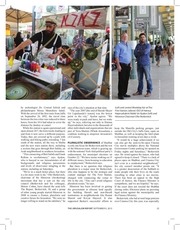
(Left and center) Weekday fair at The
First Station; (above) CEO of Hatnua
Hayerushalmit Rabbi Uri Ayalon (left) and
Hitorerut Chairman Ofer Berkovitch
by archeologist Dr. Conrad Schick and says of the city’s situation at that time.
“The year 2007 [the end of Haredi Mayor
Uri Lupolianski’s tenure] was the lowest
point in the city,” Ayalon agrees. “We
between the two cities was reduced to three were ready to pack and leave, but we woke
hours, from the 10 it had taken to cover the up,” he says, referring not only to Hatnua
distance by donkey or camel.
Hayerushalmit, but also to the thousands of
While the station is again operational and other individuals and organizations that are
open almost 24/7, the train tracks leading to
and from it now serve a different purpose. coalition working to empower Jerusalem’s
Today, they are covered up by a park with civil society.
walking and biking paths extending 7 km
south of the station, all the way to Malha PLURALISTIC OBSERVANCE of Shabbat
and the new train station there, including is only one focus for Berkovitch and the rest
a section that goes through Beit Safafa, an of the Hitorerut team, which is gearing up,
Arab neighborhood in southern Jerusalem. with the national Yesh Atid political party’s
“This connecting of Beit Safafa and Emek endorsement, for municipal elections on
Refaim is revolutionary,” says Ayalon, October 22. “We have teams working on 15
who is buoyed to see Jerusalemites of all different issues, from housing to education
backgrounds and religious persuasions to employment,” Berkovitch says.
and levels of observance mingling at the
But there is no question that religious
station, including on Saturdays.
pluralism is a major issue for Berkovitch,
“We’re in a much better place, but there who also happens to be the strategic and
is a lot more work to do,” Ofer Berkovitch, content manager for The First Station,
charged with connecting the venue to
movement that has a seat on the city life in the city. “You can’t avoid religious
pluralism issues,” he says.
Meirav Cohen, have shared the seat) tells
Hitorerut has been involved in getting
The Report. Berkovitch, 30, and a group the government to allocate land equally
of other young people started Hitorerut in for building Haredi and non-Haredi
institutions in neighborhoods like Ramat
creative future for Jerusalem. “We were no Sharett and Kiryat Hayovel. It also
longer willing to stand on the sidelines,” he supported Barkat’s successful efforts to
keep the Mamilla parking garages, just
outside the Old City’s Jaffa Gate, open on
Shabbat, as well as keeping the Intel plant
in Jerusalem running seven days a week.
“It would be a huge achievement if we
can also get the soon-to-be-open Cinema
City movie multiplex above the National
Government Center parking lot opened on
Friday nights and Saturdays,” Berkovitch
says. He voted against the mayor, who had
agreed to keep it closed. “There is a lack of
places open on Shabbat, and Cinema City
isn’t even in a residential neighborhood,”
the city council member points out. “It
is a greater desecration of the Sabbath to
make people risk their lives on the roads
travelling to other cities to see movies.
There has been an appeal to the High
Court of Justice, the Finance Minister is
sympathetic, and we are hopeful,” he says.
If the court does not rescind the Shabbat
closing order, Hitorerut plans on pursuing
legal action against the municipality and
the Finance Ministry.
Berkovitch, who led several large protests
over Cinema City this year, was especially
THE JERUSALEM REPORT SEPTEMBER 9, 2013
23
�
MARC ISRAEL SELLEM
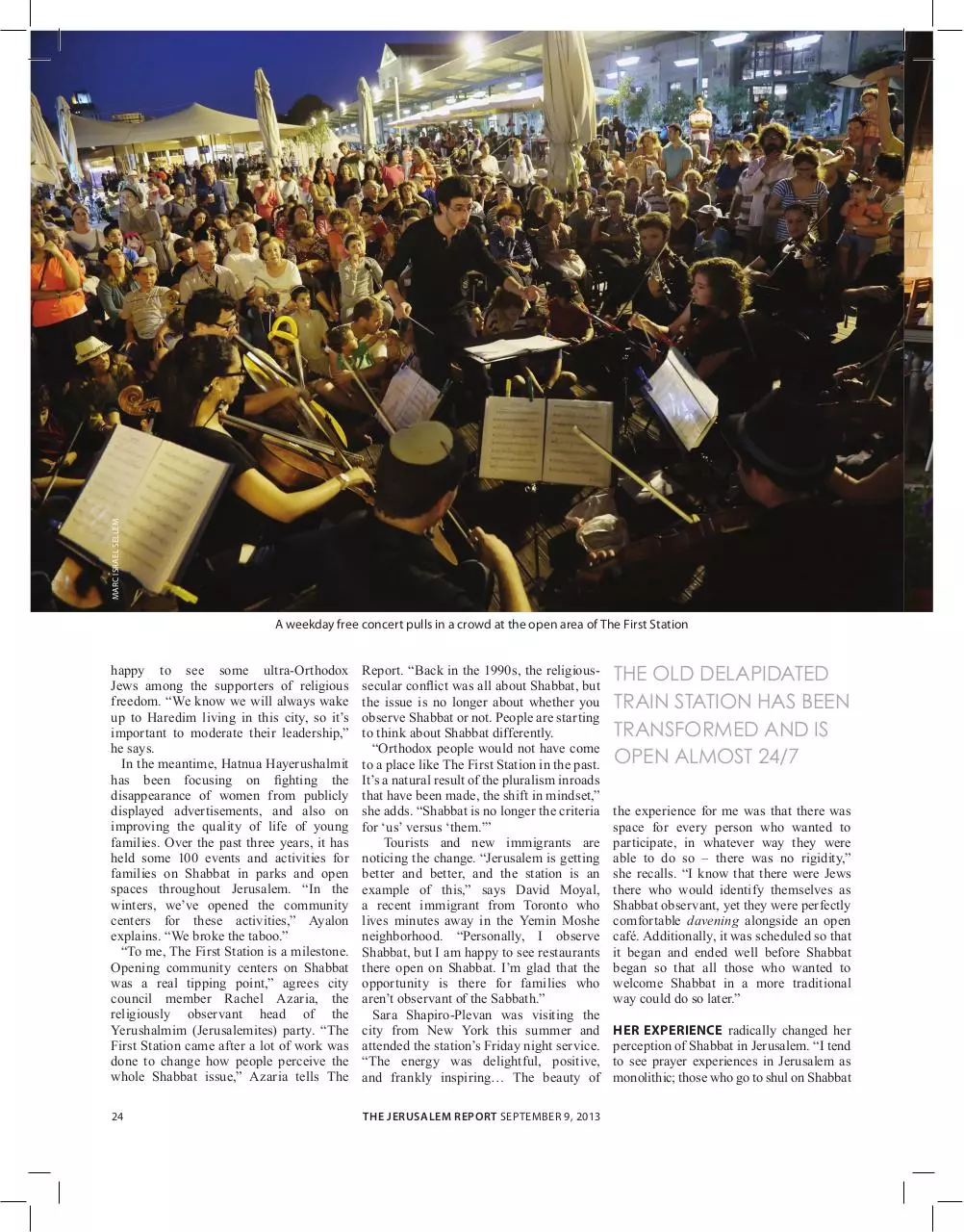
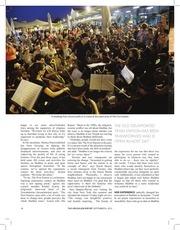
A weekday free concert pulls in a crowd at the open area of The First Station
happy to see some ultra-Orthodox
Jews among the supporters of religious
freedom. “We know we will always wake
up to Haredim living in this city, so it’s
important to moderate their leadership,”
he says.
In the meantime, Hatnua Hayerushalmit
First Station came after a lot of work was
done to change how people perceive the
whole Shabbat issue,” Azaria tells The
the issue is no longer about whether you
observe Shabbat or not. People are starting
to think about Shabbat differently.
“Orthodox people would not have come
to a place like The First Station in the past.
It’s a natural result of the pluralism inroads
that have been made, the shift in mindset,”
she adds. “Shabbat is no longer the criteria
for ‘us’ versus ‘them.’”
Tourists and new immigrants are
noticing the change. “Jerusalem is getting
better and better, and the station is an
example of this,” says David Moyal,
a recent immigrant from Toronto who
lives minutes away in the Yemin Moshe
neighborhood. “Personally, I observe
Shabbat, but I am happy to see restaurants
there open on Shabbat. I’m glad that the
opportunity is there for families who
aren’t observant of the Sabbath.”
Sara Shapiro-Plevan was visiting the
city from New York this summer and
attended the station’s Friday night service.
“The energy was delightful, positive,
and frankly inspiring… The beauty of
24
THE JERUSALEM REPORT SEPTEMBER 9, 2013
disappearance of women from publicly
displayed advertisements, and also on
improving the quality of life of young
families. Over the past three years, it has
held some 100 events and activities for
families on Shabbat in parks and open
spaces throughout Jerusalem. “In the
winters, we’ve opened the community
centers for these activities,” Ayalon
explains. “We broke the taboo.”
“To me, The First Station is a milestone.
Opening community centers on Shabbat
was a real tipping point,” agrees city
council member Rachel Azaria, the
religiously observant head of the
The old delapidaTed
Train sTaTion has been
Transformed and is
open almosT 24/7
the experience for me was that there was
space for every person who wanted to
participate, in whatever way they were
able to do so – there was no rigidity,”
she recalls. “I know that there were Jews
there who would identify themselves as
Shabbat observant, yet they were perfectly
comfortable davening alongside an open
café. Additionally, it was scheduled so that
it began and ended well before Shabbat
began so that all those who wanted to
welcome Shabbat in a more traditional
way could do so later.”
HER EXPERIENCE radically changed her
perception of Shabbat in Jerusalem. “I tend
to see prayer experiences in Jerusalem as
monolithic; those who go to shul on Shabbat
�
MARC ISRAEL SELLEM
The restored station is a popular center for food, culture and entertainment
are those who identify themselves as
religious. This destroyed that image for me,
in an overwhelmingly positive way.”
Shapiro-Plevan was surprised to discover
that the station is open on Shabbat, but
believes that it makes sense given that it
is an enclosed space that doesn’t maintain
any visibility to the street. “Now there’s a
center of culture… art, family activities
and more, that chooses not to ignore that
it is Shabbat but to reinterpret Shabbat in a
way that is more closely aligned to the real
lives and celebrations of the non-Orthodox.
It’s a way to remember Shabbat, but not
necessarily observe it in the traditional
sense,” she says.
Karen Brunwasser, deputy director of the
Jerusalem Season of Culture, a summer
scene and contemporary cultural treasures,
believes one of the upsides of this progress
is that more secular people are doing
Jewish things, like attending the service at
the station.
JSOC promotes and supports artists and
organizations that are open on Shabbat, and
schedules its own events on Shabbat when
necessary, while avoiding it when possible
for the sake of inclusiveness. “It’s always
a negotiation, but we are not motivated
by not wanting to upset the Haredim,”
Brunwasser emphasizes.
Longtime Jerusalem resident Karen
Lakin is regretfully more pessimistic
about what The First Station means for
the capital. It seems to be too good to be
true, and she is waiting for the other shoe to
drop. “I’m afraid the station won’t continue
to stay open on Shabbat,” she says. “I
worry about the underlying violence [by
Haredim against non-religious Jews and
non-Jews] and fracture in the city – about
the multiplying of these ugly events and the
police’s inability to deal with it,” she shares.
“In spite of the lovely cosmetic changes
and progress in the courts, I still feel, very
sadly, that we are moving backwards.”
Ayalon doesn’t expect to do any
backpedalling. “We’ve made the breakthrough on the Shabbat issue. You can do
things here on Shabbat and the sky will not
fall on your head,” he says. “There has not
been a single demonstration by Haredim
against any of the activities we have held
on Shabbat. This city is much more tolerant
than people think, and there are more
moderate Haredim than people think,” he
adds.
Berkovitch believes young people and
artists who are choosing to return to
Jerusalem from Tel Aviv understand this.
He is encouraged by a rise in the last two
THE JERUSALEM REPORT SEPTEMBER 9, 2013
25
the city’s non-religious public schools, as
well as statistics indicating that slightly
over one-third of Jerusalem’s new residents
secular, traditional or moderate in religious
outlook.
pluralistically minded citizens. “The main
the mistaken image and false assumptions
of this city,” he says. “We are talking values
instead of apologetics now, and there has
been a radical change as a result.
“Israeli society doesn’t realize it,” Ayalon
says of the momentum that is underway in
Jerusalem. As he sees, it the rest of Israel
hasn’t caught on that the train has left the
station.
�
 Historical archive . public document