ANESTHESIA
for Labor and Delivery
Dr. Michael Castaños
February 12, 2014
History
James Young Simpson
first administered obstetric anesthesia on January
17, 1847
used ether and chloroform for pain relief
“This is certainly the greatest blessing of this age”
John Snow
anesthetized obstetric patients with chloroform
Most famous patient was Queen Victoria for the
births of Prince Leopold and Princess Beatrice
Father of Modern Anesthesioloy
Physiologic Changes with Pregnancy
Factors that bring about change:
Rising hormonal levels
(progesterone, estrogen, chorionic,
gonadotropin, etc)
The enlarging uterus
Physiologic Changes with Pregnancy
Cardiovascular
Respiratory
Neurologic
Hematologic
Renal
Gastrointestinal
Cardiovascular Changes with Pregnancy
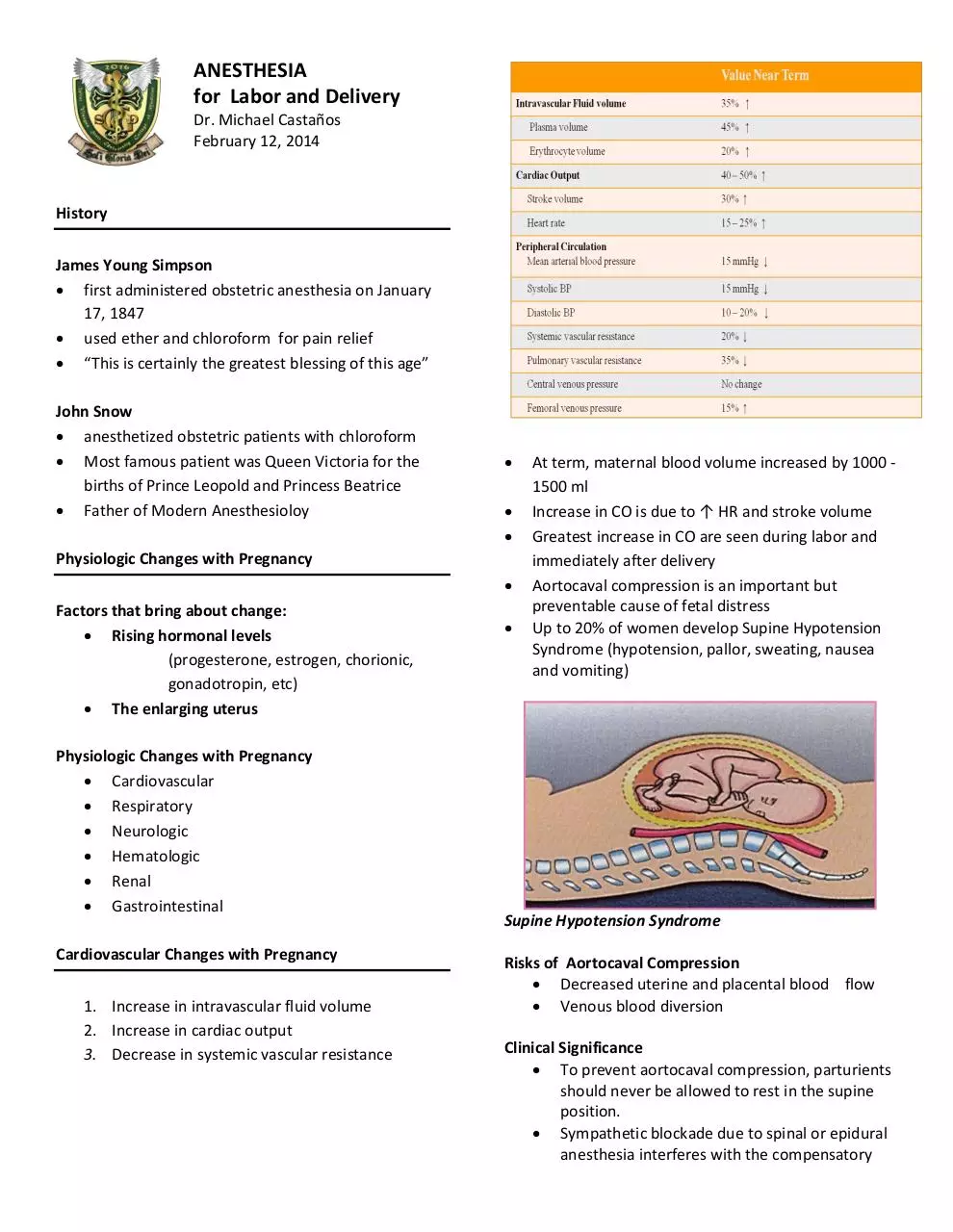
1. Increase in intravascular fluid volume
2. Increase in cardiac output
3. Decrease in systemic vascular resistance
At term, maternal blood volume increased by 1000 1500 ml
Increase in CO is due to ↑ HR and stroke volume
Greatest increase in CO are seen during labor and
immediately after delivery
Aortocaval compression is an important but
preventable cause of fetal distress
Up to 20% of women develop Supine Hypotension
Syndrome (hypotension, pallor, sweating, nausea
and vomiting)
Supine Hypotension Syndrome
Risks of Aortocaval Compression
Decreased uterine and placental blood flow
Venous blood diversion
Clinical Significance
To prevent aortocaval compression, parturients
should never be allowed to rest in the supine
position.
Sympathetic blockade due to spinal or epidural
anesthesia interferes with the compensatory
�
vasoconstrictor reflex---- profound hypotension
engorgement of the epidural vasculature makes
puncture of an epidural vein more likely
decrease in epidural space by the engorged
vessels leads to decreased drug requirement
Healthy parturient will tolerate a 1 to 1.5L of
blood loss (hemorrhage at delivery remains an
important risk)
Cardiac output remains high in first few hours
post-partum. Women with cardiac/ pulmonary
disease remain at risk after delivery
CNS Changes with Pregnancy
MAC decreases by 40%
Increased epidural blood volume
Progesterone - ↑ 20X normal at term pregnancy
↑ β endorphin levels
Obstruction of inferior vena cava by enlarging
uterus → epidural venous plexus distention →
↑ epidural blood volume
o ↓ CSF volume
o ↓ volume of epidural space
o ↑ epidural (space) pressure
Respiratory Changes with Pregnancy
Significant changes in the pulmonary system during
pregnancy:
Upper airway
Minute ventilation
Lung volumes
Arterial oxygenation
Upper Airway
Capillary engorgement of the mucosal lining of
the upper respiratory tract
Short neck
Diaphragm
Upward displacement due to upward pressure
exerted by growing uterus → decreased FRC
Elevation of the diaphragm is compensated by
↑ AP diameter of chest – thoracic breathing
favored
↓ FRC and ↑ O2 consumption leads to rapid
desaturation during periods of apnea
Clinical Significance
Decreased FRC
o more susceptible to hypoxia and
hypercarbia during apnea while
pushing
o supine and lithotomy positions
aggravate the onset of hypoxia
↓ FRC + ↑ Min Ventilation = Increased
Anesthetic Uptake
Capillary engorgement of mucosa →
trauma, bleeding, airway obstruction
Severe hyperventilation during pain leads to
hypocarbia, causing uterine artery
vasoconstriction
Administration of supplemental 100% oxygen is
mandatory during fetal distress
�
Anesthetic Significance
Airway Management is more challenging because of:
Alterations
Anesthetic Implications
Weight gain/breast
engorgement
Hinders laryngoscopy
Swollen mucosa
Easy bleeding with
manipulation
Upper airway
obstruction
Use of smaller caliber
endotracheal tubes
Renal Changes with Pregnancy
Anesthetic Implications
MAC decreased
Overdosage hazard
Decreased FRC
Faster induction with
insoluble agents
Increased VE
Speeds induction with
soluble agents
Greater risk of Hypoxemia
Alterations
Decreased FRC
Anesthetic Implications
Less O2 reserve
Increased O2 consumption
Mucosal engorgement of
the Respiratory Tract
Rapid airway obstruction
Elevated progesterone levels
o decreased gastric motility
o decreased food absorption
o lower esophageal sphincter tone at term
Placental secretion of gastrin
o higher gastric acidity (Gastric pH ≤ 2.5)
o increased gastric acid volume
Enlarged uterus
o increased intragastric pressure
o gastroesophageal angle flattens
Clinical Significance
• Increased danger of vomiting and aspiration
• Acid Aspiration Pneumonia(Mendelson’s Syndrome)
• All parturients are considered to have a full stomach
regardless of the number of hours after last food
intake
• No solid food should be given to parturients and
that liquids be restricted to a small amount of ice
chips
Medical Measures for a Full Stomach
• Histamine2-blocking agents
o (cimetidine,
ranitidine,
decrease acidity and volume
•
Hematologic Changes with Pregnancy
Clotting factors rise by 50-250%
Hemoglobin decreases by 20%
Platelet count lowered by 20%
Iron and folate anemias
Plasma flow and GFR increases by 50%
Decreased threshold for glucose and amino acids
Gastrointestinal Changes with Pregnancy
Modified responses to anesthetics
Alterations
Dilutional anemia
Platelet count – 20% ↓
The following factors are increased:
o Fibrinogen (Factor I)
o Factor VII
o Factor VIII
o Factor X
famotidine)
Metoclopramide
o increases gastric motility and lower
esophageal sphincter tone, and has central
antiemetic effects
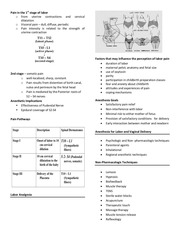
ANATOMY OF LABOR PAIN
Pain Pathways During Labor
�
Pain in the 1st stage of labor
o from uterine contractions and cervical
dilatation
o Visceral pain – dull, diffuse, periodic
o Pain intensity is related to the strength of
uterine contraction
T11 – T12
(latent phase)
↓
T10 - L1
(active phase)
↓
T10 – S4
(second stage)
2nd stage – somatic pain
o well-localized, sharp, constant
o Pain results from distention of birth canal,
vulva and perineum by the fetal head
o Pain is mediated by the Posterior roots of
S2 – S4 nerves
Anesthetic Implications
• Effectiveness of Pudendal Nerve
• Epidural coverage of S2-S4
Pain Pathways
Factors that may influence the perception of labor pain
duration of labor
maternal pelvic anatomy and fetal size
use of oxytocin
parity
participation in childbirth preparation classes
fear and anxiety about childbirth
attitudes and experiences of pain
coping mechanisms
Anesthesia Goals
Satisfactory pain relief
Non-interference with labor
Minimal risk to either mother of fetus
Provision of satisfactory conditions for delivery
Early interaction between mother and newborn
Anesthesia for Labor and Vaginal Delivery
Psychologic and Non -pharmacologic techniques
Parenteral agents
Inhalational
Regional anesthetic techniques
Non-Pharmacologic Techniques
Labor Analgesia
Lamaze
Hypnosis
Biofeedback
Muscle therapy
TENS
Sterile water blocks
Acupuncture
Therapeutic touch
Massage therapy
Muscle tension release
Reflexology
�
Accupressure
Hydrotherapy
Herbal cocktails
Aromatherapy
Parenteral Agents
•
Opioids
o Meperidine (Demerol)
o Fentanyl
o Morphine
o Nalbuphine
•
Sedatives / Tranquilizers
o Phenothiazines
o Benzodiazepines
o Dissociative medications (Ketamine)
•
Intravenous Anesthetics
o Barbiturates
o Propofol
Inhalational Analgesia
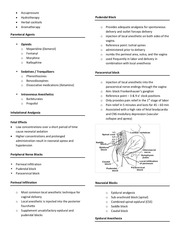
Pudendal Block
o
o
o
o
o
o
Provides adequate analgesia for spontaneous
delivery and outlet forceps delivery
injection of local anesthetic on both sides of the
vagina.
Reference point: Ischial spines
administered prior to delivery
numbs the perineal area, vulva, and the vagina
used frequently in labor and delivery in
combination with local anesthesia
Paracervical block
o
o
o
o
o
o
injection of local anesthetic into the
paracervical nerve endings through the vagina
Aim: block Frankenhauser’s ganglion
Reference point – 3 & 9 o’ clock positions
Only provides pain relief in the 1st stage of labor
Pain relief in 5 minutes and lasts for 45 – 60 min
Associated with a high rate of fetal bradycardia
and CNS medullary depression (vascular
collapse and apnea)
Fetal Effects
Low concentrations over a short period of time
cause neonatal sedation
Higher concentrations and prolonged
administration result in neonatal apnea and
hypotension
Peripheral Nerve Blocks
•
•
•
Perineal infiltration
Pudendal block
Paracervical block
Perineal Infiltration
o
o
o
Most common local anesthetic technique for
vaginal delivery
Local anesthetic is injected into the posterior
fourchette
Supplement unsatisfactory epidural and
pudendal blocks
Neuraxial Blocks
o
o
o
o
o
Epidural analgesia
Sub-arachnoid block (spinal)
Combined spinal-epidural (CSE)
Saddle block
Caudal block
Epidural Anesthesia
�
o
o
o
o
o
Spinal Anesthesia (SAB)
Continuous lumbar epidural is the most
versatile and commonly employed
technique
Administered when labor is well established
Should be administered when labor is
progressing well
Standard for vaginal delivery
Given at 6-7 cm cervical dilation
(primigravida), 4-5 cm (multipara)
Inserted at L2-L3 or L3-L4
o
o
Criteria for Epidural Anesthesia for Labor & Delivery
No fetal distress
Good regular uterine contractions
Adequate cervical dilatation
Engagement of the fetal head
o
Injection of local anesthetics into the
subarachnoid space
True Saddle Block (L5 to S5)
o Puncture at L4-L5 or L5-S1
Modified Saddle Block (T10-S5)
o Puncture L3-L4
Advantages
Rapid onset
Reliable anesthesia
Small amount of anesthetic is used
Disadvantages
o Unpredictable sensory level
o Hypotension
o Headache
Regional Anesthesia
Anesthetic Significance:
Epidural block reduces cardiac work during
labor; beneficial in some cardiac disease states
Hypotension with regional block may be
associated with decreased uterine blood flow
Reduction of local anesthetic requirement for
spinal/ epidural block
Reduced local anesthetic requirement may be
explained by:
Swelling of the epidural veins
Labor-induced increases in CSF pressure
Increased neurosensitivity to local anesthetics
Increased lumbar lordosis of pregnancy may
enhance cephalad spread of LA solutions in the CSF
Anesthesia for Cesarean Section
Complications:
Hypotension
o Most common
Intravascular injection
Intrathecal injection (1.5ml of LA per segement)
o Post-dural puncture headache
Backache
A. Regional Anesthesia
Spinal
Epidural
Combined spinal & epidural anesthesia
B. General Anesthesia
Placental Transfer of Anesthetic Drugs
Molecular weight – ( <500 daltons)
Protein binding
�
Degree of lipid solubility
Maternal drug concentration
Maternal and Fetal pH
Ionization of the drug
Advantages
rapid onset
small amounts of drugs
Disadvantage
hypotension in 50-80% of cases even if with
adequate fluid preload
General Anesthesia for Caesarian Section
Indications
rapid induction of anesthesia:
o fetal distress
o bleeding placenta previa
o placental abruption
o uterine rupture
o delivery of the second entrapped twin
Obstetric Anesthesia
All patients are considered to have full stomach
Prophylactic antacids or Metoclopramide
Supine position should be avoided
Main Anesthesia Concerns
Maternal Safety
Fetal Safety
PLEASE NOTE: For additional side notes, please refer to
JAX notes. (they were not discussed by Doc Mike). They
were not included here to avoid redundancy. Also,
damo ginskip sa lecture.
3. Greatest increase in cardiac output occurs during:
- Labor
4. The following factors are increased except:
- Factor 2
5. True regarding gastrointestinal changes in
pregnancy, except:
A. Decreased gastric motility
B. Lower esophageal sphincter tone
C. Higher gastric ph***
D. Higher gastric acid volume
6. True of cervical block, except:
A. For first stage labor
B. Targets frankenhauser's ganglion
C. Offers pain relief for 2nd stage labor***
D. Cause fetal bradycardia and cns depression
7. MAC increase:
- 40%
8. Which dermatomes are affected in the first stage of
labor?
- T10- L1
9. The ff are true of second stage of labor, except:
A. Pain is localized, sharp
B. Pain results from distention of birth canal
C. Pain mediated by S2-S4 nerves
D. Visceral pain***
10. The most common side effect of spinal anesthesia:
- Hypotension
REVIEW QUESTIONS
Notes by: Lumasag J, Iwag M, Sameon N
1. The father of anesthesia:
- John Snow
2. The ff. increases during hormonal pregnancy,
except:
A. Plasma volume
B. Stroke volume
C. Heart rate
D. Blood pressure***
�
 Historical archive . public document