“Bl
Sea ackfi
tre Wor sh” e
x
wh atme ld’s u pose
ale nt o nfa s
s,
i
pag f orc r
a
e3
monthly
November 2013
The Smithsonian Science Education
Center has agreed to remove an animal-behavior lesson plan that was abusing animals.
More specifically, the lesson called for dissection of live African dwarf frogs, fiddler crabs and millipedes. Many distressed teachers and students contacted PETA about the
lesson plan expressing concern for the animals who were
suffering from neglect and mistreatment.
One teacher explained to PETA that her supervisor
instructed her to dispose of the animals after use because
they could not be reused in another lesson. She and her
co-workers were not okay with this type of teaching.
PETA supports took action, contacting the Smithsonian and after a year’s worth of hard work, it has been
confirmed that the lesson has been taken off of the Smithsonian’s curriculum. Victory!
fumes from cars and are exposed to a high amount of pollution, all while pulling a heavy carriage.
Most times these horses are never given the opportunity to gallop freely, and especially not in a pasture like
they are meant to naturally. At night they are put into small
Help PETA save the horses in New stalls where they are unable to comfortably lay and oftentimes barely fit in at all.
York City and allow them to finally run free
PETA wants your help in supporting these horses and
as they were meant to do.
their freedom. Help us raise only $40,000 to create a video
that spreads awareness of these animal’s living conditions.
In NYC, there are approximately 220 horses used Videos are one of the essential strategies in raising awareness.
t o
pull carriages. These hors- Supporters need your help to turn this movement into a naes are exposed to all tionwide idea. Visit peta.org/horses for more info.
types of climates
and expected
to work nine
hour days,
seven days
a week,
e v e n
in
the
harshest
weather. They
inhale
Did you know?
Wild horse have
populated North America
for more than 1,000 years.
They were brought to
America by Spanish
explorers.
�
Sw
baa eater
aaa s ar
ah e
d
BLACKFISH
the movie Seaworld doesn’t want you to see
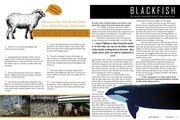
8 Reasons Why You Should Think
Twice Before Buying That Sweater
Don’t be uneducated about what you are wearing! Wool that is used to make
clothing, including many sweaters that we wearing during the winter months,
comes from lambs who are mistreated in the process of obtaining their wool.
1.
About 25% of wool used throughout the
world comes from Australia.
Due to the high demand of wool, lambs are often
5.
sheared too early which results in a premature death.
When they age or their wool production declines they
are sent to the slaughter house.
2. During shearing, Australian workers are very
rough with the animals and oftentimes hurt them.
The term “mulesing” refers to the barbaric act
6.
when workers carve the skin off the backs of lamb’s legs
Young lamb’s ears are hole punched, their tails are cut
off, and the males are castrated, usually without any
anesthesia.
and around their tail. Photos show lambs with chunks
of their skin completely exposed and bleeding because
of this act.
3.
Each year millions of sheep are shipped from
Australia to the Middle East and Africa. In the process
nearly 40,000 die and their bodies are usually thrown
over board.
They feel all of the pain of these acts. Approximately 3 million lambs die every spring in Australia,
which is considered normal.
7.
The animals are usually kept in large pens and
4.
8. In New Zealand, methane emissions from enteric
exposed to extreme heats during the summer months.
fermentation, which is typically from sheep, make up
Many die due to heat exhaustion, diseases, injuries and
stress when closely cramped together with so many other lambs.
more than 90 percent of the nation’s greenhouse-gas
emissions.
Recently, former SeaWorld employees have taken a stand
against the company for its mistreatment of its animals.
Orca whales, sometimes referred to as killer
whales, are used by SeaWorld during shows and are on
display for its guest’s entertainment. The company has not
done an adequate job of taking care of its whales in the
park which has ultimately led to it’s exposure.
Blackfish is a documentary that was created to
spread awareness and encourage others to join the fight
“... where Tilikum is taken from his mother in the wild, you can see the other whales
of his family waiting next to the boat. They
make noises that can only be explained as
a cry.”
against killer whale cruelty. It was released at the Sundance
Film Festival in January 2013. The film dives deeper into
SeaWorld’s company set-up and many past employees tell
their tales of working in the tanks with the orcas. Much of
the content focuses on a specific orca, Tilikum, who was
taken from his family in the wild when he was very young
due to his large size at such a young age.
Orca whales have very well-developed brains
which allows them to form extremely close relationships
with the other whales they travel with, who are all interrelated. When a female gives birth the calf stays with her
for the entirety of its life. Each pod of whales has its own
unique dialect that it used to communicate with the other
whales.
When the
calves are taken
from their mothers, the other whales
in the pod do not leave
him. In one clip featured in Blackfish, where Tilikum is taken from his mother
in the wild, you can see the other whales of his
pod waiting next to the boat. They make noises
that can only be described as a cry. They stay with
Tilikum until he is taken out of the water and the
boat drives away. Later, three dead whales were found
washed ashore and were thought to be his family.
The orca whale’s dorsal fin was also discussed in
the documentary. Studies found that whales in captivity
developed a curved dorsal fin, in some cases to the most
extremely where the fin looked folded in half. Whales in
the wild rarely, almost never, develop this irregularity.
This is due to lack of exercise and swimming distance. In
the wild, orcas swim hundreds of miles a day, whereas in
captivity they are usually confined to a small tank and not
enough room for adequate swimming.
The most important part of the film deals with the
death of two trainers and one man who is thought to have
snuck into the pool after the park was closed to swim with
Tilikum. In the first instance, a trainer in Spain was killed
while practicing with one of the whales. The second was a
woman who was dragged underwater by her foot and almost dismembered. She was unrecognizable after she was
pulled from the water.
The purpose of the film and of the trainers speaking out against SeaWorld is to stop allowing trainers to
be in the water with the animals because it is not safe.
They are wild animals, wrongly caged up and expected to
perform. They are unpredictable and pose a huge risk to
trainers and anyone getting too close to them. There is a
lawsuit currently going on against SeaWorld, who denied
to comment on the film.
To take a stand against orca whale cruelty and SeaWorld please join PETA in supporting Blackfish by watching
the film and spreading awareness.
Peta Monthly
•
November
3
�
Many meat products are contaminated with feces that contains harmful dieseases and pathogens.
Nearly 90 percent of ground turkey and chicken breast
contains feces, and 80 percent of ground beef does. Among
the feces, many diseases and pathogens can be found as
well including listeria, salmonella, e. coli, staph and campylobacter, which are all harmful to humans when ingested.
On top of that, almost 30 million pounds of antibiotics are
given to animals each year. When antibiotics are overused
like this, bacteria becomes antibiotic-resistant and remains
in the meat as it is processed ad eventually packaged to be
sold in supermarkets.
Seafood is another area of interested because
only 2 percent of seafood is inspected by the FDA, which
leaves lots of room for hazardous bacteria to be ingested
by humans. A study done in 2013 found that 84 percent
of all fish had unsafe levels of mercury in them, which is,
again,very harmful to humans.
Some chemicals that are used in meat production
are also used when developing photos, cleaning swimming
pools, cleaning wood pulp and industrial cleaning, just to
name a few. There are over 200 more uses.
Be aware of these harmful things also found in
meat products. Eat smarter and go vegan. Help support animals and stop ingesting harmful chemicals through meat
products.
Peta Monthly
•
November
4
�
 Historical archive . public document