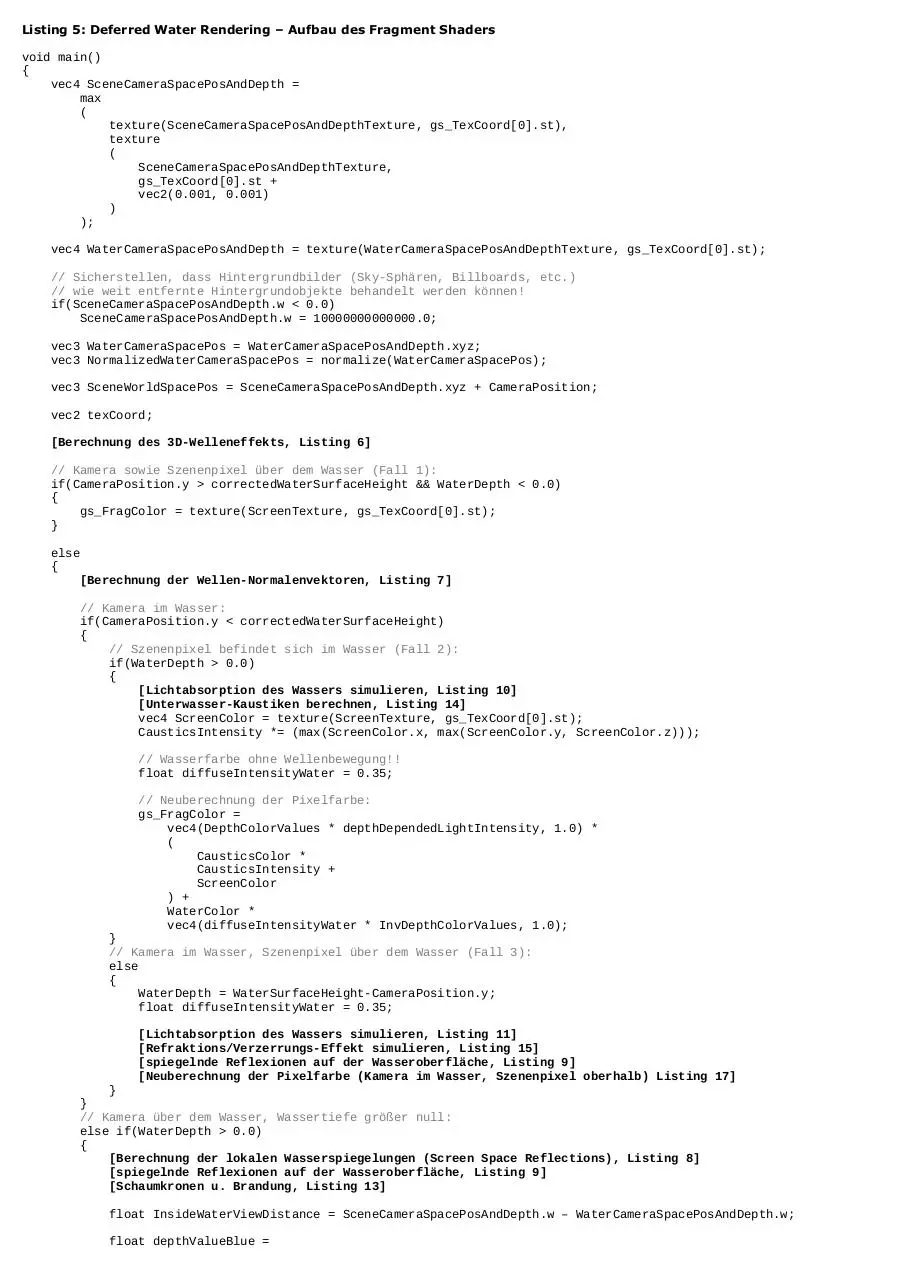
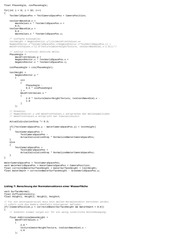
Listing 1: Darstellung des Wasserbassins (Vertex Shader)
#version 330
precision highp float;
#define ATTR_POSITION 0
[...]
#define ATTR_TEXCOORD7 9
layout(location = ATTR_POSITION) in vec4 gs_Vertex;
[...]
layout(location = ATTR_TEXCOORD7) in vec4 gs_MultiTexCoord7;
out vec4 gs_TexCoord[8];
uniform mat4 matWorldViewProjection;
void main()
{
gl_Position
= matWorldViewProjection * gs_Vertex;
gs_TexCoord[0] = vec4(gs_Vertex.xyz, gl_Position.z);
}
Listing 2: Darstellung des Wasserbassins (Fragment Shader)
#version 330
precision highp float;
in vec4 gs_TexCoord[8];
out vec4 gs_FragColor[5];
void main()
{
gs_FragColor[0] = vec4(0.0, 0.0, 0.0, 1.0);
// SceneCameraSpacePosAndDepth:
gs_FragColor[1] = gs_TexCoord[0];
gs_FragColor[2] = vec4(0.0, 0.0, 0.0, 1.0);
gs_FragColor[3] = vec4(0.0, 0.0, 0.0, 1.0);
gs_FragColor[4] = vec4(0.0, 0.0, 0.0, 1.0);
}
Ende
Listing 3: Eigenschaften einer Wasserfläche zwischenspeichern (Vertex Shader)
#version 330
precision highp float;
#define ATTR_POSITION 0
[...]
#define ATTR_TEXCOORD7 9
layout(location = ATTR_POSITION) in vec4 gs_Vertex;
[...]
layout(location = ATTR_TEXCOORD7) in vec4 gs_MultiTexCoord7;
out vec4 gs_TexCoord[8];
uniform mat4 matWorldViewProjection;
uniform mat4 matCamera;
void main()
{
gl_Position = matWorldViewProjection * gs_Vertex;
vec4 Position = matCamera * gs_Vertex;
gs_TexCoord[0] = vec4(Position.xyz, gl_Position.z);
}
Listing 4: Eigenschaften einer Wasserfläche zwischenspeichern (Fragment Shader)
#version 330
precision highp float;
in vec4 gs_TexCoord[8];
out vec4 gs_FragColor;
void main()
{
// SceneCameraSpacePosAndDepth:
gs_FragColor = gs_TexCoord[0];
}
�
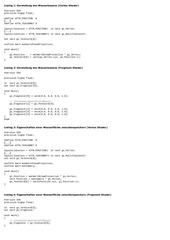
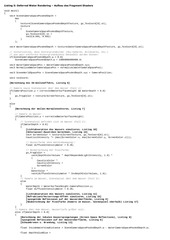
Listing 5: Deferred Water Rendering – Aufbau des Fragment Shaders
void main()
{
vec4 SceneCameraSpacePosAndDepth =
max
(
texture(SceneCameraSpacePosAndDepthTexture, gs_TexCoord[0].st),
texture
(
SceneCameraSpacePosAndDepthTexture,
gs_TexCoord[0].st +
vec2(0.001, 0.001)
)
);
vec4 WaterCameraSpacePosAndDepth = texture(WaterCameraSpacePosAndDepthTexture, gs_TexCoord[0].st);
// Sicherstellen, dass Hintergrundbilder (Sky-Sphären, Billboards, etc.)
// wie weit entfernte Hintergrundobjekte behandelt werden können!
if(SceneCameraSpacePosAndDepth.w < 0.0)
SceneCameraSpacePosAndDepth.w = 10000000000000.0;
vec3 WaterCameraSpacePos = WaterCameraSpacePosAndDepth.xyz;
vec3 NormalizedWaterCameraSpacePos = normalize(WaterCameraSpacePos);
vec3 SceneWorldSpacePos = SceneCameraSpacePosAndDepth.xyz + CameraPosition;
vec2 texCoord;
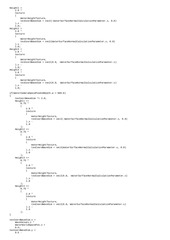
[Berechnung des 3D-Welleneffekts, Listing 6]
// Kamera sowie Szenenpixel über dem Wasser (Fall 1):
if(CameraPosition.y > correctedWaterSurfaceHeight && WaterDepth < 0.0)
{
gs_FragColor = texture(ScreenTexture, gs_TexCoord[0].st);
}
else
{
[Berechnung der Wellen-Normalenvektoren, Listing 7]
// Kamera im Wasser:
if(CameraPosition.y < correctedWaterSurfaceHeight)
{
// Szenenpixel befindet sich im Wasser (Fall 2):
if(WaterDepth > 0.0)
{
[Lichtabsorption des Wassers simulieren, Listing 10]
[Unterwasser-Kaustiken berechnen, Listing 14]
vec4 ScreenColor = texture(ScreenTexture, gs_TexCoord[0].st);
CausticsIntensity *= (max(ScreenColor.x, max(ScreenColor.y, ScreenColor.z)));
// Wasserfarbe ohne Wellenbewegung!!
float diffuseIntensityWater = 0.35;
// Neuberechnung der Pixelfarbe:
gs_FragColor =
vec4(DepthColorValues * depthDependedLightIntensity, 1.0) *
(
CausticsColor *
CausticsIntensity +
ScreenColor
) +
WaterColor *
vec4(diffuseIntensityWater * InvDepthColorValues, 1.0);
}
// Kamera im Wasser, Szenenpixel über dem Wasser (Fall 3):
else
{
WaterDepth = WaterSurfaceHeight-CameraPosition.y;
float diffuseIntensityWater = 0.35;
[Lichtabsorption des Wassers simulieren, Listing 11]
[Refraktions/Verzerrungs-Effekt simulieren, Listing 15]
[spiegelnde Reflexionen auf der Wasseroberfläche, Listing 9]
[Neuberechnung der Pixelfarbe (Kamera im Wasser, Szenenpixel oberhalb) Listing 17]
}
}
// Kamera über dem Wasser, Wassertiefe größer null:
else if(WaterDepth > 0.0)
{
[Berechnung der lokalen Wasserspiegelungen (Screen Space Reflections), Listing 8]
[spiegelnde Reflexionen auf der Wasseroberfläche, Listing 9]
[Schaumkronen u. Brandung, Listing 13]
float InsideWaterViewDistance = SceneCameraSpacePosAndDepth.w – WaterCameraSpacePosAndDepth.w;
float depthValueBlue =
�
min
(
1.0,
max
(
0.0,
(
InsideWaterMaxViewDistance –
InsideWaterViewDistance
) *
InsideWaterInvMaxViewDistance
)
);
// Szenenpixel im Wasser in der Nähe der Kamera (Fall 4):
if(depthValueBlue > 0.0 && SceneCameraSpacePosAndDepth.w < 2000.0)
{
[Lichtabsorption des Wassers simulieren, Listing 12]
[Refraktions/Verzerrungs-Effekt simulieren, Listing 16]
[Unterwasser-Kaustiken berechnen, Listing 14]
[Neuberechnung der Pixelfarbe (Kamera über dem Wasser, Unterwasserpixel nahe der Kamera), Listing 18]
}
// Szenenpixel im Wasser fernab der Kamera (Fall 5):
else
{
// Nebel- bzw. Dunst-Berechnungen:
float OneMinusHazeValue =
max
(
0.0,
(
2000.0 WaterCameraSpacePosAndDepth.w
) *
0.0005
);
float HazeValue = 1.0 - OneMinusHazeValue;
gs_FragColor =
HazeValue *
texture(BackgroundScreenTexture, gs_TexCoord[0].st) +
OneMinusHazeValue *
(
FoamColor +
diffuseIntensity *
(
WaterColor +
ScreenSpaceReflectionColor +
SpecularIntensity *
vec4(LightColor.xyz, 1.0) +
EnvironmentSpecularIntensity *
EnvironmentLightColor
)
);
}
}
// Szenengeometrie außerhalb des Wassers (Fall 1):
else
{
gs_FragColor = texture(ScreenTexture, gs_TexCoord[0].st);
}
}
}
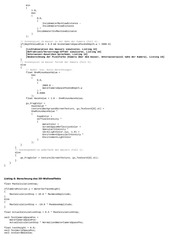
Listing 6: Berechnung des 3D-Welleneffekts
float MaxCalculationStep;
if(CameraPosition.y > WaterSurfaceHeight)
{
MaxCalculationStep = 10.0 * MaxWaveAmplitude;
}
else
{
MaxCalculationStep = -10.0 * MaxWaveAmplitude;
}
float ActualCalculationStep = 0.5 * MaxCalculationStep;
vec3 TestCameraSpacePos =
WaterCameraSpacePosActualCalculationStep * NormalizedWaterCameraSpacePos;
float testHeight = 0.0;
vec3 TestWorldSpacePos;
vec2 texCoordWaveSim;
�
float PhaseAngle, cosPhaseAngle;
for(int i = 0; i < 10; i++)
{
TestWorldSpacePos = TestCameraSpacePos + CameraPosition;
texCoordWaveSim.x =
WaveValues.x * TestWorldSpacePos.x +
0.5;
texCoordWaveSim.y =
0.5 WaveValues.x * TestWorldSpacePos.z;
/* einfache Sinuswelle:
testHeight = NegWindVector.y*(sin(WaveFrontValues.w+
NegWindVector.x*TestWorldSpacePos.x+NegWindVector.z*TestWorldSpacePos.z) +
WaveFrontValues.x*(2.0*texture(WaterHeightTexture, texCoordWaveSim).x-1.0));*/
// zykloid (trochoid)
PhaseAngle =
WaveFrontValues.w
NegWindVector.x *
NegWindVector.z *
ähnliche Welle:
+
TestWorldSpacePos.x +
TestWorldSpacePos.z;
cosPhaseAngle = cos(PhaseAngle);
testHeight =
NegWindVector.y *
(
sin
(
PhaseAngle 0.5 * cosPhaseAngle
) +
WaveFrontValues.x *
(
2.0 * texture(WaterHeightTexture, texCoordWaveSim).x 1.0
)
);
// Hinweise:
// NegWindVector.y und WaveFrontValues.x entsprechen den Wellenamplituden
// WaveFrontValues.w entspricht der Simulationszeit
ActualCalculationStep *= 0.5;
if((TestCameraSpacePos.y - WaterCameraSpacePos.y) < testHeight)
{
TestCameraSpacePos =
TestCameraSpacePos –
ActualCalculationStep * NormalizedWaterCameraSpacePos;
}
else
{
TestCameraSpacePos =
TestCameraSpacePos +
ActualCalculationStep * NormalizedWaterCameraSpacePos;
}
}
WaterCameraSpacePos = TestCameraSpacePos;
vec3 WaterWorldSpacePos = WaterCameraSpacePos + CameraPosition;
float correctedWaterSurfaceHeight = WaterSurfaceHeight + testHeight;
float WaterDepth = correctedWaterSurfaceHeight - SceneWorldSpacePos.y;
Listing 7: Berechnung der Normalenvektoren einer Wasserfläche
vec3 SurfaceNormal;
float diffuseIntensity;
float Height1, Height2, Height3, Height4;
// Für ein Unterwasserpixel muss kein Wellen-Normalenvektor berechnet werden,
// sofern sich die Kamera ebenfalls Unterwasser befindet:
if(!(CameraPosition.y < correctedWaterSurfaceHeight && WaterDepth > 0.0))
{
// Zunächst einmal sorgen wir für ein wenig zusätzliche Wellenbewegung:
float AdditionalWaveHeight =
WaveFrontValues.x *
(
2.0 *
texture(WaterHeightTexture, texCoordWaveSim).x –
1.0
);
�
Height1 =
2.0 *
texture
(
WaterHeightTexture,
texCoordWaveSim + vec2(-WaterSurfaceNormalCalculationParameter.x, 0.0)
).x 1.0;
Height2 =
2.0 *
texture
(
WaterHeightTexture,
texCoordWaveSim + vec2(WaterSurfaceNormalCalculationParameter.x, 0.0)
).x 1.0;
Height3 =
2.0 *
texture
(
WaterHeightTexture,
texCoordWaveSim + vec2(0.0, -WaterSurfaceNormalCalculationParameter.x)
).x 1.0;
Height4 =
2.0 *
texture
(
WaterHeightTexture,
texCoordWaveSim + vec2(0.0, WaterSurfaceNormalCalculationParameter.x)
).x 1.0;
if(WaterCameraSpacePosAndDepth.w < 500.0)
{
texCoordWaveSim *= 2.0;
Height1 +=
0.75 *
(
2.0 *
texture
(
WaterHeightTexture,
texCoordWaveSim + vec2(-WaterSurfaceNormalCalculationParameter.x, 0.0)
).x 1.0
);
Height2 +=
0.75 *
(
2.0 *
texture
(
WaterHeightTexture,
texCoordWaveSim + vec2(WaterSurfaceNormalCalculationParameter.x, 0.0)
).x 1.0
);
Height3 +=
0.75 *
(
2.0 *
texture
(
WaterHeightTexture,
texCoordWaveSim + vec2(0.0, -WaterSurfaceNormalCalculationParameter.x)
).x 1.0
);
Height4 +=
0.75 *
(
2.0 *
texture
(
WaterHeightTexture,
texCoordWaveSim + vec2(0.0, WaterSurfaceNormalCalculationParameter.x)
).x 1.0
);
}
texCoordWaveSim.x =
WaveValues.z *
WaterWorldSpacePos.x +
0.5;
texCoordWaveSim.y =
0.5 -
�
WaveValues.z *
WaterWorldSpacePos.z;
float phaseAngle =
WaveValues.w +
texCoordWaveSim.x *
NegWindVector.x –
texCoordWaveSim.y *
NegWindVector.z;
float tempFloat = sin(phaseAngle);
Height2 *= tempFloat;
Height4 *= tempFloat;
tempFloat = cos(phaseAngle);
Height1 *= tempFloat;
Height3 *= tempFloat;
/* Mithilfe des diffuseIntensity-Parameters simulieren wir die
Helligkeitsschwankungen der Wasserfläche.
Die zugrundeliegende Idee ist denkbar einfach – Wellenberge
erscheinen heller als Wellentäler, da sie mehr Licht in Richtung
des Spielers reflektieren können:*/
float diffuseIntensity =
WaterSurfaceNormalCalculationParameter.z *
(Height1 + Height2 + Height3 + Height4);
vec2 heightSamplePos = vec2(TestWorldSpacePos.x + 2.1, TestWorldSpacePos.z);
float WaveHeight1 =
WaveFrontValues.y *
(
AdditionalWaveHeight +
WaveFrontValues.z *
sin
(
WaveFrontValues.w +
NegWindVector.x *
heightSamplePos.x +
NegWindVector.z *
heightSamplePos.y
)
);
heightSamplePos =
vec2
(
TestWorldSpacePos.x - 2.1,
TestWorldSpacePos.z
);
float WaveHeight2 =
WaveFrontValues.y *
(
AdditionalWaveHeight +
WaveFrontValues.z *
sin
(
WaveFrontValues.w +
NegWindVector.x * heightSamplePos.x +
NegWindVector.z * heightSamplePos.y
)
);
heightSamplePos =
vec2
(
TestWorldSpacePos.x,
TestWorldSpacePos.z + 2.1
);
float WaveHeight3 =
WaveFrontValues.y *
(
AdditionalWaveHeight +
WaveFrontValues.z *
sin
(
WaveFrontValues.w +
NegWindVector.x * heightSamplePos.x +
NegWindVector.z * heightSamplePos.y
)
);
heightSamplePos =
vec2
(
TestWorldSpacePos.x,
TestWorldSpacePos.z - 2.1
);
float WaveHeight4 =
�
WaveFrontValues.y *
(
AdditionalWaveHeight +
WaveFrontValues.z *
sin
(
WaveFrontValues.w +
NegWindVector.x * heightSamplePos.x +
NegWindVector.z * heightSamplePos.y
)
);
Height1
Height2
Height3
Height4
+=
+=
+=
+=
WaveHeight1;
WaveHeight2;
WaveHeight3;
WaveHeight4;
diffuseIntensity +=
NegWindVector.w *
(WaveHeight1 + WaveHeight2 + WaveHeight3 + WaveHeight4);
diffuseIntensity = 0.35 + diffuseIntensity;
// Berechnung des Wellen-Normalenvektors:
SurfaceNormal =
normalize
(
vec3
(
Height1 - Height2,
(
0.5 +
0.025 *
WaterCameraSpacePosAndDepth.w
) *
WaterSurfaceNormalCalculationParameter.w,
Height3-Height4
)
);
}
Listing 8: Berechnung der lokalen Wasserspiegelungen (Screen Space Reflections)
vec4 ScreenSpaceReflectionColor = vec4(0.0, 0.0, 0.0, 0.0);
if(WaterCameraSpacePosAndDepth.w < ScreenSpaceReflectionRange)
{
vec3 ReflectionSurfaceNormal =
normalize
(
vec3
(
Height1 - Height2,
(
5.0 +
0.025 *
WaterCameraSpacePosAndDepth.w
) *
WaterSurfaceNormalCalculationParameter.w,
Height3-Height4
)
);
// gespiegelten Blickrichtungsvektor berechnen:
vec3 ReflectionVector;
vec3 ReflectionDirection = reflect(NormalizedWaterCameraSpacePos, ReflectionSurfaceNormal);
float tempDot = dot(ReflectionDirection, ReflectionSurfaceNormal);
float distanceStep = 7.0 / max(0.6, tempDot * tempDot);
float actualDistanceStep = 0.5 * distanceStep;
vec4 Projection;
float InvW;
float ReflectionvectorTexY;
float ReflectionvectorTexX;
vec3 diffVector;
vec4 TestSceneCameraSpacePosAndDepth;
float DistancSq;
float distanceTestFactor = 1.0;
int i;
for(i = 0; i < 10; i++)
{
// neue Ray-Marching-Position berechnen:
ReflectionVector =
WaterCameraSpacePos +
actualDistanceStep *
�
ReflectionDirection;
actualDistanceStep += distanceStep;
Projection =
matViewProjection *
vec4(ReflectionVector, 0.0);
InvW = 1.0 / Projection.w;
ReflectionvectorTexY =
0.5 *
Projection.y *
InvW +
0.5;
ReflectionvectorTexX =
0.5 *
Projection.x *
InvW +
0.5;
TestSceneCameraSpacePosAndDepth =
texture
(
SceneCameraSpacePosAndDepthTexture,
vec2(ReflectionvectorTexX, ReflectionvectorTexY)
);
// quadratischen Abstand zwischen der aktuellen Ray-Marching-Position
// und der Szenengeometrie ermitteln:
diffVector = TestSceneCameraSpacePosAndDepth.xyz - ReflectionVector;
DistancSq = dot(diffVector, diffVector);
// Schnittpunkt gefunden?
if(DistancSq < 16.0*distanceTestFactor)
{
break;
}
// Genauigkeit des Schnittpunkttests nach jedem
// Testdurchlauf ein wenig vergrößern:
distanceTestFactor *= 1.1;
}
// Falls kein Schnittpunkt gefunden wurde, spiegeln wir
// stattdessen einfach den Szenenhintergrund:
if(i == 10)
{
Projection =
matViewProjection *
vec4(ReflectionDirection, 0.0);
InvW = 1.0 / Projection.w;
ReflectionvectorTexY =
0.5 *
Projection.y *
InvW +
0.5;
ReflectionvectorTexX =
0.5 *
Projection.x *
InvW +
0.5;
}
// Intensität
// gefundenen
float DTexX =
float DTexY =
der Spiegelung in Abhängigkeit von den
Texturkoordinaten berechnen:
2.0 * ReflectionvectorTexX - 1.0;
2.0 * ReflectionvectorTexY - 1.0;
float intensity =
1.0 /
inversesqrt
(
inversesqrt
(
1.0 /
(
0.01 +
DTexX * DTexX +
DTexY * DTexY
)
)
);
//float intensity = sqrt(sqrt(0.01+DTexX*DTexX + DTexY*DTexY));
intensity =
max
(
1.0 - intensity,
0.0
�
) *
min
(
1.0,
ScreenSpaceReflectionIntensity / WaterCameraSpacePosAndDepth.w
);
ScreenSpaceReflectionColor =
intensity *
texture
(
ScreenTexture,
vec2(ReflectionvectorTexX, ReflectionvectorTexY)
);
}
Listing 9: spiegelnde Reflexionen auf der Wasseroberfläche (nach Phong)
// spiegelnde Reflexion des Umgebungslichts:
float EnvironmentSpecularIntensity =
max
(
-dot
(
2.0 *
dot(SurfaceNormal, EnvironmentNegLightDir) *
SurfaceNormal EnvironmentNegLightDir,
NormalizedWaterCameraSpacePos
),
0.0
);
// spiegelnde Reflexion des Sonnenlichts:
float SpecularIntensity =
max
(
-dot
(
2.0 *
dot(SurfaceNormal, NegLightDir) *
SurfaceNormal –
NegLightDir,
NormalizedWaterCameraSpacePos
),
0.0
);
SpecularIntensity = pow(SpecularIntensity, LightColor.w);
Listing 10: Lichtabsorption des Wassers (Kamera u. Szenenpixel im Wasser)
float depthValueBlue =
min
(
1.0,
max
(
0.0,
(
InsideWaterMaxViewDistance –
SceneCameraSpacePosAndDepth.w
) *
InsideWaterInvMaxViewDistance
)
);
float depthValueGreen =
min
(
1.0,
max
(
0.0,
depthValueBlue *
(
1.0 –
SceneCameraSpacePosAndDepth.w *
RelativeAbsorbtionCoeffGreen
)
)
);
float depthValueRed =
min
�
 Historical archive . public document