Serious Play: The Creation of Meaning. Jenna Gavin. 2014.
1. Cut and Paste - Interactive Installation
Interactive Installation
Cut and Paste was created for Digital Art Live to celebrate the 2014 Writer’s Festival. It
features two computers, one displaying an interactive scrapbook, the second displaying
remixed public domain poetry of old. Participants select words out of the scrapbook poems
and ‘paste’ them to the Digital Art Live screen. The computer on this side searches through
poem lines to find a word match, and pulls this line on-screen. The participant engages in a
process of Surrealist expression, taking words and lines out of context for the sake of
creating something new and personal.
Visual Concept
I decided on a merging of the analogue and
digital by using the screen as a high-fidelity
simulation of a table and paper surface. It
creates a magic of words running onto and off
of a page, and mixes the analogue and digital
worlds of old and new.
Figure 3. Scrapbooking.
Figure 1. Concept.
Figure 2. Paper experiment.
Refinement
I chose to subtract the colours from my work,
leaving white, black and greys, as a response
to the screen looking cluttered. I wanted the
impression of scrapbooking but realised that
visually it was not working. More elements
were not making the impression stronger.
Instead of the “essence” of scrapbooking, I
was imbuing the work with excess and
agitation. Spatially, the scissors take prime
focus; the activity of importance. Viewing the
image now (Fig. 4), it seems hollow, clean,
and the white panels are too small and
discrete for exploratory play. It has the feel of
an unfinished comic page. The image on
screen is a surface without depth, and
therefore portrays a system without depth.
Figure 4. Refinement.
�
Serious Play: The Creation of Meaning. Jenna Gavin. 2014.
1. Cut and Paste - Interactive Installation
Final Version
The image (Fig. 5) has become cleaner, and the shading gives more
representation of reality. A major change in the visual layout stemmed
from the desire to see the entire poem emerging on-screen. There was
a tension between the size of the screen height and the size of the
poems, remedied by drawing another piece of paper over top for longer
poems. This was an analogue answer using the dimensions of the
screen I had available. Displaying the whole poem creates a vast white
space, potentially a space of possibility, waiting to be filled. The
dominance of the poem is obvious, and takes the focus off the scissors.
The linearity feels stronger as the scrolling text has reduced to one line.
Insofar as unintentional meaning can be interpreted, the player has lost
some control to the poet, who is center-stage and higher on the screen.
Figure 5. Final Cut and Paste screen.
The Installation
A wooden trestle table increases the understanding of the installation (Fig. 6).
The table, as a surface, is holding a screen, itself a surface, which represents
papers on a table surface. The scrapbooking metaphor sits well on a surface
designed to facilitate scrapbooking; the concept of scrapbooking is seen and
interacted with as a concrete form and gives the player an entry point to the
work. This grounding then invites players to think about the work as a whole,
particularly the interactions with the content. The player is selecting a word out
of a current New Zealand poem and sending it to another computer to be
remixed with old public domain poetry. Chopping pieces out of poetry is an
easy act of disrespect and disorder (as easy as pushing a button). It is also a
personal expression and allows for creative interpretation. This dichotomy is
indicative of the current state of copyright and intellectual property in today’s
remix culture.
Figure 6. Installed Cut and Paste screen. Digital Art Live (2014).
�
Serious Play: The Creation of Meaning. Jenna Gavin. 2014.
2. Word Wars Mini - Arcade Video Game
Conceptual Description
The idea for Word Wars arose from a minimalist design challenge of
one-button-per-player. The overarching game design goal was for social, physical
play, and as such, the screen was shared between eight players competing over
a central letter. With a change in design goal, the mechanics of the game changed
and the original concept of minimalism was lost. The game has more
word-making opportunities due to the increased number of letters on-screen. It is
a fairer, more tempered experience, without the same feeling of addiction that the
original inspired (”just one more letter”). But with the addition of the suggested
words, the adult experience becomes more of a dictionary-explorer than a word
game. It removes the skills of vocabulary and spelling, replacing them with quick
decision-making. The game does not lose any of its possibilities, providing the
player with a whole dictionary of word combinations. I endeavoured to offer
choice and non-linearity through access to large amounts of data. No instructions
are featured on the cabinet; the players only receive instruction when they can
make a meaningful action. In this respect the minimal aspects of the original
design show through in the visual production.
Technical Description
This project took a more practical form, providing a different
perspective on the activity of game design. This redesign on a
previous version of Word Wars includes a new cabinet and new code,
adjusted for a younger and wider audience. Production took place over
a month. The cabinet is smaller, making it more portable and an
accessible height for children. Due to the restrictions of the cabinet, it
only allows for four players. The buttons are wired to an Arduino, which
is connected to an old computer running a Processing program. The
three major changes to the gameplay are: three-letter words are now
accepted for scoring; suggestions are offered to the players; and more
choice of letters is offered. These changes lower the barrier to entry.
The new interface, while under-developed, is smoother and friendlier.
It features the same blue and white theme of the cabinet. The colour
palette is restricted to blue, white, black, red and green.
Figure 7. Cabinet finished.
Figure 8. Old Word Wars interface.
Figure 9. New Word Wars interface.
�
Serious Play: The Creation of Meaning. Jenna Gavin. 2014.
3. Spy Game - Casual Video Game
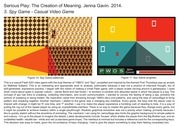
Figure 10. Spy Game patterned.
Figure 11. Spy Game progress.
This is a casual Flash AS3 video game with the dual themes of “1960's” and “Spy”, propelled and inspired by the themed First Thursdays pop-up arcade
by Matthew Gatland. This is an interesting and appropriate work to analyse, particularly because it was not a product of intensive thought, but of
self-generated, expressive practice. I began with the notion of making a small Flash game, with a player avatar moving around a gamespace. I used
what I knew about spies in popular culture – James Bond and Get Smart – to envision a comedic and absurdist space in which the player is a spy. The
concept of spy has links to sneaking, collecting information, and covert communication. I wanted to convey the feeling of being a spy, primarily the
actions of sneaking or being hidden. My inspiration came from browsing through 1960's deco and patterns, and using the idea of camouflage to bring
pattern and sneaking together. Another mechanic I added to the game was a changing key interface. Every game, the keys that the player uses to
interact with change: it might be 'K' one time, and 'T' another. I use it to make the player experience a fumbling rush of needing to hide. It is a way of
pulling the rug out of the repeat player by using an unpredictable interface. There is no way to master the game because they change every game, but
it might be possible to achieve mastery within a single playthrough. Realistic graphical simulation was not a priority when making; primarily because I
like to quickly sketch without the downtime of animating. The mechanic I am using for camouflage also limits the graphic background to simple patterns
and colours - it is up to the player to imagine the details. Latest developments include ‘houses’ which shelter the player from the Big Brother eye, and an
unlabelled health / stealth bar - white and red (a standard game trope). The interface is minimal but includes a reference card for the corresponding keys.
This decision was easy to make, given the circumstance of keys changing: I had to give the player something to stop them feeling completely lost.
�
Serious Play: The Creation of Meaning. Jenna Gavin. 2014.
4. The Unit - Board Game Paper Prototypes
The Unit
What is a unit? It is a collection or a structure, or a variation of either. The collection is self-explanatory, it’s
acquisition of particular items for the sake of getting a complete set. The set is the goal. The structure is
built up over time, not necessarily to an end-point. It could be a collective or individual achievement. The
attachment comes with the effort and aesthetic put in to create the structure, and the inevitable knowledge
that it might be eroded or destroyed. The heroes are aesthetically or functionally “valuable” and limited in
quantity. They are something the player has, and is averse to losing. They might help achieve the goal. The
puzzle is an extended form of both the structure and the collection, with only particular pieces fitting.
Metaphorically, the parts fit together. The acquisition of the correct parts is the goal.
Board Game Paper Prototypes
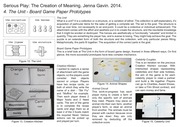
This is a brief look at The Unit in the form of board game design, themed in three different ways. On first
glance, the more successful prototypes have less complex mechanics.
Figure 12. The Unit
Figure 13. Creation Kitchen
Creation Kitchen
I wanted to capture a sense
of attachment with the game
objects, so the players could
consider
their
objects
sacred or unique. Players
have two recipe cards, on
both of which they write the
name of a dish - “Stir Fry”
and “Muffins” for example.
Then each player draws 2
Major foods and 2 Need
cards. The aim of the game
is to complete the recipe
cards and align them so at
least 2 of the 3 foods match
the required Need. Various
actions can be picked up
and played per turn.
Figure 14. Animal Shapes
Animal Circuit
This work-in-progress has each
player trying to create a farm of
only the specific sort of animals
they need. Players may place an
animal into their own farm, another
player’s farm, or steal an animal
from another. The animals must be
placed with caution because once
they are down they are only
removed by deducting off the
collective score.
Celebrity Couples
This is an iteration on the previous
Creation Kitchen concept. With
interlocked shapes representing
celebrities and their side hobbies,
the aim of the game is for each
celebrity player to meet a partner
and build a life together. Players
can go to Charities, Award Shows,
or take a Film Shoot contract, and
can earn money and fame.
Figure 15. Celebrity Unit
�
Serious Play: The Creation of Meaning. Jenna Gavin. 2014.
Patterns in Practice
Auto-biographical Analysis
What follows is a short preliminary analysis of my emerging practice as a game and installation designer. I’ve documented four recent projects that
cover a broad spectrum of interactivity: Installation; arcade cabinet game; casual video game; board game. Of particular interest are the patterns and
themes I use to express myself, which influence the meaning that I create in my work.
Simple Colour and Images
In Word Wars Mini and Spy Game, I’ve used bright, simple colours, which I consider a functional choice for helping the player distinguish game
elements. The strong splashes of colour echo arcade and casual online video games as well as the Euro-style board games, of which I am
acquainted. I’m not consciously referencing particular design aesthetics, merely creating simple shapes that separate the game space. I was using
colour in Cut and Paste until I recognised the clutter it was creating. Cut and Paste demonstrates a soft, neat digital sketch style that would feature
in more of my work if I chose to hand-sketch.
Reduction and Minimalism
A pattern I am aware of in my work is the habit of reducing and cutting. I pared back Cut and Paste successfully, switching out colour for greyscale,
multiple moving lines for one, and reducing the number of elements on-screen. Given enough time, the ugly initial prototypes become smoother and
less complicated, more refined and abstract. My initial ideas are usually complicated and tangled with other ideas; it takes a lot of thinking to distill a
single good idea. Much of the hard work is in designing the system to express the idea in my head, and how to use simple mechanics to express the
idea. Looking at Word Wars Mini, Spy Game, and Animal Circuit as examples, I work best when I have self-imposed restrictions on my creative
direction. Sometimes it is a pair of keywords that can provide the limitation: spy & 1960’s, eight-players & one-button game, cooperative & unit. It
creates a virtual Venn diagram that focusses my attention on mechanics that express the keywords.
No Instructions
In my digital works, I often provide the bare minimum of instruction for the player. I reason that many and sometimes all instructions are unnecessary,
as the game system can offer guidance in many other ways. I’m not afraid that the player get it wrong, because I value the experience of discovery.
The system should be able to catch the player when they fall. Another reason for the lack of instructions is that they break the feel of the gamespace.
This relates back to minimalism, and perhaps can be seen as a design of a neat system for the messy interactions of the player.
Variation and Possibility
When creating a game or installation, I follow design trails until they cut off the possibilities for the player. I can move no further with a system that is
static and predictable; it brings boredom for the player and designer. I’m better at achieving variable works in digital form, due to the data-handling
and algorithms I can leverage from the computer. Wordplay is a favourite outlet for creative possibilities.
�
 Historical archive . public document