SAN FRANCISCO
IN PARADISUM
San Francisco: 1905 and beyond
�
Ladies and Gentlemen,
for your entertainment, pleasure
and edification, the
Edge of Darkness Vampire Storytelling
team are proud to present
a supplement setting...
�
Introit: Or, if the Past is a Different Country;
what shall we do when we get there?
It's often said that the past is a different country and that they do things differently there. That could
well be true. At the beginning of the 20th Century everything seemed possible. The Future looked
bright.
This city, so rich, so new...so vibrant...should be Paradise.
Certainly families like the Rockerfeller's, the Vanderbilt's and the others have a lot of the wealth and
power. But a man may, with luck and toil, still find his own piece of the American Dream. It's a time
when a man may still feel compelled to fight a duel over a matter of honour and the launching of a
battleship is a source of widespread national pride.
There is much to do. The Future remains to be forged and grasped. There is much to fight for.
This could...this should...be Heaven for everyone.
Can you help make this Paradise?
What will Salvation cost?
So, as a Gamer,
what can you expect from all this?
You might be asking: why did we decide to go all the way back to 1905 and the heady days of the
beginnings of the American Century?
Well, there's a few narrative options and themes we wanted to explore. This offers a chance for this
setting to mix and interact with the present in a way we thought could be interesting and help add
depth to the overall setting.
Not only might plot and NPC's eventually intermingle, but, similar to Hungry Streets, there's a
chance for Vampires to migrate from In Paradisum to present day Sacramento. We also, with
appropriate and sensible adjustments and if it synchronizes with their Backgrounds plan to allow
existing Vampire characters in Sacramento to appear in In Paradisum.
What we've tried to do is lay out the broadbrushed strokes of a setting. Putting a little bit of
historical context into it so it's not just a piece of costume drama but, hopefully, has a little more
'look and feel' of the time. Where the animating principle of Hungry Streets is survival, the primary
theme of In Paradisum is the quest for either a personal, economic or spiritual Paradise and
Salvation.
�
Contents
1. There will also be a section on rules to explain some ingame details of the setting and
character creation.
2. A general introduction to the geography and society of San Francisco
3. A brief history of the city ~ including some contemporary world and city events too
4. A brief introduction to a few important local Mortals and Kindred
5. Throughout this Background Supplement there are 'snapshots' which look at notable world
events, culture to help introduce anecdotes about the time and place in a hope to supply some
insight into some of the Dramatis Personae.
6. There are several maps throughout to help your Vampire find their way around.
7. There's a section on notable NPC's too; people whom your characters may or may not have
cause to meet, fear or generally know.
Rules for Hungry Streets
Like the previous Hungry Streets the premise for In Paradisum is simple: this is Tier 1 gaming.
What you are looking at is a life of survival. As a Vampire of the Hungry Streets, you are either new
to the world of vampires or new to the city.
This is not an easy game, you will be weighed and you will be measured. If you are found lacking,
you may not survive. As you enter the Hungry Streets you may not know all the nuances, you may
not understand all the laws of the domain. But you are a vampire, and you know what you need to
survive; shelter from the sun and blood. But neither one may be in a ready supply. You want to make
sure you are under the radar, nothing flashy. Because if you're found squatting... there will be hell to
pay.
You start with 030xp Character Creation XP
There's a 60xp cap: When a character has earned 60xp, they can either 'graduate' to the main
game or remain at Street Level 'frozen', earning no more XP.
You start out at 1 Blood Potency and remain as such for the duration of your journey through
the Streets.
Streets won't support Bloodlines. There will be the five Clans, and nothing else. If/When a
character graduates to the main game, they can then activate a Bloodline.
This also applies to Covenants. You may not buy any dots in Covenant merits. Besides, you’ll
need your XP for survival. (But the Covenants do exist.)
As always, you are advised to please read “The Devil is in the Dots”
You are still required to do a feeding mood.
The same Vitae Pools rules are in place for this game as the main venue.
You may have only 'one' ghoul, but keep an eye on your Vitae Pool because of this and you
may have 1 dot in Herd.
You may not have your haven above 2 dots and only 1 dot can be used in Location.
Allies and Contacts cannot be above 2 dots.
These rules will keep The Hungry Streets at Tier One, and dynamic.
Note: Also, these rules are subject to change as this is a new addition to the Vampire venue.
�
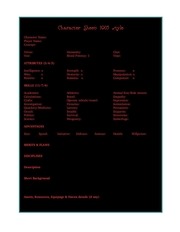
Character Sheet: 1905 style
Character Name:
Player Name:
Concept:
Virtue:
Vice:
Humanity:
Blood Potency: 1
Clan:
Vitae:
Strength: o
Dexterity: o
Stamina: o
Presence: o
Manipulation: o
Composure: o
Athletics:
Brawl:
Operate vehicle/vessel:
Firearms:
Larceny:
Stealth:
Survival:
Weaponry:
Animal Ken/Ride mount:
Empathy:
Expression:
Intimidation:
Persuasion:
Etiquette:
Streetwise:
Subterfuge:
ATTRIBUTES (5/4/3)
Intelligence: o
Wits: o
Resolve: o
SKILLS (11/7/4)
Academics:
Calculations:
Crafts:
Investigation:
Quackery/Medicine:
Occult:
Politics:
Science:
ADVANTAGES
Size:
Speed:
Initiative:
Defence:
Armour:
MERITS & FLAWS
DISCIPLINES
Description
Short Background
Assets, Resources, Equipage & Haven details (if any)
Health:
Willpower:
�
SAN FRANCISCO
A General Geographic Description
The chief seaport and city of California and the Pacific Coast. In 1910 it will be the tenth most
populous city of the United States and the most important city west of the Missouri River.
Geographically it's situated centrally on the coast of the State (37° 47' 22'55" N and 122° 25' 40.76"
W.) at the end of a peninsula; with the ocean on one side and the Bay of San Francisco on the other.
San Francisco has experienced a growth in population. It has risen from 34,000 citizens in 1850 to
298,997 by 1890. In 1900 the population is 342,782 of whom 116,885 are foreignborn. Just over
17,000 of these newly arrived citizens are from Asia and a great many are confined to the dangerous
and exotic Chinatown.
The peninsula is roughly between six and eight miles broad within the city limits. The Bay is some
50 miles long with a shoreline of more than 300 miles, covering an area of about 450 sq. miles; of
which 79 are within the very useful and navigable three fathom limit. This great inland water
receives the two principal rivers of California: the Sacramento and San Joaquin.
The islands of the Bay are part of the municipal district, as are also the Farallones (a group of rocky
islets about 30 miles out in the Pacific). However, several of the islands are controlled by the national
government and are fortified for maritime defence.
�
Perhaps the most famous of these islands is Alcatraz. In 1905 Alcatraz Island houses a United States
military prison (control of this transfers to the civilian Federal authorities in 1933). It became a
military fort in 1855 with a garrison of 200 soldiers. One of the original team of US Engineers sent to
construct the fortifications for Fort Alcatraz would become the highest ranking Union solider killed in
action during the Civil War. However, though well armed and defended, the garrison of Fort
Alcatraz itself never fired a shot in anger during the Civil War...nor, in fact, at any point of its 81
years as a military establishment.
The Engineers constructed Fort Alcatraz as part of the 'Triangle of Defence' of San Francisco Bay with
two other forts at Fort Point and Lime Point.
Additional Federal Government bases are dotted around the Bay – including one on Goat Island.
Goat Island being the home base of the United States Naval School of the Pacific.
With the increase in shipping to San Francisco during the Gold Rush in the 1850's it was recognised
that a lighthouse would be needed to help with improving the safety of navigation to the harbour.
So, in addition to the military presence on Alcatraz, the United States Coastguard built and
maintained a lighthouse on Alcatraz island.
There's usually a close and cordial relationship between the military and the lighthouse keeper on the
island.
In addition to the beacon light, the Coastguard installed a large fog bell in 1856 when it became
obvious that San Francisco's fog often rendered the original beacon ineffective! The original bell had
to be rung by hand. Later fog bells had a clockwork mechanism which would automatically ring the
bell at prescribed intervals. By the late 1860's an improved flashing beacon lens was installed in the
lighthouse to help mariners distinguish the beacon lamp from the lights of the city along the shore.
�
The original Alcatraz Island lighthouse. Built 1854 it was replaced in 1909 by the current design
In 1905 the Alcatraz fog signal bell sounds a bell every 10 seconds – the electronic Klaxon signal with
the sound familiar to many is installed in 1909 when the lighthouse is repaired after the Earthquake.'
There's another lighthouse station on Yerba Buena Island.
The old Spanish "presidio" is a United States military garrison. There is another, smaller garrison
base, close by Fort Mason Government Reservation. Additional military bases include the United
States naval station of the Pacific on Mare Island in San Pablo Bay opposite Vallejo and the various
coastal fortifications and at the harbour entrance which, between 1890 and 1900, were improved.
These lie through the Golden Gate which is a strait about 5 miles in length. The outlook from Mount
Tamalpais ascends 2,592 feet and is a few miles north. The summit provides excellent views of the
city and bay.
The Hills
There are nine main hills and 35 smaller hills in the city and the site is overall dominated by a line of
high rocky elevations which run in a crescent shape from NorthEast to South West across the
peninsula culminating in the Twin Peaks (Las Papas, " The Breasts ") which are 925 feet high.
Telegraph Hill is in the extreme north east. Nob Hill is 300 feet in elevation – this is where the
railway and mining 'kings' of the 1860's and 1870's built their impressive mansions. It is no longer
the most exclusive neighbourhood, but it continues to physically dominate the city all the same. The
Pacific Heights are now holds title as the most exclusive neighbourhood. The Golden Gate Park plays
host to Strawberry Hill (some 426 ft high).
Hilly as the city is, Man has actually worked tirelessly to shape to geography. Great hills were razed
and tumbled into the Bay for the gain of land and others were carved out to create street grades and
to the checkerboard city plan adopted in the early days.
�
Cable cars (more on them later!) and lines were first practically tested in San Francisco in 1873 (the
Earthquake will lead to a greater use of electricity.) A scenic driveway of some 20 miles may be taken
along the ocean front through the Presidio, the Golden Gate Park and through a series of well
appointed streets in the west end.
Market Street is the principal business street and is more than 3 miles long and 120 feet broad. For
nearly its full extent, excepting the immediate waterfront, and running westward to Van Ness
Avenue, a distance of 2 miles.
Throughout the city there are thousands of wooden buildings and these provide the city with a
striking architectural characteristic. The citizens aren't ignorant of the threat from earthquakes. Far
from it. One reason they make great use of wood is that they believe that redwood (in addition to
being plentiful and cheap) is better suited to withstanding earthquake shocks.
In fact, such thinking will be proved correct. Sadly, whilst the wooden buildings suffered little
damage by the shocks, the comparative noninflammability of redwood provided no safeguard to the
fire that swept the afflicted area.
Ah, it will be a terrible thing that results, but in 1900 only onethirteenth of the buildings in the city
were of other material than wood. This will be obvious to all walking the streets and to Vampires in
particular!
In the Earthquake of 1906 28,000 buildings will be destroyed causing damage estimated at
$105,000,000 (in contemporary values). However, the Earthquake will supply an opportunity for the
city to rebuild and possess office and business buildings of the then most modern type.
�
 Historical archive . public document