Adolescents’ Language Choice in Child-Parent Interactions:
The Role of Family Linguistic Context
By
Maria Medvedeva
Move2
step1
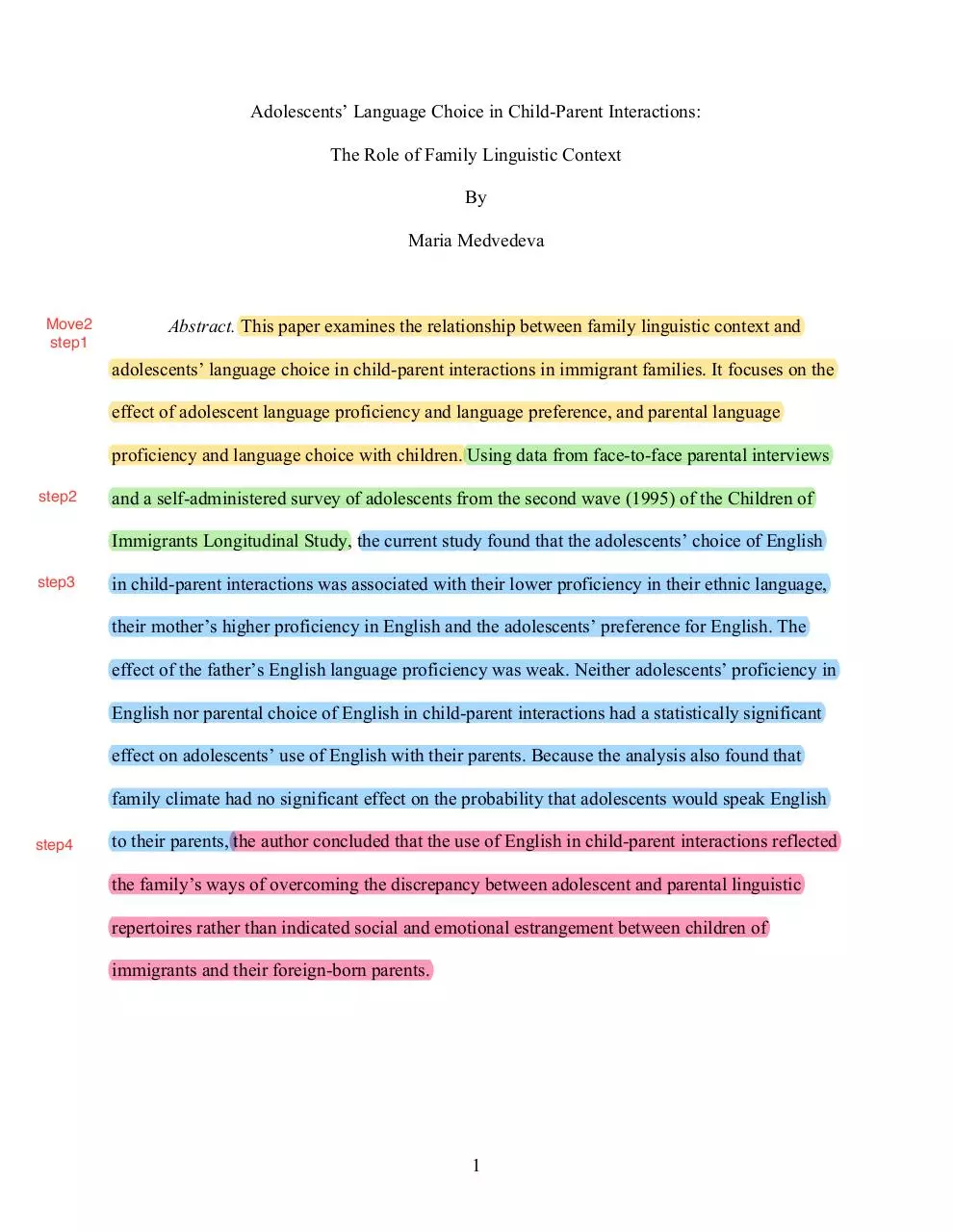
Abstract. This paper examines the relationship between family linguistic context and
adolescents’ language choice in child-parent interactions in immigrant families. It focuses on the
effect of adolescent language proficiency and language preference, and parental language
proficiency and language choice with children. Using data from face-to-face parental interviews
step2
and a self-administered survey of adolescents from the second wave (1995) of the Children of
Immigrants Longitudinal Study, the current study found that the adolescents’ choice of English
step3
in child-parent interactions was associated with their lower proficiency in their ethnic language,
their mother’s higher proficiency in English and the adolescents’ preference for English. The
effect of the father’s English language proficiency was weak. Neither adolescents’ proficiency in
English nor parental choice of English in child-parent interactions had a statistically significant
effect on adolescents’ use of English with their parents. Because the analysis also found that
family climate had no significant effect on the probability that adolescents would speak English
step4
to their parents, the author concluded that the use of English in child-parent interactions reflected
the family’s ways of overcoming the discrepancy between adolescent and parental linguistic
repertoires rather than indicated social and emotional estrangement between children of
immigrants and their foreign-born parents.
1
�
Sociolinguistic research positions language choice among the three inter-related
components of individual language behavior, together with language proficiency and language
attitudes (Hakuta and D’Andrea 1992). Hakuta and Pease-Alvarez (1994, 148) define language
choice as “an individual’s choice to use differential amounts of the languages (in different
discourse settings) given threshold proficiency in the languages.” Rather than being “a random
matter of momentary inclination”, language choice is commonly described as an “an ‘orderly’
social behavior” (Li Wei 1994, 6). Because of its implied stability and assumed direct
relationship to language proficiency, and because of the nature of language data collected by
U.S. Census Bureau, immigrant language choice has been studied extensively. Use of an ethnic
language at home, and particularly in child-parent interactions, remains a central theme in the
study of immigrant linguistic adaptation in the United States.
Past research conceptualizes language choice in child-parent interactions in a variety of
ways: as the family’s habitual pattern of language use (Fishman 1971; 1972), as a negotiation of
the home and outside linguistic influences (Caldas 2006), as an enhancement of a marketable
skill (Zhang 2008), as a realization of parental commitment to child’s socio-psychological wellbeing (Harding-Esch and Riley 2003; Portes and Hao 2002), or as an indicator of children’s
independence from or emotional closeness to their parents (Tseng and Fuligni 2000; Burck
2005). Most commonly and across ethnic groups, language choice at home is described as
correlating with the shifting significance of ethnicity for children of immigrants (Fishman 1966;
Zhou and Bankston 1998; Portes and Rumbaut 2001; Schecter and Bayley 2002; Pease-Alvarez
2003; Zhang 2005).
This study contributes to sociological research on immigrant linguistic adaptation by
exploring the sociolinguistic mechanisms of adolescents’ language choice in child-parent
interactions in immigrant families. It examines four specific questions:
2
�
(1) How does adolescents’ preference for English language influence the probability that the
adolescents will speak English to the parents?
(2) How does adolescents’ oral proficiency in their ethnic language influence the probability
that the adolescents will speak English to the parents?
(3) How does the mother’s and father’s oral proficiency in English influence the probability
that their children will speak English in child-parent interactions?
(4) How does parental choice of English language influence the probability that their children
will speak English in child-parent interactions?
Accordingly, the study advances four specific hypotheses about the relationship between
family linguistic context and adolescents’ language choice in child-parent relationships:
(1) Adolescents’ preference for English language increases the probability that adolescents will
speak English to their parents.
(2) Adolescents’ lower oral proficiency in their ethnic language increases the probability that
they will speak English to their parents.
(3) Lower parental proficiency in English decreases the probability that the adolescents will
speak English to their parents.
(4) Parental choice of English with children increases the probability that the adolescents will
speak English to their parents.
The analysis of data from face-to-face parental interviews and a self-administered survey
of adolescents from the Children of Immigrants Longitudinal Study showed that the majority of
parent-adolescent pairs reciprocally spoke their ethnic languages, followed by a non-reciprocal
pattern with adolescents speaking English and their parents speaking their ethnic languages. The
probit analysis found that adolescents’ choice of English was strongly associated with their lower
self-reported proficiency in their ethnic language, their mother’s higher English proficiency, and
the adolescents’ English preference, pointing to the linguistic foundation of adolescents’
language choice with parents as a viable addition to other explanations.
The Significance of Language Choice in the Immigrant Family
The family plays a central role in individual language development. From incidental to
planned language choices in infancy and early childhood, to literacy-oriented activities during
3
�
school years, the family establishes expectations and norms of individual language behavior at
home and outside of it, shapes children’s attitudes to languages and language speakers, and,
overall, creates a home environment that may facilitate or hinder individual language
development (Grosjean 1982; Hamers and Blanc 2000).
Past research shows that the bilingualism of children of immigrants in the United States
begins within their families, when children acquire proficiency in their ethnic languages through
daily conversations with their parents, grandparents, siblings and other family members (Portes
and Rumbaut 2001; Schecter and Bayley 2002). Studies by Pease-Alvarez and her colleagues
(1996) and Zhang (2008) show that parents of Mexican and Chinese background explicitly
define speaking their ethnic languages at home as their primary strategy for the ethnic language
maintenance of their children. The immigrant family actively shapes children’s language
development until early adolescence, when the family’s direct linguistic influence diminishes
(Veltman 1983, Caldas 2006). Fishman (1966, 184) argues that as adolescent children of
immigrants integrate into the educational and occupational structures of American society and
disengage from the ethnic cultural life of their families, they tend to “outgrow” the linguistic
authority of their foreign-born parents. Adolescents become more ambivalent about the linguistic
practices of their families. Children of immigrants from families reinforcing bilingual-biliterate
practices may become resentful toward the linguistic aspirations of their parents because of the
increased peer pressure to conform linguistically and also with growing demands of school and
extracurricular activities (Okita 2002; Caldas 2006). If children of immigrants shift toward
English monolingualism, this shift is completed within their families, when the English
language--the dominant language of a larger society--gradually becomes the exclusive medium
of communication between children of immigrants and their foreign-born parents (Fishman
1966; Hakuta and Pease-Alvarez 1994; Hamers and Blanc 2000).
4
�
It would be misleading, however, to picture the linguistic change in an immigrant family
as simply a linear shift from ethnic language monolingualism to transitional bilingualism and
toward English monolingualism, and to disregard the complex interplay of family’s linguistic
repertoires contributing to that shift. Past findings about the use of English and ethnic languages
by grandparents, parents, and siblings indicate that the immigrant family is never a domain of
exclusive ethnic language use, regardless of family’s ethnic origin (Zhang 2008, Stevens and
Ishizawa 2007; Schecter and Bayley 2002). Instead, Fishman (1966, 181) described the
immigrant family as “a meeting ground for two competing languages” and emphasized its dual
function in immigrant linguistic adaptation:
On the one hand, by transmitting the ethnic mother tongue and ethnic ways to Americanborn children, [the immigrant family] serves as a bulwark of ethnicity. On the other hand,
by brining together siblings whose use of English continues to rise as they grow older, it
also becomes an agency of Americanization of immigrant parents and their children
alike.
Fishman (1966, 181) argued that the two roles of the immigrant family were “scarcely
reconcilable”, making the immigrant family particularly vulnerable to competing cultural
influences. Burck (2005), on the other hand, observed that not only were the immigrant parents
and their children living in the two cultural worlds of their host society and country of origin, but
they also actively negotiated any cultural and linguistic differences and contradictions between
these two worlds. For example, Burck (2005) described how bilingual immigrant parents in her
study in England spoke English to their children to “perform authority” (p.140) or to connect to
their children’s concerns, which were often experienced in English. The same parents chose their
ethnic languages to express feelings of intimacy and “cultural similarity” with their children,
often shaped by their own childhood memories (p.136). Burck (2005, 143) wrote:
… just as individuals described being different in each of their languages in other
contexts, they also experienced parenting in each of their languages as being a different
5
�
kind of parent, embodying different values encoded in the language, including different
conceptualizations of ‘parenting’ and ‘children’.
Distinct cultural meanings and personal experiences associated with ethnic and English
languages, and family members’ awareness about these differences, rendered language choices
of children of immigrants and their foreign-born parents particularly consequential for childparent relationships (Portes and Rumbaut 2001; Portes and Hao 2002) and ethnic language
maintenance (Fishman 1966).
Empirical evidence shows that adolescents’ ethnic language proficiency and choice at
home are strongly associated with the quality of child-parent relations in their families, although
the direction of this relationship is unclear. On the one hand, the dissonant-acculturation
argument proposed by Portes and Rumbaut in 2001 suggests that once ethnic language
proficiency is lost, “fluent communication across generations ceases, opening the way for
affective separation and weakening of parental authority” (p.127). Portes and Hao (2002)
examined distinct forms of adolescents’ linguistic adaptation and their consequences for family
solidarity and child-parent conflict. The authors empirically distinguished fluent bilinguals,
English monolinguals, limited bilinguals and foreign monolinguals as linguistic types among
children of immigrants. Using longitudinal data and controlling for usual demographic predictors
of linguistic adaptation, Portes and Hao (2002) found that, over time, fluent bilinguals reported
greater family solidarity and lower child-parent conflict than members of other linguistic types;
these positive effects were not contingent on English ability of their parents. Portes and Hao
(2002) concluded that early acquisition of fluent bilingual skills predicted subsequently better
child-parent relationships. These results were consistent with findings reported by Zhou and
Bankston (1998) and Portes and Rumbaut (2001) that families in which either parents or children
were fluent bilinguals likely followed the path of selective acculturation, associated with more
6
�
positive child-parent relationships, and higher self-esteem, fewer depressive symptoms, and
higher academic achievement among children; children who maintained proficiency in their
ethnic languages enjoyed the greatest socio-psychological benefits of selective acculturation.
The causation, however, may go the other way. The positive association between ethnic
language use and child-parent relationships can be in part explained by children’s sense of family
obligations usually expressed through support of and respect toward their foreign-born parents
who immigrated for the better future for their children. A 1999 study by Fuligni and colleagues
found that, on average, adolescents with Asian and Latin American families placed greater
importance upon treating their elders with respect, following parental advice, and helping and
being near their families in the future than did adolescents with European backgrounds. The
authors also found that adolescents who placed greater value on family obligations reported
greater emotional closeness with their mothers and fathers, and a greater likelihood of asking for
parental and siblings’ advice about current life and future plans. The study did not ask
adolescents about their language use. We could speculate, however, that adolescents who value,
respect and communicate with their family members, and develop close emotional relationship
with their parents, are more likely to accommodate parental linguistic needs and preferences in
child-parent interactions.
Tseng and Fuligni (2000) examined the directionality of the relationship between childparent relationships and ethnic language use among East Asian, Filipino, and Latin Americanorigin adolescents in the United States. Similar to Portes and Hao (2002), the authors found that,
on average, adolescents from families with reciprocal language use in child-parent interactions
(when both parents and adolescents speak the same, either English or an ethnic, language)
reported greater family closeness and more frequent discussions of daily issues, personal
problems and future plans than did adolescents from families with a non-reciprocal language use.
7
�
Adolescents reciprocally using their ethnic language with their parents reported higher average
scores on family closeness and discussion scales than did adolescents from families reciprocally
speaking English. With longitudinal data, Tseng and Fuligni (2000) also found, however, that
family relationships were a stronger predictor of language-use patterns over a two-year period
than vice versa. More favorable child-parent relationships were associated with either English or
ethnic reciprocal language choices, and, in those relationships, parents were likely to choose the
language preferred by their children (Tseng and Fuligni 2000). The authors concluded that the
association between language use and child-parent relationships was established prior to midadolescence and determined family language choices afterwards.
Motives for Speaking an Ethnic Language at Home
Past studies indeed show that positive family relationships could be a defining motive in
children’s ethnic language maintenance and use at home. Schecter and Bayley (2002) argued that
the continuous use of Spanish among children from Mexican-origin families was first and
foremost motivated by children’s affective attitude to that language as an important part of their
family’s history. The authors (2002, 197) observed that:
…for the children we worked with, questions of the status of different language varieties,
attitudes of the dominant society toward their family’s language, and even success in
school were not their main issues. Rather, children who had maintained proficiency in
Spanish most often provided affective rationales for wanting to continue to speak their
families’ traditional language.
Shared ethnicity and cultural identity were cited as additional factors (Hakuta and PeaseAlvarez 1994; Schecter and Bayley 2002). In her study of Mexican-origin families in California,
Pease-Alvarez (2003) found that both parents and their adolescent children described a close link
between one’s ability to speak Spanish and Mexican identity. Adolescents felt that they needed
to improve their Spanish language skills in order to participate comfortably in Spanish-dominant
8
�
social networks, to avoid embarrassment when speaking Spanish, and to reestablish links with
their ethnic culture.
The linguistic foundation of language choice at home, in addition to affective and cultural
influences, was emphasized by Fishman (1966) and Hakuta and Pease-Alvarez (1994). The
authors reported that adolescents’ language choice at home was critically influenced by
adolescents’ relative proficiency in their two languages: on average, children of immigrants more
proficient in their ethnic languages were more likely to use those languages in conversations with
their parents. Hakuta and D’Andrea (1992) and Zhou and Bankston (1998) also pointed to the
significant effect of parental language proficiency and choice. Zhou and Bankston (1998, 113)
considered the parents’ lack of English proficiency among the three main factors of ethnic
languages retention among children of Asian origin, together with continuing high rates of
immigration from Asia and living in an area inhabited by co-ethnics.
Contrary to the frequently mentioned pragmatic rationale for ethnic language
maintenance, Schecter and Bayley (2002) and Zhang (2008) observed that prestige and
marketability of an ethnic language, and other potential “future gains” from maintaining an
ethnic language, were relatively weak predictors of adolescents’ current language choice at
home. Similarly, while the linguistic standards of school, peer group and local community could
reinforce or hinder parental efforts of language maintenance at home (Caldas 2006), findings by
Hakuta and D’Andrea (1992) indicated that adolescents’ language choice in child-parent
interactions was relatively immune to those outside influences.
Motives for Not Speaking an Ethnic Language at Home
Hakuta and D’Andrea (1992) suggested that there might be situational and attitudinal
reasons for not speaking an ethnic language at home. Adolescents’ increasing use of English
9
�
 Historical archive . public document