ICICTE 2013 Proceedings 2013
294
EXAMINING AN ONLINE MINI-COURSE ON WRITING IN
ENGLISH AS A SECOND LANGUAGE
Maria Eugenia Witzler D’Esposito
GPEAHF/CNPq
Brazil
Abstract
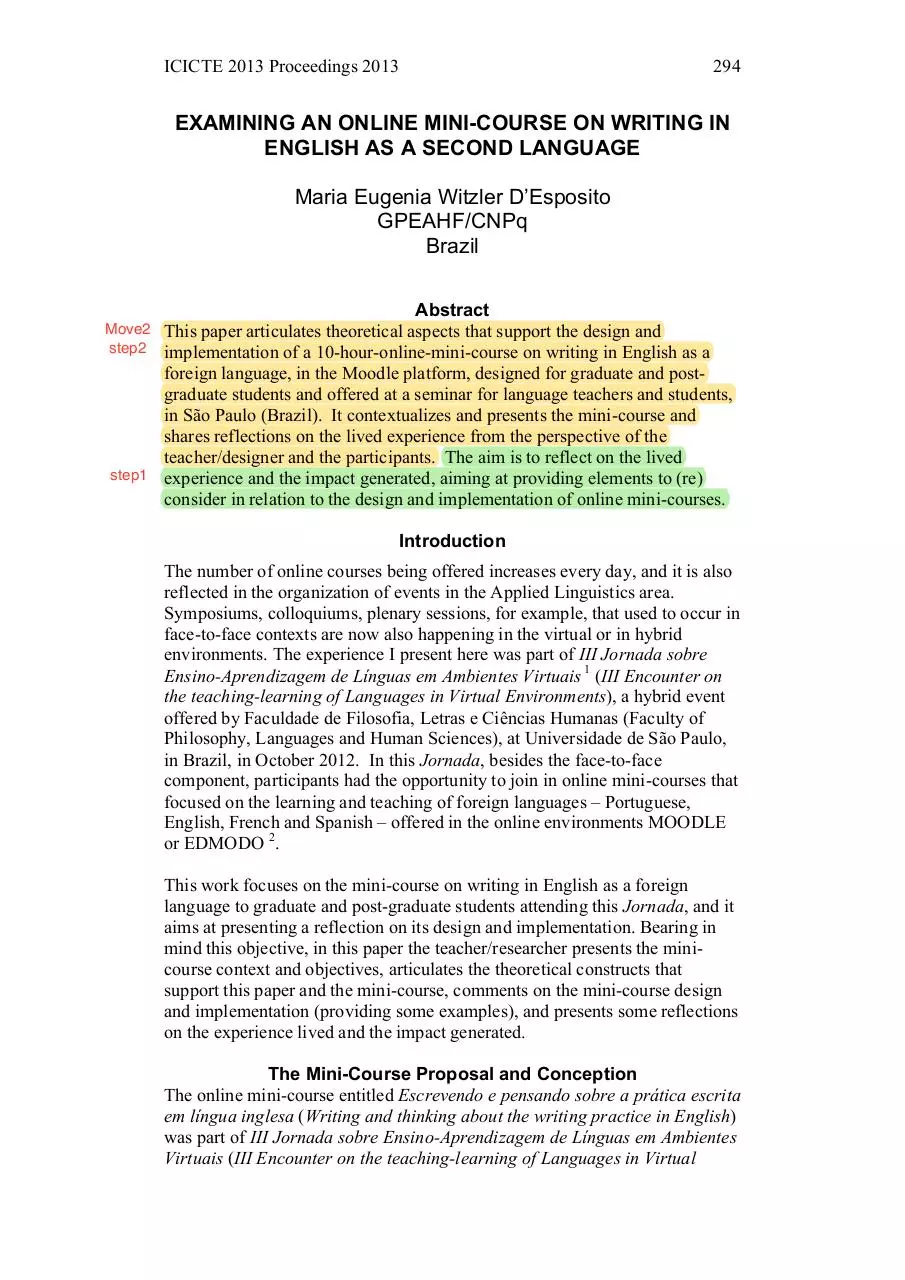
This paper articulates theoretical aspects that support the design and
implementation of a 10-hour-online-mini-course on writing in English as a
foreign language, in the Moodle platform, designed for graduate and postgraduate students and offered at a seminar for language teachers and students,
in São Paulo (Brazil). It contextualizes and presents the mini-course and
shares reflections on the lived experience from the perspective of the
teacher/designer and the participants. The aim is to reflect on the lived
step1 experience and the impact generated, aiming at providing elements to (re)
consider in relation to the design and implementation of online mini-courses.
Move2
step2
Introduction
The number of online courses being offered increases every day, and it is also
reflected in the organization of events in the Applied Linguistics area.
Symposiums, colloquiums, plenary sessions, for example, that used to occur in
face-to-face contexts are now also happening in the virtual or in hybrid
environments. The experience I present here was part of III Jornada sobre
Ensino-Aprendizagem de Línguas em Ambientes Virtuais 1 (III Encounter on
the teaching-learning of Languages in Virtual Environments), a hybrid event
offered by Faculdade de Filosofia, Letras e Ciências Humanas (Faculty of
Philosophy, Languages and Human Sciences), at Universidade de São Paulo,
in Brazil, in October 2012. In this Jornada, besides the face-to-face
component, participants had the opportunity to join in online mini-courses that
focused on the learning and teaching of foreign languages – Portuguese,
English, French and Spanish – offered in the online environments MOODLE
or EDMODO 2.
This work focuses on the mini-course on writing in English as a foreign
language to graduate and post-graduate students attending this Jornada, and it
aims at presenting a reflection on its design and implementation. Bearing in
mind this objective, in this paper the teacher/researcher presents the minicourse context and objectives, articulates the theoretical constructs that
support this paper and the mini-course, comments on the mini-course design
and implementation (providing some examples), and presents some reflections
on the experience lived and the impact generated.
The Mini-Course Proposal and Conception
The online mini-course entitled Escrevendo e pensando sobre a prática escrita
em língua inglesa (Writing and thinking about the writing practice in English)
was part of III Jornada sobre Ensino-Aprendizagem de Línguas em Ambientes
Virtuais (III Encounter on the teaching-learning of Languages in Virtual
�
ICICTE 2013 Proceedings 2013
295
Environments). The mini-course load comprised 10 hours, distributed during
two days. It was planned for the Moodle platform, and it was designed
considering a maximum of twenty participants: graduate and post-graduate
language students. There was no prerequisite in terms of participants’
language competence and a minimum of two accesses was required per day.
Its main inter-connected objectives were: (1) provide participants with a
writing situation in English as a foreign language in the online environment,
and (2) reflect on the learning teaching experience lived.
As for its conception, the aim was a design and an implementation that would
allow knowledge construction, establishing a connection between the course
content and the professional and/or personal lives of the participants. The goal
was a mini-course in which the participants and the teacher/researcher would
live and face the upcoming challenges, uncertainties, risks; deal with the
unpredictable and the relation order/disorder; include the observer, his
emotions and feelings; and consider its context, searching for pertinent
knowledge, and do collaborative work (Morin, 2006, 2006b, 2008).
The Theoretical Constructs
Complexity, complex online design, and writing in English as a second
language are the three main aspects that dialogue and underlie the mini-course
conception and, consequently, this research and paper. Thus, in this section, I
present, discuss and articulate these constructs, focusing on the design and
implementation of the online mini-course on writing in English as a second
language to graduate and post-graduate language students.
Complexity
Even though people generally associate the term complexity to something
difficult, complicated, or elaborate, Morin (2006, p. 89; 2008, p. 190) points
out that it derives from the Latin word complexus and it means, “What is
weaved together.”3 Thus, the complex vision substitutes the thought that
isolates and reduces for one that unites, so the physical world is perceived not
as a collection of fixed or isolated parts arranged in a certain order but a net of
relations, of interrelated events.
With this view, knowledge is perceived and co-produced/co-constructed via
our dialogue with the world (Morin, 2008), requiring interaction with the
object and the physical and social environments (Moraes, 2006). Knowledge
construction is, then, related to non-linear or pre-determined enrichments,
generated when we live processes and explore connections, relations, and
integrations. Therefore, complexity values and is concerned with processes,
dialogue, interactions and weaves, and it aims at non-fragmentized, linear,
detached, individualized, reductionist or compartmentalized knowledge or
curricula (Behrens & Oliari, 2007; Moraes, 2006, 2008). Experiences are
valued and considered and the human beings are seen as constituted by
reasoning, sensations, emotions, feelings, and intuitions (Morin 2006; Moraes,
2006; Behrens & Oliari, 2007; Mariotti, 2007).
�
ICICTE 2013 Proceedings 2013
296
Three interdependent principles help us think about complexity (Morin, 2006,
2006b). The recursive principle establishes a process in which products and
effects are at the same time producers and the cause of what is being
produced. This recursion ruptures with the linear idea of cause/effect,
product/producer, once everything produced is connected to what produces it
in a self-constitutive, self-organized and self-productive cycle. The
hologrammatic principle understands that not only the part is in the whole, but
also the whole is inscribed into the part. Thus, it is possible to enrich the parts
by the whole and vice versa. The dialogical principle conceives a dialogue
among aspects that have antagonistic relations. It allows us to maintain the
existing duality, and to assume, rationally, the inseparable that exists in
notions that are complementary and not contradictory, allowing us to
understand them.
Aiming at the design of an online mini-course of English that could meet
complexity and the aspects mentioned above, it was essential to consider
instructional design theory and reflect on a complex instructional design.
Complex Instructional Design
Instructional design is an intentional and systematic action that involves
planning, development and application of methods, techniques, activities,
materials, events and products in didactic situations (Filatro, 2003, 2008).
Based on the ADDIE model4 , which involves the phases of analysis, design,
development, implementation and evaluation, Filatro (2003) proposes a
contextualized instructional design in which these phases would occur
recursively along the process, not involving any degree of absolute prediction
or prescription. Some aspects from complexity are contemplated in this
proposal, but it cannot be considered a complex one because all the design (as
well as the activities and materials) is expected to be pre-established
beforehand.
Complex design should not be pre-established but co-constructed by exploring
connections, relations, and integrations when living the process. It is
composed by interrelated and continuous phases of needs’ identification,
design, design and implementation, and reflection, in a permanent movement
that allows a weave of nets. Under this perspective, design is not detached
from implementation, once they occur recursively in interdependent processes,
in a hologrammatic and dialogical way. Thus, design and implementation do
not exist as separate phases (implementation being a result of the design
phase), but design and implementation as interconnected, complementary, and
inseparable experiences. In a complex design and implementation model the
term design, then, corresponds to what is commonly named in the literature
design and re-design (D’Esposito, 2012a,b).
The Methodology of Projects (Behrens, 2006) proposal goes in this direction.
It promotes an educational activity in which situations/problems that learners
might face are presented to them, leading to the search for answers and
learning with commitment, critical vision and ethics, without memorization.
Inter-connected phases are proposed (Behrens, 2006): (1) project presentation
and discussion; (2) problem statement - considering learners experiences and
�
ICICTE 2013 Proceedings 2013
297
interests; (3) contextualization - delineates the investigation and alerts on how
to look for information; (4) theoretical/dialogical classes; (5) individual
research and production (6) group discussion and production; (7) final
production - application of the individual and group productions; and (8)
learning and project evaluation.
The Methodology of Projects (Behrens, 2006) goes in this direction. It aims at
providing students an educational activity that would lead to learning with
commitment, critical vision, ethics, and without memorization by presenting
them with situations/problems they might face. The project would comprise
interconnected phases (Behrens, 2006): (1) project presentation and
discussion; (2) problem statement - considering learners experiences and
interests; (3) contextualization - delineates the investigation and alerts on how
to look for information; (4) theoretical/dialogical classes; (5) individual
research and production (6) group discussion and production; (7) final
production - application of the individual and group productions; and (8)
learning and project evaluation.
Considering and reflecting upon the Methodology of Projects, D’Esposito
(2012) proposed real learning situations as a way to work in a complex
perspective. They refer to situations that are, were, or would be part of the
learner’s professional or personal lives that lead to discussion, encourage the
search for new information, generate individual and group research and
production (counting on their theoretical-methodological-experiential
knowledge), and generate reflection on the world they are engaged into
recalling and considering professional performances and life experiences. In
real learning situations the teacher and learners deal with challenges,
uncertainties, contradictions, the unpredictable and the undetermined as they
come along, with pertinent knowledge being co-constructed through
interactions via collaborative work (Morin, 2006, 2006b; 2008).
Focusing on the design of a complex online mini-course of writing practice in
English as a second language it was also important to consider aspects in the
writing area as follows.
Writing
I see writing as a self-negotiation and discovery of meaning(s) process that
comprehends generation, formulation and refinement of ideas; commitment;
consciousness about a reader; and revision (Zamel, 1987). During the writing
process, learners should be able to organize information, develop fluency, gain
control over the vocabulary and use more complex structures, acquire maturity
in relation to the style, and reflect on its purpose and audience (Grabe &
Kaplan, 1996). At the end of the process, they should feel that the piece of
writing belongs to them, also relating the classroom practice to their real world
(Maybin, 1996). It is important to the learner to count on his previous
experiences, making himself understood using a variety of formal aspects by
transferring abilities and strategies from his mother tongue (Friedlanger,
1996).
�
ICICTE 2013 Proceedings 2013
298
Procedures such as cooperative learning, consciousness about the audience,
language and the need for editing, as well as the support of a teacher who
observes and plays the role of a facilitator, model, reader and a sustainer who
interferes in the work, structuring the writing and helping the writer
understand it are important aspects in the process (Grabe & Kaplan, 1996; Cox
1994).
Although the literature mentioned relates to writing in English as a mother
tongue, it provides relevant aspects to be considered in relation to writing in
English as a foreign language.
The Online Mini-Course Design & Implementation
The aim of the mini-course Escrevendo e pensando sobre a prática escrita em
língua inglesa (Writing and thinking about the writing practice in English)
was to provide a real learning situation close to the participants’ reality that
could foster the presentation of possibilities and/or proposals retrieving their
practical, tacit or theoretical knowledge, allowing the articulation of theory
and practice, the exchange of experience and reflection on the practices.
Activities that would lead to some investigation; autonomous and critical
knowledge production; readings; individual and group investigation (that
would allow participants to access various learning strategies, and, mainly, to
learn how to learn, not simply memorizing information); search for answers
with commitment and critical vision; exchange of information and opinions;
production, and formative evaluation of the mini-course.
Bearing in mind the mini-course objectives, the teacher/researcher opted to
work with general aspects related to the writing process and a specific type of
text5: an application letter. This decision was based on her previous research
in which she investigated the needs expressed by English teachers from
regular schools in Brazil, a Brazilian official document (Proposta Curricular
do Estado de São Paulo para a disciplina de Língua Estrangeira Moderna,
São Paulo, 2008), and the materials devised for classrooms use (Cadernos,
São Paulo, 2008a,b) by Secretaria da Educação do Estado de São Paulo
(Secretary of Education of São Paulo State). Therefore, the writing situation
was based on something that was, is, or would be, part of the participants’
professional or personal lives, their needs and the official documents.
The mini-course was organized around four topics: getting to know my
colleagues and what they think of writing, writing, time to write, and
reflecting on the experience. As I expected participants to access the platform
at least twice a day, I planned to display a topic in the morning and another in
the afternoon. As highlighted in the previous section, complex courses cannot
be totally pre-defined as they should be co-constructed by the participants
whenever exploring connections, relations, and integrations, during the course.
Therefore, the design and implementation of the mini-course occurred almost
simultaneously. Even though a general plan had been made and the support
material devised beforehand, they were thoroughly revised in order to attend
to the participants’ needs and expectations, and also considering the
experience being lived. So, the course I present below was not completely
�
ICICTE 2013 Proceedings 2013
299
displayed on the platform before its start but designed and implemented
(weaved) during the two days.
Nine people enrolled in the mini-course, but only seven actually accessed the
platform: three of them were not from São Paulo State, and were finishing a
Master in the Education area; one was a Bachelor in Languages and had a
specialization in the area; one had a Master degree in Languages and was
doing a Doctorate in Applied Linguistics and Language Studies; one was a
Bachelor in Languages; and two were Languages graduate students (in the
second year). Only the two undergraduates did not have experience in the
teaching of English as a second language in regular schools and/or language
institutes.
The first topic entitled Getting to know my colleagues and what they think of
writing, focused on creating a sense of group, getting to know the participants,
their needs and their opinion on writing. The participants were asked to fill in
their profile and share with the group information about themselves; to answer
a questionnaire designed by the teacher that had the objective to know about
their formation, their relation to writing, the types of texts they need to write
for personally and/or professionally, how they see writing, and their
experiences with online courses; and to answer a survey on Writing is...
because. …This was the only topic completely devised and inserted in the
platform before its start. All seven participants engaged in the activities
proposed.
In the second topic, Writing, I invited participants to think about the writing
process. I started by proposing to them a forum that raised the question
“What does the writing practice involve?” After it, participants were asked to
read the support material entitled Writing, what is it?7 and write a diary. The
objective of the diary activity was for participants to reflect about writing
based on the reading material they had access to, their personal experiences
and the forum. Seven participants took part in the forum and accessed the
support material but only four of them completed the diary.
On the second day, the third topic, Time to write, presented participants with a
real learning situation and focused on the production of an application letter.
It began by raising questions about application letters (what they are, what
they should contain, how they should be organized) and asking participants to
research about the topic, share information and together construct knowledge
about it in a wiki. Then, the teacher provided some support material on
Formal Letters, which was followed by a task, a dialogue, in which,
collaboratively, participants were supposed to create a checklist on the aspects
they should remember when writing an application letter. To sum up this
topic, participants were given a series of real job advertisements links, were
asked to select one of their interests and write an application letter to submit.
The task was divided in three parts - plan, write, and edit – and participants
counted on teachers’ feedback though out it. Four participants accessed the
support material, but only three engaged in the activities proposed.
�
ICICTE 2013 Proceedings 2013
300
The fourth and last topic, Reflecting on the experience, proposed a diary, in
which the teacher asked participants to reflect on writing and the online minicourse experience (support materials, activities, tools, platform, etc.). Only
one participant took part in this topic.
By the end of the second day, I noticed, once more, that some participants
accessed the activities but did not do them – especially the writing task – and
the mini-course ended up with two participants.
A Few Considerations
Looking back at the mini-course design and implementation experience and
reflecting on it, I believe that the opportunity to offer online mini-courses on
events like Jornada can be very appealing. and, with time, people can get used
to it and profit more from these new learning opportunities. However, special
attention must be taken when offering them.
One of the challenges I faced, as the teacher/designer of this mini-course was
to think about it without knowing in advance who the participants would be.
After proposing the course I had no elements to consider for its design, and
when the mini-course started, I had only two days to design and implement it.
Therefore, I tend to believe that having some information about the
participants beforehand, for a two-day-online-mini-course that aims at
attending the participants’ needs, with interaction, co-construction of
knowledge, research, exchange of ideas and production, would be important.
Online courses tend to offer asynchronous activities, and this characteristic is
one of the reasons people get interested in this sort of courses. The possibility
of accessing platforms from various places (not necessarily the formal school
environment), at different times of the day is appealing to some people.
However, these aspects may be an issue for teachers when designing and
implementing a two-day-mini-course, especially if they expect the
participants’ interaction for doing the tasks. As I would like participants to
have the chance to experience various interfaces (wiki, forum, dialogue, diary,
etc) and to finish the course with some theoretical support and experiential
knowledge, I personally became very anxious when I noticed that participants
had not accessed the platform and completed the activities. Maybe this would
not be an issue if my aim was not to offer a complex course, but in this
particular case, I expected and counted on participants to reconsider the initial
plan, and design and implement new activities and support material.
I tend to believe that time constraints were one of the main issues for this
online mini-course and for the drop out rate. This aspect was called to my
attention as well as the event organizers’ and, in the face-to-face day of the
Jornada, they announced that the mini-courses would be on air for another
couple of days, in order for participants to have the chance to catch up.
Unfortunately, the whole mini-course on writing had already been inserted in
the platform, so the activities that required individual research, exchange of
ideas for future exposure to support materials and production did not make
much sense. Therefore, according to me, this could have been a de-motivating
factor for participants.
�
ICICTE 2013 Proceedings 2013
301
I believe I could offer participants the chance to construct knowledge and to
work with it in a non-isolated way, counting on experiences, allowing a weave
and establishing connections and relations among the content of the minicourse, the participants’ lives and needs, and the context they are part of. It
was an attempt to offer mutual, non-linear or pre-determined enrichments
through relations, interactions and connections. I also tend to believe
participants could see writing as a process and notice the mini-course not as a
series of fragmented topics but inter-connected aspects contemplating the
principles proposed by Morin ( 2006, 2006b).
Notes
1. The Jornada offers to its participants the chance to reflect and
exchange experiences on the learning and teaching in virtual
environments, creating room for discussions on teachers’ formation
and the role of teachers and students for this context. The first session,
which was face-to-face, focused on the presentation of prestigious
researchers. The second one was also face-to-face, and offered a
conference, workshops, communications and posters. The third
session’s format was hybrid: face to-face conferences, tables and
communications, and communications and mini-courses in the virtual
environment.
2. MOODLE and EDMODO are free virtual learning environments. For
information access: http://moodle.org or www.edmodo.com
3. I have translated the in-text citations present in this paper.
4.
The ADDIE Model involves: (1) analysis - identification of needs,
technological infrastructure and media; objectives definition, and
students’ profile delineation; (2) design – establishment of curricula,
team and schedule; selection of pedagogical and technological
strategies; (3) development - pedagogical and technological
definitions; production and adaptation of material, and teachers and
tutors formation; (4) implementation - didactic situation and
application of the proposal; (5) evaluation - analysis of the course,
system, technological and pedagogical structures.
5. I will not discuss or emphasize in this paper the different
nomenclatures: type of texts or genre. According to Paltridge (2002)
the terms genre and text type are frequently used interchangeably.
6. Moodle and Edmodo were the available platforms. I decided on
Moodle due to my previous experience with it.
7. All support material has been devised and adapted from a material
previously designed by D’Esposito (2010).
References
Behrens, M. A. (2006). Paradigma da complexidade: metodologia de
projetos, contratos didáticos e portfólios (The paradigm of complexity:
methodology of projects, didactic contracts and portfolios). Petrópolis,
RJ: Editora Vozes.
�
ICICTE 2013 Proceedings 2013
302
Behrens, M. A., & Oliari, A. L. T. (2007). A evolução dos paradigmas na
educação: Do pensamento científico tradicional a complexidade (The
evolution of the paradigms in education: From the traditional scientific
thought to complexity). Diálogo Educacional, 7, 53-66.
Cox, B. (1994). Writing. In S. Brindley, Teaching English (pp.169-178). Great
Britain: The Open University Press.
D'Esposito, M. E. (2010). Writing Practice in English to High School
Teachers. São Paulo: Author
D’Esposito, M. E. W. (2012a). Prática escrita em língua inglesa: Um curso
online para professores da rede estadual, sob a perspectiva da
complexidade (Writing practice in English: An online course for State
school teachers, in light of the complexity theory). Doctorate
Dissertation. Programme of Post-Graduate Studies in Applied
Linguistics and Language Studies. Pontifícia Universidade Católica de
São Paulo.
D'Esposito, M. E. W. (2012b). EFL Writing Practice: An online complex
course. In: ICICTE Proceedings - International Conference on
Information Communication Technologies in Education (pp. 632-642).
Rhodes, Greece.
Filatro, A. (2003). Design instrucional contextualizado: Educação e
tecnologia. (Contextualized instructional design: Education and
technology). São Paulo: Editora Senac.
Filatro, A. (2008). Design instrucional na prática. (Instructional design into
practice). São Paulo: Pearson Education do Brasil.
Friedlander, A. (1996). Composing in English: Effects of a first language on
writing in English as a second language. In B. Kroll (Ed.), Second
language writing. Research insights for the classroom (pp. 109-125).
New York: Cambridge Applied Linguistics.
Grabe, W., & Kaplan, R. B. (1996). Theory & practice of writing. London and
New York: Longman.
Mariotti, H. (2007). Pensamento complexo: suas implicações à liderança, a
aprendizagem e ao desenvolvimento sustentável (Complex thought:
implications to leadership, learning and sustainable development). São
Paulo: Atlas.
Maybin, J. (1996). Teaching writing - Process or genre? In S. Brindley (Ed.),
Teaching English (pp. 186-194). Great Britain: The Open University
Press.
Moraes, M. C. (2006). O paradigma educacional emergente (The emerging
educational paradigm). Campinas, SP: Papirus.
Morin, E. (2005). A cabeça bem-feita: Repensar a reforma, reformar o
pensamento (The well-made head: To rethink the reform, to reform the
thought). Rio de Janeiro: Bertrand Brasil.
Morin, E. (2006). Introdução ao pensamento complexo (Introduction to
complex thought). Porto Alegre: Editora Sulina.
Morin, E. (2008). Ciência com consciência (Science with conscience). Rio de
Janeiro: Bertrand Brasil.
Paltridge, B. (2002). Genre, text type, and the English for Academic Purposes
(EAP) classroom. In A. M. Johns, (Ed.) Genre in the classroom:
Multiple perspectives (pp. 73-90). Mahwah. NJ: Laurence Erlbaum
Associates.
�
 Historical archive . public document