“Distelfink
Airlines”
Issue 3
Summer 2015
The newsletter of Corey J. Beitler Aviation Photography!
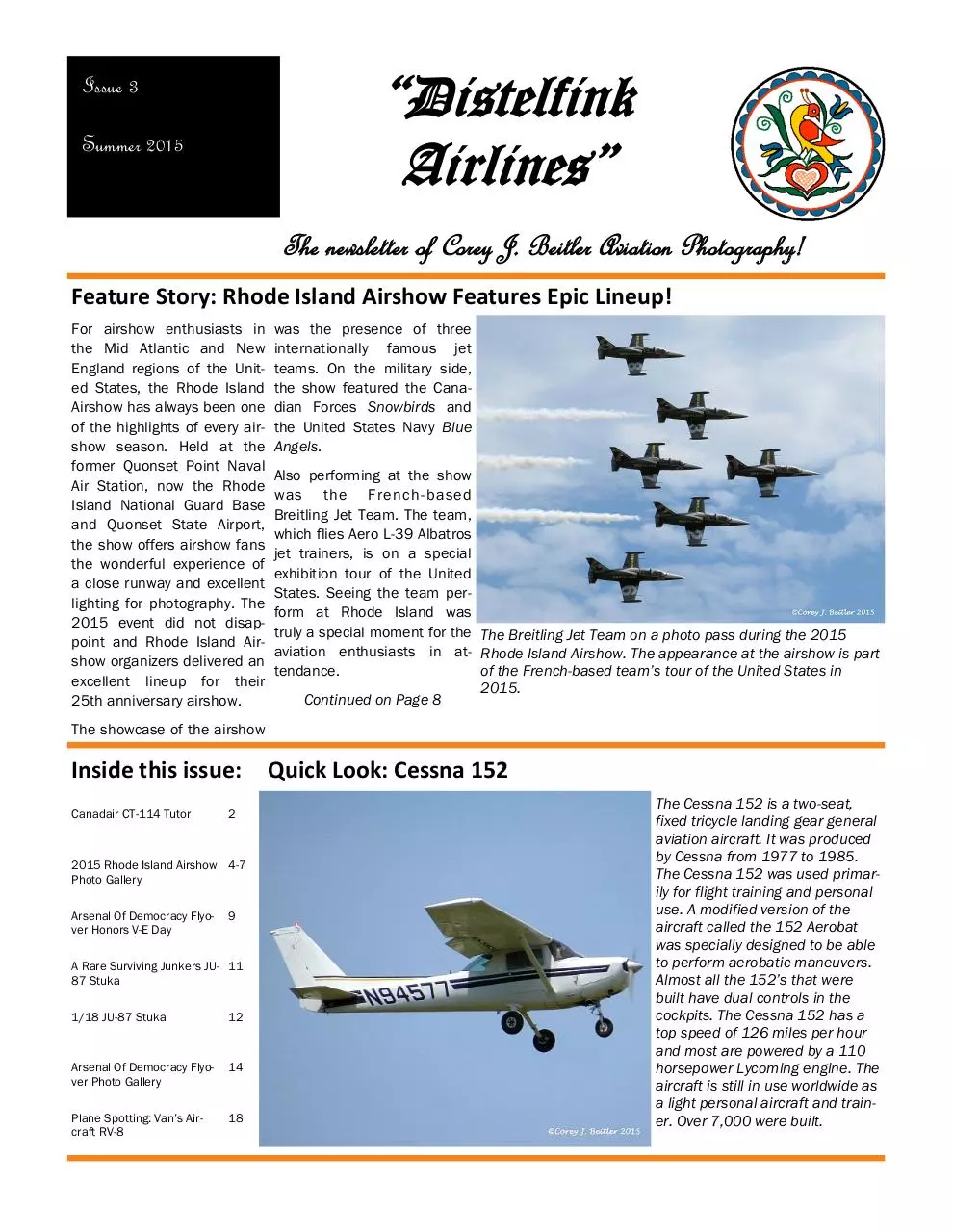
Feature Story: Rhode Island Airshow Features Epic Lineup!
For airshow enthusiasts in
the Mid Atlantic and New
England regions of the United States, the Rhode Island
Airshow has always been one
of the highlights of every airshow season. Held at the
former Quonset Point Naval
Air Station, now the Rhode
Island National Guard Base
and Quonset State Airport,
the show offers airshow fans
the wonderful experience of
a close runway and excellent
lighting for photography. The
2015 event did not disappoint and Rhode Island Airshow organizers delivered an
excellent lineup for their
25th anniversary airshow.
was the presence of three
internationally famous jet
teams. On the military side,
the show featured the Canadian Forces Snowbirds and
the United States Navy Blue
Angels.
Also performing at the show
was the French -based
Breitling Jet Team. The team,
which flies Aero L-39 Albatros
jet trainers, is on a special
exhibition tour of the United
States. Seeing the team perform at Rhode Island was
truly a special moment for the The Breitling Jet Team on a photo pass during the 2015
aviation enthusiasts in at- Rhode Island Airshow. The appearance at the airshow is part
of the French-based team’s tour of the United States in
tendance.
2015.
Continued on Page 8
The showcase of the airshow
Inside this issue:
Canadair CT-114 Tutor
2
2015 Rhode Island Airshow 4-7
Photo Gallery
Arsenal Of Democracy Flyover Honors V-E Day
9
A Rare Surviving Junkers JU- 11
87 Stuka
1/18 JU-87 Stuka
12
Arsenal Of Democracy Flyover Photo Gallery
14
Plane Spotting: Van’s Aircraft RV-8
18
Quick Look: Cessna 152
The Cessna 152 is a two-seat,
fixed tricycle landing gear general
aviation aircraft. It was produced
by Cessna from 1977 to 1985.
The Cessna 152 was used primarily for flight training and personal
use. A modified version of the
aircraft called the 152 Aerobat
was specially designed to be able
to perform aerobatic maneuvers.
Almost all the 152’s that were
built have dual controls in the
cockpits. The Cessna 152 has a
top speed of 126 miles per hour
and most are powered by a 110
horsepower Lycoming engine. The
aircraft is still in use worldwide as
a light personal aircraft and trainer. Over 7,000 were built.
�
Page 2
“Distelfink Airlines”
Canadair CT-114 Tutor
Visitors to the 2015 Rhode Island Airshow had the unique opportunity to see the Canadian Forces Snowbirds participate in
an airshow in the United States. One of the interesting aspects
about the Snowbirds is that they use the Canadair CT-114 Tutor jet trainer in their performances. Few of the visitors to the
Rhode Island Airshow probably realized that this little aircraft
has served as a jet trainer and aerobatic demonstration aircraft in Canada for over 50 years.
The design was a product of the Canadair Preliminary Design
department for a jet training aircraft. The design incorporated
a single turbojet engine, a low-wing and tricycle landing gear.
The design would feature a T-tail configuration. One unique
aspect of the aircraft was the crew seating. To facilitate flight
training between an instructor and student, the crew seating
was arranged in a side-by-side configuration. The prototype of
the aircraft, designated by the company as the CL-41, first flew
in January of 1960.
One critical aspect of the design of the CL-41 was the positioning of the vertical stabilizer. As a training aircraft, the CL-41
needed to be able to be demonstrate spin recovery. If the vertical fin is too far forward, a spin cannot be initiated. If the fin
would be positioned too far aft, recovery from a spin would
be impossible. Wind tunnel tests were done to determine
the optimum positioning for the vertical fin. Original wind
tunnel models of the CL-41 had a cruciform tail. After testing the models in the wind tunnel, the CL-41 design was
revised to a T-tail configuration by removing the portion of
the tail above the horizontal stabilizer.
In September of 1961, the Canadian government ordered
the CL-41 to serve as the primary jet trainer of the Canadian Forces. Canadair produced 190 examples of the CL41A, the production variant, for the Canadian Forces. The
Canadian Forces adopted the CT-114 Tutor designation for
the aircraft. In 1976, the Canadian government modified
the 113 surviving examples of the aircraft by upgrading
the avionics and adding provisions to carry two bellymounted 41-gallon external fuel tanks. The CT-114 Tutor
would serve for over 30 years as the primary training aircraft of the Canadian Forces.
Continued on Page 3
A Canadair CT-114 Tutor of the Canadian Forces Snowbirds flight demonstration team comes in for a landing at the 2015
Rhode Island Airshow. The Snowbirds have been flying the CT-114 Tutor since the formation of the team in 1972.
�
Issue 3
Page 3
Canadair CT-114 Tutor (Continued From Pg. 2)
Canadair developed the basic design of the Tutor even further.
During the 1960’s, Canadair modified the CL-41A into an armament training and light attack aircraft. The modified design
featured an upgraded engine and underwing pylons that could
carry up to 4,000 lbs. of weapons or other underwing stores.
In March of 1966, the Royal Malaysian Air Force ordered twenty examples of the attack version of the Tutor. Named the Teuban, the aircraft were used as counterinsurgency (COIN) aircraft. The Teuban saw service with the Royal Malaysian Air
Force from 1967 to 1986. In 1986, the Tebuans were phased
out and replaced by the Aermacchi MB-339.
team has showcased the CT-114 Tutor and its capabilities
throughout North America over the past 43 airshow seasons. Although the team mostly performs at locations in
Canada, many airshow seasons have included visits to
various cities in the United States. In past airshow seasons, the Snowbirds have even performed in airshows as
far south as Mexico. The only changes made to the CT-114
for airshow performances is the addition of a smoke system, a highly tuned engine to enhance flight performance
and the addition of the brightly colored Snowbirds paint
scheme.
The Canadair CT-114 Tutor was retired by the Canadian
Forces as a primary jet trainer in 2000. The aircraft was
replaced in service by the BAE CT-155 Hawk and the
Beechcraft CT-156 Harvard II. A few CT-115 Tutors are
used for flight research purposes by the Royal Canadian
Air Force and a few have been preserved in museums. The
Snowbirds operate eleven CT-114 Tutors in their airshow
team. A number of CT-114 Tutors are held in storage for
use as Snowbirds aircraft in future airshow seasons. Although a search has begun for a replacement aircraft, it is
In 1971, members of the Two Canadian Forces Flying Training expected that the Snowbirds will continue to use the CTSchool at Canadian Forces Base Moose Jaw, Saskatchewan 114 Tutor in their airshow performances for the next sevexplored the possibility of forming a flight demonstration team. eral years.
The aircraft selected were some of the CT-114’s that had been
The CT-114 Tutor is a wonderful and dependable aircraft
previously used by the Golden Centennaries.
that trained thousands of pilots for the Canadian Forces
In addition to being used as a trainer, the CT-114’s excellent
flying characteristics made it ideal for aerobatics and formation flying. In 1967, the Royal Canadian Air Force took ten
CT-114’s to form an aerobatic team to celebrate Canada’s centennial year. Sporting a gold, blue and red paint scheme, the
Tutors and their support personnel formed a team called the
Golden Centennaries. The Golden Centennaries flew at airshows and performed demonstrations in Canada throughout
1967. After 1967, the team was disbanded.
The name Snowbirds was adopted as the result of an elementary school contest to pick the name for the team in 1972. In
1978, the team gained squadron status and became the 431
Air Demonstration Squadron. The Snowbirds began flying airshows and flyovers using the CT-114 on a regular basis. The
during a service life that spanned over 30 years. It is very
fitting that in the twilight of its career, this little jet trainer
gets to shine on the airshow scene, being flown with grace
and precision by the pilots of the world famous Canadian
Forces Snowbirds.
Three Canadair CT-114 Tutors of
the Canadian Forces Snowbirds
sit at rest on the ramp following
the 2015 Rhode Island Airshow.
The CT-114 is a small aircraft with
a length of about 32 ft. The CT114 also has a wingspan of approximately 36 ft and a height of
just over 9 ft. The CT-114 has a
top speed of 486 miles per hour
and a range of 948 miles. On the
Snowbirds transient flights to airshows, the chief mechanic for
each aircraft rides with the pilot
of the aircraft, due to the side-byside seating arrangement of the
CT-114. The small external tanks
mounted on the underside of the
aircraft hold the smoke oil used
during the airshow performances.
These tanks can also be used to
hold extra fuel on long flights.
�
Page 4
“Distelfink Airlines”
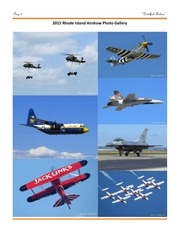
2015 Rhode Island Airshow Photo Gallery
�
Issue 3
Page 5
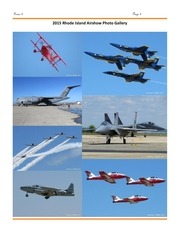
2015 Rhode Island Airshow Photo Gallery
�
Page 6
“Distelfink Airlines”
2015 Rhode Island Airshow Photo Gallery
�
Issue 3
Page 7
2015 Rhode Island Airshow Photo Gallery
�
Page 8
“Distelfink Airlines”
Rhode Island Airshow Features Epic Lineup (Continued From Pg. 1)
The team is led by civilian pilot Jacques
Bothelin, who has over 11,000 flight
hours in over 140 different types of aircraft. The rest of the positions on the
seven-ship team are flown by former
French Air Force pilots who also have
thousands of hours of flight experience.
This experience showed as the Breitling
Jet Team performed a captivating and
graceful routine in the skies above
Rhode Island on both days of the airshow. The display was greatly enhanced
by the wonderful announcing of Luc
Herbiniere. At the end of the routine,
team leader Jacques Bothelin dedicated
the performance to all the American
veterans who helped France regain its
freedom during World War II. This touching dedication gathered a warm reception from the crowd in Rhode Island.
In addition to the Snowbirds, the Canadian Forces also sent their CF-18 Hornet
Demonstration Team to the show. This
year, the CF-18 has a dazzling paint
scheme designed to commemorate the
75th Anniversary of the Battle Of Britain.
The crowd in Rhode Island certainly
loved seeing this beautifully painted jet
and the demonstration flown Captain
Denis “Cheech” Beaulieu. The incredible
flying by Captain Beaulieu showcased
the speed and maneuverability of Canada’s frontline air superiority fighter jet.
The United States Air Force was also
represented at the Rhode Island Airshow. The F-16 Viper Demonstration
Team attended the event and demonstration pilot Captain Craig “Rocket”
Baker performed a fantastic aerial display of the capabilities of the multi-role
fighter jet. The F-16 also participated in
the Heritage Flight with a World War II
Era P-51 Mustang fighter plane flown
by Jim Beasley. The USAF Heritage
Flight once again proved to be a popular airshow routine with the crowd.
The Rhode Island National Guard participated in the show this year after
being absent in recent years due to
budget restrictions. Two of the Rhode
Island Air National Guard Lockheed C130J transport aircraft did a flyover of
the airshow during opening ceremonies. The Rhode Island Army National
Guard also demonstrated the Sikorsky
UH-60 Blackhawk utility helicopters
they operate at the airshow. The UH60’s delivered a pair of Humvees to the
airshow grounds slung under their bellies. These hometown heroes got a
standing ovation from the airshow
spectators.
Also featured at the airshow were several civilian performers considered airshow legends. The 2014 US Aerobatic
Champion Rob Holland performed a
thrilling aerobatic routine in his MX-S
aircraft. He was joined by the world famous Sean D. Tucker who flew his famous orange colored Oracle Challenger
biplane. Tucker was performing at
Rhode Island for the 22nd time in his
career and is always a crowd favorite at
the event. Finally, John Klatt also performed in his Air National Guard sponsored MX-S aerobatic aircraft.
Vintage aircraft also took to the sky during the airshow. Veteran airshow performer Mark Murphy flew his immaculate World War II Era P-51 Mustang. The
demonstration reminded airshow spectators of the important historical impact
the P-51 made during World War II. The
GEICO Skytypers also performed at the
airshow in their six North American SNJ
training aircraft from World War II. The
Skytypers routine showcases to airshow
spectators what flight training and formation flying was like during the Second
World War.
Continued On Page 10
The Canadian Forces Snowbirds perform
at the 2015 Rhode Island Airshow. The
Snowbirds perform most of their airshow
demonstrations in Canada, so any chance
to see them performing at an airshow in
the United States is a wonderful opportunity American aviation enthusiasts. The
Snowbirds are officially known as the 431
Demonstration Squadron and are based
at the 15 Wing, near Moose Jaw Saskatchewan. The team has been performing
demonstrations since 1971. The Snowbirds fly the Canadair CT-114 Tutor in their
airshow performances. The CT-114 was
used as a jet trainer by the Canadian Forces from 1961 until 2000. The CT-114’s
excellent handling qualities and slow
speed make it a superb aircraft for the
formation flying performed by the Snowbirds.
�
Page 9
“Distelfink Airlines”
Arsenal Of Democracy Flyover Honors 70th Anniversary Of V-E Day
Visitors to Washington D.C. on Friday
May 8, 2015 had the opportunity to witness a historic and quite possibly a once
in a lifetime event. In honor of the 70th
Anniversary of V-E (Victory in EuropeWorld War II) Day, a special flyover of
about 40 World War II aircraft took place
over the National Mall, World War II Memorial and the Smithsonian National Air
and Space Museum.
The special flyover took place after a
over a year of hard work and planning by
various organizations. Special permission had to be secured to fly over the
restricted airspace of downtown Washington D.C. at low altitudes. Clearance
also had to be obtained from nearby
Reagan National Airport and from the
airlines that operate service from that
facility. Finally, various museums had to
be contacted and funds raised to bring
the participating aircraft to the Washington D.C. area to perform in the flyover. In
addition to the flyover, a ceremony for
surviving veterans and their families was
held at the World War II Memorial to
honor their service and sacrifice during
World War II.
by several formations of aircraft that
were used as trainers during the war.
The training aircraft participating included Boeing Stearmans, Fairchild PT19 Cornells and a large flight of North
American SNJ/AT-6 Texan advanced
trainers.
of two Chance Vought F4U Corsair fighters. The sound of these wonderfully restored World War II fighters roaring overhead captivated the crowd. Three more
P-51’s joined up with the Commemorative Air Force’s Consolidated B-24 Liberator heavy bomber for their flight over
Later formations in the flyover included the National Mall. This formation
aircraft that were important in the key showed the spectators how escorting
fighter aircraft protected bomber foraerial battles of World War II. The organizers of the flyover were able to put mations during World War II. Also a
15 different formations of various types crowd favorite were the two Boeing B-17
Flying Fortresses that participated in the
of aircraft together. The flyover was
highly publicized and a large crowd of event.
spectators gathered to view the flyover The world’s only flying Curtiss SB2C Hellthroughout the National Mall. At the
diver was flown as part of the event by
World War II Memorial, veteran airshow the Commemorative Air Force The flyoannouncer Rob Reider performed a
ver also included the world’s only flying
wonderful narration of the event, deBoeing B-29 Superfortress, “Fifi”, also
scribing each formation sequence and operated by the organization. Another
the history of the aircraft flying in the
unique aircraft to participate in the
formations.
event was a very rare surviving Lockheed P-38 Lightning twin-engine fighter.
The flyover included several rare air-
craft. The Pearl Harbor formation group
included two Curtiss P-40 Warhawks, a
U.S. fighter aircraft that was important
in the early stages of World War II. To
commemorate the famous Doolitte
The flyover began shortly after the noon Raid of World War II, the flyover includhour with a flight of L-Bird aircraft. The L- ed three North American B-25 Mitchells. Also a part of the flyover were
Bird aircraft, such as the famous Piper
crowd favorite aircraft from World War
Cub, were used as army co-operation
II such as a flight of four North Ameriaircraft and air ambulances during
World War II. The L-Birds were followed can P-51 Mustang fighters and a flight
The flyover concluded with a missing
man formation flown by the Texas Flying
Legends Museum. The missing man
formation included a Curtiss P-40 Warhawk, Chance Vought F4U Corsair,
Grumman TBF Avenger and a North
American P-51 Mustang. This formation
was performed in honor of all those who
gave there lives for our nation during
World War II. This tribute was a fitting
way to end such a special event.
A Douglas SBD-5 Dauntless and a
Grumman FM-2 Wildcat fly in formation
during the 2015 Arsenal Of Democracy
Flyover that took place over the National Mall of Washington D.C. on May 8,
2015. These aircraft were part of a
formation commemorating the Battle
of Midway. During that battle, SBD
Dauntless dive bombers sunk four Japanese aircraft carriers, turning the tide
of the war in the Pacific theatre in favor
of the United States. During that battle,
fighter pilots flying the Wildcat provided
cover for the SBD’s and engaged the
Japanese Zero fighter aircraft. The
Wildcat also played a large role in the
Battle of Guadalcanal.
�
 Historical archive . public document