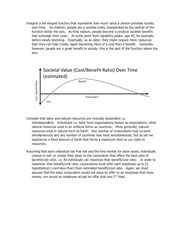
Imagine a hill-shaped function that represents how much value a person provides society
over time. As children, people are a societal costs, represented by the section of the
function below the axis. As they mature, people become a produce societal benefits
that outweigh their costs. At some point their capability peaks- age 40, for examplebefore slowly declining. Eventually, as an elder, they might require more resources
than they can help create, again becoming more of a cost than a benefit. Generally,
however, people are a great benefit to society- this is the part of the function above the
axis.
Consider that labor and natural resources are mutually dependent i.e.
interdependent. Individuals i.e. labor form organizations known as corporations, while
natural resources exist in an artificial forms as countries. More generally, natural
resources exist in natural form as Earth. Any number of corporations may co-exist
simultaneously and any number of countries may exist simultaneously, but as yet we
experience a fixed amount of Earth that forms a maximum limit on our claim to
resources.
Assuming that each individual has free will and the free market for labor exists, individuals
choose to sell, or invest, their labor to the corporation that offers the best ratio of
benefit/cost ratio. i.e. All individuals can maximize their benefit/cost ratio. In order to
maximize their benefit/cost ratio, corporations must offer each employee up to [a
hypothetical-1-cent-less-than] their estimated benefit/cost ratio. Again, we must
assume that the labor corporation would not issue an offer to an employee that loses
money, nor would an employee accept an offer that was 2nd best.
�
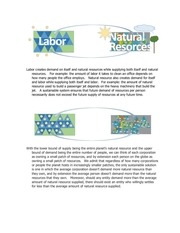
Labor creates demand on itself and natural resources while supplying both itself and natural
resources. For example: the amount of labor it takes to clean an office depends on
how many people the office employs. Natural resource also creates demand for itself
and labor while supplying both itself and labor. For example: the amount of natural
resource used to build a passenger jet depends on the heavy machinery that build the
jet. A sustainable system ensures that future demand of resources per person
necessarily does not exceed the future supply of resources at any future time.
With the lower bound of supply being the entire planet's natural resource and the upper
bound of demand being the entire number of people, we can think of each corporation
as owning a small patch of resources, and by extension each person on the globe as
owning a small patch of resources. We admit that regardless of how many corporations
or people the planet hosts in increasingly smaller patches, the only sustainable solution
is one in which the average corporation doesn’t demand more natural resource than
they own, and by extension the average person doesn't demand more than the natural
resources that they own. Moreover, should any entity demand more than the average
amount of natural resource supplied, there should exist an entity who willingly settles
for less than the average amount of natural resource supplied.
�
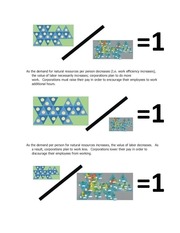
As the demand for natural resources per person decreases (I.e. work efficiency increases),
the value of labor necessarily increases; corporations plan to do more
work. Corporations must raise their pay in order to encourage their employees to work
additional hours.
As the demand per person for natural resources increases, the value of labor decreases. As
a result, corporations plan to work less. Corporations lower their pay in order to
discourage their employees from working.
�
There are three possible strategies that corporations can use to optimize their returns on
investment: benefit maximization, cost minimization, or some optimal point on
the benefit/cost ratio curve. Benefit maximization and cost minimization can be
excluded as viable strategies due to the law of diminishing returns. E.g. Benefitmaximizing corporations would struggle to control costs while competing to
provide increasingly large benefits to capture potential employees. Alternately,
cost-minimizing corporations would struggle to provide benefits while competing
to offer increasingly small workloads to their employees. Therefore, we would
expect corporations to create a benefit/cost ratio to satisfy employees.
In order to maintain benefit/cost ratios in stable equilibrium- i.e. efficient marketbenefits and costs must be completely uncorrelated. While it might be
theoretically possible to create a system that operated on a single currency, it
seems far more likely that such a system operate on two separate currencies:
one for labor and the other for natural resources.
As the resources cannot actually think for themselves and therefore estimate value,
some people will become owners of the resource. This is not a problem in and
of itself, but it does create a conflict of interests wherein owners of resources
attempt to encourage extra spending of resources in order to raise the price of
natural resources. The only way to resolve this conflict is for corporations to
increasingly valuing their employees’ labor while simultaneously cutting their
overhead expenses, thus devaluing the natural resource by definition.
Given that the overwhelming majority of the population supports the value of labor
while a small but powerful minority supports the value of natural resource, and
each currency is an input to valuing itself, we can conclude that the only stable
system is one in which individual corporations voluntarily lower the price of their
labor when they judge that the value of natural resource is too high. The
natural response to this is an increase in demand for labor and a corresponding
decrease in demand for natural resource, and vice versa.
Since individuals can maximize their utility by choosing a corporation that provides the
best ratio of benefits to costs and corporations maximize their utility by
regulating the exchange rate between the currencies that represent their organic
labor and natural resource, the resultant system includes am automatic counterbalancing effect that constantly levels the income distribution, thereby creating a
voluntary system that encourages maximum economic growth.
While capitalism corrects itself by allowing the government to redistribute funds as the
income distribution becomes increasingly skewed and socialism corrects itself by
allowing the black market to redistribute goods and services as the income
distribution becomes increasingly level, we consider the possibility that such a
dual-currency system encourages maximum economic growth via a balanced
income distribution by allowing organizations and their members to choose either
savings or spending of labor or resources as each sees fit.
�
 Historical archive . public document