-1-
�
Agenda
Collaborative Filtering (CF)
–
–
–
–
–
–
–
–
–
–
–
Pure CF approaches
User-based nearest-neighbor
The Pearson Correlation similarity measure
Memory-based and model-based approaches
Item-based nearest-neighbor
The cosine similarity measure
Data sparsity problems
Recent methods (SVD, Association Rule Mining, Slope One, RF-Rec, …)
The Google News personalization engine
Discussion and summary
Literature
-2-
�
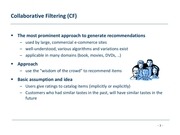
Collaborative Filtering (CF)
The most prominent approach to generate recommendations
– used by large, commercial e-commerce sites
– well-understood, various algorithms and variations exist
– applicable in many domains (book, movies, DVDs, ..)
Approach
– use the "wisdom of the crowd" to recommend items
Basic assumption and idea
– Users give ratings to catalog items (implicitly or explicitly)
– Customers who had similar tastes in the past, will have similar tastes in the
future
-3-
�
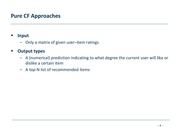
Pure CF Approaches
Input
– Only a matrix of given user–item ratings
Output types
– A (numerical) prediction indicating to what degree the current user will like or
dislike a certain item
– A top-N list of recommended items
-4-
�
User-based nearest-neighbor collaborative filtering (1)
The basic technique
– Given an "active user" (Alice) and an item 𝑖 not yet seen by Alice
find a set of users (peers/nearest neighbors) who liked the same items as Alice
in the past and who have rated item 𝑖
use, e.g. the average of their ratings to predict, if Alice will like item 𝑖
do this for all items Alice has not seen and recommend the best-rated
Basic assumption and idea
– If users had similar tastes in the past they will have similar tastes in the future
– User preferences remain stable and consistent over time
-5-
�
User-based nearest-neighbor collaborative filtering (2)
Example
– A database of ratings of the current user, Alice, and some other users is given:
Item1
Item2
Item3
Item4
Item5
Alice
5
3
4
4
?
User1
3
1
2
3
3
User2
4
3
4
3
5
User3
3
3
1
5
4
User4
1
5
5
2
1
– Determine whether Alice will like or dislike Item5, which Alice has not yet
rated or seen
-6-
�
User-based nearest-neighbor collaborative filtering (3)
Some first questions
– How do we measure similarity?
– How many neighbors should we consider?
– How do we generate a prediction from the neighbors' ratings?
Item1
Item2
Item3
Item4
Item5
Alice
5
3
4
4
?
User1
3
1
2
3
3
User2
4
3
4
3
5
User3
3
3
1
5
4
User4
1
5
5
2
1
-7-
�
Measuring user similarity (1)
A popular similarity measure in user-based CF: Pearson correlation
𝑎, 𝑏 : users
𝑟𝑎,𝑝 : rating of user 𝑎 for item 𝑝
𝑃
: set of items, rated both by 𝑎 and 𝑏
– Possible similarity values between −1 and 1
𝒑 ∈𝑷(𝒓𝒂,𝒑
𝒔𝒊𝒎 𝒂, 𝒃 =
𝒑 ∈𝑷
− 𝒓𝒂 )(𝒓𝒃,𝒑 − 𝒓𝒃 )
𝒓𝒂,𝒑 − 𝒓𝒂
𝟐
𝒑 ∈𝑷
𝒓𝒃,𝒑 − 𝒓𝒃
𝟐
-8-
�
Measuring user similarity (2)
A popular similarity measure in user-based CF: Pearson correlation
𝑎, 𝑏 : users
𝑟𝑎,𝑝 : rating of user 𝑎 for item 𝑝
𝑃
: set of items, rated both by 𝑎 and 𝑏
– Possible similarity values between −1 and 1
Item1
Item2
Item3
Item4
Item5
Alice
5
3
4
4
?
User1
3
1
2
3
3
sim = 0,85
User2
4
3
4
3
5
sim = 0,00
User3
3
3
1
5
4
sim = 0,70
User4
1
5
5
2
1
sim = -0,79
-9-
�
 Historical archive . public document