The Falsification of Special Relativity
Octavian Balaci
23 June 2015 , tavib72@mail.com
Abstract
Reassert the twin paradox in a new light, leading to the conclusion
that the theory of relativity is inconsistent with the physical reality.
Symmetric clocks paradox using two clocks in a special setup, in which
both clocks are in inertial movement on the entire duration of experiment.
1
The Clocks Paradox
The clocks paradox also known as the twins paradox is a direct consequence
of the symmetry of the relativity principle in the context of constant light
speed principle. One consequence of special relativity, among others, is the
time dilation witch imply that in a relative moving inertial frame with respect
to a reference frame, the coordinate time intervals become larger compared
with the proper time intervals in the moving frame and consequently the
clocks run slower than the clocks from the reference frame. The theory of
relativity claim that this is a real physical effect which affect the proper
time of the relative moving system compared with the proper time of the
reference system which is equal with the coordinate time. Also a number
of experiments seem to indicate that this is a real effect. In consequence a
relation between the proper time intervals counted by two clocks in relative
movement to each other must exist and this relation must be consistent in
any valid analysis of special relativity, from any valid inertial frame.
The root of the problem is that while relativity principle is active, we
cannot have a sense of which is in motion, instead any group of inertial
systems can be considered in motion relative to each other. Is not dificult to
see that this situation will lead to inconsistent predictions.
1
�
1.1
The Classic Twins Paradox
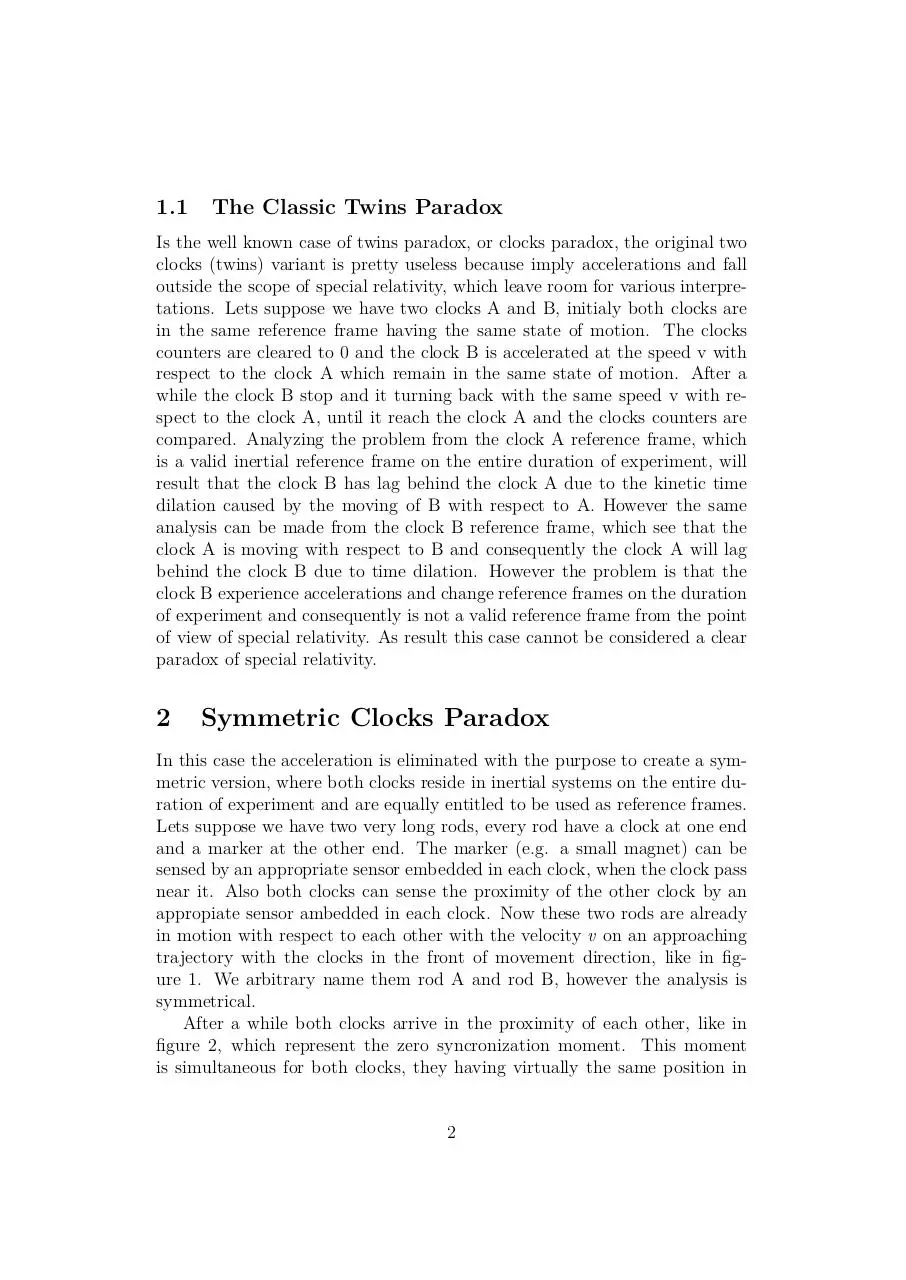
Is the well known case of twins paradox, or clocks paradox, the original two
clocks (twins) variant is pretty useless because imply accelerations and fall
outside the scope of special relativity, which leave room for various interpretations. Lets suppose we have two clocks A and B, initialy both clocks are
in the same reference frame having the same state of motion. The clocks
counters are cleared to 0 and the clock B is accelerated at the speed v with
respect to the clock A which remain in the same state of motion. After a
while the clock B stop and it turning back with the same speed v with respect to the clock A, until it reach the clock A and the clocks counters are
compared. Analyzing the problem from the clock A reference frame, which
is a valid inertial reference frame on the entire duration of experiment, will
result that the clock B has lag behind the clock A due to the kinetic time
dilation caused by the moving of B with respect to A. However the same
analysis can be made from the clock B reference frame, which see that the
clock A is moving with respect to B and consequently the clock A will lag
behind the clock B due to time dilation. However the problem is that the
clock B experience accelerations and change reference frames on the duration
of experiment and consequently is not a valid reference frame from the point
of view of special relativity. As result this case cannot be considered a clear
paradox of special relativity.
2
Symmetric Clocks Paradox
In this case the acceleration is eliminated with the purpose to create a symmetric version, where both clocks reside in inertial systems on the entire duration of experiment and are equally entitled to be used as reference frames.
Lets suppose we have two very long rods, every rod have a clock at one end
and a marker at the other end. The marker (e.g. a small magnet) can be
sensed by an appropriate sensor embedded in each clock, when the clock pass
near it. Also both clocks can sense the proximity of the other clock by an
appropiate sensor ambedded in each clock. Now these two rods are already
in motion with respect to each other with the velocity v on an approaching
trajectory with the clocks in the front of movement direction, like in figure 1. We arbitrary name them rod A and rod B, however the analysis is
symmetrical.
After a while both clocks arrive in the proximity of each other, like in
figure 2, which represent the zero syncronization moment. This moment
is simultaneous for both clocks, they having virtually the same position in
2
�
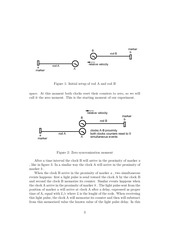
Figure 1: Initial setup of rod A and rod B
space. At this moment both clocks reset their counters to zero, so we will
call it the zero moment. This is the starting moment of our experiment.
Figure 2: Zero syncronization moment
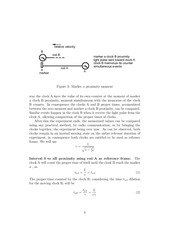
After a time interval the clock B will arrive in the proximity of marker a
, like in figure 3. In a similar way the clock A will arrive in the proximity of
marker b .
When the clock B arrive in the proximity of marker a , two simultaneous
events happens: first a light pulse is send toward the clock A by the clock B
and second the clock B memorize its counter. Similar events happens when
the clock A arrive in the proximity of marker b . The light pulse sent from the
position of marker a will arrive at clock A after a delay, expressed as proper
time of A, equal with L/c where L is the lenght of the rods. When receiveing
this light pulse, the clock A will memorize its counter and then will substract
from this memorized value the known value of the light pulse delay. In this
3
�
Figure 3: Marker a proximity moment
way the clock A have the value of its own counter at the moment of marker
a clock B proximity, moment simultaneous with the memorize of the clock
B counter. In consequence the clocks A and B proper times, accumulated
between the zero moment and marker a clock B proximity, can be compared.
Similar events happen in the clock B when it receive the light pulse from the
clock A, allowing comparition of the proper times of clocks.
After this the experiment ends, the memorized values can be compared
using any practical method, by radio communication, or by bringing the
clocks together, the experiment being over now. As can be observed, both
clocks remain in an inertial moving state on the entire relevant duration of
experiment, in consequence both clocks are entitled to be used as refrence
frame. We will use
1
γ=q
2
1 − vc2
Interval 0 to aB proximity using rod A as reference frame. The
clock A will count the proper time of itself until the clock B reach the marker
a , as
L
τaA = = taA
(1)
v
The proper time counted by the clock B, considering the time taA dilation
for the moving clock B, will be
τaB =
taA
L
=
γ
vγ
4
(2)
�
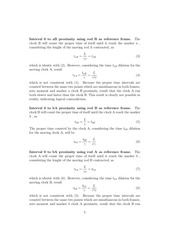
Interval 0 to aB proximity using rod B as reference frame. The
clock B will count the proper time of itself until it reach the marker a ,
considering the lenght of the moving rod A contracted, as
τaB =
L
= taB
γv
(3)
which is identic with (2). However, considering the time taB dilation for the
moving clock A, result
taB
L
τaA =
= 2
(4)
γ
γ v
which is not consistent with (1). Because the proper time intervals are
counted between the same two points which are simultaneous in both frames,
zero moment and marker a clock B proximity, result that the clock A run
both slower and faster than the clock B. This result is clearly not possible in
reality, indicating logical contradiction.
Interval 0 to bA proximity using rod B as reference frame. The
clock B will count the proper time of itself until the clock A reach the marker
b , as
L
(5)
τbB = = tbB
v
The proper time counted by the clock A, considering the time tbB dilation
for the moving clock A, will be
τbA =
tbB
L
=
γ
vγ
(6)
Interval 0 to bA proximity using rod A as reference frame. The
clock A will count the proper time of itself until it reach the marker b ,
considering the lenght of the moving rod B contracted, as
τbA =
L
= tbA
γv
(7)
which is identic with (6). However, considering the time tbA dilation for the
moving clock B, result
tbA
L
τbB =
= 2
(8)
γ
γ v
which is not consistent with (5). Because the proper time intervals are
counted between the same two points which are simultaneous in both frames,
zero moment and marker b clock A proximity, result that the clock B run
5
�
both slower and faster than the clock A. All these results show that, when the
principle of relativity is rigorously applied, the theory of relativity become
unable to make consistent predictions about what is happened with the two
clocks. In consequence the theory of relativity cannot be considered a valid
theory of physics.
Because the space-time kinetic properties defined by special relativity is
inconsistent, leading to logical contradictions, the idea of space-time curvature also become inconsistent and with it the theory of general relativity
become false too. In this conditions the concepts of space and time must
return to their original purely abstract nature independent by any physical
phenomenons or entities.
Because the special relativity was introduced as resolution for the electrodynamics problem of not being invariant at Galilean transformations, a new
resolution must be found. The observation that light is deflected by gravity may indicate that the gravitation have influence over the elctromagnetic
properties of vacuum, leading to gravitational refraction of light. A model
which interpret the electrodynamic and gravitational phenomena based on
this assumption is found in [9].
References
[1] Albert Einstein (1905) On the Electrodynamics of Moving Bodies
[2] Albert Einstein (1922) Sidelights on Relativity
[3] William H. McCrea (1951) The Clock Paradox in Relativity Theory
[4] Herbert Dingle (1956) A Problem in Relativity Theory
[5] Luis Essen (1971) The Special Theory of Relativity: A Critical Analysis
[6] Tom Van Flandern (1998) The Speed of Gravity - What the Experiments
Say , Physics Letters A, 250 (1998) 1-11
[7] Milan R. Pavlovic (2000) Einsteins Theory of Relativity - Scientic Theory
or Illusion?
[8] Ling Jun Wang (1999) Symmetrical Experiments to Test the Clock Paradox
[9] Octavian Balaci (2013) Connection Between Gravity and Electromagnetism
6
�
 Historical archive . public document