Management of Emergencies in patients with Adrenal Insufficiency
Symptoms
1. Onset can take place very quickly over minutes or hours
2. Patients experience fatigue, nausea, vomits, dizziness, light-headedness, abdominal pain,
confusion, headache, somnolence
3. It can present exactly as if it was a gastro, a stomach flu or peritonitis
4. Fever is common even in the absence of a real triggering infection. However, once the patient
is stabilized infections should be ruled out because often they are the precipitating event
Precipitating Events
1.
2.
3.
4.
Infections, particularly gastroenteritis, are the most frequent causes.
Surgery, strenuous exercise, emotional stress and accidents.
Cessation of glucocorticoid therapy by the patient (or by the attending physician)
In approximately 10% of cases the cause cannot be identified
Exam and lab findings
1.
2.
3.
4.
5.
Hypotension (systolic BP below 100) or hypovolemic shock
Paleness, shallow pulse, decrease sensorium, tachycardia
Fever or slight elevation in body temperature
Hyponatremia and or hyperkalemia
Hypoglycemia or reduce need for hypoglycemic agents in diabetics
Treatment
1. ADRENAl CRISIS GRADE 1: Patient able to swallow and not vomiting
a. As soon as suspected, whether it ends up being a real adrenal crisis or not, the patient
must take an extra dose of cortisone or hydrocortisone or dexamethasone or
prednisone immediately, equivalent to the total daily dose (TDD) regularly taken. For
example, a patient taking Cortef 10mg in the morning, 5mg at noon and 5 mg at supper,
would take 20mg as soon as symptoms of adrenal crisis are suspected.
b. The TDD should then be repeated every 4-8 hours, depending on symptoms, for a total
of 2-4 fold the TDD per day for the duration of the precipitating event, for instance a
bad cold.
c. If symptoms persist or worsen, the patient should call her or his primary care doctor for
assistance or visit an emergency room. If patient starts to deteriorate, for instance
feeling weakness, nausea, vomiting, somnolent, despite following a & b above, the
emergency kit of solucortef® 100mg should be used as soon as possible and as the
patient is taken to the nearest emergency room.
2. ADRENAL CRISIS GRADE 2: Patient is unable to use the oral route either because of persisting
vomits or because of depressed level of consciousness
a. Solucortef® 100 mg via intramuscular (ideally) or subcutaneous should be given by the
patient him or herself, the first responders or a trained relative or accompanying
person at the scene. The emergency kit carried by the patient or the first responders
should be used. The deltoid muscle (arm), the supero-external quadrant of the gluteus,
or the external quadriceps can be used to inject the diluted solution of solucortef®.
b. Transport to the nearest emergency should follow.
c. What follows is dictated by the state of the patient. In general the following applies:
i. An IV dose of 100mg of hydrocortisone should be given as soon as an IV access is
established. This should be followed by an IV infusion of 200mg / 24h or 50mg
every 6 hours for the first 24 h.
�
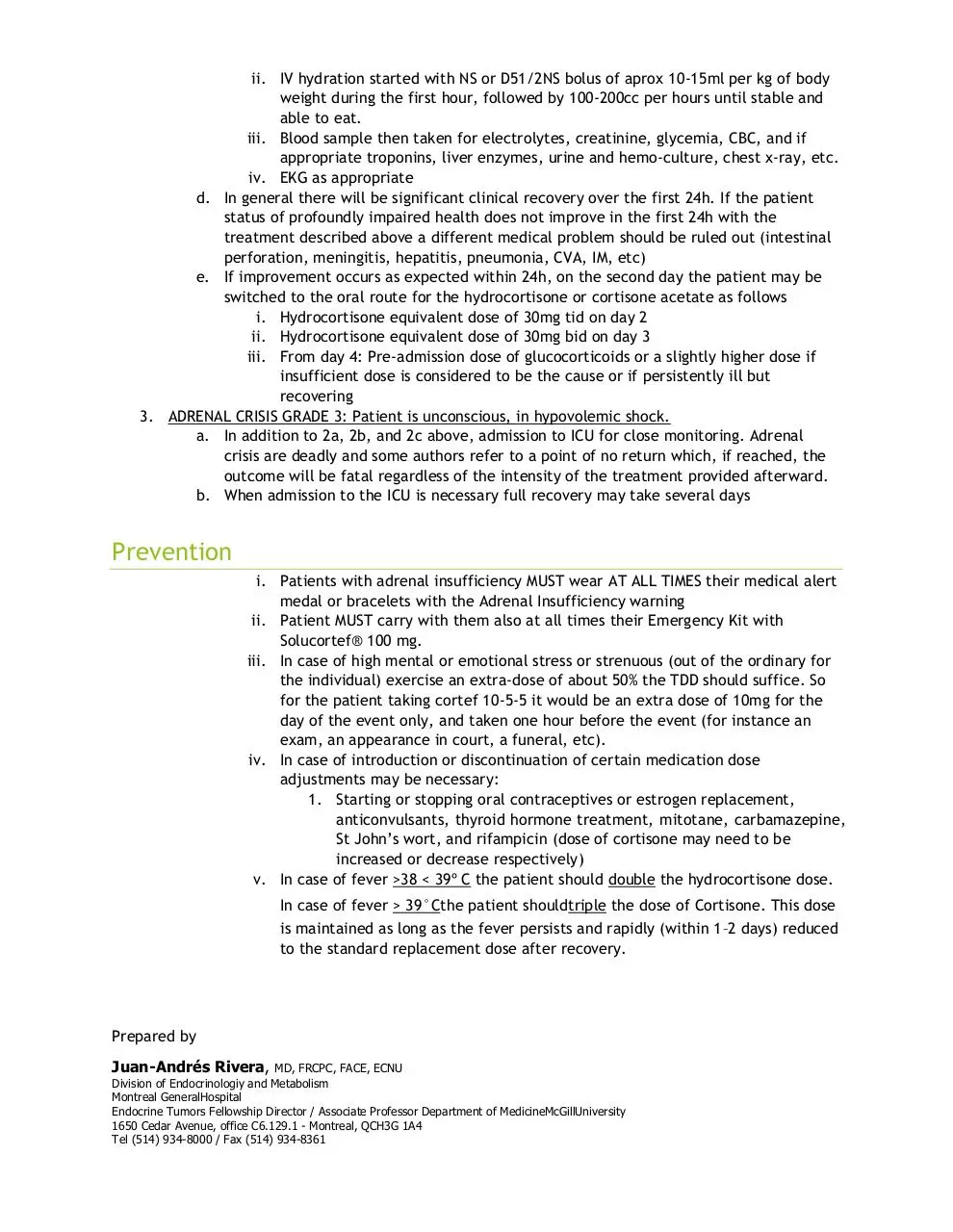
ii. IV hydration started with NS or D51/2NS bolus of aprox 10-15ml per kg of body
weight during the first hour, followed by 100-200cc per hours until stable and
able to eat.
iii. Blood sample then taken for electrolytes, creatinine, glycemia, CBC, and if
appropriate troponins, liver enzymes, urine and hemo-culture, chest x-ray, etc.
iv. EKG as appropriate
d. In general there will be significant clinical recovery over the first 24h. If the patient
status of profoundly impaired health does not improve in the first 24h with the
treatment described above a different medical problem should be ruled out (intestinal
perforation, meningitis, hepatitis, pneumonia, CVA, IM, etc)
e. If improvement occurs as expected within 24h, on the second day the patient may be
switched to the oral route for the hydrocortisone or cortisone acetate as follows
i. Hydrocortisone equivalent dose of 30mg tid on day 2
ii. Hydrocortisone equivalent dose of 30mg bid on day 3
iii. From day 4: Pre-admission dose of glucocorticoids or a slightly higher dose if
insufficient dose is considered to be the cause or if persistently ill but
recovering
3. ADRENAL CRISIS GRADE 3: Patient is unconscious, in hypovolemic shock.
a. In addition to 2a, 2b, and 2c above, admission to ICU for close monitoring. Adrenal
crisis are deadly and some authors refer to a point of no return which, if reached, the
outcome will be fatal regardless of the intensity of the treatment provided afterward.
b. When admission to the ICU is necessary full recovery may take several days
Prevention
i. Patients with adrenal insufficiency MUST wear AT ALL TIMES their medical alert
medal or bracelets with the Adrenal Insufficiency warning
ii. Patient MUST carry with them also at all times their Emergency Kit with
Solucortef® 100 mg.
iii. In case of high mental or emotional stress or strenuous (out of the ordinary for
the individual) exercise an extra-dose of about 50% the TDD should suffice. So
for the patient taking cortef 10-5-5 it would be an extra dose of 10mg for the
day of the event only, and taken one hour before the event (for instance an
exam, an appearance in court, a funeral, etc).
iv. In case of introduction or discontinuation of certain medication dose
adjustments may be necessary:
1. Starting or stopping oral contraceptives or estrogen replacement,
anticonvulsants, thyroid hormone treatment, mitotane, carbamazepine,
St John’s wort, and rifampicin (dose of cortisone may need to be
increased or decrease respectively)
v. In case of fever >38 < 39º C the patient should double the hydrocortisone dose.
In case of fever > 39 °Cthe patient shouldtriple the dose of Cortisone. This dose
is maintained as long as the fever persists and rapidly (within 1–2 days) reduced
to the standard replacement dose after recovery.
Prepared by
Juan-Andrés Rivera,
MD, FRCPC, FACE, ECNU
Division of Endocrinologiy and Metabolism
Montreal GeneralHospital
Endocrine Tumors Fellowship Director / Associate Professor Department of MedicineMcGillUniversity
1650 Cedar Avenue, office C6.129.1 - Montreal, QCH3G 1A4
Tel (514) 934-8000 / Fax (514) 934-8361
�
 Historical archive . public document