Fooman's Supraball Tips and Strategies
Contents
Introduction....................................... 2
Positions............................................. 2
Attributes............................................3
Intermediate Information................... 4-5
Areas of the Field............................... 6-7
Offensive Skills.................................. 8-9
Defensive Skills................................. 9-11
Goalkeeping....................................... 11
Boosting and Blocking....................... 12-13
Tricks..................................................13-14
Team Offense Philosophy.................. 15-16
Cherry Picking................................... 16-17
Team Defense Philosophy................. 17-18
Loose Balls and Timing Strategies.... 18
Winning Championships.................... 19
Sportsmanship.................................... 20
Conclusion......................................... 20
�
Introduction
Hello, my name is Fooman. I've been playing Supraball in North America since May
2014 and Deathball since 2003, mostly as a defenseman. I have played in countless
public games, pickup games, league games, and weekend tournaments. I would like to
share my knowledge, experiences, and thoughts with you so that you may be the best
team player you can be. These ideas are based around playing 5v5 Supraball as a team at
a high skill level. In low skill level matches your individual skills will determine your
rank, but it takes 5 players on the same page to reach the top ranks. Like any sport, there
are a few ways to play the game, and different schools of thought, but I feel my Supraball
philosophies provide a good base on which to build for any player.
Positions
Supraball games are 5v5 with 1 goalkeeper, 1 defenseman, 2 midfielders, and 1 forward.
These positions are not locked in. At any point willing players may swap positions, but
each player should know what attributes they have and what position is best suited for
those attributes.
Forward - The forward is the star scorer of the team. The team counts on the forward to
make a goal out of a scoring chance. Forwards must have great accuracy/timing, and
great scoring touch. Many players want to be the star on the team, but you should really
be sure you have the skills to take on this role.
Midfielder - The midfielders do a bit of everything. Defending, passing, boosting,
blocking, scoring... they do it all. Midfielders must have good reflexes, good predictive
skill, good accuracy/timing, and good scoring touch. Most players should start off at
midfielder to get a good feel for the game in total.
Defenseman - The defenseman keeps the opposing forward in check and runs the offense
like a point guard in basketball. Defensemen must have good accuracy/timing and great
predictive skill. The defenseman usually never scores and does not get much statistical
glory, but they are instrumental in every play in some way. Note: the term "defenseman"
refers to the position, and "defender" refers to any field player when the team does not
have the ball.
Goalkeeper - The goalkeeper cleans up the mess when the team's defense has broken
down. The goalkeeper makes the save and starts the counterattack. Goalkeepers must
have good predictive skills, great reflexes, and plenty of patience. Also, it really helps to
have a low ping. A goalkeeper will only be engaged in the play part of the time.
Because of this, goalkeeper is the least chosen position. If you want instant queues, be a
goalkeeper.
2
�
Attributes
I have identified 4 specific attributes in Supraball players. A man's got to know his
limitations, and a Supraball player has got to know what attributes he possesses, which
attributes he can improve on, and which attributes he has maxed out. The cold hard truth
is that not everyone can be good at this game. Life isn't fair and some gamers just have a
higher ceiling than others, but knowing what you are made of can put you in the best
position to have fun playing Supraball.
Reflexes - Simple reflexes, everyone has them, including athletes and gamers. The
average human reaction time here is about 260 milliseconds(ms). A younger gamer may
have better reflexes. As one ages past his prime though, he inevitably gets slower. It's
science. Reflexes are most important for keepers since they have to quickly react to fast
shots. Also, internet latency comes into play here. A player with a 100 ms ping
automatically has worse reflexes than the same player with a 40 ms ping. Supraball is a
more ping-forgiving game than other FPS games, but it never hurts to play on a server
where you have the advantage. Everyone is simply better with a lower ping.
Predictive Skill - Contrary to reflexes, predictive skill is easier to acquire. The more you
play Supraball the more patterns you will see in player positioning, accuracy/timing, and
decisions. As your experience with the game increases, the more you will innately
predict. At the highest level, a player may glance at the minimap in the bottom right
corner, evaluate where all 10 players are, their direction of movement, and their speed.
Evaluating all of this to make the correct play can mean a goal for your team. Knowing
the offensive habits of your opponent can create a turnover. If you know that your
opponent is a good predictor, then being unpredictable is a good option.
Accuracy/Timing - Accuracy and timing increase with practice. On offense, a player
with good accuracy/timing can curve a shot inside the post, volley in a crossing pass, and
curve a rolling shot on goal. On defense, a player with good accuracy/timing can bait a
poor pass and get the interception, mark a forward close enough to get the turnover, and
clear a hard shot away before it reaches the goalkeeper. Running some drills by yourself
or with a friend can help improve these skills.
Scoring Touch - Scoring touch is what I call that extra ability that some players possess.
It is the ability to get a shot away when there are 3 defenders around you. It is the ability
to volley off the wall 5 times and get a shot on net. It is the ability to cherry pick your
way into breakaways. It is the ability to dribble the ball right past a defender in good
position to get off a shot or pass. I don't possess this as a player, so I don't know how to
get it. If I had to guess, a lot of practice and looking at the middle radar.
3
�
Intermediate Information
I'm not going to go over the basics like "left click to shoot," but there are some subtle
mechanics to the game that are not particularly obvious when you first start playing
Supraball. Knowing theses mechanics will give you an advantage.
Health - All players have 100 health points. Kicking the ball carrier does 60 points of
damage. Kicking any player in the keeper box(aka “The box”) results in an instant KO.
Health regenerates slowly during normal play. After a goal everyone's health returns to
100. Be aware of everyone's health. If you have two hits, you have some extra time to
pass around a defender. If you have one hit, move the ball before an opponent knocks
you out. Do not pass to a closely marked teammate with one hit, if he makes the catch he
may get knocked out immediately. Goalkeepers should consider charging at an opponent
with one hit, especially if he is receiving a pass.
Run Speed - Carrying the ball slows players down, including goalkeepers. The ball
carrier runs at 76% of the speed as a player without the ball. Goalkeepers get a speed
boost to help them make saves, pass around opponents, and dodge out at loose balls.
Goalkeepers run 33% faster than field players.
Max Jump Height - To reach maximum height, use all four of your jumps immediately
from the ground. You will not be able to hang in the air for long, but you will be able to
get to high balls before your opponent.
Ball Weight - The ball has weight to it. Catching the ball in the air will make you fall
faster. Also, jumping with the ball is only 62.5% as effective as jumping without it.
Ball Speed - The ball travels at many different speeds. Here are the base ball speeds for a
player standing still. Let's use a locked pass as the standard speed and call it v. Kicking
a stationary ball is slower than a locked pass at 86% of v. Dumping the ball is also
slower than a locked pass at 79% of v. Charged shots and passes range from 23% of v to
162% of v.
Adding/Subtracting Ball Speed - The ballcarrier's direction of movement affects the
speed of the ball. Move forward to add some speed. Move backwards for a slower shot
or pass.
Kick Power - When a player kicks another player the direction of movement of each
player matters. Two players running straight at each other results in a weak kick. Players
running with each other results in a strong kick. It is important to know this to get the
biggest boosts you can get and also to not get kicked away when you are defending.
Kick Rate - Goalkeepers can kick more frequently than field players. The kick rate for
field players is 0.765 seconds while for goalkeepers it is 0.465 seconds.
4
�
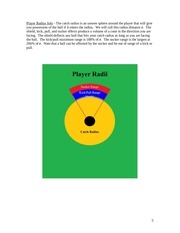
Player Radius Info - The catch radius is an unseen sphere around the player that will give
you possession of the ball if it enters the radius. We will call this radius distance r. The
shield, kick, pull, and sucker effects produce a volume of a cone in the direction you are
facing. The shield deflects any ball that hits your catch radius as long as you are facing
the ball. The kick/pull maximum range is 188% of r. The sucker range is the largest at
206% of r. Note that a ball can be affected by the sucker and be out of range of a kick or
pull.
5
�
Areas of the Field
Scoring Area - Red - The scoring area is in front of the goal from which where 85% of
goals are scored. Attackers need to make runs into the scoring area with or without the
ball. Goals are scored here because the keeper has too many angles of the goal to cover
and has to pick one. If you have the ball in the scoring area, you must shoot, time is
limited.
Setup Area - Orange - The setup area is a great place for a ball carrier to look into the
scoring area for a teammate. Attackers without the ball should make runs into the setup
area to receive passes and immediately look to the scoring area. Ballcarriers may want to
try to set themselves off the front wall. Direct shots from the setup area are more easily
saved, but rolling shots have a good chance of fooling a goalkeeper. If everything is
covered, consider retreating for another attack.
6
�
Boosting Corridor - Yellow - The boosting corridor is where most boosts are going to
occur. No matter what is happening in the game, the best position is in the middle of the
field where you are closest to the goals. If your team is in good defensive position, the
closest teammate for a boost up is likely to be in the boosting corridor. If your team is
attacking the goal, the closest teammate for a boost back will likely be here as well. This
is also prime area for double/triple boosts. This is also the area to block boosts.
No Man's Land - White - The outer areas are no man’s land. Almost nothing good
happens here. You are too far from the goal to shoot or pass for a shot. You are likely
too far away from a teammate to boost. These zones are only good for relieving pressure
and regrouping for an attack. Too often I see attackers hanging out here. They are
waiting for a pass. The question I always have is “What are you going to do with the ball
once you get it here?” Any shot you take is easily grabbed by the keeper. Any pass you
make will be slow enough for opposing defenders to react to it. You are not going to
juke your defender face to face. Your only good play is to move the ball to a teammate
and attack the scoring area. IF YOU ONLY LEARN ONE THING FROM THIS
GUIDE, DO NOT HANG AROUND IN NO MAN'S LAND.
Goalkeeper's Domain - Blue - This is where goalkeepers can safely track down loose
balls most of the time. Keeping possession of the ball is very important and while the
defenseman is keeping the cherry picker in check, many loose balls will find their way to
the goalkeeper’s domain. Be on your toes, and be ready to dodge out to both sides of the
field to grab the ball.
7
�
Offensive Skills
This section covers skills and tips, mostly concerning individual play, useful at all levels
of Supraball.
Receiving the Ball - Running with the ball slows you down, but if you receive a pass
while in the air, you will get a slight boost until you land. Jump right before catching the
ball and use 3 more jumps to get maximum distance up the field.
Maximum Run Speed - Because running with the ball slows you down, you may want to
pass back and forth with an open teammate so that you both spend as much time as
possible at max running speed.
Volleys - Volleys are the best way to get a fast shot off. Hold down your shield and kick
when the ball comes within your range. Holding shield will help ensure that you do not
accidentally catch the ball and it slightly increases the range of time for the volley to
connect.
Boop - Holding the shield without the volley will send a slow shot/pass where you are
aiming if the ball hits your shield. Boops might be considered showboating/insult plays,
but sometimes it works.
Rolling Shot/Pass - While on the ground with the ball, aim level. Start your charge. Add
a sidespin and press the pass key during the charge. Release your charge to fire a shot
that will bite into the ground hard as it rolls. This can be useful in passing around a
defender in good position or shooting on goal from a bad angle.
Using the Walls - The side and front walls can be used to make passes around defenders
or use the front wall to set up a volley shot to yourself. You can also pass to yourself off
the walls and use the catch momentum to increase your space on a defender. Buying just
a little bit of time and space can open up better opportunities.
Pogo - Sometimes you can fool a defender by charging the gun, jumping in the air, and
firing the shot straight down back to yourself. The defender may think you made a pass
or shot. If he turns his head, you have the advantage. The disadvantage to the pogo is
that you cannot quickly make a locked pass if you are charging.
Reset the Charge - If you are charging up a pass or shot and you see an opponent jump
the lane, shoot the ball directly at the nearest wall to pass to yourself and try again.
Juke - Completing a pass with a good defender in your face is not easy. Juke him left and
right to open up space to get the ball around, over, or under him. If the defender is
hanging in the air, pass over him when he runs out of jumps. You can also use all 4 of
your jumps quickly to open up space over his head for a quick pass.
8
�
Slingshot - Without the ball, use your sucker to try to sling your way past a defender.
This is hard to accomplish because the defender will likely kick you back, but sometimes
you can get an extra boost if he is not paying attention.
Passing Quickly - I would say most players take 0.4 to 0.5 seconds to receive a ball and
lock a pass to a teammate if they are trying to pass quickly and safely. If you are slower
than this, then windows will close, defenders will get in better position. However, if you
are faster than this, you can make passes that are unexpectedly fast and take a defender
by surprise. Defenders get used to the average time it takes from a reception to a pass
and make moves based on this time that disrupt an attack.
The Bomb - Getting kicked in the air has little effect on your positioning. Go to the top
of the box and have your keeper bomb the ball here. If your defender plays the ball, hit
him away and go for the catch. If he hits you, there is still a good chance you can catch
the ball and turn for a quick shot or pass. If the keeper goes for the ball, you have a
chance at an open net if you can make the catch.
Defensive Skills
This section also covers skills and tips, mostly concerning individual play, useful at all
levels of Supraball.
Marking and Checking - If you are in man to man defense, get as close as you are
comfortable with to your man and be ready to kick him if he moves towards you or if a
pass comes in to him. You can cause a turnover by kicking him out of position enough to
grab the ball or create a loose ball. Sometimes you can jump into the passing lane and
intercept the ball before it gets to the receiver.
Sucker - Hold shield and pull button to create a vacuum effect that will affect the ball if it
gets near you. This is good to use as you approach the ballcarrier, especially if he is on
the wing. It can cause a loose ball or can make a locked pass go slightly off target,
slowing down the opposing receiver. You cannot catch the ball while sucker is active.
Also be careful in front of the goal. A pass/shot going wide may be pulled onto the goal
frame.
Shield - Holding the shield button will prevent you from catching the ball. Useful if you
have one hit of health. This can be a good tool for blocking quick shots, but be aware
that your shield is disabled in your own keeper box.
Gun Watching - Be aware of which way attackers are facing. If they are in the scoring
area they are likely facing the goal, waiting for a pass to volley. Keep then in check by
kicking them back. Also, as you approach a ballcarrier near the wall, see if he is looking
to cross or pass back. Attack the carrier from the direction he is facing to cause the most
trouble.
9
�
 Historical archive . public document