EXCERPT FROM
Alaska Native Sovereignty: Possible Criminal Justice Applications
By:
Gary D. Copus, Ph.D.
David M. Blurton, J.D.
Published in the Northern Review, #14, Summer 1995
APPROPRIATENESS OF TRIBAL LOCAL CONTROL
While the above discussion of regulatory law demonstrates that some aspects of law and
order can be maintained through the use of regulatory law, it is an entirely different
question as to whether regulatory maintenance of law and order would be appropriate for
Alaska Native villages. Even given the ability of tribes to assume local control of
criminal behavior through the mechanism of regulatory ordinances, such control may not
be desirable.
Two areas need consideration. First, the type of criminal activity is important. If, for
instance, a majority of the crimes in a village are first degree
murders regulatory control is obviously questionable if not impossible. If the crimes are
minor offenses, however, tribal regulatory control probably would be seen by villages
and the State as appropriate. Second, the quality of services provided by the State could
well obviate the need for tribal control. For example, if all residents of the village viewed
the quality of State criminal justice services as being good, then village assumption of
those services may not be a priority to the village.
Data was collected from two villages by examining the cases on file in the two respective
State magistrate’s offices. Each village is served by a different magistrate who maintains
a court and public case file storage for all past cases arising in the village. The cases
studied were for crimes which occurred between July 1, 1992 and June 31, 1993. The
case data was collected in the spring of 1994 to allow cases, originating near the end of
the study period, to complete the State justice process. Each village, Village A and
�
Village B, are remote and readily accessible only by air. There are no roads to either
village and both are approximately 120 air miles from Fairbanks. Fairbanks is the
administrative center for judicial services. Village A has a population of approximately
400 with a one person police department. Village B has 700 population served by four
police officers. Both villages are State chartered municipalities with police officers
operating under the authority of the respective city councils and ultimately the State. The
magistrate in Village B lives in the village whereas the magistrate for Village A travels to
the village once a month or when needed. Each village has a substantial non-Native
population of approximately 20%.
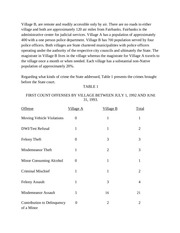
Regarding what kinds of crime the State addressed, Table 1 presents the crimes brought
before the State court.
TABLE 1
FIRST COUNT OFFENSES BY VILLAGE BETWEEN JULY 1, 1992 AND JUNE
31, 1993.
Offense
Village A
Village B
Total
Moving Vehicle Violations
0
1
1
DWI/Test Refusal
1
1
2
Felony Theft
0
3
3
Misdemeanor Theft
1
2
3
Minor Consuming Alcohol
0
1
1
Criminal Mischief
1
1
2
Felony Assault
1
3
4
Misdemeanor Assault
5
16
21
Contribution to Delinquency
of a Minor
0
2
2
�
Harassment
0
1
1
Burglary
2
3
5
Reckless Endangerment
0
1
1
Disorderly Conduct
1
2
3
Possession of a Controlled
1
0
1
Resisting Arrest
0
1
1
Sexual Assault
1
1
2
Contempt of Court
0
1
1
14
40
54
Substance
Totals
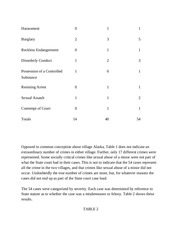
Opposed to common conception about village Alaska, Table 1 does not indicate an
extraordinary number of crimes in either village. Further, only 17 different crimes were
represented. Some socially critical crimes like sexual abuse of a minor were not part of
what the State court had in their cases. This is not to indicate that the 54 cases represent
all the crime in the two villages, and that crimes like sexual abuse of a minor did not
occur. Undoubtedly the true number of crimes are more, but, for whatever reasons the
cases did not end up as part of the State court case load.
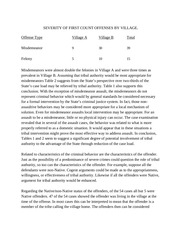
The 54 cases were categorized by severity. Each case was determined by reference to
State statute as to whether the case was a misdemeanor or felony. Table 2 shows these
results.
TABLE 2
�
SEVERITY OF FIRST COUNT OFFENSES BY VILLAGE.
Offense Type
Village A
Village B
Total
Misdemeanor
9
30
39
Felony
5
10
15
Misdemeanors were almost double the felonies in Village A and were three times as
prevalent in Village B. Assuming that tribal authority would be most appropriate for
misdemeanors Table 2 suggests from the State’s perspective over two-thirds of the
State’s case load may be relieved by tribal authority. Table 1 also supports this
conclusion. With the exception of misdemeanor assault, the misdemeanors do not
represent criminal behavior which would by general standards be considered necessary
for a formal intervention by the State’s criminal justice system. In fact, those nonassaultive behaviors may be considered more appropriate for a local mechanism of
solution. Even for misdemeanor assaults local intervention may be appropriate. For an
assault to be a misdemeanor, little or no physical injury can occur. The case examination
revealed that in several of the assault cases, the behavior was related to what is more
properly referred to as a domestic situation. It would appear that in these situations a
tribal intervention might prove the most effective way to address assault. In conclusion,
Tables 1 and 2 seem to suggest a significant degree of potential involvement of tribal
authority to the advantage of the State through reduction of the case load.
Related to characteristics of the criminal behavior are the characteristics of the offender.
Just as the possibility of a predominance of severe crimes could question the role of tribal
authority, so too can the characteristics of the offender. For example, suppose all the
defendants were non-Native. Cogent arguments could be made as to the appropriateness,
willingness, or effectiveness of tribal authority. Likewise if all the offenders were Native,
argument for tribal authority would be enhanced.
Regarding the Native/non-Native status of the offenders, of the 54 cases all but 5 were
Native offenders. 47 of the 54 cases showed the offender was living in the village at the
time of the offense. In most cases this can be interpreted to mean that the offender is a
member of the tribe calling the village home. The offenders then can be considered
�
Native and local residents, both characteristics conducive to tribal authority.
Characteristics of the victim and victim’s relationship to the offender further enhances the
legitimacy of tribal authority. On the 31 cases for which victim
race was known, all but two of the victims were Native. The data also suggests that in
most cases the victims were known to the offender.
Another factor is the presence of alcohol. Known to be a major factor in crime throughout
the nation, in the villages alcohol is also found to be prevalent in criminal behavior. For
the 36 cases on which data was known, 28 cases reported alcohol to be a factor. Tribal
authority, rather than a remote State system, may be more appropriate to intervene in the
alcohol cycle to prevent a number of crimes from occurring.7
Those factors discussed above suggest that traditional authority would be compatible
with many crimes and individual offenders currently comprising the State court case
load. Yet, if the State is doing a satisfactory job of managing the cases under its
jurisdiction, there may be less interest of the tribes in taking on the burden of
administering justice services. That dissatisfaction exists has been recognized by
participants in four Bush Justice Conferences. The initial conference being held in 1970
and the last in 1985. Participants suggested several improvements including: increasing
the number of magistrates; using new technology to provide prompter hearings; or
supporting alternative justice systems. (Alaska Judicial Council, p. 32). Two indicants,
for which data was collected, are related to the Bush Conferences’ suggestions.
The time it takes the State to close a case ranges from several days to over 3 years. One
case took over 600 days and 5 cases were still in the process of conclusion at the time of
the data collection. These cases will be in excess of 600 days at time of closing. The
cases generally were evenly distributed across the time range. This distribution may
suggest to the tribe that how long a case will take to complete is a matter of uncertainty.
Perhaps more serious is the issue of whether a case was actually prosecuted by the State.
A comment heard numerous times by the authors was, “nothing ever happens to people
who commit crimes in the villages.” Table 3 shows the disposition status by final plea of
each of 51 cases for which data was available, and suggests how the perception of State
inactivity regarding criminal justice in the villages has arisen.
�
TABLE 3
DISPOSITION OF CASES BY FINAL PLEA ENTERED BY ACCUSED.
Final Plea
No Contest to
Not Guilty No Contest
Guilty
Reduced Charges
Disposition
Guilty
2
0
14
2
Guilty of
Lesser Offense
0
2
1
13
Dismissed By DA
0
14
2
0
Dismissed By
Court
0
1
0
0
2
17
17
15
Totals
One-third, or 17, of the 51 cases on which data were available had the offender entering
in a final plea of not guilty. For those 17 cases 14 were dismissed by the District Attorney
and one was dismissed by the court. Although the reasons for dismissal were not
determined, it seems plausible to assume either the reasons had to do with the “quality”
of the case or with reasons internal to the District Attorney’s office. In either case, from
the view of the tribe it appears all one has to do is plead not guilty and the odds are good
you will have your case dismissed.
Furthermore, of the 34 cases for which the offender was officially found guilty of a
crime, only three of the cases resulted in the offender receiving any significant time of
incarceration.9 The maximum period of actual incarceration time required was only 90
days. Clearly, from the village viewpoint it is easy to believe the State is not providing
criminal justice services when only three of 51 cases filed with the State court system
result in any significant incarceration of the offender.
Table 4 looks further at the dismissals by addressing whether the dismissals were for the
lesser, misdemeanor, crimes as would be expected.
�
Table 4
RELATIONSHIP BETWEEN CASE DISPOSITION AND LEVEL OF
SEVERITY.
Level of Severity of Original Charge
Misdemeanor
Felony
Disposition
Guilty
17
1
Guilty of
Lesser Offense
11
5
Dismissed by DA
8
8
Dismissed by Court
0
1
36
15
Totals
Contrary to expectations, 9 of the dismissals were for felonies and 8 were for
misdemeanors. From a village perspective it may seem that not only does
pleading not guilty predict a dismissal but the level of severity of the crime does not seem
to matter.
Conclusion
A basic theme of the Alaska Native Commission’s Report was a return of traditional
rights and responsibilities to tribal authority. The Commission recognized that many of
the services needed by villages can best be provided by the villages themselves. The
general population of Alaska is predominantly non-Native, and each time tribal
independence is suggested, a hue and cry is heard from those espousing “one State, one
people” concepts. Thus, the general population of Alaska may need additional
compelling reasons for accepting a renewal of tribal governments in Alaska.
As has been noted by Blurton and Copus (1993), fiscal factors provide additional
�
incentive for the State to seek village assumption of services such as those involving
public safety. Because of a reduction in oil revenues, Alaska’s state government has had
to reduce government services. State law enforcement and prosecutorial agencies have
not escaped the reductions thus resulting in adverse affects upon the maintenance of law
and order in rural Alaska. In some rural communities some services have been virtually
eliminated. Theoretically, the State’s responsibilities have not decreased; but, practically,
a void may be developing in the provision of criminal justice services to Alaska rural
communities. Tribal law enforcement and prosecution of at least selected crimes may be
a practical means of filling the growing void. Additionally, tribal courts are the only local
courts which can exist in Alaska.10 Consequently, revitalization of tribal authority is the
only alternative which can alleviate State court case loads and accompanying financial
woes.
Two major obstacles, standing in the way of a cooperative attitude on the part of the
State, have been examined and determined to be surmountable or not a problem of major
proportions. The jurisdictional issues posed by P.L. 280 can be circumvented by tribes
using regulatory laws rather than criminal laws to deter unwanted behavior. The second
potential obstacle concerns the severity of crimes occurring in the villages. The State is
unlikely to relinquish, the villages probably unwilling to accept, and regulatory law
maybe inappropriate to justify a transfer of State jurisdiction for serious offenses, like
murder, to tribal governments. Data collected from the two villages examined for this
article suggests the severity of offenses will not pose a significant problem for tribal
assumption of law and order maintenance. Of the 54 criminal cases examined in the
study, only 15 were felony offenses under State law. Furthermore, in only three of the
cases was incarceration employed in any degree which could be construed as punishment.
Consequently, it appears the vast majority of village crimes being processed by the State
are misdemeanors, and quite suitable for being conferred to tribal authorities.
Finally, since this article has suggested tribal use of regulatory law for deterring actions
classified as crimes by the State, it would be remiss not to attempt to suggest suitable
regulatory language for at least one of the offenses a tribe would likely handle. Because
“misdemeanor assault” posed the largest category of crime occurring in the two villages
studied, it seems the most appropriate to address. As indicated earlier, the U.S. Supreme
Court’s differentiation between criminal and regulatory law suggests regulatory law
generally allows an activity but proscribes abuses of the activity. Thus a regulatory law
seeking to proscribe misdemeanor assault must be couched as permitting an activity
�
which encompasses, while simultaneously maintaining, assaultive behavior. The
following is offered as potential regulatory language by which a tribe might exercise
regulatory jurisdiction over misdemeanor assault:
The settlement of personal disputes occurring within the village boundaries may
be pursued in private or public locations. Disputants are encouraged to seek tribal
mediation when private negotiations are unsuccessful in resolving differences.
The settlement of disputes by physical altercations is prohibited.
Such a regulation allows a general behavior, namely the settlement of personal disputes
between members of the village. The regulation simultaneously recognizes and prohibits
physical altercations as an abusive means of settling disputes. Misdemeanor assault
certainly can be characterized as conduct involving a physical altercation. Consequently,
a tribe might effectively regulate conduct which the State would characterize as
misdemeanor assault. By crafting similar regulations most, if not all, of the crimes
included in the study of the two villages and processed by the State could be handled
through regulatory means by tribal entities.
�
 Historical archive . public document