FOR PUBLICATION
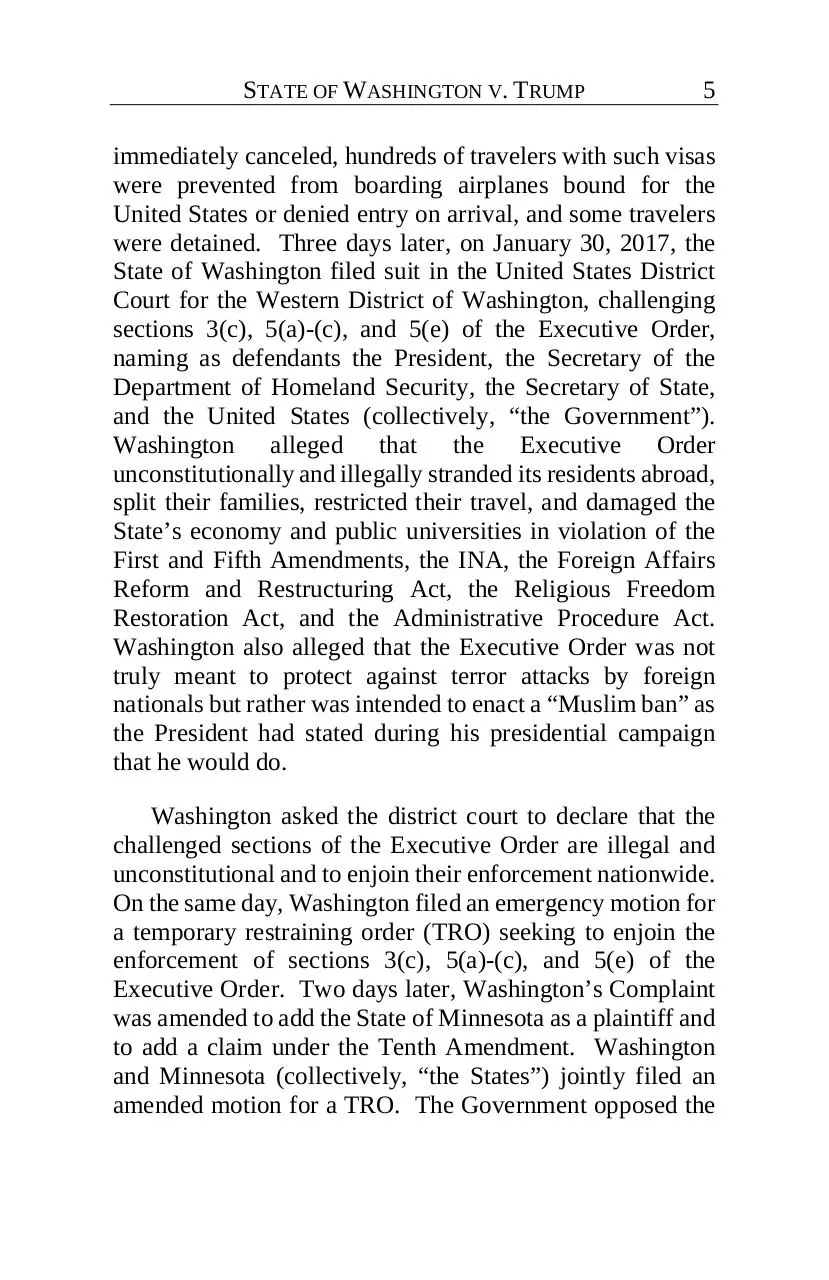
UNITED STATES COURT OF APPEALS
FOR THE NINTH CIRCUIT
STATE OF WASHINGTON; STATE OF
MINNESOTA,
Plaintiffs-Appellees,
No. 17-35105
D.C. No.
2:17-cv-00141
v.
DONALD J. TRUMP, President of the
United States; U.S. DEPARTMENT OF
HOMELAND SECURITY; REX W.
TILLERSON, Secretary of State; JOHN
F. KELLY, Secretary of the
Department of Homeland Security;
UNITED STATES OF AMERICA,
Defendants-Appellants.
ORDER
Motion for Stay of an Order of the
United States District Court for the
Western District of Washington
James L. Robart, District Judge, Presiding
Argued and Submitted February 7, 2017
Filed February 9, 2017
Before: William C. Canby, Richard R. Clifton, and
Michelle T. Friedland, Circuit Judges
Per Curiam Order
�
2
STATE OF WASHINGTON V. TRUMP
COUNSEL
August E. Flentje (argued), Special Counsel to the Assistant
Attorney General; Douglas N. Letter, Sharon Swingle, H.
Thomas Byron, Lowell V. Sturgill Jr., and Catherine Dorsey,
Attorneys, Appellate Staff; Chad A. Readler, Acting
Assistant Attorney General; Noel J. Francisco, Acting
Solicitor General; Civil Division, United States Department
of Justice, Washington, D.C., for Defendants-Appellants.
Noah G. Purcell (argued), Solicitor General; Marsha Chien
and Patricio A. Marquez, Assistant Attorneys General;
Colleen M. Melody, Civil Rights Unit Chief; Anne E.
Egeler, Deputy Solicitor General; Robert W. Ferguson,
Attorney General; Attorney General’s Office, Seattle,
Washington; for Plaintiff-Appellee State of Washington.
Jacob Campion, Assistant Attorney General; Alan I. Gilbert,
Solicitor General; Lori Swanson, Attorney General; Office
of the Attorney General, St. Paul, Minnesota; for PlaintiffAppellee State of Minnesota.
ORDER
PER CURIAM:
At issue in this emergency proceeding is Executive
Order 13769, “Protecting the Nation From Foreign Terrorist
Entry Into the United States,” which, among other changes
to immigration policies and procedures, bans for 90 days the
entry into the United States of individuals from seven
countries. Two States challenged the Executive Order as
unconstitutional and violative of federal law, and a federal
district court preliminarily ruled in their favor and
�
STATE OF WASHINGTON V. TRUMP
3
temporarily enjoined enforcement of the Executive Order.
The Government now moves for an emergency stay of the
district court’s temporary restraining order while its appeal
of that order proceeds.
To rule on the Government’s motion, we must consider
several factors, including whether the Government has
shown that it is likely to succeed on the merits of its appeal,
the degree of hardship caused by a stay or its denial, and the
public interest in granting or denying a stay. We assess those
factors in light of the limited evidence put forward by both
parties at this very preliminary stage and are mindful that our
analysis of the hardships and public interest in this case
involves particularly sensitive and weighty concerns on both
sides. Nevertheless, we hold that the Government has not
shown a likelihood of success on the merits of its appeal, nor
has it shown that failure to enter a stay would cause
irreparable injury, and we therefore deny its emergency
motion for a stay.
Background
On January 27, 2017, the President issued Executive
Order 13769, “Protecting the Nation From Foreign Terrorist
Entry Into the United States” (the “Executive Order”).
82 Fed. Reg. 8,977. Citing the terrorist attacks of September
11, 2001, and stating that “numerous foreign-born
individuals have been convicted or implicated in terrorismrelated crimes” since then, the Executive Order declares that
“the United States must ensure that those admitted to this
country do not bear hostile attitudes toward it and its
founding principles.”
Id.
It asserts, “Deteriorating
conditions in certain countries due to war, strife, disaster,
and civil unrest increase the likelihood that terrorists will use
any means possible to enter the United States. The United
�
4
STATE OF WASHINGTON V. TRUMP
States must be vigilant during the visa-issuance process to
ensure that those approved for admission do not intend to
harm Americans and that they have no ties to terrorism.” Id.
The Executive Order makes several changes to the
policies and procedures by which non-citizens may enter the
United States. Three are at issue here. First, section 3(c) of
the Executive Order suspends for 90 days the entry of aliens
from seven countries: Iraq, Iran, Libya, Somalia, Sudan,
Syria, and Yemen. 82 Fed. Reg. 8,977-78 (citing the
Immigration and Nationality Act (INA) § 217(a)(12),
codified at 8 U.S.C. § 1187(a)(12)). Second, section 5(a) of
the Executive Order suspends for 120 days the United States
Refugee Admissions Program. 82 Fed. Reg. 8,979. Upon
resumption of the refugee program, section 5(b) of the
Executive Order directs the Secretary of State to prioritize
refugee claims based on religious persecution where a
refugee’s religion is the minority religion in the country of
his or her nationality. Id. Third, section 5(c) of the
Executive Order suspends indefinitely the entry of all Syrian
refugees. Id. Sections 3(g) and 5(e) of the Executive Order
allow the Secretaries of State and Homeland Security to
make case-by-case exceptions to these provisions “when in
the national interest.” 82 Fed. Reg. 8,978-80. Section 5(e)
states that situations that would be in the national interest
include “when the person is a religious minority in his
country of nationality facing religious persecution.” 82 Fed.
Reg. 8,979. The Executive Order requires the Secretaries of
State and Homeland Security and the Director of National
Intelligence to evaluate the United States’ visa, admission,
and refugee programs during the periods in which entry is
suspended. 82 Fed. Reg. 8,977-80.
The impact of the Executive Order was immediate and
widespread. It was reported that thousands of visas were
�
STATE OF WASHINGTON V. TRUMP
5
immediately canceled, hundreds of travelers with such visas
were prevented from boarding airplanes bound for the
United States or denied entry on arrival, and some travelers
were detained. Three days later, on January 30, 2017, the
State of Washington filed suit in the United States District
Court for the Western District of Washington, challenging
sections 3(c), 5(a)-(c), and 5(e) of the Executive Order,
naming as defendants the President, the Secretary of the
Department of Homeland Security, the Secretary of State,
and the United States (collectively, “the Government”).
Washington alleged that the Executive Order
unconstitutionally and illegally stranded its residents abroad,
split their families, restricted their travel, and damaged the
State’s economy and public universities in violation of the
First and Fifth Amendments, the INA, the Foreign Affairs
Reform and Restructuring Act, the Religious Freedom
Restoration Act, and the Administrative Procedure Act.
Washington also alleged that the Executive Order was not
truly meant to protect against terror attacks by foreign
nationals but rather was intended to enact a “Muslim ban” as
the President had stated during his presidential campaign
that he would do.
Washington asked the district court to declare that the
challenged sections of the Executive Order are illegal and
unconstitutional and to enjoin their enforcement nationwide.
On the same day, Washington filed an emergency motion for
a temporary restraining order (TRO) seeking to enjoin the
enforcement of sections 3(c), 5(a)-(c), and 5(e) of the
Executive Order. Two days later, Washington’s Complaint
was amended to add the State of Minnesota as a plaintiff and
to add a claim under the Tenth Amendment. Washington
and Minnesota (collectively, “the States”) jointly filed an
amended motion for a TRO. The Government opposed the
�
6
STATE OF WASHINGTON V. TRUMP
motion the next day, and the district court held a hearing the
day after that.
That evening, the court entered a written order granting
the TRO. Washington v. Trump, No. C17-0141-JLR, 2017
WL 462040 (W.D. Wash. Feb. 3, 2017). The district court
preliminarily concluded that significant and ongoing harm
was being inflicted on substantial numbers of people, to the
detriment of the States, by means of an Executive Order that
the States were likely to be able to prove was unlawful. Id.
at *2. The district court enjoined and restrained the
nationwide enforcement of sections 3(c) and 5(a)-(c) in their
entirety. Id. It enjoined section 5(e) to the extent that section
“purports to prioritize refugee claims of certain religious
minorities,” and prohibited the government from
“proceeding with any action that prioritizes the refugee
claims of certain religious minorities.” The court also
directed the parties to propose a briefing schedule for the
States’ request for a preliminary injunction and denied the
Government’s motion to stay the TRO pending an
emergency appeal. Id. at *3.
The Government filed a notice of appeal the next day and
sought an emergency stay in this court, including an
immediate stay while its emergency stay motion was under
consideration. We denied the request for an immediate stay
and set deadlines for the filing of responsive and reply briefs
on the emergency stay motion over the next two days. 1
Washington v. Trump, No. 17-35105, 2017 WL 469608 (9th
Cir. Feb. 4, 2017). The motion was submitted after oral
argument was conducted by telephone.
1
We have also received many amicus curiae briefs in support of
both the Government and the States.
�
STATE OF WASHINGTON V. TRUMP
7
Appellate Jurisdiction
The States argue that we lack jurisdiction over the
Government’s stay motion because the Government’s
appeal is premature. A TRO is not ordinarily appealable.
See Bennett v. Medtronic, Inc., 285 F.3d 801, 804 (9th Cir.
2002). We may nonetheless review an order styled as a TRO
if it “possesses the qualities of a preliminary injunction.”
Serv. Emps. Int’l Union v. Nat’l Union of Healthcare
Workers, 598 F.3d 1061, 1067 (9th Cir. 2010). This rule has
ordinarily required the would-be appellant to show that the
TRO was strongly challenged in adversarial proceedings
before the district court and that it has or will remain in force
for longer than the fourteen-day period identified in Federal
Rule of Civil Procedure 65(b). See, e.g., id.
We are satisfied that in the extraordinary circumstances
of this case, the district court’s order possesses the qualities
of an appealable preliminary injunction. The parties
vigorously contested the legal basis for the TRO in written
briefs and oral arguments before the district court. The
district court’s order has no expiration date, and no hearing
has been scheduled. Although the district court has recently
scheduled briefing on the States’ motion for a preliminary
injunction, it is apparent from the district court’s scheduling
order that the TRO will remain in effect for longer than
fourteen days. In light of the unusual circumstances of this
case, in which the Government has argued that emergency
relief is necessary to support its efforts to prevent terrorism,
we believe that this period is long enough that the TRO
�
8
STATE OF WASHINGTON V. TRUMP
should be considered to have the qualities of a reviewable
preliminary injunction. 2
Standing
The Government argues that the district court lacked
subject matter jurisdiction because the States have no
standing to sue. We have an independent obligation to
ascertain our jurisdiction, Arbaugh v. Y & H Corp., 546 U.S.
500, 514 (2006), and we consider the Government’s
argument de novo, see, e.g., Hajro v. U.S. Citizenship &
Immigration Servs., 811 F.3d 1086, 1098 (9th Cir. 2016).
We conclude that the States have made a sufficient showing
to support standing, at least at this preliminary stage of the
proceedings.
Article III, section 2 of the Constitution allows federal
courts to consider only “Cases” and “Controversies.”
Massachusetts v. EPA, 549 U.S. 497, 516 (2007). “Those
two words confine ‘the business of federal courts to
questions presented in an adversary context and in a form
historically viewed as capable of resolution through the
judicial process.’” Id. (quoting Flast v. Cohen, 392 U.S. 83,
95 (1968)). ”Standing is an essential and unchanging part of
the case-or-controversy requirement” and is therefore a
prerequisite to our jurisdiction. See Lujan v. Defs. of
Wildlife, 504 U.S. 555, 560 (1992). The “gist of the question
of standing” is whether the plaintiff has a sufficiently
“personal stake in the outcome of the controversy” to ensure
that the parties will be truly adverse and their legal
2
Our conclusion here does not preclude consideration of appellate
jurisdiction at the merits stage of this appeal. See Nat’l Indus., Inc. v.
Republic Nat’l Life Ins. Co., 677 F.2d 1258, 1262 (9th Cir. 1982).
�
STATE OF WASHINGTON V. TRUMP
9
presentations sharpened. Massachusetts, 549 U.S. at 517
(quoting Baker v. Carr, 369 U.S. 186, 204 (1962)).
To establish Article III standing, a plaintiff must
demonstrate “that it has suffered a concrete and
particularized injury that is either actual or imminent, that
the injury is fairly traceable to the defendant, and that it is
likely that a favorable decision will redress that injury.” Id.
(citing Lujan, 504 U.S. at 560-61).
Because standing is “an indispensable part of the
plaintiff’s case,” it “must be supported in the same way as
any other matter on which the plaintiff bears the burden of
proof, i.e., with the manner and degree of evidence required
at the successive stages of the litigation.” Lujan, 504 U.S. at
561. At this very preliminary stage of the litigation, the
States may rely on the allegations in their Complaint and
whatever other evidence they submitted in support of their
TRO motion to meet their burden. See id. With these
allegations and evidence, the States must make a “clear
showing of each element of standing.” Townley v. Miller,
722 F.3d 1128, 1133 (9th Cir. 2013). 3
The States argue that the Executive Order causes a
concrete and particularized injury to their public universities,
which the parties do not dispute are branches of the States
under state law. See, e.g., Hontz v. State, 714 P.2d 1176,
1180 (Wash. 1986) (en banc); Univ. of Minn. v. Raygor,
620 N.W.2d 680, 683 (Minn. 2001).
3
Our decision in Townley concerned a motion for a preliminary
injunction, but the legal standards applicable to TROs and preliminary
injunctions are “substantially identical.” Stuhlbarg Int’l Sales Co., Inc.
v. John D. Brush & Co., Inc., 240 F.3d 832, 839 n.7 (9th Cir. 2001).
�
 Historical archive . public document