Centre Number
For Examiner’s Use
Candidate Number
Surname
Other Names
Examiner’s Initials
Candidate Signature
Question
General Certificate of Education
Advanced Subsidiary Examination
January 2010
Mark
1
2
3
Chemistry
Unit 1
CHEM1
4
5
Foundation Chemistry
6
Thursday 14 January 2010
9.00 am to 10.15 am
TOTAL
For this paper you must have:
● the Periodic Table/Data Sheet, provided as an insert
(enclosed)
● a calculator.
Time allowed
● 1 hour 15 minutes
Instructions
● Use black ink or black ball-point pen.
● Fill in the boxes at the top of this page.
● Answer all questions.
● You must answer the questions in the spaces provided. Answers
written in margins or on blank pages will not be marked.
● All working must be shown.
● Do all rough work in this book. Cross through any work you do not
want to be marked.
Information
● The marks for questions are shown in brackets.
● The maximum mark for this paper is 70.
● The Periodic Table/Data Sheet is provided as an insert.
● Your answers to the questions in Section B should be written in
continuous prose, where appropriate.
● You will be marked on your ability to:
– use good English
– organise information clearly
– use accurate scientific terminology.
Advice
● You are advised to spend about 50 minutes on Section A and about
25 minutes on Section B.
(JAN10CHEM101)
WMP/Jan10/CHEM1
CHEM1
�
2
Areas outside
the box will
not be scanned
for marking
SECTION A
Answer all questions in the spaces provided.
1 Ionisation energies provide evidence for the arrangement of electrons in atoms.
1
(a) Complete the electron configuration of the Mg+ ion.
1s2 ......................................................................................................................................
(1 mark)
1
(b)
(i) State the meaning of the term first ionisation energy.
...................................................................................................................................
...................................................................................................................................
...................................................................................................................................
(2 marks)
1
(b)
(ii) Write an equation, including state symbols, to show the reaction that occurs
when the second ionisation energy of magnesium is measured.
...................................................................................................................................
(1 mark)
1
(b) (iii) Explain why the second ionisation energy of magnesium is greater than the first
ionisation energy of magnesium.
...................................................................................................................................
...................................................................................................................................
...................................................................................................................................
(1 mark)
1
(b) (iv) Use your understanding of electron arrangement to complete the table by
suggesting a value for the third ionisation energy of magnesium.
Ionisation energies of
magnesium / kJ mol –1
First
Second
736
1450
Third
Fourth
Fifth
10 500
13 629
(1 mark)
(02)
WMP/Jan10/CHEM1
�
3
1
Areas outside
the box will
not be scanned
for marking
(c) State and explain the general trend in the first ionisation energies of the Period 3
elements sodium to chlorine.
Trend ..................................................................................................................................
Explanation ........................................................................................................................
.............................................................................................................................................
.............................................................................................................................................
(3 marks)
(Extra space) ......................................................................................................................
.............................................................................................................................................
.............................................................................................................................................
1
(d) State how the element sulfur deviates from the general trend in first ionisation energies
across Period 3. Explain your answer.
How sulfur deviates from the trend ...................................................................................
.............................................................................................................................................
Explanation ........................................................................................................................
.............................................................................................................................................
.............................................................................................................................................
(3 marks)
(Extra space) ......................................................................................................................
.............................................................................................................................................
.............................................................................................................................................
1
(e) A general trend exists in the first ionisation energies of the Period 2 elements lithium
to fluorine. Identify one element which deviates from this general trend.
.............................................................................................................................................
(1 mark)
13
Turn over �
(03)
WMP/Jan10/CHEM1
�
4
Areas outside
the box will
not be scanned
for marking
2 Ammonium sulfate reacts with sodium hydroxide to form ammonia, sodium sulfate and
water as shown in the equation below.
(NH4)2SO4(s) + 2NaOH(aq) → 2NH3(g) + Na2SO4(aq) + 2H2O(l)
2
(a) A 3.14 g sample of ammonium sulfate reacted completely with 39.30 cm3 of a sodium
hydroxide solution.
2
(a)
(i) Calculate the amount, in moles, of (NH4)2SO4 in 3.14 g of ammonium sulfate.
...................................................................................................................................
...................................................................................................................................
...................................................................................................................................
(2 marks)
2
(a)
(ii) Hence calculate the amount, in moles, of sodium hydroxide which reacted.
...................................................................................................................................
(1 mark)
2
(a) (iii) Calculate the concentration, in mol dm–3, of the sodium hydroxide solution used.
...................................................................................................................................
...................................................................................................................................
(1 mark)
2
(b) Calculate the percentage atom economy for the production of ammonia in the reaction
between ammonium sulfate and sodium hydroxide.
.............................................................................................................................................
.............................................................................................................................................
.............................................................................................................................................
(2 marks)
(04)
WMP/Jan10/CHEM1
�
5
2
Areas outside
the box will
not be scanned
for marking
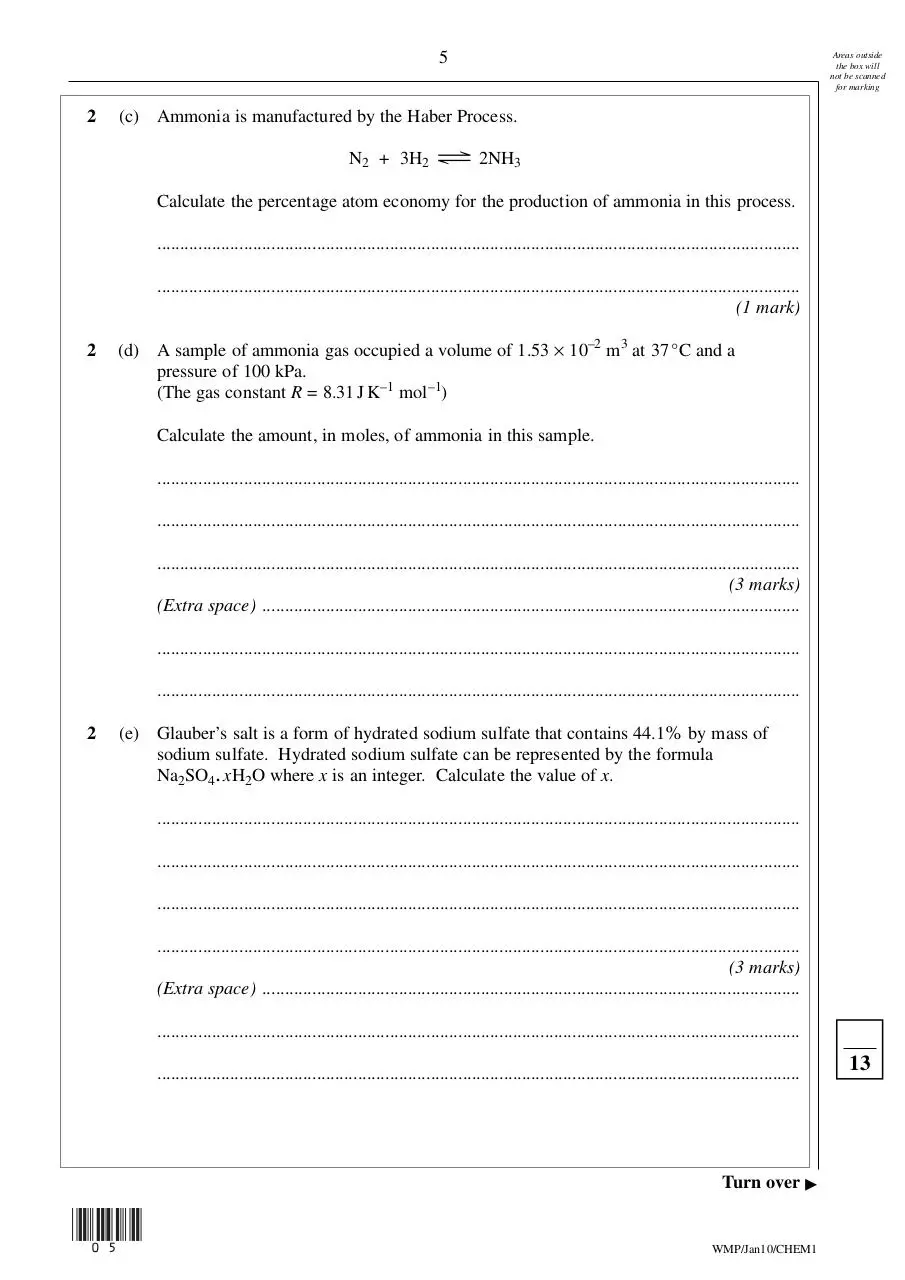
(c) Ammonia is manufactured by the Haber Process.
N2 + 3H2
2NH3
Calculate the percentage atom economy for the production of ammonia in this process.
.............................................................................................................................................
.............................................................................................................................................
(1 mark)
2
(d) A sample of ammonia gas occupied a volume of 1.53 × 10⁻² m3 at 37 °C and a
pressure of 100 kPa.
(The gas constant R = 8.31 J K–1 mol –1)
Calculate the amount, in moles, of ammonia in this sample.
.............................................................................................................................................
.............................................................................................................................................
.............................................................................................................................................
(3 marks)
(Extra space) ......................................................................................................................
.............................................................................................................................................
.............................................................................................................................................
2
(e) Glauber’s salt is a form of hydrated sodium sulfate that contains 44.1% by mass of
sodium sulfate. Hydrated sodium sulfate can be represented by the formula
Na2SO4. xH2O where x is an integer. Calculate the value of x.
.............................................................................................................................................
.............................................................................................................................................
.............................................................................................................................................
.............................................................................................................................................
(3 marks)
(Extra space) ......................................................................................................................
.............................................................................................................................................
.............................................................................................................................................
Turn over �
(05)
WMP/Jan10/CHEM1
13
�
6
Areas outside
the box will
not be scanned
for marking
3 The table below shows the boiling points of some hydrogen compounds formed by Group 6
elements.
Boiling point / K
3
H2O
H2S
H2Se
H2Te
373
212
232
271
(a) State the strongest type of intermolecular force in water and in hydrogen sulfide (H2S).
Water ..................................................................................................................................
Hydrogen sulfide ................................................................................................................
(2 marks)
3
(b) Draw a diagram to show how two molecules of water are attracted to each other by the
type of intermolecular force you stated in part (a). Include partial charges and all lone
pairs of electrons in your diagram.
(3 marks)
3
(c) Explain why the boiling point of water is much higher than the boiling point of
hydrogen sulfide.
.............................................................................................................................................
.............................................................................................................................................
(1 mark)
3
(d) Explain why the boiling points increase from H2S to H2Te
.............................................................................................................................................
.............................................................................................................................................
(2 marks)
(06)
WMP/Jan10/CHEM1
�
7
3
Areas outside
the box will
not be scanned
for marking
(e) When H + ions react with H2O molecules, H3O + ions are formed.
Name the type of bond formed when H + ions react with H2O molecules.
Explain how this type of bond is formed in the H3O + ion.
Type of bond ......................................................................................................................
Explanation ........................................................................................................................
.............................................................................................................................................
(2 marks)
3
(f) Sodium sulfide (Na2S) has a melting point of 1223 K.
Predict the type of bonding in sodium sulfide and explain why its melting point is
high.
Type of bonding .................................................................................................................
Explanation ........................................................................................................................
.............................................................................................................................................
.............................................................................................................................................
(3 marks)
(Extra space) ......................................................................................................................
.............................................................................................................................................
.............................................................................................................................................
Turn over for the next question
Turn over �
(07)
WMP/Jan10/CHEM1
13
�
8
Areas outside
the box will
not be scanned
for marking
4 Alkanes are saturated hydrocarbons which can be obtained from crude oil.
Pentane is an example of an alkane. A molecule of pentane contains five carbon atoms.
4
(a)
(i) State the meaning of the term saturated and of the term hydrocarbon as applied
to alkanes.
Saturated ...................................................................................................................
...................................................................................................................................
Hydrocarbon .............................................................................................................
...................................................................................................................................
(2 marks)
4
(a)
(ii) Give the general formula for the alkanes.
...................................................................................................................................
(1 mark)
4
(b) Pentane burns completely in oxygen.
4
(b)
(i) Write an equation for this reaction.
...................................................................................................................................
(1 mark)
4
(b)
(ii) State how the products of this reaction may affect the environment.
...................................................................................................................................
...................................................................................................................................
(1 mark)
4
(c) Give the name of a solid pollutant which may form when pentane burns incompletely
in air.
.............................................................................................................................................
(1 mark)
(08)
WMP/Jan10/CHEM1
�
9
Areas outside
the box will
not be scanned
for marking
4
(d) One molecule of C9H20 can be cracked to form one molecule of pentane and one other
product.
4
(d)
(i) Write an equation for this cracking reaction.
...................................................................................................................................
(1 mark)
4
(d)
(ii) Suggest a type of compound that can be manufactured from the other product of
this cracking reaction.
...................................................................................................................................
...................................................................................................................................
(1 mark)
4
(d) (iii) State why a high temperature is needed for cracking reactions to occur.
...................................................................................................................................
...................................................................................................................................
(1 mark)
Question 4 continues on the next page
Turn over �
(09)
WMP/Jan10/CHEM1
�
 Historical archive . public document