Centre Number
For Examiner’s Use
Candidate Number
Surname
Other Names
Examiner’s Initials
Candidate Signature
Question
General Certificate of Education
Advanced Subsidiary Examination
January 2011
Mark
1
2
3
Chemistry
Unit 1
CHEM1
4
5
Foundation Chemistry
6
Thursday 13 January 2011
9.00 am to 10.15 am
TOTAL
For this paper you must have:
l the Periodic Table/Data Sheet, provided as an insert
(enclosed)
l a calculator.
Time allowed
l 1 hour 15 minutes
Instructions
l Use black ink or black ball-point pen.
l Fill in the boxes at the top of this page.
l Answer all questions.
l You must answer the questions in the spaces provided. Do not write
outside the box around each page or on blank pages.
l All working must be shown.
l Do all rough work in this book. Cross through any work you do not
want to be marked.
Information
l The marks for questions are shown in brackets.
l The maximum mark for this paper is 70.
l The Periodic Table/Data Sheet is provided as an insert.
l Your answers to the questions in Section B should be written in
continuous prose, where appropriate.
l You will be marked on your ability to:
– use good English
– organise information clearly
– use accurate scientific terminology.
Advice
l You are advised to spend about 50 minutes on Section A and about
25 minutes on Section B.
(JAN11CHEM101)
WMP/Jan11/CHEM1
CHEM1
�
Do not write
outside the
box
2
Section A
Answer all questions in the spaces provided.
1
Water can be found as ice, water and steam.
1 (a)
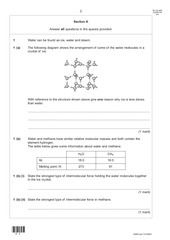
The following diagram shows the arrangement of some of the water molecules in a
crystal of ice.
With reference to the structure shown above give one reason why ice is less dense
than water.
............................................................................................................................................
............................................................................................................................................
............................................................................................................................................
(1 mark)
1 (b)
1 (b) (i)
Water and methane have similar relative molecular masses and both contain the
element hydrogen.
The table below gives some information about water and methane.
H2O
CH4
Mr
18.0
16.0
Melting point / K
273
91
State the strongest type of intermolecular force holding the water molecules together
in the ice crystal.
............................................................................................................................................
(1 mark)
1 (b) (ii) State the strongest type of intermolecular force in methane.
............................................................................................................................................
(1 mark)
(02)
WMP/Jan11/CHEM1
�
Do not write
outside the
box
3
1 (b) (iii) Give one reason why the melting point of ice is higher than the melting point of
methane.
............................................................................................................................................
............................................................................................................................................
............................................................................................................................................
(1 mark)
1 (c)
A molecule of H2O can react with an H+ ion to form an H3O+ ion.
1 (c) (i)
Draw and name the shape of the H3O+ ion. Include any lone pairs of electrons.
Shape of the H3O+ ion
Name of shape...................................................................................................................
(2 marks)
1 (c) (ii) Suggest a value for the bond angle in the H3O+ ion.
............................................................................................................................................
(1 mark)
1 (c) (iii) Identify one molecule with the same number of atoms, the same number of
electrons and the same shape as the H3O+ ion.
............................................................................................................................................
(1 mark)
1 (d)
Water can also form the hydroxide ion.
State the number of lone pairs of electrons in the hydroxide ion.
............................................................................................................................................
(1 mark)
9
Turn over
(03)
䊳
WMP/Jan11/CHEM1
�
Do not write
outside the
box
4
2
Indium is in Group 3 in the Periodic Table and exists as a mixture of the
isotopes 113In and 115In.
2 (a)
Use your understanding of the Periodic Table to complete the electron
configuration of indium.
1s2 2s2 2p6 3s2 3p6 4s2 3d10 4p6 .........................................................................................
(1 mark)
2 (b)
A sample of indium must be ionised before it can be analysed in a mass spectrometer.
2 (b) (i)
State what is used to ionise a sample of indium in a mass spectrometer.
............................................................................................................................................
............................................................................................................................................
(1 mark)
2 (b) (ii) Write an equation, including state symbols, for the ionisation of indium that requires
the minimum energy.
............................................................................................................................................
(1 mark)
2 (b) (iii) State why more than the minimum energy is not used to ionise the sample of
indium.
............................................................................................................................................
............................................................................................................................................
(1 mark)
2 (b) (iv) Give two reasons why the sample of indium must be ionised.
Reason 1 ............................................................................................................................
Reason 2 ............................................................................................................................
(2 marks)
(04)
WMP/Jan11/CHEM1
�
Do not write
outside the
box
5
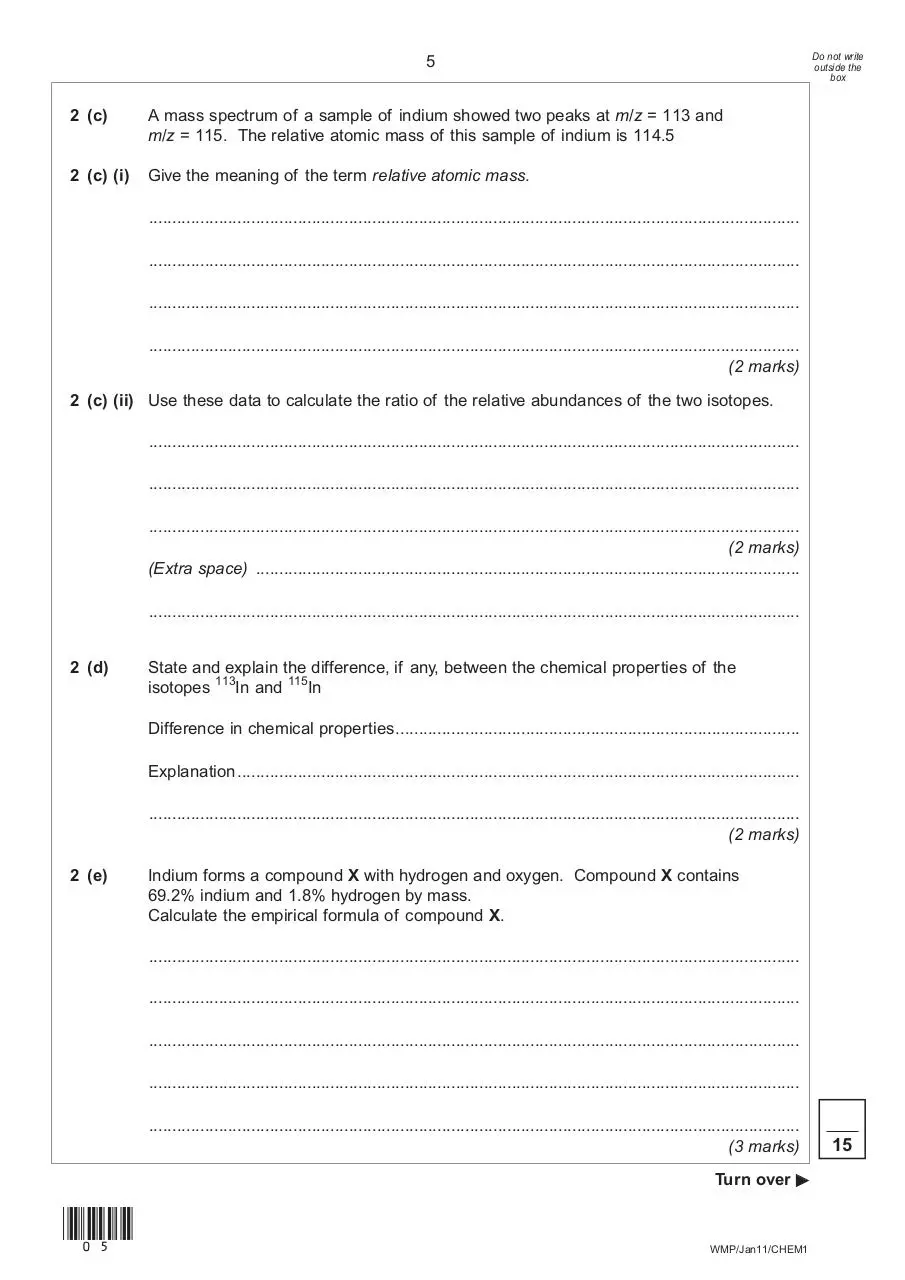
2 (c)
A mass spectrum of a sample of indium showed two peaks at m/z = 113 and
m/z = 115. The relative atomic mass of this sample of indium is 114.5
2 (c) (i)
Give the meaning of the term relative atomic mass.
............................................................................................................................................
............................................................................................................................................
............................................................................................................................................
............................................................................................................................................
(2 marks)
2 (c) (ii) Use these data to calculate the ratio of the relative abundances of the two isotopes.
............................................................................................................................................
............................................................................................................................................
............................................................................................................................................
(2 marks)
(Extra space) .....................................................................................................................
............................................................................................................................................
2 (d)
State and explain the difference, if any, between the chemical properties of the
isotopes 113In and 115In
Difference in chemical properties.......................................................................................
Explanation.........................................................................................................................
............................................................................................................................................
(2 marks)
2 (e)
Indium forms a compound X with hydrogen and oxygen. Compound X contains
69.2% indium and 1.8% hydrogen by mass.
Calculate the empirical formula of compound X.
............................................................................................................................................
............................................................................................................................................
............................................................................................................................................
............................................................................................................................................
............................................................................................................................................
(3 marks)
Turn over
(05)
䊳
WMP/Jan11/CHEM1
15
�
Do not write
outside the
box
6
3 (a)
An unknown metal carbonate reacts with hydrochloric acid according to the following
equation.
M2CO3(aq) + 2HCl(aq) → 2MCl(aq) + CO2(g) + H2O(l)
A 3.44 g sample of M2CO3 was dissolved in distilled water to make 250 cm3 of
solution. A 25.0 cm3 portion of this solution required 33.2 cm3 of 0.150 mol dm–3
hydrochloric acid for complete reaction.
3 (a) (i)
Calculate the amount, in moles, of HCl in 33.2 cm3 of 0.150 mol dm–3
hydrochloric acid. Give your answer to 3 significant figures.
............................................................................................................................................
............................................................................................................................................
(1 mark)
3 (a) (ii) Calculate the amount, in moles, of M2CO3 that reacted with this amount of HCl.
Give your answer to 3 significant figures.
............................................................................................................................................
............................................................................................................................................
(1 mark)
3 (a) (iii) Calculate the amount, in moles, of M2CO3 in the 3.44 g sample. Give your answer to
3 significant figures.
............................................................................................................................................
............................................................................................................................................
(1 mark)
3 (a) (iv) Calculate the relative formula mass, Mr, of M2CO3
Give your answer to 1 decimal place.
............................................................................................................................................
............................................................................................................................................
(1 mark)
3 (a) (v) Hence determine the relative atomic mass, Ar, of the metal M and deduce its identity.
Ar of M ................................................................................................................................
Identity of M ......................................................................................................................
(2 marks)
(06)
WMP/Jan11/CHEM1
�
Do not write
outside the
box
7
3 (b)
In another experiment, 0.658 mol of CO2 was produced. This gas occupied a volume
of 0.0220 m3 at a pressure of 100 kPa.
Calculate the temperature of this CO2 and state the units.
(The gas constant R = 8.31 J K–1 mol–1)
............................................................................................................................................
............................................................................................................................................
............................................................................................................................................
............................................................................................................................................
............................................................................................................................................
............................................................................................................................................
............................................................................................................................................
(3 marks)
3 (c)
Suggest one possible danger when a metal carbonate is reacted with an acid in a
sealed flask.
............................................................................................................................................
............................................................................................................................................
(1 mark)
3 (d)
In a different experiment, 6.27 g of magnesium carbonate were added to an excess of
sulfuric acid. The following reaction occurred.
MgCO3 + H2SO4 →
3 (d) (i)
MgSO4 + CO2 + H2O
Calculate the amount, in moles, of MgCO3 in 6.27 g of magnesium carbonate.
............................................................................................................................................
............................................................................................................................................
(2 marks)
3 (d) (ii) Calculate the mass of MgSO4 produced in this reaction assuming a 95% yield.
............................................................................................................................................
............................................................................................................................................
............................................................................................................................................
............................................................................................................................................
(3 marks)
15
Turn over
(07)
䊳
WMP/Jan11/CHEM1
�
Do not write
outside the
box
8
4
Cetane (C16H34) is a major component of diesel fuel.
4 (a)
Write an equation to show the complete combustion of cetane.
............................................................................................................................................
(1 mark)
4 (b)
Cetane has a melting point of 18 oC and a boiling point of 287 oC.
In polar regions vehicles that use diesel fuel may have ignition problems.
Suggest one possible cause of this problem with the diesel fuel.
............................................................................................................................................
............................................................................................................................................
(1 mark)
4 (c)
The pollutant gases NO and NO2 are sometimes present in the exhaust gases of
vehicles that use petrol fuel.
4 (c) (i)
Write an equation to show how NO is formed and give a condition needed for its
formation.
Equation .............................................................................................................................
Condition ...........................................................................................................................
(2 marks)
4 (c) (ii) Write an equation to show how NO is removed from the exhaust gases in a catalytic
converter. Identify a catalyst used in the converter.
Equation .............................................................................................................................
Catalyst ..............................................................................................................................
(2 marks)
4 (c) (iii) Deduce an equation to show how NO2 reacts with water and oxygen to form
nitric acid (HNO3).
............................................................................................................................................
(1 mark)
(08)
WMP/Jan11/CHEM1
�
Do not write
outside the
box
9
4 (d)
Cetane (C16H34) can be cracked to produce hexane, butene and ethene.
4 (d) (i)
State one condition that is used in this cracking reaction.
............................................................................................................................................
(1 mark)
4 (d) (ii) Write an equation to show how one molecule of cetane can be cracked to form
hexane, butene and ethene.
............................................................................................................................................
(1 mark)
4 (d) (iii) State one type of useful solid material that could be formed from alkenes.
............................................................................................................................................
(1 mark)
10
Turn over for the next question
Turn over
(09)
䊳
WMP/Jan11/CHEM1
�
 Historical archive . public document