Centre Number
For Examiner’s Use
Candidate Number
Surname
Other Names
Examiner’s Initials
Candidate Signature
Question
General Certificate of Education
Advanced Subsidiary Examination
June 2015
Mark
1
2
3
Chemistry
Unit 1
CHEM1
5
Foundation Chemistry
Friday 22 May 2015
4
6
9.00 am to 10.15 am
7
For this paper you must have:
the Periodic Table/Data Sheet, provided as an insert
(enclosed)
a ruler with millimetre measurements
a calculator.
TOTAL
Time allowed
1 hour 15 minutes
Instructions
Use black ink or black ball-point pen.
Fill in the boxes at the top of this page.
Answer all questions.
You must answer the questions in the spaces provided. Do not write
outside the box around each page or on blank pages.
All working must be shown.
Do all rough work in this book. Cross through any work you do not
want to be marked.
Information
The marks for questions are shown in brackets.
The maximum mark for this paper is 70.
You are expected to use a calculator, where appropriate.
The Periodic Table/Data Sheet is provided as an insert.
Your answers to the questions in Section B should be written in
continuous prose, where appropriate.
You will be marked on your ability to:
– use good English
– organise information clearly
– use scientific terminology accurately.
Advice
You are advised to spend about 50 minutes on Section A and about
25 minutes on Section B.
(JUN15CHEM101)
WMP/Jun15/CHEM1/E5
CHEM1
�
Do not write
outside the
box
2
Section A
Answer all questions in the spaces provided.
1
This question is about the elements in Period 3 of the Periodic Table.
1 (a)
State the element in Period 3 that has the highest melting point.
Explain your answer.
[3 marks]
Element ...............................................................................................................................
Explanation .........................................................................................................................
.............................................................................................................................................
.............................................................................................................................................
.............................................................................................................................................
.............................................................................................................................................
1 (b)
State the element in Period 3 that has the highest first ionisation energy.
Explain your answer.
[3 marks]
Element ...............................................................................................................................
Explanation .........................................................................................................................
.............................................................................................................................................
.............................................................................................................................................
.............................................................................................................................................
.............................................................................................................................................
1 (c)
Suggest the element in Period 3 that has the highest electronegativity value.
[1 mark]
.............................................................................................................................................
(02)
WMP/Jun15/CHEM1
�
Do not write
outside the
box
3
1 (d)
Chlorine is a Period 3 element.
Chlorine forms the molecules ClF3 and CCl2
1 (d) (i)
Use your understanding of electron pair repulsion to draw the shape of ClF3 and the
shape of CCl2
Include any lone pairs of electrons that influence the shape.
[2 marks]
Shape of ClF3
Shape of CCl2
1 (d) (ii) Name the shape of CCl2
[1 mark]
.............................................................................................................................................
1 (d) (iii) Write an equation to show the formation of one mole of ClF3 from its elements.
[1 mark]
.............................................................................................................................................
11
Turn over for the next question
Turn over 䊳
(03)
WMP/Jun15/CHEM1
�
Do not write
outside the
box
4
2
Tellurium is the element with atomic number of 52
2 (a)
Using information from the Periodic Table, complete the electron configuration of
tellurium.
[1 mark]
[Kr] .......................................................................................................................................
2 (b)
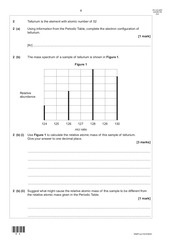
The mass spectrum of a sample of tellurium is shown in Figure 1.
Figure 1
Relative
abundance
124
125
126
127
128
129
130
m/z ratio
2 (b) (i)
Use Figure 1 to calculate the relative atomic mass of this sample of tellurium.
Give your answer to one decimal place.
[3 marks]
.............................................................................................................................................
.............................................................................................................................................
.............................................................................................................................................
.............................................................................................................................................
.............................................................................................................................................
2 (b) (ii) Suggest what might cause the relative atomic mass of this sample to be different from
the relative atomic mass given in the Periodic Table.
[1 mark]
.............................................................................................................................................
.............................................................................................................................................
(04)
WMP/Jun15/CHEM1
�
Do not write
outside the
box
5
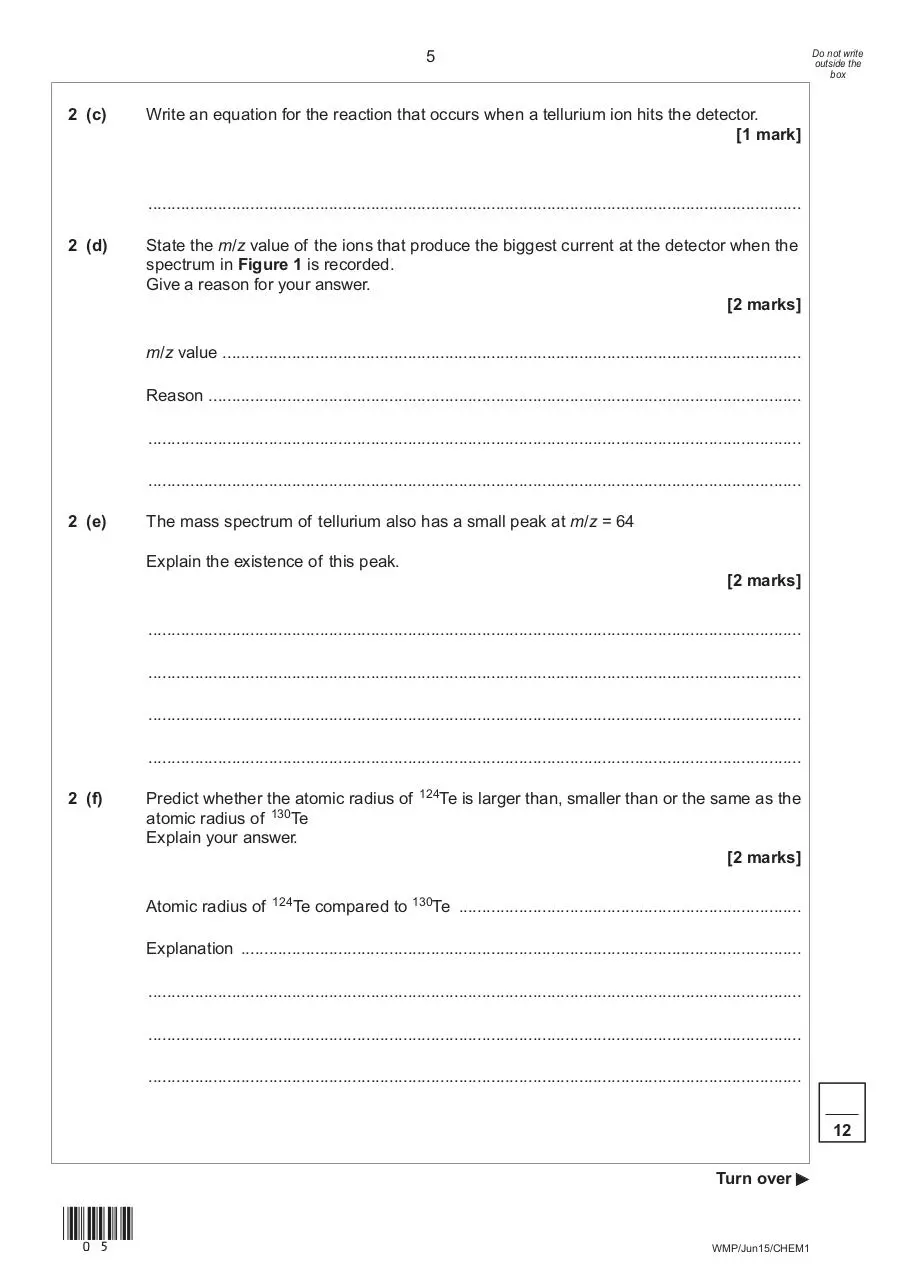
2 (c)
Write an equation for the reaction that occurs when a tellurium ion hits the detector.
[1 mark]
.............................................................................................................................................
2 (d)
State the m/z value of the ions that produce the biggest current at the detector when the
spectrum in Figure 1 is recorded.
Give a reason for your answer.
[2 marks]
m/z value .............................................................................................................................
Reason ................................................................................................................................
.............................................................................................................................................
.............................................................................................................................................
2 (e)
The mass spectrum of tellurium also has a small peak at m/z = 64
Explain the existence of this peak.
[2 marks]
.............................................................................................................................................
.............................................................................................................................................
.............................................................................................................................................
.............................................................................................................................................
2 (f)
Predict whether the atomic radius of
atomic radius of 130Te
Explain your answer.
124Te
is larger than, smaller than or the same as the
[2 marks]
Atomic radius of
124Te
compared to 130Te ..........................................................................
Explanation .........................................................................................................................
.............................................................................................................................................
.............................................................................................................................................
.............................................................................................................................................
12
Turn over 䊳
(05)
WMP/Jun15/CHEM1
�
Do not write
outside the
box
6
3
Silicon dioxide (SiO2) has a crystal structure similar to diamond.
3 (a)
Give the name of the type of crystal structure shown by silicon dioxide.
[1 mark]
.............................................................................................................................................
3 (b)
Suggest why silicon dioxide does not conduct electricity when molten.
[1 mark]
.............................................................................................................................................
.............................................................................................................................................
.............................................................................................................................................
3 (c)
Silicon dioxide reacts with hydrofluoric acid (HF) to produce hexafluorosilicic acid
(H2SiF6) and one other substance.
Write an equation for this reaction.
[1 mark]
.............................................................................................................................................
3
(06)
WMP/Jun15/CHEM1
�
Do not write
outside the
box
7
4
A sample of hydrated nickel sulfate (NiSO4. xH2O) with a mass of 2.287 g was heated to
remove all water of crystallisation. The solid remaining had a mass of 1.344 g.
4 (a)
Calculate the value of the integer x.
Show your working.
[4 marks]
.............................................................................................................................................
.............................................................................................................................................
.............................................................................................................................................
.............................................................................................................................................
.............................................................................................................................................
.............................................................................................................................................
.............................................................................................................................................
.............................................................................................................................................
.............................................................................................................................................
.............................................................................................................................................
4 (b)
Suggest how a student doing this experiment could check that all the water had been
removed.
[2 marks]
.............................................................................................................................................
.............................................................................................................................................
.............................................................................................................................................
.............................................................................................................................................
6
Turn over for the next question
Turn over 䊳
(07)
WMP/Jun15/CHEM1
�
Do not write
outside the
box
8
5
A hydrogen peroxide molecule can be represented by the structure shown.
H
O
O
H
5 (a)
Suggest a value for the H–O–O bond angle.
[1 mark]
.............................................................................................................................................
5 (b)
Hydrogen peroxide dissolves in water.
5 (b) (i)
State the strongest type of interaction that occurs between molecules of
hydrogen peroxide and water.
[1 mark]
.............................................................................................................................................
5 (b) (ii) Draw a diagram to show how one molecule of hydrogen peroxide interacts with one
molecule of water.
Include all lone pairs and partial charges in your diagram.
[3 marks]
(08)
WMP/Jun15/CHEM1
�
Do not write
outside the
box
9
5 (c)
Explain, in terms of electronegativity, why the boiling point of H2S2 is lower than H2O2.
[2 marks]
.............................................................................................................................................
.............................................................................................................................................
.............................................................................................................................................
.............................................................................................................................................
.............................................................................................................................................
7
Turn over for the next question
Turn over 䊳
(09)
WMP/Jun15/CHEM1
�
 Historical archive . public document