�
Cleansing Homes and Minds in Chile, 18911905
by
Carl J. Murdock
Clinical Case:
Hallucinatory Delirium of Mystic Type--Madness communicated throughout a family-Cure.
J.M., fifty-three years of age, married, without any education, of robust constitution with
moderate and healthy habits, without appreciable organic illness, was sent to the
establishment the 12th of September of 1897.
Upon report from the médico de ciudad, the night-watch court ordered the internment of
the patient, her husband and of their three daughters.
The facts which determined this order were the following:
Someone denounced to the authorities that for some days they did not see the C. family;
that the neighbors of the house which this family inhabited noted there occurred in it unusual
and uncustomary events: they would receive no one except an old woman who visited them
daily, continuous songs were heard, and not one member of the family had gone outside for
many days.
Taking account of such indignities, all observers believed they were delirious and
alienated, and they were sent to the Casa de Observación, annexed to this institution....
When J.M. was interred in this establishment, there was no sign in her of any organic
infection; all functions were normal and was there only a diminution of appetite and sleep.
She retained perfect awareness of her state and situation, saying that she was victim of ill will
and abuse for having maintained her ideals and the certainty of what she had seen.
She appeared tranquil, persevering in her convictions and belief in the hallucinations
which she had experienced. She maintained that la Mamita, the name with which the family
referred to the woman who visited them, was the la Virgen de Andacollo; that she saw the
Virgin rise up to the heavens on a cloud, and that she heard the Virgin promise two loads of
gold for her prayers, submission and faith.
�
"These were to appear," she said, "in the room which we gave over to la Mamita, and
greed, fear of the desire to rob them, provoked our hiding."
She recounted that, with her husband and daughters, she spent several days praying and
singing, without eating or sleeping, and admitted having had various hallucinations of sound,
touch and sight, each of mystic character.
"I'd rather die before thinking that everything I say and believe could not be true," she
frequently told us in response to the observations we made so as to awaken doubts in her
beliefs....
Three weeks later, she made an attempt to present herself before colleagues so as to
obtain release, and in the interview room, her delirium--which seemed already subsided-revived with fervor, remaining until, days later, this belief weakened and she was granted
release.1
This remarkable account of the C. family's experience of law and public health
demonstrates with ferocity the weight of policing in the name of public health. Denounced to
the authorities by a well-to-do neighbor ("vecino") for behavior which fell unacceptably far
outside the norm, this family was subjected to the most coercive and intrusive of clinical
treatment at the asylum. According to case notes, J.M.'s seemingly delirious eldest daughter
was strapped to her bed when not submerged in lengthy therapeutic baths, force-fed through
her nose purgatives and digestive "disinfectants," regularly given sedatives, and subjected to
repeated attempts at hypnosis by physicians.2 Despite evident resistance, this treatment was
sufficient to "awaken doubts" in the parents, leading the father to recant their story:
Although ignorant and with a weak psyche, he believed with less firmness in the
phenomena which had occurred, and in the existence of this supposed Virgin, of the loads of
gold, etc., to such an extent that, upon admission, he already doubted the reality of those
supposed facts, and it was easy to convince him of the illusions of which he and his family
had been victims.3
Considering the treatment his eldest daughter and wife received at the asylum, and the
rigors of hard labor on the fields worked by inmates of the Sección de Hombres, it is not
surprising that this "ignorant" man soon saw the light his doctors were shining at him. While
the entire family was released within a month, their internment at the behest of wealthier
neighbors from whom they claimed to have received only "ill will and abuse" reveals one of
the mechanisms of social control exercised by the "Parliamentary Republic" of Chile after
1891. That the weight of the state fell most heavily on the poor is demonstrated as clearly in
documents as in photos from the asylum.4
�
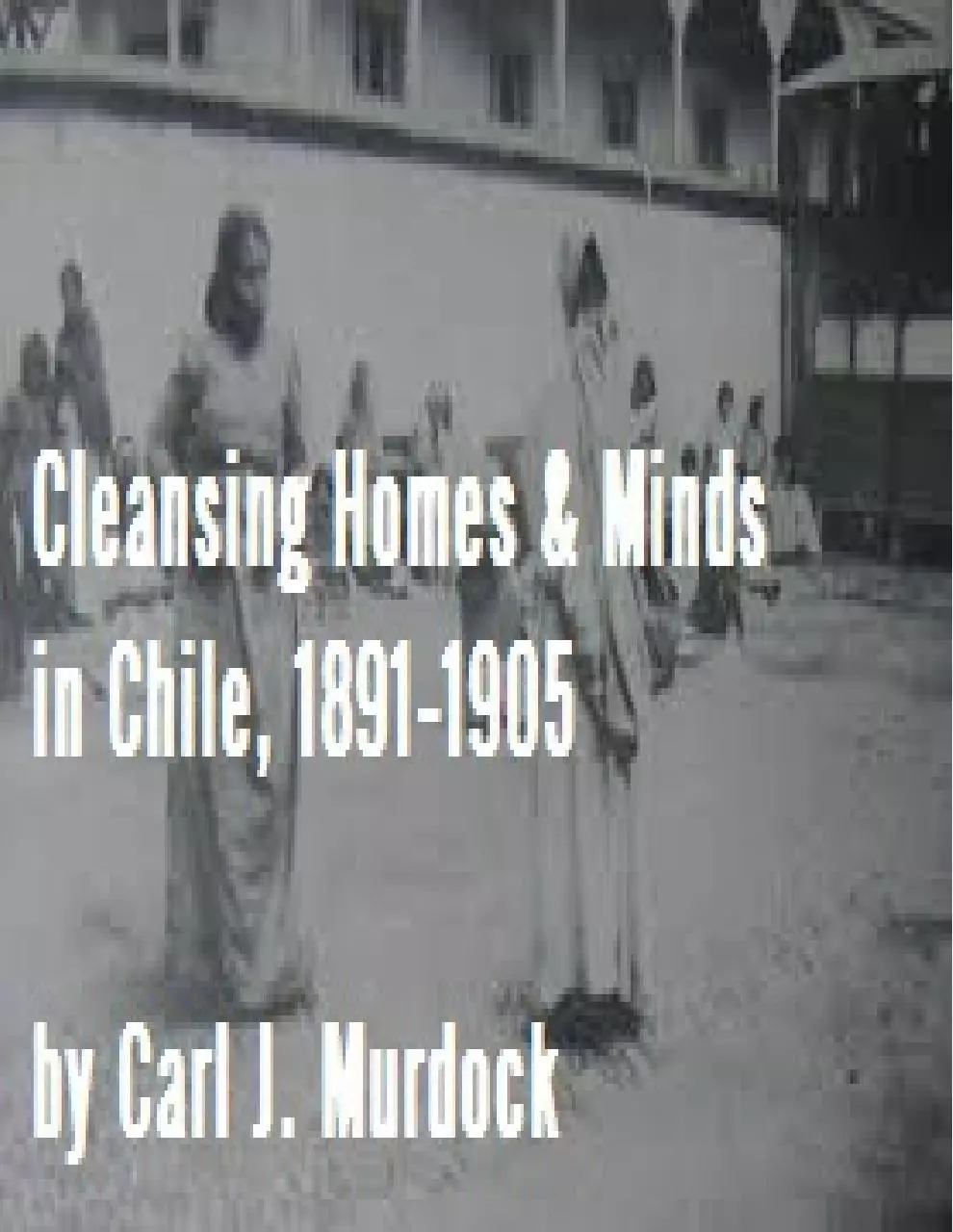
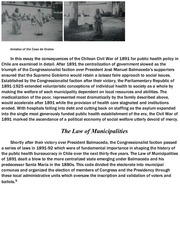
Inmates of the Casa de Orates
In this essay the consequences of the Chilean Civil War of 1891 for public health policy in
Chile are examined in detail. After 1891 the centralization of government slowed as the
triumph of the Congressionalist faction over President José Manuel Balmaceda's supporters
ensured that the Supremo Gobierno would retain a laissez faire approach to social issues.
Established by the Congressionalist faction after their victory, the Parliamentary Republic of
1891-1925 extended voluntaristic conceptions of individual health to society as a whole by
making the welfare of each municipality dependent on local resources and abilities. The
medicalization of the poor, represented most dramatically by the family described above,
would accelerate after 1891 while the provision of health care stagnated and institutions
eroded. With hospitals falling into debt and cutting back on staffing as the asylum expanded
into the single most generously funded public health establishment of the era, the Civil War of
1891 marked the ascendance of a political economy of social welfare utterly devoid of mercy.
The Law of Municipalities
Shortly after their victory over President Balmaceda, the Congressionalist faction passed
a series of laws in 1891-92 which were of fundamental importance in shaping the history of
the public health bureaucracy in Chile over the next thirty-five years. The Law of Municipalities
of 1891 dealt a blow to the more centralized state emerging under Balmaceda and his
predecessor Santa María in the 1880s. This code divided the electorate into municipal
comunas and organized the election of members of Congress and the Presidency through
these local administrative units which oversaw the inscription and validation of voters and
ballots.5
�
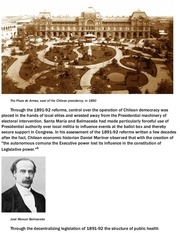
The Plaza de Armas, seat of the Chilean presidency, in 1890
Through the 1891-92 reforms, control over the operation of Chilean democracy was
placed in the hands of local elites and wrested away from the Presidential machinery of
electoral intervention. Santa María and Balmaceda had made particularly forceful use of
Presidential authority over local militia to influence events at the ballot box and thereby
secure support in Congress. In his assessment of the 1891-92 reforms written a few decades
after the fact, Chilean economic historian Daniel Martner observed that with the creation of
"the autonomous comuna the Executive power lost its influence in the constitution of
Legislative power."6
José Manuel Balmaceda
Through the decentralizing legislation of 1891-92 the structure of public health
�
administration in Chile shifted noticeably. The Consejo Superior de Higiene, created in 1889
was subsequently reformed in 1892 to hold thirteen members, seven named by the
President, three by the Municipalidad de Santiago, and three by the Consejo itself. While the
President maintained a majority in the selection of the Consejo's personnel, the reservation of
six members to local and potentially professional and patronized interests was an important
limit on the power of the central state.
Moreover, the duties of this highest body of public health policy in Chile were restricted to
the study of health problems, suggestion of remedies to the appropriate authorities,
submission of annual reports (memorias) to the President, and proposal of physicians to be
named to public health functions.7 The Consejo Superior held no budgetary or punitive
powers to facilitate public health policy implementation. In its emphasis on naming
investigative commissions and gathering information, the Consejo Superior had little
apparent real impact on public health--in contrast to the departmental consejos whose
involvement in neighborhood disinfection and efforts to combat local outbreaks of disease
brought the implementation of policy into the day-to-day lives of the majority of Chileans.
Given the decentralized context in which they received final form, it is not surprising that
the Consejos Provinciales de Higiene (also created in 1889, reformed in 1892-93, and
thereafter known as Consejos Departamentales) were structured in a manner so as to shift
still more influence to local elite. The departmental consejos were composed of the regional
governor, a vecino named by the Governor, the mayor of the principal municipality in the
department and "a person named by this corporation." Additional members of the committee
included representatives of the Consejo Superior and Junta de Beneficencia in Santiago, as
well as "the médico de ciudad, charged with the duties of Committee Secretary."8 In
accordance with the post-1892 structure of the Chilean state, the attributions of the
departmental consejos included the actual enforcement of "sanitary measures" developed by
the Consejo Superior.9 Under the Law of Municipalities local government was to administer
the vaccination, health inspection and disinfection programs previously organized directly by
the Ministry of the Interior.10
At its lower levels the Chilean public health bureaucracy experienced a thorough
dislocation of its personnel and surveillance capacities as a result of the decentralization
which followed 1891. Legislation passed in late 1892 made médicos de ciudad functionaries
of municipal governments rather than of the Ministry of the Interior. In return for the relatively
generous salary and prestigious appointment as médico de ciudad, a Presidential decree of
1887 had required these physicians to provide additional care through establishments
administered by the Supremo Gobierno (which included the overwhelming majority of
hospitals, clinics and lazarettes throughout Chile). With the 1892 law, médicos de ciudad
were freed of this obligation, and most municipalities simply reduced the staffing of local
hospitals rather than take up the expense of remunerating médicos de ciudad for services
�
rendered in local public health establishments.11
One manner in which the influence of the central government in provision of public
health diminished after 1891 was in marked changes in funding priorities approved by the
Congress and pursued by the Ministry of the Interior. The rapid growth of central government
regular and special funds to public health institutions under Santa María and Balmaceda did
not continue in the Parliamentary Republic. Instead, the Junta de Beneficencia found itself
increasingly reliant on its own means of funding to meet the inflating costs of health in an
urbanizing society. Public health administration in Chile became steadily more indebted to
private interests through the sale of special bonds issued by the Committee on its capital
holdings, and more dependent on rents generated by haciendas administered by the Junta de
Beneficencia.12
The number of patients admitted into Santiago's three hospitals was essentially stable
between 1886 and 1899, indicating that the care-giving capacities of these institutions did
not keep pace with urbanization.13 Far from expanding their treatment, Santiago's hospitals
faced a losing battle with population growth and inflation which--in the political economy of
social welfare dominant after 1891--led to turning prospective patients away from care within
buildings that steadily deteriorated, a problem exacerbated by a decreasing and underpaid
staff.14
With yearly inflation of six to seven percent on average in the period, Santiago's hospitals
enjoyed annual budgetary increases after 1892 of just two to four percent.15 The yearly
accounts reported to the Beneficence Committee demonstrate a tremendous drop-off in
income growth for each of Santiago's hospitals.16 Losses in income were most evident at San
Juan de Dios and San Francisco de Borja in terms of capital directly held by each institution
(rents from properties, liquid capital assets).17 As the sale of liquid and fixed capital in the
early 1890s eliminated resources particular to each institution, the relative weight of
subsidies from the Supremo Gobierno greatly increased in the accounts of Santiago's
hospitals.18 The primary effect of the Parliamentary Republic's laissez faire approach to
public health--curbing central state aid and pushing establishments towards more
individualized means of funding--was in fact to increase the dependence of hospitals on the
Supremo Gobierno19. The decentralizing Congressionalists of 1891-2 actually succeeded in
heightening the fiscal centralization of public health through the very negligence of their social
policies.
�
San Juan de Dios hospital, c. 1920
The various institutions of public health throughout the country also ran increasingly
large deficits as the 1890s progressed, and began to resort to more radical methods of
maintaining their fiscal health within the atomized structure of laissez faire public health.
Valparaíso's only hospital carried a debt of over 150,000 pesos by 1894, while in 1899, to
meet daily operating expenses, San Juan de Dios hospital in Santiago reduced the pay of
nuns, medical students and subaltern employees on its staff, and suspended renovation of
the crumbling eighteenth-century building.20 During an epidemic of smallpox in Valparaíso
during 1904-5, personnel of the entire public health system in the city (employees of the
hospital, lazarettes, disinfection teams and so on) went without pay for three months as the
municipality was unable to finance both care to its populace and remuneration to its
functionaries.21
�
Board of Higiene disinfection team in uniform, c. 1910
The decentralization of the Chilean state led to stagnation in those public works projects
related to health whose initiation had been a central feature of both the Santa María and
Balmaceda administrations. Expansion and construction of public health institutions begun
under budgets set in the 1880s was repeatedly delayed or halted during the 1890s as funds
were withheld or cut by as much as fifty percent by the Congress.22 Existing institutions found
themselves suddenly without funding in the wake of the Civil War, and later restoration of
state aid followed consistent lines which reflected political priorities of a new sort. Institutions
which enjoyed restored or even increased funding after 1891 were of a special cast, with the
insane asylum the most conspicuous example of public health policy deployed as social
control.23
�
 Historical archive . public document