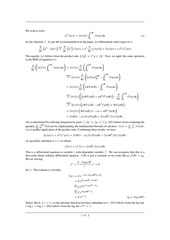
We wish to solve
aR
Z
2
a f .ar/ D 2�f .r/
f .u/u du
(�)
0
for the function f . As per the recommendation in the paper, we differentiate with respect to a,
� .?/ d � �
�
d
d � 2
a � f .ar/ D
a2 f .ar/ C a2
f .ar/ D 2af .ar/ C a2 rf 0 .ar/
da
da
da
�0
The equality (?) follows from the product rule: fg D f 0 g C fg 0 . Next, we apply the same operation
to the RHS of equation .�/.
!
!
Z aR
Z aR
d
d
2�f .r/
f .u/u du D 2�f .r/
f .u/u du
da
da
0
0
!
Z aR
�aR
d �
.01/
D 2�f .r/
uF .u/ 0
F .u/ du
da
0
!
Z aR
d
D 2�f .r/
aRF .aR/
F .u/ du
da
0
!
Z aR
�
�
d
.?/
2 0
F .u/ du
D 2�f .r/ aRF .aR/ C aR F .aR/
da 0
�
�
.02/
D 2�f .r/ aRF .aR/ aR2 f .aR/ C RF .aR/
�
�
D 2�f .r/ RF .aR/ .1 a/ C aR2 f .aR/
a/f .r/F .aR/ C 2�aR2 f .r/f .aR/
R
R 0
(01) is determined by utilizing integration by parts: fg 0 D fg
f g. (02) follows from evaluating the
R aR
Rx
d
d
quantity da 0 F .u/ du by implementing the fundamental theorem of calculus: f .x/ D dx
c f .t / dt .
(?) is another application of the product rule. Combining these results, we have
D 2�R.1
2af .ar/ C a2 rf 0 .ar/ D 2�R.1
a/f .r/F .aR/ C 2�aR2 f .r/f .aR/:
As specified, substitute a D 1, to obtain
2f .r/ C rf 0 .r/ D 2�R2 f .r/f .R/
This is a differential equation in variable r with dependent variable f . We can recognize that this is a
first-order linear ordinary differential equation. f .R/ is just a constant, so we write this as f .R/ D rR .
We are solving
2 2rR �R2
f0C
f D0
r
for f . The solution is, trivially,
f .r/ D C e
R
.2 2rR �R2 /=r dr
D C e .2rR �R
2
2/ lnjrj
03
.2rR �R2
04
2
D C e ln.r
D C r 2rR �R
D C rq
2
:
2/ /
2
(q D 2rR �R2 )
Notice that 0 � r � 1, so the absolute function becomes redundant on r. (03) follows from the log law
x log y D log y x . (04) follows from the log law e ln x D x.
1 of 2
�
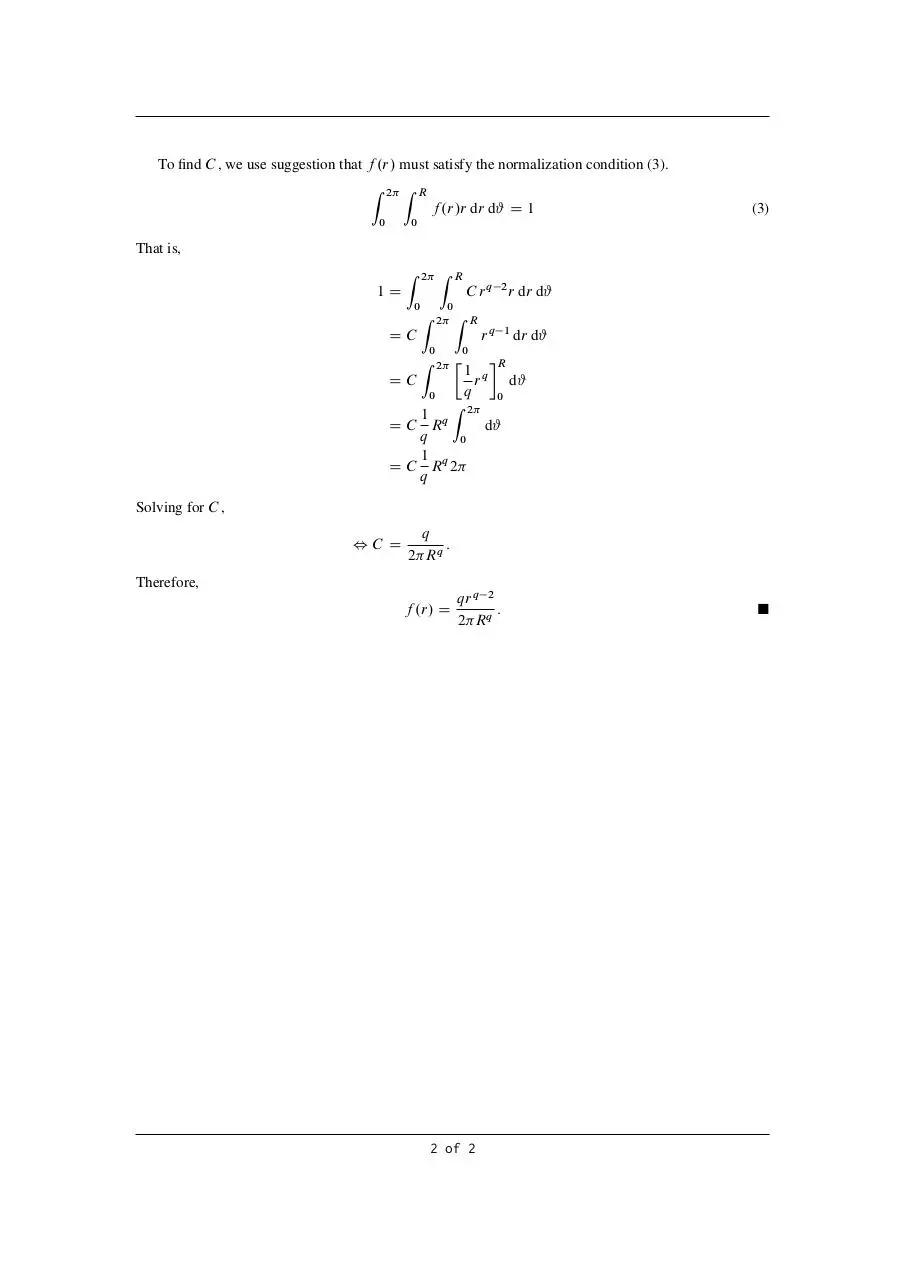
To find C , we use suggestion that f .r/ must satisfy the normalization condition (3).
Z
2�
R
Z
f .r/r dr d# D 1
0
(3)
0
That is,
Z
2�
Z
R
Z
0
2� Z R
C rq
1D
0
DC
0
rq
r dr d#
1
dr d#
0
2�
Z
2
DC
0
�
1 q
r
q
�R
d#
0
Z 2�
1
d#
D C Rq
q
0
1
D C Rq 2�
q
Solving for C ,
,C D
q
:
2�Rq
Therefore,
f .r/ D
qr q 2
:
2�Rq
2 of 2
�
�
 Historical archive . public document