�
�
�
Did Muhammad Copy the Qur'an?
The Qur'an claims to be directly from God. So why have people
accused Muhammad of copying sources that were not revealed by
God? We examine these claims.
Ok, let's look at plagiarism. Plagiarism is the "practice of taking someone else's work or ideas and passing
them off as one's own". This is not always a problem. It doesn't make something wrong or untrue. However the
Qur'an makes a very very clear claim in Surah 10:37 "This Qur’an is not such as can be produced by
other than Allah,..." So if there is copying from other non-scriptural sources, there is a huge problem. Allah has
clearly stated that man can NOT create the contents of the Qur'an. However if we have many cases where the
Qur'an has clearly copied from books written by man, we have a problem.
The Qur'an very clearly appears to copy the portions of the story of Mary from the Protoevangelium of
James the Lesser: a false gospel 500 years before the Qur'an. We have actual physical copies of this text prior
to the Qur'an. The nature of judgment throughout the Qur'an (the idea of balances) is taken from the "Testament
of Abraham". Surah 87:18-19 calls the "Testament of Abraham" by the name "Scriptures of Abraham and
Moses". This is a problem because the "Testament of Abraham" is not a scripture of any people. Muhammad
was either incorrect in thinking that the "Testament of Abraham" was a scripture of the Jewish and
Christian people or he was incorrect; using the wrong book. Another example of copying is found in the
Infancy Gospel of Thomas, written 350 years before Islam. The story of Jesus taking a bird a bringing it to life is
recorder here. We have two documents (one from the 3rd century and one from the 4th) that quote this
document, making it clear that it existed well before the Qur'an. There are other texts that the Qur'an appears to
have copied. Clearly the Qur'an is not written by Allah, but incorporates text from human sources. This
document contains 16 potentials cases where plagiarism occurs.
�
Qur'an (Sahih International) (~630 AD)
Protoevangelium of James the Lesser (~145
AD)
3:37 Every time Zechariah entered upon her in the
prayer chamber, he found with her provision. He
said, "O Mary, from where is this [coming] to you?"
She said, "It is from Allah . Indeed, Allah provides
for whom He wills without account."
8:2 But Mary continued in the temple as a dove
educated there, and received her food from the
hand of an angel.
3:40 He said, "My Lord, how will I have a boy when
I have reached old age and my wife is barren?" The
angel said, "Such is Allah ; He does what He wills."
3:44. That is from the news of the unseen which We
reveal to you, [O Muhammad]. And you were not
with them when they cast their pens as to which of
them should be responsible for Mary. Nor were you
with them when they disputed.
8:13 But Joseph refused, saying, I am an old man,
and have children, but she is young, and I fear lest I
should appear ridiculous in Israel. 14 Then the highpriest replied, Joseph, fear the Lord thy God, and
remember how God dealt with Dathan, Korah, and
Abiram, how the earth opened and swallowed them
up, because of their contradiction.
8:6 And behold the angel of the Lord came to him,
and said, Zacharias, Zacharias, Go forth and call
together all the widowers among the people, and let
every one of them bring his rod, and he by whom
the Lord shall shew a sign shall be the husband of
Mary.
8:12 And the high-priest said, Joseph, Thou art the
person chosen to take the Virgin of the Lord, to
keep her for him: 13 But Joseph refused, saying, I
am an old man, and have children, but she is
young, and I fear lest I should appear ridiculous in
Israel.
Even though the Protoevangelium of James the Lesser, which
Muhammad plagiarized, is considered a fake (pseudepigraphal) gospel
created by someone other than James in 145 AD (Many years after the
death of James in ~65 AD, but ~500 years before the Qur'an) that has
been rejected by all, it clearly states “Wherefore that which shall be born
of thee shall be holy, and shall be called the Son of the Living God, and
thou shalt call his name Jesus; for he shall save his people from their
sins.” in verse 9:14. Since the Qur'an clearly states that the Injil, Zabur
and Taurat were correct at the time of Muhammad (Surah 35:31, 10:37,
40:69-70, 46:12, 46:29-30, 2:91, 3:3, 4:162, 9:111, 5:51 – chronological
order) and that the Qur'an is a confirmation of the text (“this Book is a
verification (of the taurat)” 46:12 as one of many examples). Since a
contradiction occurs either directly between the Qur'an and this source
text or indirectly between the Bible and the Qur'an at the time of
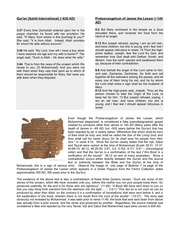
Muhammad, this is a sign of serious error. Observe the image of one page of Bodmer 7 (a page of the
Protoevangelium of James the Lesser which appears in a Greek Papyrus from the Ferrini Collection dated
approximately 300 AD; 300 years prior to the Qur'an).
The existence of the above text is also a contradiction of these three Quranic verses: “Such are some of the
stories of the unseen, which We have revealed unto you, before this neither you nor your people knew them. So
persevere patiently, for the end is for those who are righteous”. (11:49). “A Book We have sent down to you so
that you may bring forth mankind from the darkness into the light......”. (14:1) “This Qur’an is not such as can be
produced by other than Allah, on the contrary it is a confirmation of (revelations) that were sent before it, and a
full explanation of the book, wherein there is not doubt from the Lord of the worlds ”. (10:37). The story was
obviously not revealed by Muhammad, it was seen prior to verse 11:49, the book that was sent down from above
was actually from a prior source, and the verse was produced by another. Regardless, the source material was
considered a fake and rejected by the very Taurat, Injil and Zabur that Muhammad says were correct in 600 AD.
�
Qur'an (Sahih International) (~630 AD)
Testament
7:8-9 (repeated in 21:47, 23:102-103, 33:39, 42:17,
57:25, 101:6-11) And the weighing [of deeds] that
Day will be the truth. So those whose scales are
heavy - it is they who will be the successful. And
those whose scales are light - they are the ones
who will lose themselves for what injustice they
were doing toward Our verses.
(From Ch. 12) And behold the angel holding the
soul in his hand, and he brought it before the judge,
and the judge said to one of the angels that served
him, Open me this book, and find me the sins of this
soul. And opening the book he found its sins and its
righteousness equally balanced, and he neither
gave it to the tormentors, nor to those that were
saved, but set it in the midst. (From Chapter 13) all
things in all men are tried by fire and the balance.
50:16-18, 20 And We have already created man
and know what his soul whispers to him, and We
are closer to him than [his] jugular vein When the
two receivers receive, seated on the right and on
the left. Man does not utter any word except that
with him is an observer prepared [to record]. And
the Horn will be blown. That is the Day of [carrying
out] the threat.
19:70-73 Then, surely it is We who are most
knowing of those most worthy of burning therein.
And there is none of you except he will come to it.
This is upon your Lord an inevitability decreed.
Then We will save those who feared Allah and leave
the wrongdoers within it, on their knees.
of
Abraham
(~80-100
AD)
(From Ch. 13) The two angels on the right hand
and on the left, these are they that write down the
sins and the righteousness, the one on the right
hand writes down the righteousness, and the one
on the left the sins.
(From Ch. 13) The fiery and pitiless angel, holding
the fire in his hand, is the archangel Puruel, who
has power over fire, and tries the works of men
through fire, and if the fire consume the work of any
man, the angel of judgment immediately seizes him,
and carries him away to the place of sinners, a most
bitter place of punishment. But if the fire approves
the work of anyone, and does not seize upon it, that
man is justified.
The importance of this text is that it presents theology found repeatedly in the Qur'an that is copied from an
external source. It also illustrates what Muhammad incorrectly thought the Jewish/Christian scriptures were (the
very scriptures he states are correct; Surah 87:18-19). This is the only place where the Qur'an specifically states
it is quoting another source: Surah 87:18-19 “Indeed, this is in the former scriptures, The scriptures of Abraham
and Moses.” However the source material (as seen above) is NOT the “scriptures of Abraham and Moses” (the
Taurat or “that which was with them” - Surah 61:6) but the apocryphal Testament of Abraham. Muhammad
incorrectly refers to the Testament of Abraham as the “scriptures of Abraham and Moses” or “that which was with
them”. Either Muhammad is incorrect when he mistakes the Testament of Abraham as the scriptures of the Jews
and Christians (which it obviously is not – it is not canon or in any widespread use in Judaism or Christendom) or
Muhammad is incorrect in declaring that the Testament of Abraham was part of the scriptures of the Jews and
Christians (as it clearly was not Jewish or Christian scripture prior to the Qur'an, at the compilation of the Qur'an
or following the Qur'an). If Muhammad was incorrect about the Testament of Abraham being the scriptures of
the Jews and Christians, it puts the following Suwar into error: Suwar 35:31, 10:37, 40:69-70, 46:12, 46:29-30,
2:91, 3:3, 4:162, 9:111, 5:51.
The source and Qur'an both contain the core eschatological notion of justice vis a vis scales and measures. The
source can also be seen to include the idea of angels/jinn on each shoulder and the idea of a man passing
through fire to paradise or hell. This manuscript is available in two recensions (later copies, not the original text):
a longer and a shorter (a Sahidic text - form of Egyptian language) from the 5 th century (two hundred years
before the Qur'an). The original text has been estimated to have been created in first century Egypt.
Also, this Quranic/Apocryphal illustration of judgement actually contains no justice at all, as it states that men do
not have to do good, but only more good than bad (more charity than murder, more love than rape, more
success than child molestation), we see that the notion comes from a very problematic understanding of right
and wrong (ethics / morality).
�
Qur'an (Sahih International) (~630 AD)
Infancy Gospel of Thomas (~185 AD)
5:110 [The Day] when Allah will say, "O Jesus, Son
of Mary, remember My favor upon you and upon
your mother when I supported you with the Pure
Spirit and you spoke to the people in the cradle and
in maturity; and [remember] when I taught you
writing and wisdom and the Torah and the Gospel;
and when you designed from clay [what was] like
the form of a bird with My permission, then you
breathed into it, and it became a bird with My
permission; and you healed the blind and the leper
with My permission; and when you brought forth the
dead with My permission; and when I restrained the
Children of Israel from [killing] you when you came
to them with clear proofs and those who disbelieved
among them said, "This is not but obvious magic."
Section 2 And a certain Jew, seeing what Jesus
was doing, playing on the Sabbath, went off
immediately, and said to his father Joseph: Behold,
thy son is at the stream, and has taken clay, and
made of it twelve birds, and has profaned the
Sabbath. And Joseph, coming to the place and
seeing, cried out to Him, saying: Wherefore doest
thou on the Sabbath what it is not lawful to do? And
Jesus clapped His hands, and cried out to the
sparrows, and said to them: Off you go! And the
sparrows flew, and went off crying. And the Jews
seeing this were amazed, and went away and
reported to their chief men what they had seen
Jesus doing
The Infancy Gospel of Thomas is obviously pre-Islamic. It was quoted by
Irenaeus of Lyon in his work Against Heresies in approximately 185 AD. A
manuscript fragment (Papyrus Oxyrhynchus 405, see left top) of “Against
Heresies” exists in the Cambridge University library which is dated
approximately 200 AD (400 years before Islam).
This work is also quoted in Epistula Apostolorum. A multitude of preIslamic manuscript fragments of Epistula Apostolorum exist. One Coptic
manuscript from the 4th or 5th century (see left bottom, from French Institute
in Cairo), one Latin manuscript from the 5 th century and a complete early
Ethiopic text.
“
As a result of the multiple quotations of the Infancy Gospel of Thomas the text is
obviously pre-Islamic. The existence of this manuscript (whether it was directly
copied or not) is a major problem for Islam as it violates the following Surah
This Qur’an is not such as can be produced by other than Allah, on the contrary
it is a confirmation of (revelations) that were sent before it, and a full explanation
of the book, wherein there is not doubt from the Lord of the worlds”. (10:37)
�
Original Text Pre-Dating the Qur'an where Physical Manuscript evidence is Lacking
Just like any book, ancient documents exist in two forms: the original and the copies. It is extremely rare for us
to obtain the original text. Almost all historical documents (including the Qur'an) exist as copies. In the case of
the previous documents (the Testament of Abraham and the Protoevangelium of James the Lesser) we currently
have multiple copies of the document that are dated far before the Qur'an. In some cases we have quotes from
the work definitively indicating it existed prior to the excerpts (such as the Infancy Gospel of Thomas).
This next set of examples are of copies of an original document that we have found after the dictation of the
Qur'an (approx. 620 AD). The copies all contain very strong evidence that the original texts were created before
the Qur'an. In some cases the original documents would have been created to take advantage of the fame of
the person who supposedly wrote them. In the case of Rabbi Eliezer (author of the Pirke of Eliezer), who died in
118AD, it is unlikely that anyone would know who he was beyond 620AD had his text not existed earlier. In other
cases the text contains multiple quotes from a specific time period. For example, the Pirke of Eliezer contains
multiple 3rd century quotes (from Shemaiah, Ze'era and Shila). We have a better understanding of 3 rd century
documents today (with digital storage and communication) than any non-3 rd century author would. It is unlikely
that a document created outside of the 3rd century would have been able to so faithfully reproduce the works of
3rd century contemporaries. The most likely explanation for a document that so accurately describes 3 rd century
textual works is that the document was created or had serious additions in the 3 rd century.
Finally, and most convincing is the character and quality of the language used in the documents. It is unlikely
that you or I would be able to communicate fluently in English (or Bahasa Malayu) if we were to travel back two
hundred years. Even if we could get by with our understanding of early 19 th century English, we would notice
some very different words (do you know what an Arfarfan'Arf is? or a Batty Fang, or a Damfino or what
Enthuzimuzzy means?). Observing the style of the language also provides a clear indication of the time period
the document was created in. Fairly, it should be noted that some of these documents have later additions (such
as chapter 20 of the Pirke of Eliezer which post-dates the Qur'an and likely comes from the 9 th century). It
should also be noted however that most prominent historical documents have additions (such as the Qur'an's
Kufic Script). These additions should not be seen as negations of the core original texts.
•
Arabic Infancy Gospel (6th Century) has Jesus speaking in the crib. Repeated in Surah 19:29-34
•
Pirke De-Rabbi Eliezer (~250 AD) has the story of Cain and Abel where Cain is guided by a bird to hide
the corpse of the brother he murdered. Repeated in Surah 5:30-31.
•
Pirke De-Rabbi Eliezer (~250 AD) has the golden calf created by the Israelites exiting the fire and
mooing. Repeated in Surah 20:86-89
•
Pirke De-Rabbi Eliezer (~250 AD) has the story of Moses presenting a leprous hand before Pharaoh.
Repeated in Surah 7:108
•
Pirke De-Rabbi Eliezer (~250 AD) has Pharaoh realizing his error and turning to the God of the
Israelites. Repeated in Surah 10:90-91
•
Pirke De-Rabbi Eliezer (~250 AD) has the story of Abraham being told in the night to sacrifice his son.
Surah 37:102 states Abraham had a dream to sacrifice his son. (Some dispute over the equivalency of
night and dream)
•
Gospel of Pseudo-Matthew (~600 AD) has the narrative of Jesus commanding a tree to bend and
provide his mother fruit and drink while they had taken a break during and arduous during. The Qur'an
(Surah 19:22-26) has a similar story where a pregnant Mary is in pain on an arduous journey and is told
to bend a palm tree to receive fruit and drink. Both narrative praise God's provision.
�
•
Targum Sheni (debated 4th to 9th century – although it being mentioned in the Jerusalem Talmud
indicates it was created before 421 CE – the date the Jerusalem Talmud was completed) has the story
of Seba coming to visit Solomon. Solomon animal before him. Solomon threatens violence on a single
bird species. Solomon speaks with birds in order to find out about the Queen of Sheba The bird tells
Solomon of a wealthy city not possessed by his kingdom. Makes specific mention of the ruler being
female. Sent message to Queen of Sheba via bird. Queen of Sheba is distressed. Demons and Jinn
are involved in conspiracy against the leadership of Queen Sheba. Queen Sheba sends great gifts to
Solomon. Solomon expresses humility in relation to Queen of Sheba. Queen enters a building,
mistaking a shiny floor for a pool of water she lifts up the garments on her leg. Shortly afterward Queen
Sheba acknowledges the God of the Israelites. Each of these details is duplicated in Surah 27.
•
Genesis Rabbah (4th to 6th century) has Abraham questioning his father regarding the worship of idols.
Abraham disapproves. People question Abraham in return regarding his denial of idols. Abraham
breaks all the idols present. Abraham lies (mocks) and says that the largest idol destroyed the others.
Abraham states that the idols are powerless. Abraham is sent to the fire to determine if his God is true.
Abraham wins, his God is proven true. These details also appear in Surah 21:51-70.
There are also additional accusations of plagiarism that we have not been able to directly verify (we do not have
the source text available online, for us to compare) or have too many later addition to be considered in-depth.
•
Midrash, Zohar and Hagigah descibe the seven heavens and hells described the Qur'an can also be
found in the
•
Midrash on the Psalms describes the hells found in the Qur'an.
•
Talmud describes the story of Moses' resurrection. Repeated in Surah 2:55-57.
The following legends are reported to have existed prior to the compilation of the Qur'an (i.e. existing Arabic
legend). We have not had time to verify these instances for this paper.
•
Arab folk tales (as well as Greek and Christian folk tales) contained stories very similar to that of the 7
men and their animals sleeping for centuries in a cave. Repeated in Surah 18:9-26.
•
The story of the 12 gushing springs was a pre-existing Arab folk tale. Repeated in Surah 2:60.
•
The story of a village being turned to apes because of a Sabbath breach was common before the
compilation of the Qur'an. Repeated in Suwar 2:65 and 7:163-166.
•
The story of the she-camel that jumped out of a rock to become a prophet is found many years prior to
Muhammed. Repeated in Suwar 7:73-77; 54:27-29; 91:13-14. It is definitely evident that pre-Islamic
Arabs greatly revered the she-camel as a sign of overcoming hardship, economic wealth and joy
(Religious Beliefs in PreIslamic Poetry by Nader Masarwah)
�
 Historical archive . public document