WER
WATC
HERALD OF CHRIST'S PRESENCE.
-"Watchman, What of the Night?" "The Morning Cometh.''-lsaiah _xxi. 11.
VoL. II
PITTSBURGH, PA., JANUARY,
===.----.::.--=-
1881
.
Ko. 7
========���=�
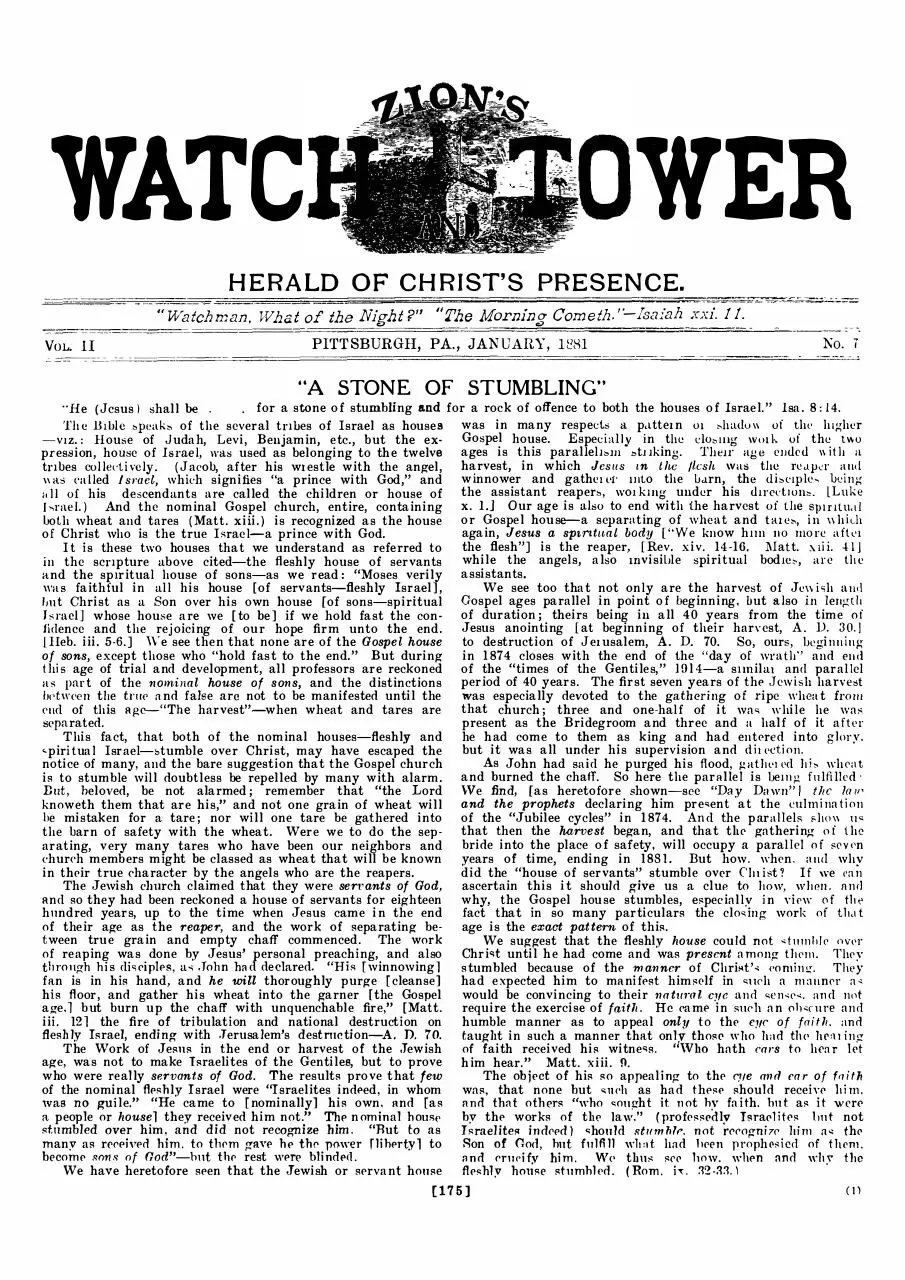
"A STONE OF STUMBLING"
for a stone of stumbling and for a rock of offence to both the houses of Israel." lsa. 8:14.
"He ( Jcsus l shall be .
was in many respect,; a p<tttern 01 �hado\\ ui the htgher
The lhulc �p e ab of the several tnues of Israel as houses
Gospel house.
Especially in the do�1llg wo1 k ui the tv.u
-v1z.: Hou8e of Judah, Levi, Benjamin, etc., but the ex
ages is this parallell,m ,biking.
Then· age cuded \\ ith a
pression, house of Israel, was used as belonging to the twelve
harvest, in which Jesus zn the flesh was the rcapc·r and
tnbes colle•-tivcly.
(Jacob, after his wtestle with the angel,
winnower and gathell'l' mto the u<trn, the dbelpJe, being
''a,; ea l led Israel, whieh signifies "a prince with God," and
the assistant reaper�, wo1 kmg under his duectwn,. lLuke
l• II of his
descendants are called the children or house of
x. I.] Our age is also to end with ihe harvest oi the SJHl'ltu,tl
And the nominal Gospel church, entire, containing
I �rae!.)
or Gospel house--a separating of wheat and tale�, in \\hkh
both wheat and tares (Matt. xiii.) is recognized as the house
again, Jesus a sptrttttal body ["We know hnn no more aftL'l
of Christ who is the true Israel-a prince with God.
the flesh"] is the reaper, [Rev. xiv. 14- 1 6. l\Iatt. :-..!ii. -U J
It is these two houses that we understand as referred to
while the angels, also mvisillle spiritual bodiC�, are th e
in the scnpture above cited-the fleshly house of servants
assistants.
and the spiritual house of sons-as we read: "Moses verily
We see too that not only are the harvest of Je\�ish awl
was faithful in all his house [of servants-fleshly Israel],
Gospel ages parallel in point of beginning, !Jut also in length
lmt Christ as a Son over his own house [of sons-spiritual
of duration; theirs being in all 40 years from the time oi
J �racl] whose house are we [to be] if we hold fast the con
Jesus anointing [at beginning of their harvest, A. JJ. 30. J
fidence and the rejoicing of our hope firm unto the end.
to destruction of Jerusalem, A. D. 70.
So, ours, IJ cginn in g
Uieb. iii. 5-6.] '\'e see then that none are of the Gospel house
in 1 874 closes with the end of the "day of wrath'' and end
of sons, except those who "hold fast to the end." But during
of the "times of the Gentiles," Hll4-a similar and parallel
this age of trial and development, all professors are reckoned
period of 40 years. The first seven years of the Jewish harv e ti t
a� par t of the no mi n a l house of sons, and the distinctions
was especially devoted to the gathering of ripe wh e a t from
hf't\\'ecn the true and false arc not to be manifested until the
that church; three and one-half of it wa" while he wa�
end of this Rgc-"The harvest"-when wheat and tares are
present as the Bridegroom and three and a half of it after
SC'parated.
he had come to them as king and had entC'red into glor�'·
This fact, that both of the nominal houses-fleshly and
but it was all under his supervision and ditPdion.
� pirit ua l Israel-otumble over Christ, may have escaped the
As John had said he purged his flood, gathL·ted hb whrat
notice of many, and the bare suggestion that the Gospel church
and burned the chaff. So here the parR lie! is IJewg fulfilled·
is to stumble will doubtless be repelled by many with alarm.
"Ve find, [as heretofore shown-sC'e "Day Dawn"! the la1t•
Dut, beloved, be not alarmed; remember that "the Lord
and the prophets declaring him pre�ent at the culmination
knoweth them that are his," and not one grain of wheat will
of the "Jubilee cycles" in 1 874. And the p arall el s sho\\ ll"
be mistaken for a tare; nor will one tare be gathered into
that then the lwrvest began, and that tl!C' gathering oi 1.he
the barn of safety with the wheat. Were we to do the sep
bride into the place of safety, will occupy a paraliC'! of SC'V<'n
arating, very many tares who have been our neighbors and
years of time, ending in 1 881.
But how. whC'n. an<! why
ehureh members might be classed as wheat that will be known
did the "house of servants" stumble over Cln i st ? If we l'an
in their true eharacter by the angels who are the reapers.
The Jewish clmrch claimed that they were serrants of God,
ascertain this it should give us a clue to how, when. and
why, the Gospel house stumbles, especially in Yirw 0f th"
R nd so they had been reckoned a house of servants for eighteen
hundred years, up to the time when Jesus came in the end
fact that in so many particulars the cl 0 '< in g work of thc1 t
of their age as the reaper, and the work of separating be
age is the exaat pattern of thiR.
tween true grain and empty chaff commenced. The work
We suggest that the fleshly house could not �tumid<' nv<'r
of reaping was done by Jesus' personal preaching, and also
Chri"t until he had come and was present amo ng thPm. Thr�·
stumbled because of the manner of Chri�<t'� I'Omin!,!".
ThPy
thro ugh his di�eip!Ps, a-; .John had declared. "HiR [winnowing]
fan is in his hand, and he will thoroughly purge [cleanse]
had expected him to mRnifl'st himsl'lf in '<lll'h a ma n nC' r a"
his floor, and gather his wheat into the garner [the Gospel
would be convincing to their natt1ml eye and '<Cil<P<. and n nt
age.l but burn up the chaff with unquenchable fire," [Matt.
require the exercise of faith. He l'ame in s11eh an nh,cure and
iii. 121 the fire of tribulation and national destruction on
humble manner as to appeal only to the eye of faith. and
tlesl!ly Israel, ending with .Jerusalem's dest ru c ti on-A . D. 70.
taug!Jt in such a manner that only t hosl' "·ho had thC' hl':n ing
The Work of JeRnR in the end or harvest of the .Jewish
of faith received hiR witne"s.
"'Vlw hath cars to hra r lPt
age, was not to make TRraelites of the Gentiles, but to prove
him hear." Matt. xiii. !l.
The object of hiR so appealing to thP C'Jie and enr of foith
who were really servants of God. The results prove that few
waR, that none but "ll<'h as had thl'sl' Rhould receiYI' him.
of the nominal flPRh ly Israel were "Israelites indl'ed, in whom
was no guile. "
"He came to [nominally] his own, and [as
Rnd that others "who '\Olttrht it. no t hv fait h . but as it W('r<'
a people or house] they received him not."
Th!' nomi nal hom;p
by thl' works of tlw Ia \�." (professedly I sra C'l it('s lmt not
stumbled over him, and did not recognize him.
"Rut to as
IRraelites i ndl'l'd ) "honld stumh7r. not f<"<"og-ni7P him a" th('
many as rN' l'h•Pd him. to tlH•m g-aw h!' thP power flihPrtyl to
Ron of Gocl, h11t fulflll wl1at had lwen p roph l'si cd of th('m.
becomp sons of God"-h11t thr rest wl're hlindNl.
nnd <"ruf'ifv him.
V'I'C' tlm>< s('(' lww. whl'n nnd whv
the
.
fll'Rhly h01iRe stHmhl('O. (Rom. i�. �2-��.)
We have heretofore seen that the Jewish or sPrvant honRe
[1 7 5 ]
(!)
�
(1-2)
ZIO N 'S
W A TC H
Now, let us look with even deeper interest to the stumbling
of the uommal Gospel house-spiritual Israel.
We suggest
that as the tie�hly house could not stumble over him until
he came at the nrst advent, so the spiritual house cannot
stumble over Chnst until his second advent. The causes of
stumbling too are the same; those of the Gospel church who
expect the second coming of Christ and establishment of his
kingdom are expecting (Just as the fleshly house did) an
outward display, which will appeal to the natural eye, ear,
and human senses generally.
Some know not, and others who ought to know experi
mentally, seem to forget, that if we are in Christ Jesus we
are new creatures. "Ye are not m the flesh, but in the spirit
(condition) if so be that the spirit of Christ dwell in you."
(Rom. viii. 9.) All of this class of persons have given up
reckoned dead, {and are daily dymg to) the fleshly human
nature, and are daily partaking more and more of the spiritual
or divine nature, into the perfection of which we are expecting
soon to be changed, when the separating of "the harvest"
is complete.
These should all remember the rule which we
apply to other things. viz. "We look not at the things which
are seen (of the natural eye), but at the things which are
not seen, for the things which are seen are temporal, but
the things which are not seen are eternal." (2 Cor. iv. 1 8.)
\Vhich o f the things which w e as new creatures prize so
highly are visible to the natural eye ? None; it was by the
eye of fatt1" that we realized our heavenly Father's smile,
saw Jesus as our Leader, saw the "crown of life," and "prize
of our high calling." Our spiritual eye of faith has seen, and
our circumcised ears heard of the glorious things "God hath
in reservation for them that love him," which the natural
man cannot see and hear, because they are spiritually dis
cerned." ( 1 Cor. ii. 14.)
We see and hear, because led
by the Spirit (through the word.)
"We walk by faith, and
not by [natural] sight."
Would that all could realize that this class described
[dead to the natural, but alive spiritually] are the only
ones who will constitute the body or bride of Christ. These
have fulfilled their covenant by sacrificing the human nature.
"They shall be mine . . . . in that day when I make up
my jewels." [Mal. iii. 17.]
It is to this cZass only that
Jesus comes as Head and Bridegroom, and only they are to
recognize his presence during the harvest of this age, as
only those with the eye and ear of faith recognized Jesus
in the harvest of the fleshly house.
[True, there will be
in due time outward manifestations of "power and great
glory," which will convince all mankind of the reality of the
new kingdom; but this comes after the bride has recognized
his presence, been separated from the tares, and "made like
unto Christ's glorious body," for "when he shall appear [to
the world] we also shall appear with him in glory." We shall
not be revealed in flesh, but in glory. "We shall be revealed
[made known] in flaming fire," [judgments] inflicting right
Pons punishment upon wrong doers, and lifting up the poor
and oppressed.
We believe that Christ is now present, in the sense of
having commenced the work of taking to himself his great
power and reigning.
ThP work begins with the separating
of tares from wheat in the living church and the association
of the wheat of all ages with himself in the authority of
his kingdom.
"To him that overcometh will I grant to sit
with mP in my throne," and "to him will I give power over
the nation!'>," to continue until all things are subdued under
him. It seems propt>r, too, that the work should be�in thus,
by taking hi'> bride allfl the twain becoming one.
It mn<ot hp pc�iufnl ly Pvirlent to all true Christian<; that
the nominal f'hureh whieh callA herself the spouse of Christ,
i'l far from being the "little flock" who walk the narrow
way-"the way their Leader trod."
Many are Christians
in name and form only, "having a form of godliness, but
denying the power thereof." by living contrary to their pro
fe«sions.
Many are moralists only, who recognize and use
the church only as a Rocial and moral club. Many are hypof'rite'l, who use the church as a stepping-stone to wealth and
social standing. Some are true children of God and feel that
the church is too empty and formal and worldly, yet are
earried on with the otherR by the thought that they may be
too timid.
''Mr. A. and MrR. C. are very intelligent and
wealthy and moral people and they approve of such things,
and who am I that I should object ? They would think me
weak and fanatical-I will continue with them; certainly
much good i'l being done."
A fpw-a little flock-while still using their influence and
example as "living epistles" for their Master, feel themselves
almoAt, or entire1y, separated from the nominal church. The
('burch's union with the world in worldly plans. ways, customs
TO WER
PlTTSBURGH, PA.
and dre"s are out of harmony with their new nature, and
their seeking to be "not conformed to the world, but trans·
formed by the renewing of then mmds" to harmony with the
will of God; they cannot feel at home w1th the carnally
minded.
Their eye delights not so much in beauty of form,
as in the perfection of the new nature, begotten of God through
the word of truth; not so much m the beauty of dress as in
the beauty of character and its Christ-like-ness; not so much
in the grandeur of the house as in the greatness and love
liness of him whom they "worship in spuit and in truth;"
not so much at the language and eloquence of the preacher as
in the understanding of the word of God.
These go sometimes to meet with the nominal church, but
are always separate in spirit and usually seek and enJoy
more the society of others like-minded.
These are obliged
to study the word privately, for if they do attend preachmg
they hear a sermon on some topic of morality duected to
the world of unbelievers.
Nor can the pastor be blamed
entirely for so doing, the policy of the church having sup
plied him a congregation, nine-tenths of which are worldly
and cannot understand spiritual things, he feels it to be h1s
duty to preach to the majority; consequently the sheep of
the flock receive little or none of the "strong meat" of the
word. Will these starve, think you? I tell you, nay; the
great Shepherd will provide "meat in due season" to all
who reaUy hunger and thirst after it, he will lead them to
green pastures.
This last class is to be the bride. Careless of the opinions,
smiles or frowns of the world, she cares only to be m favor
with her beloved-the heavenly Bridegroom.
And these arc
to recognize him now, the others are to stumble and not
recognize him until these have all gone in to the marriage and
the door to that high position is closed. Our understanding
is that the Bridegroom came in 1874; and this little company
is being brought to a knowledge of his presence, and in that
sense, being separated from other true Christions who either
are overcharged with the affairs of this world or bound by
chains of denominationalism, are making void the Word of
God through their traditions, etc., and still others, who, not
being in condition of heart to receive him on the evidence
of his word, but who turn to seek light
on his presence
in other directions and find it. not until the door to that
high calling is shut. Matt. xxv. 1 0.
We trust, then, that all readers may see that the reason
why the church in general stumbles here, (as the fleshly
house did,) is because only a "little flock" in it is the bride.
The two houses of Israel each in turn were called to be
Christ's bride.
Both fail to attain the position, but as God
had foreseen and arranged, a little company from each do
receive him, and "As many as receive him" are acceptable.
"The election hath obtained it, and the rest were blinded"
{by their own condition) . Rom. xi. 7.
The path.way in which the little flock walk, though rugged
and difficult, is filled with light-"Thy word is a lamp to my
feet and a lantern to my footsteps."
And it is this light
which prevents us from stumbling over this stone of stum
bling. The prophetic word shows us that we are in "the
day of the Lord," and enables us to receive him, not by the
sight of the natural eye, but by the eye of faith, for "we walk
by fo,ith, not by sight."
This is just as Peter advised us:
We have a sure word of prophecy, unto which ye do well to
take heed as unto a light shining in a dark place.
[2 Pet.
i. 19.]
The day of the Lord is called a day of darkness,
and we, unless enlightened by the word of prophecy, would
stumble as the others of the church are doing over the stone
of stumbUng in this dark place. But enlightened by our lamp,
how our hearts have been rejoiced Rince we found him present,
and though a stone of stumbling to others, "To you, who
believe, he i s precious." ,1 Pet. ii. 7.
THE DAY OF VISITATION
\Vhen Jesus had finished his ministry he rode to Jeru·
salem on the ass, assuming [typically] to the fleshly house
the office of king, and in the exercise of that office he de
clared: "Your house is left unto you desolate"-here giving
up the fleshly house.
We repeat that they were given up
because, not being Israelites indeed, they did not receive him
-stumbled-and so we read that when he had told them of
their overthrow and destruction he assigns as the cause
"Because thou knewest not the time of thy visitation." [Luke
xix. 41-44.]
Their time of visitation was, in a sense, the
whole forty years to the destruction of the nation ; but there
had been the time of trial first ; if during that first thrpe
and a half years they had been in a condition to receive
.Jesus, the visitation following would have been of blessing,
but unready and rejecting him, it became a visitation of w rath.
[176]
�
}ANUARY, 1881
ZIO N 'S
W A TC H
So also here, during the first three and a half years, from
1874 to 1878, the opportunity was given to the general Gospel church to receive Christ tke present one, but they stumBecause they knew not
bled similarly to the fleshly house.
the time of their visitation-being unready-and are similarly
cast off-given over to destruction (as an institution) -a.
visitation of wrath.
After the giving up of the fleshly house, especially during
the three a,nd a half years following, or the last half of their
covenant week [the 70th, Dan. ix. 24], favor was still shown
to all who left it and accepted of the fact that Jesus Christ
had come, etc.; so here there will be special favor shown to
all who separate in heart from the cast-off church, and receive
the presence of the Lord during the three and a half years
from 1878 to 1881, and after that to those who become part
of "the great company," for some shall glorify God in this
"day of visitation" and wrath.
[1 Pet. ii. 12.]
The number of Scriptures which speak of the Gospel
church after being cast off from God's favor, and of her
rapid decline and fall are somewhat wonderful. In Rev. iii.
14 to 2 1, the whole picture is vividly presented. The Lord is
addressing the last phase of the church, the seventh.
[We in
common, with nearly all expositors of the Apocalypse, understand the seven churches here addressed to represent seven
phases or conditions of the entire nominal church, from the
days of the apostles to the end of the Gospel age, in the
order mentioned.] To this seventh church, Jesus says:
"I
know thy works, [the works are greater far than the faith]
that thou art neither cold nor hot; so, then, because thou art
lukewarm I will spew thee out of my mouth."
What a
description this is of the present condition of her, whom God
calls "Babylon"-confusion-mixture--lukewarm.
Babylon says she is "rich. increased in goods and has need
of nothing" ; that she is in a more prosperous condition than
ever before, and she boasts of fine churches, high steeples,
eloquent preachers. wealthy members, splendid music, large
salaries and worldly popularity, and knows not that sh e is
"poor and miserable and blind," (stumbling over present
truths) and remembers not that her worldly popularity is an
"For the
evidence of her disfavor with the Bridegroom.
friendship of the world is enmity against God." She is there·
fore given up, as was the fleshly house-she is "spewed out of
She has been his mouthpiece, and through her
his mouth."
he has spoken to the world. but it shall be so no longer. "The
Yoice of the Bridegroom and the Bride shall be heard no
more at all in thee." Rev. xviii. 23.
To our understanding this "spewing" and "falling'' dates
from 1878, the exact parallel of time to the giving and ''leaving desolate" of the fleshly house. And now the call is "Come
out of her, my pPople! that ye be not partakers of her sins
and receive not of hPr plagnec;," and while we expect that most
of the second company will not be freed from her bondage
until afterward, we do not expect that all who constitute
part 0f th e brt'de Wl'll be separated b efore th e Autumn of 188 1•
then "the voice of the bride will no more be heard in her."
The fall of Babylon is not only the subject of a large portion of the book of Revelation, but also of many of the
prophecies.
As fleshly hrael went into captivity to literal
Babylon, so did the Gm;pel house go into captivity to
"Babylon, the great mother of harlots," and i R still bound by
many of her chains of darkness and error. In prophecy when
depicting the desolations, etc.. coming upon Babylon, we
understand it to refer to both the type and the anti -type, and
especially to the latter, and they harmonize wonderfully with
the account given of the same event in Rev. xii. 13, 16-19.
While there are many such prophecies, we merely refer to
one; Jer. 1 and li. ''How is the hammer of the whole earth
cut asunder and broken! How is Babylon become a desolation
among the nations! . . . . Wold unto them ; for their day is
come and the time of their visitation. The voice of them that
flee and escape out of the land of Babylon to declare in Zion
the vengeance of the Lord our God, the vengeance of his
temple . . . . and the most proud shall stumble and fall and
none shall raise him up. . . . At the noise of the taking of
Babylon the earth is moved and the cry is heard among the
nations. . . .
Flee out of the midst of Babylon and deliver
every man his soul [life] ; be not cut off in her iniquity, for
this is the time of the Lord's vengeance ; he will render unto
her a recompense.
Babylon hath been a golden cup in the
Lord's hand that made all the earth drunken. . . . We wou1d
have healed Babylon, but she is not healed ; forsakE> her and
let us go, every man, into his own country. . . . The Lord
hath brought forth our righteousness; come, let us declare in
"In those
Zion the work of the Lord our God." (li. 10.)
days and at that time," saith the Lord, "the iniquity of Israel
I-12
TO W E R
(2-7)
shall be sought for and there shall be none, and the sins of
Judah, and they shall not be found." (1. 20.) This last text
shows us that the time really meant by the prophesy was not
at the deliverance of Israel from literal Babylon (though
type and antitype are closely interwoven), but at the end of
this age, when, says Paul: God shall "take away their sins."
After telling the nominal church that she is no longer hts
mouthpiece, Jesus says:
"Be zealous therefore and repent."
This is his message to the nominal church as a whole; but
now he recognizes some who are in, but not of Babylon
individuals, and to these he says:
"Behold, I stand at the
door and knock; if any man hear my voice and open the door
I will come in to him, and will sup with him, and he with
me."
It is not at the door of the sinner's heart the Lord
stands thus knocking, as some have supposed, but at the
hearts of the true IsraeUtes, in this seventh or closing stage
of the Gospel church. And what a wonderfully clear picture
this affords us-the two things occur at the same time, �. e.,
while the one party is "stumbling" and being "spewed out,"
the other party, the "little flock," "the overcomers," are being
made aware of his presence.
These hear his knock-the
prophecies which announce him as present, not as coming in
the future, but present now.
When any one knocks at your door, it is an indication, not
that they will come, but that they have come.
So the Lord
has given us a striking picture, illustrative of his presence at
the time Babylon is given up.
Since we each individually
heard the knock of the prophecies, opened our heart and
realized his presence, how fully his promise has been fulfilled,
"I will come in . . .. and sup with him, and he with me."
What a blessed feasting on the truth we have enjoyed. Ah.
yes, when our Lord girds himself and comes forth to serve us,
as he has done during these years, we get food indeed. We
have meat to eat that the world knoweth not of, a parallel
again to those true Israelites who received him at his first
"The disciples came unto him privately, saying,
advent.
Ea:plain unto us," and Jesus answers: "To you it is given to
know the mysteries of the kingdom of heaven, but to all them
that are without [unbelievers] all these things are done in
parables" (figures of speech which they cannot understand.)
"Blessed are your eyes, for they see; and your ears, for they
hear ; for verily I say unto you, that many prophets and
righteous men have desired to see the things which ye see,
and have not seen them."
(Matt. xiii. 17)
And the same
is true of those who see him present now by the eye of faith
by the light of the sure word of prophecy-"blessed are your
eyes."
While all overcomers-the bride-are to get the victory,
etc., and not fall with Babylon, yet from other scriptures we
find that some who are really children of God, will fall with
her.
"Many among them shall stumble and fall. and be
broken."
(I sa. viii. 15. l
But (Psa.. xxxvii. 24) "though he
fall yet shall he
111'0'1' BE U'l''l'EBLY OAS'l' DOWN."
The stumbling and fall of both the houses of Israel should
be regarded rather as a blessing than otherwise, as the
prophet has said:
"This child [Jesus] is set for the fall and
rising again of many in Israel"-both houses. The rejection
of the nominal house was necessary before the call could go
"to the Gentiles to take out a people (bride) for his name."
For, "through their fall salvation is come to the Gentiles."
(Rom. x.i . 1 1.) And though the fleshly house fell, they are to
nse agam to all that was promised them as a fleshly seed of
A braham (in the Millennia! age.)
Then, why should any
;
complain "if the fall of them be the riches of the world, '
or resulted in throwing open to the world in general the op·
portunity of running the race for "the prize of high calling"
-to be the "bride, the Lamb's wife?" And "what shall the
receiving of them [back to favor as God's people 1 be but life
from the dead ?"-resurrection .-[Rom. xi. 15.1
So with the stumbling and fall of the second hou�:<e. It is
necessary that the nominal rhurch should fall in orrlPr that
the true might be manifested-separated and "enter into the
joys of her Lord."
But while the fleshly houE:e �;hall be
restored, the Babylon church will never be restored.
As a
great millstone cast into the sea, so shall Babylon fall, and be
found no more.
[Rev. xviii. 21.]
While this is true espe·
cially of the mother of harlots ; it is true also of all }1er
daughters who partake of her nature, and only individuals
out of Babylon shall arise from among her ashes. savin<T:
"True and riglltPous a TP his judgments: for he hath j\1dg; d
the J!reat harlot."
"Alleluia: for the Lord God omnipotent
reigneth ."
And they will thus "glorifv
God in the dav
of
·
·
visitation . " [I Pet. ii. 12.]
But let us "walk in his footsteps"-"th<' path of the just"
(righteous ) and, enlightened and illumined by the word,
[177]
�
ZIO N 'S
(3)
WA T CH
n•alizing the presence of our Lord, glorify God without hav·
mg to go into the wrath.
"Watch ye that ye may be
accounted worthy [clothed With his righteousness, "unspotted
from the world"] to escape all those things coming upon the
world, and stand before the Son of Man." Let us remember
that the 'little flock' have always been the church "whose
names are written in heaven," though during the Gospel age
the number has seemed much larger, by reason of tares. And
though you may have little of earthly communion with saints,
remember to keep up your relationship and union with the
head of the church-Christ.
As at the first advent some of the people would have
believed if the Pharisees had received him, and it was asked,
"Have any of the Scribes or Pharisees believed on him?" So
now many say if the Lord is present why do not the leading
preachers of the churches believe it?
We cannot risk our
Take my life, and let it be
Consecrated, Lord, to thE>e.
T O WER
PITTSBURGH, PA.
judgment as to the meaning of the word as against theirs.
"Can the blind
Of the leaders of that church Jesus said:
lead the blind; shall they not both fall?" (Luke vi. 39.) They
d1d; both leaders and masses stumbled and fell. So too Jesus
says of the nominal church here, "Thou knowest not that thou
art poor and blind." And again, for the same reasons, many
stumble and fall.
Let us remember, dear friends, that the great Teacher and
Leader of the flock is Christ.
The gmde unto truth is the
Spirit of truth through the word, and if any man teach, you
are required to square and measure his teachings, by going
"to the law and to the testimony, If they speak not according
to these it is because there IS no light in them."
(I sa. VIii.
20. )
A� children of the light, let us walk in the hght, and
be sanctified and separated from both world and worldly church.
CONSECRATION PRAYER
Take my moments and my days,
Let them flow in ceaseless praise.
Take my hands, and let them move
At the impulse of thy love.
Take my intellect, and use
Every power as thou shalt chose.
Take my feet, and l et them be
Swift and beautiful for thee.
Take my will, and make it thin(';
It shall be no longer mine.
Take my voice, and let me sing
Always, only, for my King.
Take my heart, it is thine own 1
Fit it for thy royal throne.
Take my lips, and let them be
Filled with messages from thee.
Take my love; my Lord, I pour
At thy feet its treasure store!
Take my silver and my gold,
Not a mite will I withhold.
Take myself, and I will be,
Ever, only, all, for thee!
-Selected.
HOLY PLACE
It will be admitted by all Bible students, that a correct
understanding of terms used, is necessary, in order to a clear
comprehension of any subject. Now that the tabernacle of the
wilderness is unfolding so grandly, as a type, or shadow of
the true tabernacle, and giving us a better knowledge of God
and Christ, and the way to God, it becomes important to
understand the terms used in connection with it.
For various reasons, it seems especially important to know
the scripture names of the three places in the tabernacle.
It is evident that in some passages, the term holy is used for
most holy, or referring to both,, so that it is necessary to
determine the place referred to by the connections; but we
think it can be clearly shown that the names are not all used
interchangeably.
It seems that there has been a general misunderstanding
in regard to the term holy place. It needs only to be stated
that words in italics in the scriptures, have been rmpplied by
the translators, and were not in the original.
If that is
invaria bly the case, then we think that it can be shown that
wherever place is not in italics, the term "holy place" has ref·
<>rE-neE' to the court of the tabernacle; and consequently the
other ttw places are called the holy and most holy, or holiest
of all; place being in italics, in both old and new testament.
So we have "the holy place; " (the court ) "the holy," (beyond
the first vail ) and "the most holy," or holiest of all (beyond
the second vail ) .
Notice in Exodus, Lev. and Reb. As has
been shown. the alter of burnt offering; and the laver for w ash
ing, were in the court or holy place. The anima1s for sacrifice
were killed there.
"And he shall slay the lamb in the place
whPre he shall kill the sin offering in the holy place." Lev.
xiv. 1 3. "And the remainder thereof shall Aaron and his sons
Pat; with unleavened bread shall it be eaten in the holy place ;
in the conrt of the tabernacle of the congregation they shall
cat it." Lev. vi. 1 6·26.
It will be noticed that place is in the original in these
pas�ages, not being in italics; and that the holy place and
court are identical. "And the Lord spake unto Moses, saying:
Thou shalt make a laver of brass, and his foot of brass to
1cash; and thou Rhalt put it betw{'en the tabernacle of the
congregation and the alter, and thou shalt put water therein,
for Aaron and his sons shall wash their hands and their feet
thereat; when they go into the tabernacle of the congregation,
they shall wash, that they die not; or when they come near
to the alter to minister, to burn offering made by fire unto
the Lord."
Ex. xxx. 17-20.
"Whatsoever shall touch the
fiesh thereof shall be holy; and when there is sprinkled of
the blood thereof upon any garment thou shalt wash that
whereon it was sprinkled, in the holy place" (the court ) .
Lev. vi. 27.
These passages make it certain that whoever or whatever
was washed in connection with the tabernacle, was washed
at the laver, in the holy place; and we have seen that the
holy place is the court of the tabernacle; and we found also,
in Ex. xxx. 20, that whoever would enter the holy, must first
wash at the laver, that he die not. Now coming to Lev. xvi.
which gives us a picture of the day of atonement, we find that
if the high priest would enter holy or most holy, he must first
wash his flesh in water and put on the holy linen garments;
then kill the bullock to make atonement for himself and his
house; and take his blood in and sprinkle upon and before
the mPrcy seat; then come out and kill the goat, which was to
make atonement for the people, and do with his blood as he
did with the blood of the bullock; then after making atone
ment for the holy, and the tabernacle, and the alter; and
sending away the scapegoat; Aaron shall come into the taber
nacle of the congregation, (evidently in this passage as in
some others-the court) and shall put off the linen garments,
which he put on when he went into the holy, and leave them
there, and shall wash his flesh with water in the holy place
(the court ) . Lev. xvi. 23, 24.
In the face of all these facts, it is persistently claimed by
some that Aaron killed the bullock, then stopped on his way
to the most holy, and washed his flesh in the holy, and put on
the holy garments, and also stopped on his way out to wash,
etc., in the holy; claiming that the beauty of the type con
sisted in the washing where no place was provided for that
purpose; and notwithstanding it was death to enter the holy
before waf'hing. We think the beauty of any explanation of
God'R word should consist in adhering to the genPral teaching
B. W. K.
of the word.
TRACT SUPPLEMENT No. 1
With this numbPr we sE>nd Tract No. 1.
Vi"e have ar
ranged for quite a number of them. anrl you may expect one
or two a month for �evPral months.
They will all he free,
(Jn ron<litio11 that vou oHler no more than vou will wisPlv u-.p.
We will not send more than 2!) at one time.
You can
re -order when they are gone. This is a way in which all can
"both labor and suffer reproach," as well as give the "glad
tidings" to some who have ears to hear and hearts to appre·
ciate; "The love of God, which passeth all under11tanding,"
·
revealed to us in His word.
We suggest that each tract be carefully read by you
before you give it to others.
[178]
�
HID TREASURES
silver, and searchest for her as for hid treasures, then shalt thou understand the fear of the Lord and
find the knowledge of God." Prov. 2 : 4, 5.
searched ) what was necessary for them to know, but that
If we go back to the second verse we shall find the thing
was not enough for us to know, any more than the >.upply of
spoken of is wisdom.
Webster says that, "in Scripture theology wisdom is true
silver and gold which was in the world at the t1me of the
discovery of America wa� sufficient for the world without any
religion." What does rehgtan mean ? The word is taken from
religio, to bind anew, or to rebind. It is used i n a general
addition up to the present time.
Our fathers worked the
sense to signify "any system of faith and worship." N ottce
same mine, but did not exhaust it, thank God. There a 1 P
nuggets of gold coming to the light all the tinw.
1t is a system. This brings us to the conclusion ( if we take
But let us see what Scripture evidence we have that th<·�P
Webster for the standard of words, and we have no reason to
differ ) that wisdom is the true system of faith and worship.
things are so. Jesus said, when weeping over Jeru�alf"m, ··l f
Then it follows that we are to seek for the true system of
thou hadst known at least in this thy day, the thing� wlw•h
faith and worship as men seek for sih·er.
But, says one,
belong unto thy peace, but now they are hid from thine eye�.''
silver is out of sight in the earth, and is hard to be found ;
But were they to remain hidden ? No ! Isaiah, look ing down
through the ages ( the remainder of the Jewi>.h age, and
but what is necessary to be known of the true system of
religion is revealed so plainly that the wayfaring man, though
through the Gospel age to the coming age-in the restitution
a fool, need not err therein. I know the prophet speaks of a
age ) , says, then the eyes of the blind shall see. Je-,u>o befurP
goOll time coming, when it shall be so revealed that "the wayhad called them blind, and that was how these tlung� w�>re
f.uing man, though a fool, ( like the rich man who had to
"hid from their eyes."
pull down his barns and build larger ) shall not <.'rr therein.''
Paul, Col. 1. 26, says, "The mystery" of the word of God
"hath been hid from ages and from generations, but now ( Ill
Now, we think there is a strong analogy between seeking for
this good-news age) is made manifest to hts saints.
a knowledge of the true system of faith and seeking for
silver. Paul says, Heb. v. xi, "There are many tbin_g� . . .
Again, in Eph. i i i . 4, 5, 6, he says "The mystery of Christ
. . . . in other ages was not made known unto the sons of
haJ d [difficult] to be uttered," and Peter, 2 Peter i i i . 16,
men, as it is now revealed unto the holy apostles and prophets
�peaks of "things hard to be unders tood, which they that are
unlearned ( in the word ) and unstable. wrest, as they do also
by the Spirit, that the Gentiles should be fellow heirs and
of the same body," and he tells us that he was made a minthe other scriptures, to their own destruction.''
ister to make all men see what is the fellowship of the my�E xpcnence, as well a s the word. teaches us that as there
is much and persistent search and pains-taking required to
tery which, from the beginning of the world, hath been hid
in God.''
find the "vein" or "lead" of precious metal concealed i n the
earth, so there is to find the vein or lead of precious truth
Oh, how glorious are these things to those who search for
them as for hid treasure ! Truly, here is the knowledge of
h idden away in the mine of God's word.
( about ) God.
We think it a du. ty to find out all we possibly can of
G od's "system of faith," and what we cannot find out will be
Men, in mining have lights fixed upon their heads, and
only that which he ha� so completely hidden. But some one
they bend low, sometimes prostrate in search. \Ve need to be
humble and have our minds illuminated with the Spint.
may ask, Why has he h idden it, i f it is right for us to know
When men have found silver in the mine it has to be separated
i t "! We answer, that it may not be found until i t is needed.
from materials which are useful in themselves, but detract
Go<I'H wisdom has hidden it ju st far enough away to be found
from the value of the precious metal unless separated. So
by our finite minds, after diligent search, just at the right
tinw. or, as the Spirit says. dtte time; and it is those who
the child of God, like Timothy, needs to "rightly divide the
are i ntE'rested and earne�t enough to search and find the
word of truth.'' Let us, dear brethren. continue our search
JPwcls, who are to be ve�ted with regal authority.
after wisdom, which shall result in finding "the knowledge of
One might just as well say that the silv<"r and gold. the
God," for "it cannot be valued with the gold of Ophir, with
<'oa l an<l the oil were hidden away in the ea1th bpcause it was
the precious onyx or the sapphire."
not right for us to have them, as that it is not right to
"The gold and the crystal cannot equal it, and the exchange
of it shall not be for jewels of fin<.' gold.'' And when we
SPill <"11 fo r the true system of faith.
have found it let us not waste nor hoard it, but "put it to
But, says one. we hav<.' had thP true system of faith all
the exchangers, that at his coming he may receh·e his own
a lung th rough the past-what more can we have ? Did not
with usury.
our fathers understand it 9 Y<.'s, they understood ( those who
J. C. S.
"If thou seekest her
as
"OUR HOUSE"
" For W<" know that i f our earthly house of this tabernacle tccre dissolved, we have a building of God, a house not made with
hands eternal i n the heavens." 2 Cor. 5 : 1 -2.
From a not hasty but careful perusal of the Scriptures,
are satisfied that the view generally taken of this passage,
( With the context ) by the nominal church, hitherto, is
erroneous.
This may seem somewhat immodest ; we do not so intend.
I f we have any l ight it is received, not inherent in us, that
i-<. "in onr flesh d wplleth no good thing." If we h a ve apprehended the truth, it is because "he, the spirit of truth," leads
us, for "the natural man receiveth not the things of the
Apirit, for they are foolishness unto him, neither can he know
them, because they are spiritually discerned.'' 1 Cor. ii. 14.
The Church is not to blame for not seeing before ; how can
one be expected to see in the night anything more than the
outlines of the l andscape ; but now the day dawns, "let us
not sleep, as do others." 1 Thes. v. 6.
The prophets uttered some things which they did not fully
umlerstand and which it was not necessary they should fully
understand, because th<"y were for us. 1 Peter i. 1 0 - 1 2.
But about this matter, Paul says ( as mouth-piece for the
Church ) , "We know that if our earthly house of this tabrrnacle were d issolved we have a [singular numberl building of
God. a house not made with hands," etc.
Paul was writing to the Corinthians here, but he waR also
writing "to all that in every place call on the name of Jesus
Christ our Lord, both theirs and ours.'' I Cor. i. 2. The
word "theirs" reier� evidently to ,T<.'ws.
Paul waf! a ,J ew,
Acts xxi. 39, bu t he Rtyles hi mself "the Apostl<.' of the Gentiles," Ro m xi 1� ; so in harmony with the latter h<" could
i n thi � dediC'ation of h i s <"pistle say. ''both th ei r <� and ours"
to the new church, whi eh was made u p of both J<.'ws and
Gentiles.
They ( the .Tews ) Rtood aloof from the Gospel and
W <"
.
were enemies of the cross of Christ ; thus standing at a distance, the term "theirs," although Paul was a Jew, was
appropriate to them, and converts from both could be wry
appropriately called "theirs and ours.''
Now, to �uch he
says, "We know that if our earthly house of this tabernacle
( to which so many precious promises have been made ) were
dissolved, we have a building of God, a l10use not made with
hands." It may seem strange to us that the old hou.;; c of
Israel should not be able to see the typical nature of their
ceremonies, and that "what!'\"<.'r is to be on the higher or
spiritual plane, is brought to view first on the plane n f the
flesh.'' But though God had been speaking "by the mouth of
all the holy prophets sine<" the world began," of a re;;titution, they did not see that ther<.' was to be, in its a p p l icati on
to them, a time of dissolution. before the time of restitution ;
and it seems that the Gospel church in Paul's time. ne<.'d<.'d
to be admonished of the danger of looking at that which is
seen, forgetting that "that which ig seen [by mortal eye] is
temporal.''
He had to combat that tendrncv, as in Galatians i i i . �"Are ye so foolish ? having began i n the spirit, are ye now
made perfect by the flesh ?" "If our <.'arthly hom:e of thi�
tabernacle were dissolVPd, wr havp a building of God."
The "tabernacle of David is fallen down," hut God in lli;�
good time will rebuild i t ; but those who ar<" "hegott<.'n again
unto a lively hope by th<" rpsurr<"ction of Jesus Christ from
the dead," have the p ow <.' r or privileg<" of b<.'coming !'Oils of
God, and together will comtitute the howw of G od : not th<"
house of Mos<.'s nor thP houR<" of David ( aftPr the fle,-h \ n o r
anv
· other house but th<.' house of God eternal
"Wherefore, holy breth rPn, partakers of thP lJe;l wn l y L':.t ll ·
[ 1 79]
0 4)
�
Z I O N 'S
WA T C H
lllg, t'ullsHler the Apostle and 1-llgll Priest of our profession,
C h n::.t J e::.us, who was 1a1thful to him that appointed him, as
a l :;o l\loses was faithful 111 a l l his house, io1 this man was
cuunted \\ orthy of more glm y than ?.Io,es, i nasmuch as he
who hath uul lded the hou,l', hath more honor than the
house." .
".-\.nd �loses verily was faithful in all hi�:� house, as a
'll' rv.wt." W hat for ? · tor a testuuony of those things which
\\ Prt' to come after." "But Christ as a son over his own house,
\\ hose house are we, i f we hold fast the confidence and the
l eJOH'Ing of the hope firm unto the end." Heb. iii. 1 -6.
Now, no matter if the earthly house of our tabernacle,
"whet her of David or the Gospel, be dissolved, we have a
Lui l d l llg of God, a house not made with hands eternal in the
ht•a vens.
W e ha\ e here a thought suggested by the word dissolve,
wluch is 111 harmony with the prophecy of Malachi, iii. 3.
"And he shall sit as a refiner and purifier of sliver ; and he
�ha l l punfy the sons of Levi and purge them as gold and
� i lvPr." We have often heard this referred to and the man
ner of the refiner watching the melting of the precious metal
until he can see his own image reflected, as an illustration
ot God's dealing with each of his children, all of whiCh is
ve1 y beautiful and truthful, but there is in this expression
"dis,olved," and yet existing afterwards, a �;till deeper thought
th a t im p1 e-s-es u,.
The refiner of sih er often finds impurities clinging to his
�ih·er after it has passed through the hottest fire ; then he
dissolves i t : after the application of certain chemicals, silver
and gold will dissolve in water. A person unacquainted with
the process would say there was no silver in the water, though
the water were full of it ; the water appears as before-a
h tt le discolored if the silver was impure--otherwise as clear
a,; if it were not there, and the refiner can cause a restitu·
tion of that silver to a pure and permanent form and more
Leautiful than before ; he puts into that water an agent ( an
influence ) that causes the water to fet go of it ; and the silver
111 fine particles goes together by itself, no longer "dissolved"
or "suspended." Then the refiner, to complete the work of
re;.titution, puts it in the fire again ; thus it "receives from
hi� hand double" for all its impurity.
Now, in prophetic language, waters represent sometimes
people and sometimes afflictions. Ha!l not the earthly house,
"both theirs and ours," passed, and are they not passing
through such waters ! Have "tht>y" not been dissolved and
"ours" ( the nominal church ) being dis�olved T No matter ;
"we know that if our earthly house of this tabernacle were
TO WER
PrTTSBURGH, l'A.
dissolved, we have a building of God." So Paul could say
to the Connthians and the ualatians, who were feanng lest
they should not be connected m some way with the earthly
house, that it was a matter of mmor Importance-all It was
for was a type and stepping-stone to somethmg higher and
better.
Some may say, this is "far fetched," but we have fetched
it only from the prophet Malachi, and made what seems to us
the only true application, and it seems to make perfect har
mony with all other Scripture. We have been held entranced
hour after hour as we have compared Scnpture with Scripture
and found beautiful harmony with this view all through the
word, and thank the Lord for it.
We would not be understood as saying that the word, body
and house, are never applied to our physical bodies, for it
not unfrequently is, and we thmk it is so used in the lOth
verse of this chapter, though we do not feel over-positive about
it lest it might refer to the different organizations, that shall
finally be "gathered together in one," for we hope that the
Methodist body, the Baptist body and the Presbyterian body
( all of which are called bodies by their own authorities ) will
form, i f not the body of Christ, yet the "household of God" ;
and we know that "we must all ( all these different bodies }
stand before the judgment seat of Christ ( when and where ? ) ;
that every one may "give an account of the things done in his
body"-no, "that every one may receive the things done iu
his body." [His is in italics in our Bibles. ]
Perhaps some one is ready to ask, "How do you har
monize it with the 8th verse ?"
We would say that the
apostle ( Col. iii. 3 ) , though speaking of our death to sin,
tells us where our life is ( whether our physical bodies are
dead or alive, makes no difference, ) from the time of beget·
ting onward, our "life is hid with Christ in God" until "he,
who is our life, shall appear," then the earnest expectation
of the creature [who is the creature but the one who has no
sp iritual life, the outside world] , "waiting for the manifesta.
tion of the sons of God" will be realized and the sons of
God will be recognized. Till then we shall not be able to find
out what God has hidden.
Then, when we are born again,
" BOBN BY A NEW CELESTIAL BIRTH,"
we shall have life in ourselves and together constitute the
"building of God," the "house not made with hands." Dear
brethren, how near and dear the relation we sustain to each
other-"Builded together for the habitation of God."
J. c. s.
"HOW LONG. 0 LORD �"
Th1s is a question doubtless that many ask themselves, viz :
"How soon will our change come T" This change many of us
have looked forward to for years, and we yet with much
pleasure, think of the time when we shall be gathered unto
Jesu� and see him as he is. In the article concerning our
d�ange, in December paper, we expressed the opinion that it
was nearer than many supposed, and while we would not
attempt to prove our change at any particular time, yet we
propose looking at some of the evidences which seem to show
the translation or change from the natural to the spiritual
c·ondition, due this side or by the fall of our year 1881. The
evidence that our change will be by that time, increases since
we have seen that the change to spiritual bodies is not the
marriage. While we thought the marriage to be the change,
and knowing there was three and a half years of special
favor to the nominal church ( now left desolate ) from 1878, we
c·oul<l not expect any translation this side of 1 881, or during
t!Ji-. three and a half years. But since we recognize that going
into the marriage is not only being made ready ( by recognizing
JJi� pre�ence } for the change, but also, that going in includes
t Ju� change itself, then the evidences that we go in ( or will
J,e c·hanged ) inside of the time mentioned are strong, and
c:omrnend themselves to all interested as worthy of investiga·
tion. Aside from any direct proof that our change is near, the
fae;t that the manner of the change can now be understood,
i� evidence that we are near the time of the change, for truth
i'! "meat in due season," and understood only as due. It will
he remembered that after the spring of 1 878, ( whE>n we under
�tand .Jesus was due as King) that the subject of holinesR or
the wedding garment, was very much agitated. And aside
from the parallel to thE> end of the JewiRh age, and favor at
that time being shown to the .Jewish nation, which implied the
pn"-c•nee of the King, the C'onsideration of the wedding gar
me-nt, waR also proof of the C'orrectness of thE> application. for
"the King had comp in to sC'e the guests," fMatt. xxii. 1 1 . ]
and hence all WPrP intC'rP«ted in knowing how thPy 8toocl
before him. Now as the inspection of guests is the last thing
prior to our change, which precedes the marriage and we are
all now considering the change, it would seem that the time
for it, is nigh.
We shall now present what we adduce from the types and
prophetic points as seeming to indicate the translation of the
saints and closing of the door to the high calling by 1881.
We first notice the building of the Temple, by Solomon which
seems to be a type of the spiritual as indicated in Act vii.
4-7. The time occupied in building is found by comparing 1
King vi. 1, 37 and 38, which was seven years and six months,
yet called seven years. Verse 38. "The house when it was
in building, was built of stone made ready before it was
brought thither : so that there was neither hammer, nor ax,
nor any tool of iron heard in the house while it was in
building." Verse 7. The quiet manner of building suggests
to our mind the noiseless resu rrection of the dead in Christ
and change of the living, and if so the resurrection and change
would cover a period of seven years, thus bringing to our
mind, in its order.-First thE' fmmd11tion laid and so on until
completion, and this would be in harmony with statement in
Rev. xi. 1 8, viz : "Give reward unto thy servants, the prophets,
and to the saints," that is, "Every man in his own order." In
1 Kings v. 1 7, we read, "The king commanded and they
brought great stones, costly stones, and hewed stones to lay
the foundation of the house." Those we would understand to
represent the "apostles and prophets, which are the founda
tion, Jesus Christ himself being the chief corner-stone, in
whom all the building fitly framed together, groweth unto an
holy temple in the Lord" ( Eph. ii. 20-21 ) .
The laying of the foundation-stone, we think, would fitly
represent the resurrection of the prophets, which resurrection
would seem to be indicated by God'R statement to Daniel, viz :
"Go thou thy way till the end be ; for thou shalt rest. and
stand in thy lot at the end of the days." ( Dan. xii. 1 3 . ) The
days here referrPd to are mt>ntioned in the 1 2th vers;P as "the
[ 1 80]
�
}ANUARY, 1881
ZIO N ' S
WATC H
thousand, three hundred and five and thirty days," and from
538 when the abommation was set up, ( so mentwned m verse
1 1 , ) 1 335 years, if prolonged to their utmost, would reach to
the year 1874.
LFor argument, see "Day Dawn." J
This is
one of the arguments which prove the presence of Ohnst at
that time, for Daniel could not stand in his lot or be resur
rected until Christ came. Besides it is also a parallel to the
baptism of Jesus in the Jewish age, at which time the harvest
of that age begun and he was recogmzed as Lord of the har
vest and Bridegroom. So we understand the bridegroom came
at a parallel point in this age and those that were ready
went m.
( Matt. xxv. 10. )
tiince we find that going m
includes the change to spiritual bodies, it is significant that
the days of Dame! and the presence of the .Bridegroom occur
at the same time, viz : autumn of 1 8 7 4, and if Daniel stood
in his lot at that time, he was raised a spiritual body ; and
as he 1 ep1 esents the order of prophets and their resurrection
as !Shown by the laying of the foundation-stones of the temple,
then it would seem that the temple began to be built at that
If this be a correct apphcation ( and it seems har·
t1me.
moruous ) and the time of bUilding i s seven years, then we
would expect our change by or betore the fall of 1 8 8 1 , as
from 1874 to then would be the tnne given for building.
lt is true that the parable of 1vlatt. xxv. is only in ref
erence to the Jiving phase of the church.
Yet we beheve
that while those living ''virgins" go into the wedding by
coming into a knowledge of the Bndegroom's presence, etc.,
durmg the seven years harvest l from 1 8 7 4 to 1 88 l j yet the
paral!le is having as 1t were a fulfil lment on a still h1gher
plane dunng the same seven years, VIZ. : The going in �o the
.
cond1t10n ot readmess for marr1age ot all the chaste v ugms,
the dead ( by resurrection ) and hvmg ( by translation or
change. )
ln gomg into the spiritual condition "we cannot
precede them."
( K Diaglott, 1 Thess. iv. 1 5 . ) As Daniel's
tuue wut> up in 187-1 it i�:� reasonable to �:�uppose that the order
he repre,cnted went in at that time, since which the "dead
in Christ" are l!eing ra1sed ; and as the seven years are
about complete, that we will soon follow by being changed.
Matt. x x v . and the parallelism of the Jewish and Gospel ages,
seem to teach that the wise of the virgins "who are alive and
"
l'l' I I J : t l ll
m ust a l l come m, to a knowledge of the Bridegroom's
presence, by the fall of 1 8 8 1 , when the door-opportunity to
IJecome a memller of the bride-wil l close.
llut it is possible that the change to the spiritual condi
tion-the going in to the marriage on the higher p lane-may
not occur at the same moment to each individual. We sug
gest us quite posstble, that the change may come to some
pt epa red, before that time.
I f the dead are to be raised before we are changed i t can
a, well take place some time before, as a moment, and if the
temple is any type it is evident that some will be raised at
least seven years before the last are changed. The fact that
the body or mass of the saints are assembled together when
we are gathered, is intimated by Luke xvii. 34-37, and Paul in
Heb. xii. 22-23, says :
"Ye are come [ coming] unto Mount
Zion, the heavenly Jerusalem, and to an innumerable com
pany of angels. To the general assembly and church of the
first born, and to the spirits of j ust men made perfect." We
come to these.
The next point we will consider is that of Noah entering
the Ark. It seems that the flood of forty days in the destruc
tion of the old world is a type of the forty years' trouble
here at the end of this world, ( age ) and as Noah entered
there and escaped, so some shall enter here and escape.
"The Lord said unto Noah, Come thou, and all thy house,
into the Ark. For yet seven days, and I will cause it to rain
upon the earth forty days and forty n i ghts." And Noah did
according unto all that the Lord commanded him ; and it
came to pass after seven days, that the waters of the flood
were upon the earth. ( Gen. vii. 1 - 1 0. )
The language in con
nection with this circumstan<'e seems to suggest the idea that
Noah and those with him were seven day s going in, and if
�o. thpn thiR would h a rm o n i ze with the seven years fa d ay
for a year] buil din g of the templ e or time of going in, com·
mencing with 1 874.
There is one point. however, we will
It rained forty days after Noah entered, which
not ice . viz :
would represent forty vears' trouble after we enter.
From
1 88 1 to 1914 inclusivP, i� on ly about thirty-three years, hence
in this respect the time di ffer11. This is not when considered
an objection to the position, for though the time of harvest
and end of this age commen<'ed <'hronologically in 1 874, yet
the trouble cannot break. in the full sense, until the saints
have been t aken .
"Yet seven days f yearRl and 1 will <'&use
it to rain upon the e arth ." sh
...
 Historical archive . public document