HERALD OF CHRIST’S PRESENCE.
" V/atchman, What o f the Nip-hi?”
"The M orninp
C?
e? Com eth.’'—Isaiah xxl. 11.
VOL. VII
PITTSBURGH, PA., JANUARY, 1886
No. 5
VIEW FROM THE TOWER
The outlook at the opening of the New Year has some very
encouraging features. The outward evidences are that the
marshalling of the hosts for the battle of the great day of
God Almighty, is in progress while the skirmishing is com
mencing. While the Protestant (?) sects are coming daily
into closer sympathy with the “Mother Church,” as they
rightly call the Church of Rome, the governments are doing
likewise. The latest proof of this is found in dispatches dated
January 1, 1886, in which it is announced that the Prussian
government, which for several years past has been at enmity
with the Church of Rome, proscribing many of her priests and
bishops, declaring that the influence of Papacy is contrary to
the peace and prosperity of the Empire, is now come into per
fect harmony; and the Pope has decorated Prince Bismarck
with the “Order of Christ,” the badge of which is richly set in
diamonds. This present was accompanied by an autograph
letter from the Pope, and in return Emperor William of Prus
sia has decorated the Pope’s chief secretary, Cardinal Jacobini,
with the “Order of the Black Eagle,” the most honorable deco
ration of the Prussians.
What of this you ask? A fulfilling of prophecy we reply.
In the battle already beginning, we are clearly told that there
will be a general division of the world into two contending
parties. The kings, chief men, and mighty or influential men,
the wealthy and the worldly great, are all on one side the
battle, and with them the symbolic beast (Papacy) and Prot
estantism. All these unite their efforts, realizing that they
must stand or fall together. (Rev. 19:18-20.) On the other
side is the now present Lord, who, having taken his great
power, begins the work of blessing the world by smiting down
the oppressors—oppressive errors, and those influenced by the
spirit of those errors, who attempt to monopolize the favors
of God both temporal and spritual, and to oppress the people
in their own advancement.
But who are with the Lord in this great work of smiting
down error and oppression? The kings of earth? No. Finan
ciers and capitalists? No; their interests are on the other
side the question also. And where will the professed minis
ters of Christ stand who were sent to declare the good tidings
of the deliverance which the King of kings is now bringing
about? Where will the dignitaries and the influence of the
Nominal Church be found? With the Lord? Ah, no; they
have become so identified with the world that their interests
will be bound up together, and their influence will be given
on the side of error and oppression, on the side of kings and
capitalists from whom they receive their support and upon
whom they have become dependent.
Who then are with the King of kings in this conflict?
Those close to him, his “regular army” are few—a little flock.
Among these his followers, all faithful and true, are not many
great, or rich, or mighty, according to the course of this
world; but they are all rich in faith—chosen and faithful.
(Rev. 17:14.) But the new and rightful King has an im
mense army of “irregulars” in every kind of uniform (except
the white of the “regulars” ) Communists, Infidels, Socialists,
Anarchists, N ih ilists; all these fight in the battle of the
great day, though ignorant of him whose kingdom they help
to establish. These are the vultures of Rev. 19:17, 18, 21,
who battle for plunder and get their fill in the overturning
1— 52
of earth’s kingdoms;* because the time is come for Messiah
to take the dominion of earth and to overthrow the oppressors
and corrupters of the earth, (Rev. 19:15 and 11:17, 18.)
preparatory to the establishment of everlasting peace upon the
only firm foundation of righteousness and truth.
Meantime, while those who are in opposition to the king
dom of God and its scepter of righteousness, impartiality and
justice, are being gathered to the great slaughter referred to
above, (See Luke 19:27.) the Lord’s professed Church is hav
ing its trial completed. Its testing “so as by fire” is being
accomplished, and the stewards are being heard as to the
faithfulness or slothfulness of their stewardship.
(Luke
19:15.) We see and feel this daily also, another evidence that
the time for the glorifying of the Church the body of Christ,
is nigh at hand, after which they will shortly be manifested
for the joy and blessing of the groaning creation. Rom.
8:19-23.
From the T oweb is seems evident that the deeply inter
ested are daily becoming more so, as inspired by the truth they
are making effort at the cost of inconvenience and sacrifices of
various kinds to spread the glad tidings; while others who
love the present world and its honors and comforts are be
coming more and more cold and indifferent. This, too, is
what we should expect. We are in the testing time, and must
take our stand on one side or the other.
Many who inquired for the “suggestions” offered in our
issue of September last, and engaged more actively in the
work, are finding it a favorable opportunity for reaching
hearing ears; and more than that we notice that their own
hearts are being enkindled with the flame of the heavenly love
in the message which they bear to those who sit in gross dark
ness all around them.
All this is encouraging, and in the name of the Master,
we bid his faithful ones be of good cheer, and of thankful
heart; while we trust that we all shall be more faithful and
more used in the blessed service during the year begun, and
that it shall be yet more rich in grace, knowledge, love, and
good works, of faithful stewardship, let us render thanks for
the favors and blessings past; for by the grace of God we are
what and where we are.
To all the readers of the T ower the Editor sends greet
ing and best wishes for the year 1886. May it be to all of
you “A Happy New Year.” Happy may ye be because of God's
favors, realizing them in all the affairs of life, especially in
the increasing knowledge of His plan and word of tru th ; in
the privilege of suffering reproach and dishonor for the truth's
sake, rejoicing and being exceeding glad that He counts you
worthy to thus share the sufferings of Christ. (Acts 5:41.'
May you have abundant and well improved opportunity for
suffering reproach for the name of Christ and in suffering
for well doing. (1 Pet. 4:14-16.) And being thus proved
worthy of the everlasting glory reserved in heaven for such
as thus follow in the Master’s footsteps, may you have at
the same time the joy of the Lord, rejoicing with an unwaver
ing hope in “the glory that shall be revealed in us.” Rom.
8:18.
• [This view of the physical aspects of the conflict is not out of
harmony with the explanation offered in Volume VII of Scripture
Studies, which treats the subject from the symbolical standpoint.]
[ 81 7 ]
�
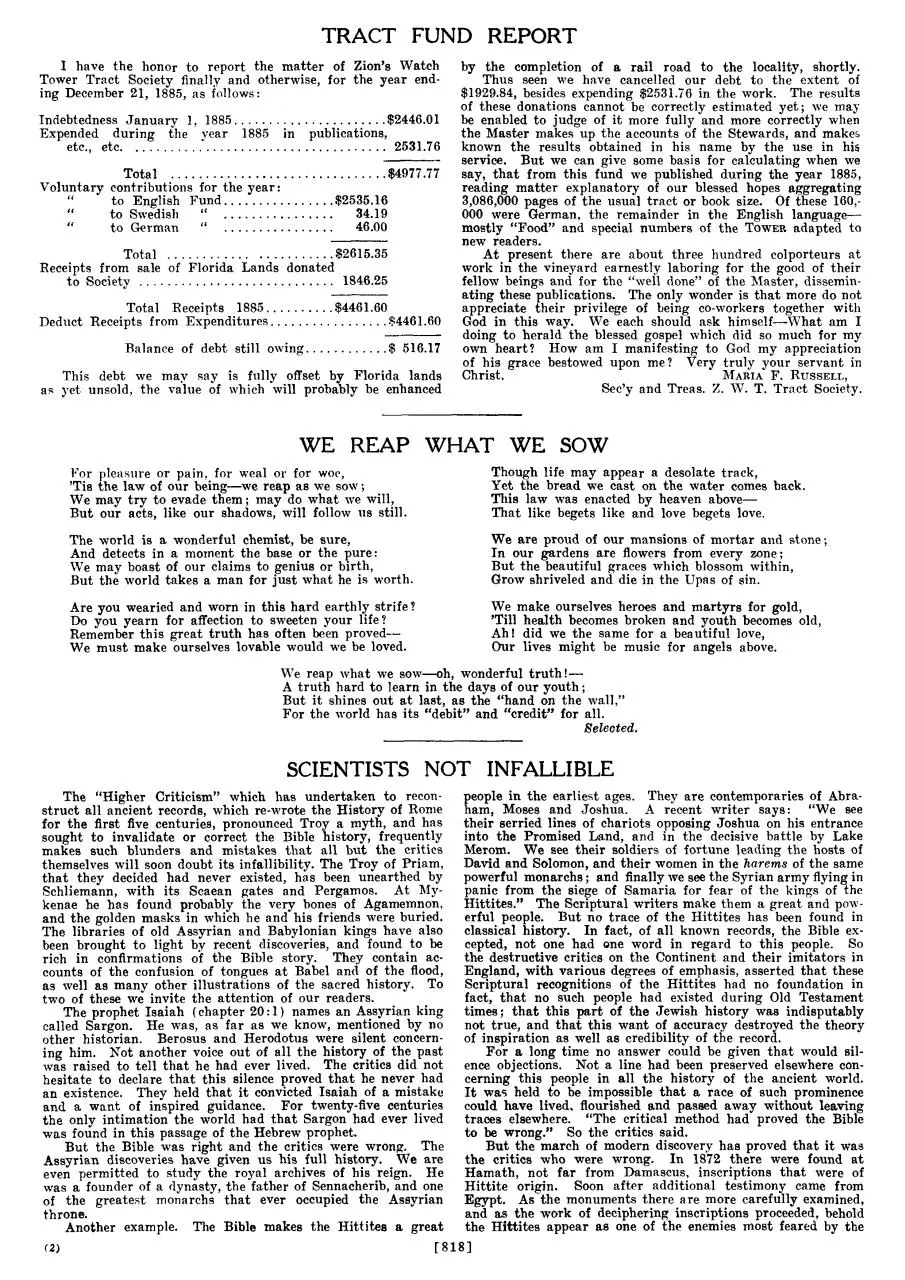
TRACT FUND REPORT
I have the honor to report the matter of Zion’s Watch
Tower Tract Society finally and otherwise, for the year end
ing December 21, 1885, as follows:
Indebtedness January 1, 1885........................................... $2446.01
Expended during the vear 1885 in publications,
etc., etc....................... ' .................................................... 2531.76
Voluntary
“
“
“
Total .............................................................. $4977.77
contributions for the year:
to English Fund....................................$2535.16
to Swedish
“
34.19
to German “
46.00
Total ............................................... $2615.35
Receipts from sale of Florida Lands donated
to Society ....................................................... 1846.25
Total Receipts 1885.................. $4461.60
Deduct Receipts from Expenditures................................. $4461.60
Balance of debt still owing.......................$ 516.17
This debt we may say is fully offset by Florida lands
as yet unsold, the value of which will probably be enhanced
by the completion of a rail road to the locality, shortly.
Thus seen we have cancelled our debt to the extent of
$1929.84, besides expending $2531.76 in the work. The results
of these donations cannot be correctly estimated yet; we may
be enabled to judge of it more fully and more correctly when
the Master makes up the accounts of the Stewards, and makes
known the results obtained in his name by the use in his
service. But we can give some basis for calculating when we
say, that from this fund we published during the year 1885,
reading matter explanatory of our blessed hopes aggregating
3,086,000 pages of the usual tract or book size. Of these 160,000 were German, the remainder in the English language—
mostly “Food” and special numbers of the T ower adapted to
new readers.
At present there are about three hundred colporteurs at
work in the vineyard earnestly laboring for the good of their
fellow beings and for the “well done” of the Master, dissemin
ating these publications. The only wonder is that more do not
appreciate their privilege of being co-workers together with
God in this way. We each should ask himself—What am I
doing to herald the blessed gospel which did so much for my
own heart? How am I manifesting to God my appreciation
of his grace bestowed upon me? Very truly your servant in
Christ.
M aria F. R u s s e l l ,
Sec’y and Treas. Z. W. T. Tract Society.
WE REAP WHAT WE SOW
For pleasure or pain, for weal or for woo,
’Tis the law of our being—we reap as we sow ;
We may try to evade them ; may do what we will,
But our acts, like our shadows, will follow us still.
Though life may appear a desolate track,
Yet the bread we cast on the water comes back.
This law was enacted by heaven above—
That like begets like and love begets love.
The world is a wonderful chemist, be sure,
And detects in a moment the base or the pure:
We may boast of our claims to genius or birth,
But the world takes a man for just what he is worth.
We are proud of our mansions of mortar and stone;
In our gardens are flowers from every zone;
But the beautiful graces which blossom within,
Grow shriveled and die in the Upas of sin.
Are you wearied and worn in this hard earthly strife?
Do you yearn for affection to sweeten your life?
Remember this great truth has often been proved—
We must make ourselves lovable would we be loved.
We make ourselves heroes and martyrs for gold,
’Till health becomes broken and youth becomes old,
Ah! did we the same for a beautiful love,
Our lives might be music for angels above.
We reap what we sow—oh, wonderful truth!—
A truth hard to learn in the days of our youth;
But it shines out at last, as the “hand on the wall,”
For the world has its “debit” and “credit” for all.
Selected.
SCIENTISTS NOT INFALLIBLE
The “Higher Criticism” which has undertaken to recon people in the earliest ages. They are contemporaries of Abra
ham, Moses and Joshua. A recent writer says: “We see
struct all ancient records, which re-wrote the History of Rome
their serried lines of chariots opposing Joshua on his entrance
for the first five centuries, pronounced Troy a myth, and has
into the Promised Land, and in the decisive battle by Lake
sought to invalidate or correct the Bible history, frequently
Merom. We see their soldiers of fortune leading the hosts of
makes such blunders and mistakes that all but the critics
David and Solomon, and their women in the harems of the same
themselves will soon doubt its infallibility. The Troy of Priam,
powerful monarchs; and finally we see the Syrian army flying in
that they decided had never existed, has been unearthed by
panic from the siege of Samaria for fear of the kings of the
Schliemann, with its Scaean gates and Pergamos. At MyHittites.” The Scriptural writers make them a great and pow
kenae he has found probably the very bones of Agamemnon,
erful people. But no trace of the Hittites has been found in
and the golden masks in which he and his friends were buried.
classical history. In fact, of all known records, the Bible ex
The libraries of old Assyrian and Babylonian kings have also
cepted, not one had one word in regard to this people. So
been brought to light by recent discoveries, and found to be
rich in confirmations of the Bible story. They contain ac the destructive critics on the Continent and their imitators in
England, with various degrees of emphasis, asserted that these
counts of the confusion of tongues at Babel and of the flood,
Scriptural recognitions of the Hittites had no foundation in
as well as many other illustrations of the sacred history. To
fact, that no such people had existed during Old Testament
two of these we invite the attention of our readers.
times; that this part of the Jewish history was indisputably
The prophet Isaiah (chapter 20:1) names an Assyrian king
not true, and that this want of accuracy destroyed the theory
called Sargon. He was, as far as we know, mentioned by no
other historian. Berosus and Herodotus were silent concern of inspiration as well as credibility of the record.
For a long time no answer could be given that would sil
ing him. Not another voice out of all the history of the past
ence objections. Not a line had been preserved elsewhere con
was raised to tell that he had ever lived. The critics did not
cerning this people in all the history of the ancient world.
hesitate to declare that this silence proved that he never had
an existence. They held that it convicted Isaiah of a mistake
It was held to be impossible that a race of such prominence
could have lived, flourished and passed away without leaving
and a want of inspired guidance. For twenty-five centuries
traces elsewhere. “The critical method had proved the Bible
the only intimation the world had that Sargon had ever lived
to be wrong.” So the critics said.
was found in this passage of the Hebrew prophet.
But the march of modern discovery has proved that it was
But the Bible was right and the critics were wrong. The
the critics who were wrong. In 1872 there were found at
Assyrian discoveries have given us his full history. We are
Hamath, not far from Damascus, inscriptions that were of
even permitted to study the royal archives of his reign. He
Hittite origin. Soon after additional testimony came from
was a founder of a dynasty, the father of Sennacherib, and one
Egypt. As the monuments there are more carefully examined,
of the greatest monarchs that ever occupied the Assyrian
and as the work of deciphering inscriptions proceeded, behold
throne.
the Hittites appear as one of the enemies most feared by the
Another example. The Bible makes the H ittites a great
[818]
( 2)
�
J anuary , 1886
Z I O N ’S
WATCH
Egyptians, as a great people, occupying a vast territory, and
as one of the chief of then existing peoples. Nor was this
a ll; the Assyrian tablets and cylinders added their testimony,
and carried the history of the Hittites back to nineteen hun
dred years before Christ, declaring that at that remote period
they were a mighty people. Their remains have been found
from the borders of Egypt to the Euphrates and northward to
Asia Minor, proving that they occupied a large part of West
ern Asia and were a mighty race.
TOWER
(3)
Thus are the critics put to shame. So will it always be.
We may sometimes have to wait for further light in order to
silence them, but in due time it will come. “We have not fol
lowed cunningly-devised fables,” but the word of eternal truth.
The storms of error may beat upon it and seem for a time to
prevail, but it will stand, for “it is founded upon a rock.”—
Evangelist.
OUR MONTHLY SPREAD
“Give us this day our daily
J a n u a r y , 1886.
1. In righteousness begin the year.
17.
2. Be strong; believe; cast out thy fear.
18.
3. Trust thou in God, He will thee save.
19.
4. Fight the good fight of faith, be brave.
20.
5. With energy pursue life’s race.
21.
6. Soon thou may’st see the Saviour’s face.
22.
7. The Morning dawns! Thy blessed Lord is here.
23.
8. As Steward, now, unto the King give an account.
24.
9. Error and sin, twin monsters, cast ye down.
25.
26.
10. To overcomers there’s a crown.
27.
11. By grace we conquor in the strife.
12. The gift of God—eternal life.
28.
13. Turn not the wand’rer from thy door—
29.
30.
14. Blessed are they who feed the poor.
15. This be thy prayer, “Thy kingdom come.”
31.
16. 0 Father, lead thy people home!
bread.”
Forgive as we forgive, O Lord.
My trust will I put in thy word.
No longer in sin’s by-ways roam.
The Spirit and the Bride say come.
The harvest passes, summer ends.
Some spurn the mercy heaven sends.
Drink deep the heavenly waters bright.
Flee from the darkness, walk in light.
Lo! “Rock of Ages cleft for thee.”
Into the sacred shelter flee!
Swift passeth moments, hours and days.
Forget not to give God due praise.
Above all things, keep thyself pure.
God’s promises are ever sure.
They’re saved who to the end endure.
—Selected.
OUR STEWARDSHIP
“So account of us, as of the servants of Christ, and stewards of the manifold mysteries of God. Moreover it is required of stewards that a man be found faithful.”— 1 Cor. 4:1, 2.
There is a sense in which all men are stewards. Every
zeal to dispose of the “goods” in their hands there would be on
good gift comes from the Creator, either directly or indi the part of the stewards. They would be earnestly seeking and
watching for good opportunities to dispose of the consecrated
rectly, and every man possessing means or talents should
“stuff.” Soon influence would lose its present high premium,
recognize them as trust loans under his temporary control.
and time, and talent, and money, in the Lord’s work would
But in a much more particular sense the consecrated, the
be more abundant.
saints, are God’s stewards, and of such Paul is here writing.
Once we were under condemnation, even as the world still
Some get the mistaken idea that a steward is not expected
is. We, through faith, are reckoned as having escaped the
to spend that committed to his care unless circumstances de
condemnation; we are cleansed; we are justified freely from
mand it of him. This is a great m istake; it is part of a stew
all things through faith in the blood of atonement. Thus
ard’s business to look up opportunities for using the “goods”
(reckonedly) made free from sin and death—and (reckonedly)
committed to his charge. This is the clear teaching of Matt.
restored to the perfect manhood and its rights, enjoyed before
25:27: “Thou oughtest therefore to have put my money to
sin and condemnation, we had something which we could offer the exchangers, and then at my coming I should have re
to God—something (reckonedly) clean and pure and accept
ceived mine own with interest.” Such diligence in seeking and
able to God, viz., our justified selves. When we gave our all
finding ways and means to dispose of our- consecrated talents
to God, it included mind, body, time, talent, money, influ
to God’s glory, and to the advancement of His truth, is es
sential to faithful stewardship, (Matt. 25:21) and any other
ence, reputation—all.
Paul informs us that all such sacrifices (previously justi
course is a violation of covenant; and he who does so, is an
“unprofitable servant” (25:29). It is thus that Paul reas
fied, i. e., reckoned clean and fit through faith in the ransom)
oned when he wrote, It is required of stewards that they be
are “acceptable to God” (1 Pet. 2 :5 ). But how does God
found faithful, and it was thus that he practiced, also. He
accept of them? We answer, By making us the stewards of
was a faithful steward indeed ever seeking new and greater op
all those talents, etc., which we consecrated to him. So then,
portunities to spend and be spent in the heavenly service.
our stewardship is a very special one. If we consecrated all to
And as always, “He that seeketh findeth.”
God, we have nothing, and should not once think of the things
consecrated as ours; they are no more ours than the posses
But says one, Can it be that God demanded this of us? Ah
sions, time, talents or money of another man are ours. When
no, dear friend, you seem not to understand the matter at all.
you consecrated all—even unto death—you became reckonedly
The sacrifices which we make are not to meet the demands of
dead, as a human being and to earthly ambitions, and reckon God’s justice; those demands were all fully met more than
edly alive, as a “new creature,” of a new, a spiritual nature,
eighteen centuries ago and there are no such demands now
against those who come unto God by way of faith in the re
so that really, considered from this standpoint, we should
think and act thus: I am now (reckonedly) a spiritual or
demption. But, God has purposed the selection of a “little
heavenly being; my riches, my home, my honor, my every
flock” to be the Bride and joint heir with Christ Jesus of
interest is now in heaven; but I am now here on earth, as
the eternal glory and tells us that He seeketh such to be con
a messenger or servant of God, entrusted with the responsi
formed to the divine image of His Son, as prove themselves
bility of disposing of the earthly things once mine, (redeemed
earnestly desirous and worthy of that honor by freely and
by Jesus, and then by me consecrated to God,) to the best
gladly surrendering their little all of earthly valuables (?)
possible advantage for the advancement of the Lord’s cause—
a sacrifice to His cause.
His children and His truth.
It is because you declared it your desire to thus sacrifice,
0 that all the consecrated may more fully realize them that he appointed you a steward of your own gifts and talents.
selves as the Lord’s Stewards, or Executors, appointed to
If now you regret the consecration, and desire to be excused
administer upon their own Wills. How it would destroy the 7,
from faithful service as the Lord’s steward, nothing is more
my, mine spirit, to realize that the I that once was is no
evident than that you are “not fit for the kingdom” honors,
more, but is dead! that “I live, yet not I,” my former self;
“No man having put his hand to the plow, and looking back,
that I is dead; but Christ liveth in m e; that I, os a member
is fit for the kingdom of God.” (Luke 9:62). Such are un
of the Christ, a spiritual creature, now live. The feeling, then,
worthy to be of the Bride and joint heir with Christ, what
should be, I want to spend, fully and promptly, yet wisely
ever else they might be fitted for. This is evident because the
as possible, the Master’s goods, time, talent, money, influence,
very test which the Lord applies, by which to select the “little
etc., put into my hands for disposal, anxious only that every
flock” proves those unfaithful and unworthy who desire to
farthing of it shall be so spent as the Master’s Word directs,
shirk the opportunities for service.
and as His example illustrated.
Peter tells us that we are stewards of the many and various
Ah, if it were thus, what an earnest offering, and what a
favors of God (1 Pet. 4:10) and should so use them as to be
[ 8 19 ]
�
(3 -6 )
Z I O N ’S
WATCH
“goods stewards.” And not only are we stewards of the con
secrated money, goods, time and talents in our hands be they
little or much; but in the text at the head of this article Paul
mentions specially, the fact that we are stewards of the mys
teries of God’s plan. In addition to our own consecrated pow
ers to use, God gives us a glad glorious message to the world
the “good tidings of great joy which shall be to all people”
ultimately, but which now is vailed from the world and is to
them mysteries or hidden secrets. To receive the “good news”
is to become a steward of it, and brings the opportunity and
the incentive also for carrying out the original stewardship.
It furnishes a reason as well as an opportunity, for wise and
diligent use of every talent under the steward’s charge.
It is required of a steward that a man be found faithful to
TOWER
P ittsb u r g h , P a.
his trust, and if unfaithful in administering upon the poor
little valuables ( ?) which we ourselves consecrated, should we
expect to have entrusted to us the greater authority and stew
ardship of the future? If we would rob God of the things we
ourselves gave him in consecration; if we are unfaithful as
stewards and appropriate to ourselves the “loss and dross,”
the gilded trinkets of the present, can we expect him who
knoweth the heart to entrust to such care the true riches of
his glory and kingdom.
Every steward should speedily look up his accounts and
see to it that however the past has been, in the future he will
be faithful. All such will hear the Master’s voice say, “Well
done! good and faithful servant; enter into the joys of thy
Lord.”
PAUL’S EARNEST DESIRE
[Reprinted in issue of December, 1879, which please see.]
THE MORNING COMETH
[Reprinted in issue of December, 1881, which please see.]
“ BLIND GUIDES”
At the M. E. Church Conference Nov. 9tli, Bishop Foster
addressing the twelve bishops and forty laymen of the Con
ference with the large audience present, among other things,
said, as reported in the daily Press:—
“There are some who too fondly anticipate a millennium.
There is a lack of information on the progress of Christianity.
The facts are misstated daily in pulpits all over the country.
Ministers hesitate to present the worst side for fear of caus
ing discouragement. They create hopes that are never to be
realized. We are not at the dawn of the millennium. Com
pared with the work to be done, the past is nothing. Our chil
dren’s children for ten generations to come must labor harder
than we are doing to accomplish the conversion of the world.
Tlie world’s population is 1,500,000,000. Of these Christians
number less than a third. Half of that third belong to the
Roman Catholic Church. The Protestants number 113,000,000.
They are divided into 500 sects. And this number of their
strength includes also all the thieves, ex-convicts, the de
based, besotted, the speckled and streaked in Christendom.
The popular idea is that the Church of Rome is anti-Christ.
I don’t agree with the popular belief. I regard that wonder
ful institution as a great Christian camp. It may have to be
reconstructed, but before us we have the great problem—
the 1,100,000,000 of pagans to convert to Christianity. That
is the solid rock that looms up in our path. Look at it; see
what work has been done in 1800 years, and how much is yet
to be accomplished. In India, after more than a hundred years
of mission work, we have 600,000 converts [ ?] and 2,000,000
Christian [ ?] among 260,000,000 heathen. Can we remove
that solid boulder that is as old as the hills? . . . It is a big
loaf to be leavened and it has been a long time working. We
have now with us the sunlight of modern thought that is
melting superstition. I am tired of the cant from our pulpits
of sacred phrases that mean nothing.”
This contains some hard truth, symbolically called “hail,”
as it is written, “The hail shall sweep away the refuge of lies.”
(Isa. 28:17.) Thus this great Doctor of Divinity is un
wittingly serving truth as are Communists, et al., in other di
rections. Few sensible, thinking people can differ with the
bishop as to the facts to which he refers, but we must take ex
ception to his inferences and unscriptural reasonings there
from.
Among the facts agreed to, one is, that few in Christian
lands have any adequate conception of the smallness of even
nominal Christianity as compared to the world as a whole,
even when the reckoning is carried to the extreme of reckoning
the entire population of the United States as “Christian,” i.
e., not barbarous, and including in this calculation all the
infidels and unbelievers and the children. If this be reduced to
ordinary limits it is an indisputable fact that not one third of
these are even professors of religion; and of the professors,
who can estimate rightly the smallness of the “little flock”
of wholly consecrated ones, but the Searcher of the thoughts
and intents of the heart ?
But while the Bishop sees this fact, it is in a very limited
measure, for he proceeds to reckon the great mass of people
living in civilization, including as he says, all the thieves, ex
convicts, the debased, and besotted, and he might have added
the Infidels and Atheists in Christendom, and lumping them
and all their evils together, the Bishop asks how long it will
take to convert the balance of the world to this same state.
We question if any but a very few would be bettered by such
a conversion. When they are all thus converted the Millen
nium will be here, the Bishop’s argument would imply. Alas!
it will indeed be a sad Millennium of war, murder, suicide,
want, oppression and misery, if we judge from the Millennium
now being enjoyed by the nations taking the highest rank
among the so-called converted nations or Christian kingdoms
(Christ-en-dom).
The Bishop’s blindness to the Scriptural teaching concern
ing the Millennium and its object, and how it will be brought
about, is another illustration of the truth of prophecy by its
fulfillment. (See Isa. 29:10-12.) He is blind and cannot see
afar off, and his argument is based wholly upon human reas
oning devoid of and opposed to Scripture. He reasons exactly
as the worldly man reasons, and neglects to seek wisdom con
cerning the future at the fountain of wisdom, God’s Word.
We wonder whether he remembers that the Scriptures state
that the worldly will be in darkness as to God’s purpose and
methods, and that the child of God has the more sure word
of prophecy, to which he does well to take heed as a light
shining in a dark place. [2 Pet. 1:19.] Does he forget that
God is working the matter in such a way that it will be a
surprise to the world, and come upon them as a snare—covert
ly, when not expected—and that they only who have the super
natural light of God’s Word shall not be in darkness, that it
should come upon them thus? for these will be guided by it
into' an understanding of “things to come,” not discernable
from the worldly standpoint. (John 16:13.)
As the Bishop looks out he sees the comparative smallness
even of nominal Christianity, and under the false idea that the
world must be converted to this Babylon condition, in which
over five hundred sects contradict each other, before Christ
comes, he is led to relax the strictness with which Christian
character should be measured, so as to include under the name
of Christ all who make any pretensions toward morality, in
order to swell the number of the five hundred sects. And be
cause the Church of Rome and the Greek Catholic Church
would help on the count and number more than all the others,
these must all be counted to the “Christian Union” in order to
swell the pride of Christendom and carry out their theory—■
that the world is being rapidly converted to Christ.
But God will laugh at their calamity, and mock when their
fear cometh—when this seemingly great structure of Babel
falls to pieces in the day of the Lord; for “the Lord knoweth
them that are his” ; and his description of that “little flock” ;
of whom he says, “They shall be mine in that day when I make
up my jewels” (Mai. 3:17), leaves no question that it is a
very different flock from the “speckled and streaked” of which
the Bishop speaks. It is to the “pure in heart” who have
“made a covenant by sacrifice,” a “little flock” that it is the
Father’s good pleasure to give the Millennial kingdom. When
this elect company is selected, and thus exalted to power with
Christ their head, they shall break in pieces the shackles and
fetters, religious and political, by which Satan, the “god of
this world,” has so long oppressed the world and humanity.
Thus he shall make “wars to cease unto the ends of the earth”
(Psa. 46:9 and Rev. 11:17, 18). Then “He shall speak peace
[ 8 20 ]
�
J anuary , 1886
Z I O N ’S
WATCH
to the heathen” (Zech. 9:10). He will turn to the people a
pure language, that they may all call upon the name of the
Lord, to serve him with one consent (Zeph. 3 :9 ). Then the
knowledge of the Lord shall fill the whole earth.
This error that the Church, in her present condition, is
to conquer and convert the world before the Lord comes, has
misled many in every stage of the Church in this Christian
age. It has been Satan’s snare by which lie has diverted the
attention and service of many away from the work given by
the Lord, viz.: to witness to the world, and to feed and build
up the Church, and prepare her as his joint-heir to accomplish
with him in the next age the subduing of all things unto him
self.
TOWER
(6 -7 )
The Bishop’s hopes for the success of his plans for the
future lie, not in Church creeds which cause a jargon, or in
the power of the truth as conveyed to us through God’s Word,
originally accepted as the sword" of the Spirit; these for eight
een hundred years have failed to accomplish the Bishop’s plans
though the Word of God has not failed to accomplish God’s
plans (Isaiah 55:8-11), but now his hope grasps a new lever
of power, which above he terms “the sunlight of modern
thought.”
In his last sentence the Bishop voices the sentiment of
the world and the devil, as well as the saints, for all are tir
ing of “the cant from our pulpits, of sacred phrases that mean
nothing.” See Isa. 29:15, 14.
JOYFUL SERVICE
If you want to know the character of a house, asks the
servants—especially the old servants. If you want to know
what sort of a condition the public services are in, sometimes
you will hear various accounts for them. But it is different
with the service of our Lord. Ask the old servants and you
will get the best account of it. There may be servants who
have tried it for a while and have become froward and willful.
Those who have been at it longest have the best things to say
about it. Ask such an one as Paul, the aged. Observe the
cheerfulness of the latest epistles of Paul. You have a good
deal about his trouble and suffering in the midtime, but when
he came to be Paul the aged, when he is writing to Timothy
and Titus, he is extremely cheerful and consolatory. He has
been long in the service. Ask the Apostle John, who began
in earliest life and lasted longest in earthly service. You will
hear how he had not found it an easy service—nobody does
who goes thoroughly through with the Lord. John had, after
the Master left, been arrested and threatened along with his
friend at Jerusalem. Afterwards he had been exiled, as we
know, to Patmos, for the Word of God. He had lost his own
brother, James, and his dearest friend, Simon Peter, by mar
tyrdom in the service of Jesus Christ. But what does he say
of it at the end ? Look at his epistle: “His commandments are
not grievous,” He came more and more to see, as all aged
Christians do see more than they saw it in youth, how
thoroughly reasonable is this service; how good, how blessed.
John heard his Master saying, and put his “Amen” to it
at the end of his service, “My yoke is easy and my burden is
light.” It may be a question having regard to the context,
whether, when our Lord says “Take my yoke upon you,” he
just meant the yoke assigned to us, or the yoke that he had
borne, and which he called us to share. Take the latter mean
ing. Just as when he says to his disciples, “My peace I give
unto you.” He intends not merely a peace that he can confer,
but the very peace that possessed his own soul in the midst of
his tribulation, and says, “That peace I give unto you. In the
world ye shall have tribulation, but in Me you will have
peace.” So in regard to those obligations of duty. He calls
those who come to him to follow him in the way, and to bear
the yoke with the courage and the burden he endured when
he was here as the Father’s elect Servant. So we are not
merely commanded, by the thought that God has a right to
give his orders, and we cannot take a higher place than to be
his servant, but we have, as has been again and again pointed
out, to follow the Master, who himself has served, and knows
all the difficulties of the service.
It gives a master great power over his workmen when they
know quite well that he is not a mere amateur in the thing
itself; not merely master because he has money enough to em
ploy them, but is a master who has done the work himself, and
knows it better than they do; has done it well, has done it
thoroughly, and joins them in the work, and says, “Come and
work with m e; what you do not know how to do. I will show
you.” It is such a Master whom we serve.—Donald Fraser.
LOOK WE FOR ANOTHER?
“Art thou he that should come, or look we for another?”—Luke 7:19.
Almost 1900 years ago the Jewish Church was left desolate.
the Messiah, because, perhaps, they looked for hint to come
Matt. 23:38. Before that time they were God’s people as dis in a manner different from that foretold in the Scriptures
concerning him.
tinguished from all other peoples or nations; for “unto them
were committed the oracles of God.”
He came to his own and they received him not. His own
They were the “believers” of that age or day. They be
people then, were Israel after the fiesh, the nominal house
lieved in the true God, in the Scriptures, and, of course, in the
hold of faith; and now he comes to their antitype, the nominal
coming of the promised Messiah. As a nation they were God’s
Christian Church or household of faith. But now as then
nominal people, or “household of faith,” yet among them were
they receive him not. They say, He has not come, “All things
only a few “Israelites indeed.” (“For they are not all Israel
continue as they were.” etc. Only a few of the Jewish “house
which are of Israel; neither because they are the seed of Abra hold” received him at his first coming, and only a few re
ham, are they all children,” etc., Rom. 9:6, 7.)
ceive him now. They receive him because of the evidence,
When Jesus came, only a few became his disciples. Only
evidence, too, of the same character as that given to John—
a few discovered that the events of his birth, life, death, and
transpiring events; the fulfillment of the signs of his pres
resurrection were a fulfillment of their own Scriptures. John
ence bearing witness to the fact.
the Baptist preached his coming, and afterwards received and
Such as desire his appearing, and know the object of his
baptized him, and no doubt saw the Spirit descending upon
coming, are not only rejoicing in, but heralding his presence,
him, and heard the voice from heaven saying: “Thou art my
and preaching that the harvest is come, the fields ripe, and the
beloved Son in whom I am well pleased,” yet when in prison
separating work_begun; that the Gospel day or age is ending,
John heard of the works of Christ, he sent by his disciples and
and the Millennial day is dawning. “To-day, if ye will hear
said unto him, Art thou he that should come, or are we to
h is voice , harden not your hearts.” Let not prejudice hindei
look for another? Jesus answering, said, “Go and shew John
you.
again those things which ye do hear and see; how that the
“Behold he stands at the door and knocks, if you will hear
blind see, the lame walk, the lepers are cleansed, the deaf
his voice he will come in to you, and will sup with you and
hear, the dead are raised, to the poor the gospel is preached,
you with him.”
and blessed is he, whosoever shall not be offended in me.”
Blessed are they who do not stumble over him, for they
Thus Jesus called attention to transpiring events, the ful
shall be made rulers over all his goods. We cannot force oth
fillment of their own Scriptures, as proof that he was the Mes
ers to receive him, neither could John the Baptist, but we
siah. He might have replied: “I am he.” An imposter might
can bear witness to the truth as the Scriptures reveal it to
have made the same claim, and given the same answer; but
us. and “He that is able to receive it. let him receive it.”
mark, the answer Jesus gave called their attention to evidence
“Who hath ears to hear let him hear.” Think of the class who
such as would convince them of the truth of his claim, pro
rejected Jesus at his first coming. They were members “in
vided they had been sufficiently interested in the Scriptures
good and regular standing” in the Jewish Church; they rev
to make them capable of apprehending them, and of discern
erenced the Scriptures as a whole but neglected to search them
ing the unfolding of truth then due, i. e., the fulfilling of
in particular, giving more earnest heed to the traditions of
prophecy, etc.
the elders which made void the Word of God. They were
Notice also the significance of the last part of the answer,
looking for a Messiah to come, yet not according to the" Scrip
“Blessed is he.” etc. Many, many were they who were of
tures which declared the manner and object of his coming.
fended (made to stumble) in him, believing not that he was
Therefore they failed to recognize him when present. And
[ 82 1]
�
(7-8)
Z I O N ’S
WATCH
just so their antitype, the nominal Christian Church is to-day
stumbling, and falling to discern him at his second advent;
and for the same reason. But even this is in fulfillment of
the prophecy; for it is written, “He shall be for a stone of
stumbling and for a rock of offence to both the houses of
Israel.” (Isa. 8:14.) Let us take heed, and neither be found
“asleep” nor “drunken” with false doctrines and traditions,
nor so “overcharged with the cares of life,” as not to discern
the signs of his presence.
If any man shall say unto you, Lo, here is Christ, or there;
believe it not: or behold he is in the desert; go ye not forth:
or behold he is in the secret chamber, believe it n ot; for Christ
is a spiritual being and the eye of flesh can no more see
him than it can see Satan, the god or ruler of this present evil
world, the end of which is so near, “even at the doors.”
Brethren, Jesus has come, and found the “household of
TOWER
P ittsb u r g h , P a.
faith,” the Church nominal, as a body, lukewarm, indiffer
ent and proud of their riches and increase in goods, but he
knows their works, and says, “I will spue thee out of my
mouth.” (Rev. 3:15-19.) As a nominal system it shall no
longer be God’s mouthpiece to expound his word. He is choos
ing out from her his fit vessels. Because she is wretched and
miserable and poor and blind and naked, he counsels her, “Buy
of me gold tried in the fire, that thou mayest be rich; and
white raiment that thou mayest be clothed, and that the shame
of thy nakedness do not appear; and anoint thine eyes with
eye-salve that thou mayest see,” and “He that hath an ear, let
him hear what the Spirit saith unto the churches.”
Who hath ears to hear, should hear the counsel, and also
heed the command now due, “Come out of her, my people, that
ye be not partakers of her sins, and that ye receive not of her
plagues.”
W m . C. M ac M il l a n .
THE BASIS OF HOPE
“Ye shall not surely die.” Gen. 3:4.
Under the mask of friendship, and as a bearer of good
was held out through the law for man to seek for or to avoid,
news, Satan, filled with jealousy at sight of the newly created
but life itself that renders any condition possible, is the
beings, struck the blow for their destruction.
He meant the
promise everywhere held out by the law, or spoken of by the
murder of the race [John 8:44,] and he was sucessful. While
prophets. [Gen. 2:7.
Deut. 30. Mai. 2:5 and all between.]
all who accept the Scriptures admit the authorship of the
So deeply fixed in the human mind has this monologue of
cunning lie, comparatively few are ready to believe that it
Satan become, that the true meaning of death is almost be
is the only text in all the inspired writings that intimates that
yond the grasp of the intellect of many.
And the theories
man is immortal, or that when dead he is at all different
and conjectures upon the condition in death, [which they call
from the lower orders of the animal creation.
They every after death,] are as numerous and different as the nations
where recognize just what scientific research reveals, i. e.
of earth and their difference of knowledge upon other sub
jects.
Having no data for conclusions, and with no evi
that life is not a created element at all, but a principle or
force from some incorruptable and immortal fountain, trans dences from the grave, it is not strange that no two classes
mitted into different organisms. That it is the same prin have arrived at the same understanding of the matter. Hence
we have theories innumerable from the simple “Happy hunt
ciple in all, the difference of its manifestations consisting in
the endless variety of organism, and not in the principle itself.
ing grounds” of the Red man, to the complete and listless
swallowing up of the being in “bliss ineffable in the bosom
[See “Food for Thinking Christians,” page 134—Eccl. 3:18of the Creator,” of the Buddhist and, from the refining pro
20; 1 Tim. 6:16.]
cesses of symbolic fires of advanced theorists, to the more
All life is the same whether in fish, fowl, beast, man or
monstrous but equally absurd doctrine of writliings in torture,
angel, and can be withdrawn by Him in whom all “live and
or shrinking aghast in mental horrors of the heathen and
have their being.”
[Psalm 36:9.]
dark ages and, [with shame we add,] of our own day; all
God subjected the creation to frailty in hope, [Rom. 8:20],
traducing the character of God-and dishonoring to Christ.
and mankind in endeavoring to find a basis of hope for the
The condition of death is the antithesis of life, it can
future, believed it lay in an inherent immortality; that death
only be defined in negatives or in figurative expressions.
It
is not really death, but a condition of some kind through
is not a road to Paradise nor a passage-way through which
which he passes into another sphere of existence.
And
a being is evolved into something else.
If so, it would be
upon this idea are built all the theories and philosophies of
a blessing [1 Cor. 15:26], and Satan would have been telling
a future state, that man has conceived.
the truth in intimating that a spark remained that could
God’s dealings with the Jew and with the world were
not die.
not of a kind to enlighten mankind upon the real hope if he
It is figuratively called “a land” in Scriptures, but it is
chose Satan’s lie. He manifested no love toward his crea
the “enemy’s land,” a “land of darkness” and “obscurity”
ture, but was a “jealous God, visiting the iniquities of the
The “land of forgetfulness,” “Where
fathers upon the children unto the third and fourth gener without “any order.”
no man is,” etc.
It is also named “Sheol” and “Hades,”
ation of them that hate him.” [Exod. 20:5.] And he was
“hell” etc.
It is the place to which all alike go from the
so dreadful that man could not but excessively fear him.
sinner of three-score and ten, to the little one of two years
“Every transgression received a just recompense of reward.”
old and under. All cease to be, and “are not.” [Matt. 2:17,
No love was shown, and mercy was only granted that the
18; Jer. 31; 15, 16; Ezek. 3; 20; Psa. 88:12; Job 14:2.]
whole Jewish race be not destroyed. [2 Sam. 24:16.]
We used to wonder why Lazarus and others were silent
There was no manifestation of love from God through all
upon their experience in hades, but now we know that they
the long ages of man’s experience with Justice.
The first
public choir that sang of “Peace and Good Will to Man” point had nothing to tell, that “the dead know not anything.”
ed to the infant in the manger, the real basis of hope for
The hope for the world lies in a resurrection from the dead,
and not in any “ray of divinity” inherent in man.
This
the world; not affirming that man does not die, but that an
hope has always been deemed a heresy, even by the sys
“off-spring” from the dying stem has been vitalized from the
tems that “allow” a resurrection [Acts 24:14, 15; 26:7, 8.]
fountain of life and will become the “root” and life giver
while denying it virtually.
And the basis of this hope
to the dying race.
See articles “David’s Son and Lord,” Dec.
is Jesus only, who is “The resurrection and the life” [John
1885 Tower, and “Except a Corn of Wheat Die,” Feb., 1885.
11:25]—a more than representative man; to him has been
Here then is the hope for the world of mankind; and on
that central fact the doctrine of Jesus, from the “pure milk” given to have “life in himself” and apart from him all at
death perish. [1 Cor. 15.] He only hath the keys of
to the “strong meat,” must be built, as the only true hope for
hades and can re-create from nothing the beings that before
the future destiny of man.
existed and give them back the boon he purchased for and
He who rids himself of these doctrines, who leaves this
will again present to every son and daughter of Adam; and
central fact at any point, at once wanders off into darkness,
and must build again to some extent on the lie that mur as they hear his voice and appreciate the gift he will restore
to them all that was lost by the “fall.”
[Acts 3:21.]
dered the race.
[Jno. 8:44.]
“What think ye of Christ? is the test,
We regret to say that not a few are thus, wandering, and
To try both your state and your scheme:
multiplying theories are to-day advanced which practically
ignore the doctrine of Christ, and while they are less repug
You cannot be right in the rest,
Unless you think rightly of him.”
nant than the heathenish idea of eternal torment, they are
II. L. G il l is .
no less obnoxious to the fires that will burn up his enemies
round about.
T h e P assover anniversary occurs this year in April and
The value of a gift lies in the appreciation of it, and life is
will be announced particularly in our next issue. We hope
a gift that will not be forced upon any.
It is the synonym
that all who can possibly spare the time and money, will
of existence, the principle that man lost, and without which
arrange matters so as to commemorate with us here. We hope
there can be no sensation of either pain or pleasure.
It is
to have a very general meeting. Let all the preaching breth
the one essence that man found it impossible to retain.
It
is not heaven, or hell, or any other place, or condition, that
ren make an extra effort to be present with us.
[ 8 22 ]
�
QUESTION COLUMN
which we enter at our birth, is simply the process which cul
Quea.
Matt. 19:21.
Why did Jesus tell the young man
minates in the full penalty—death—cessation of life—extinc
to “keep the commandments” in order to “enter into life”
tion of being—non-existence. If death is the penalty, then
instead of making faith a ground of salvation? and how does
this harmonize with Rom. 3:20? In verse 20 he replies that
when will the penalty end?
There is no inherent power in
he has kept all these; but still he lacked, and Jesus says
us which can ever deliver us from non-existence—death. The
only way which the Scriptures disclose for man’s restoration
[v. 20]: “If thou w ilt be perfect, go and sell that thou hast
to existence is by the payment of his ransom, an equivalent
and give to the poor, and thou shalt have treasure in heaven:
price, a substitute.
And this ransom was found in the
and come follow me.”
What is implied in the word perfect
more than what is covered by the commandment, and what
Son of God who became a man—was “made flesh” [transform
was the treasure he should have in heaven aside from
ed from the spiritual to the human nature] in order that he
might give himself a ransom for all.
eternal life?
A.
In his answer to the young man, Jesus declares
That which Jesus laid down for our redemption was his
just what Moses had declared [Lev. 18:5], that under
being or existence in the condition he then possessed it—i. e.
God’s covenant with them, keeping the Law would insure eter
life or existence as a human being.
We must not consider
nal life to any Jew; but from the days of Moses to Christ
life (vitality) in the abstract without regard to nature the
not one had merited life by keeping the law. Hence death
thing referred to, which he had power and commandment both
still reigned even as it had reigned from Adam to Mose3,
to lay down and to take again.
But in the sense of being
though many prophets and faithful men of the past had tried,
or personality, the human Jesus gave himself his life , his
in all sincerity, to keep the commandments.
Hence every
being, a ransom for all.
And likewise he received life, be
Jew should by this time have been convinced that none were
ing, or personality, in his resurrection; but it was a new be
able to keep the law, because of their imperfect, degenerate
ing that arose of a new nature.
Jesus arose a spiritual and
condition. God’s perfect law is the full measure of a perfect
no longer a human being; existence “it” was recovered, but
man’s ability. Had Israel acknowledged this, the law would
not under human conditions, not human existence, for he never
have answered its purpose to them, for God knew beforehand
did and never will take back our ransom price, thank God.
that they could not keep it, and never expected them to. It
It remains the equivalent price of our condemned race; and
was simply given to them to prove their shortcomings and their
because it was laid down forever, we may live forever.
It
inability to measure up to its requirements, and hence should
is life in the abstract sense that the pronoun “i t ” refers to
have prepared them to accept deliverance through Christ.
in the text mentioned.
This young man had not learned this lesson, and therefore
“If there had been a law given which could have given
Jesus bade him go on trying to keep the law.
But a little
life, verily righteousness should have been by the law,” and
doubtful lest he might not be any more successful in winning
not by a sacrifice.
But commanding a man could never
life than had his forefathers, the patriarchs and prophets, al make an imperfect man capable of meeting the requirements
though he thought he kept the law perfectly, he inquired,
of justice; and even if able to do so fully, there were penal
“What lack I yet?” Jesus’ answer is designed to convince
ties against each of us through and because of Adam’s sins
him that he had not kept the law perfectly—that he did not
which must be met, paid, settled by some one, and for each
love God with all his heart, nor his neighbor as himself. He
to meet them for himself, would be death—extinction. Hence
proved to him that he loved himself and his possessions more
the need of first a ransom, and secondly a life-giver; both
than either.
And the young man evidently understood it, for
of which needs are supplied to us by God in Christ Jesus
he went away sorrowful, evidently convinced that he yet fell
our Lord.
A thousand or a million years in death would
short of the requirement of the law.
To keep the law per
not pay man’s penalty, as there is no limitation of time either
fectly in this age requires sacrifice. Who can love his neigh
mentioned or implied, in the terms of the prescribed penalty
bor as himself and see that neighbor suffer while he has enough
nor in any scriptural reference to it; there is no escape except
and to spare ? All mankind are suffering under the weight of sin,
through the ransom provided.
ignorance and misery, and whensoever we will we may do
The human existence of Jesus, our ransom, our substi
them good.
Natural benevolence sometimes plans and ar tute, was surrendered to everlasting death; but thank God
ranges for the comfort and blessing of fellow-creatures, but
be lives as a divine being to claim and restore to its perfec
the Body of Christ, all in whom the Spirit of the Master rules,
tion that purchased by his human life—mankind.
will be ready and anxious to follow His example of doing
good to the extent of self-sacrifice in order to do good to
P rince Bismarck recently honored by the Pope with an
their fellows.
In giving they will, above all else, seek to
autograph letter and a medal of the Order of Jesus set in
bestow spiritual food and clothing to the hungry and naked.
diamonds, is the first “Protestant” ever so honored by the
To keep the law in the next age, while it will still re
Church of Rome.
Does this indicate that the “infallible
quire a measure of restraint and self-denial until perfection
church,” whose doctrines she claims are “unchangeable,” has
is reached, yet will not require sacrifice of things lawful, even
changed?
or that Protestants have changed?
That Pro
unto death, because of the changed condition of mankind and
testants no longer protest has been shown in these columns
his surroundings.
recently by reference to the course and language of represen
Had the young man sold all and followed Jesus, he would
have obtained more than the law promised.
The law prom tative Baptists, Methodists and Presbyterians.
Is your work a task? If so, why? Is it because—of
ised life everlasting, human existence—restitution, a treasure
your own self-will and against God’s ordering—you have chosen
on earth; but the treasure in heaven to which Jesus referred
some labor of which he does not approve? Is your trade
is a change of nature from human to spiritual, and not only
or your profession a dishonest one? Does what brings profit
so, but to the highest order of spiritual being, the divine
to you bring evil to others or dishonor on the cause of God?
nature, as explained by Peter. 12 Pet. 1:4.]
Then the quicker you abandon that work the better. However
The treasure in heaven is reserved for all those who, like
profitable it may seem to you, however much it coincides with
Jesus, keep the law in this age, when its requirements amount
your own most intense desires, it can never be otherwise than
to and imply a sacrifice even unto death.
And only those
a task. You will never find your calling, until you listen to
do keep the law who, being justified by faith in the precious
the voice of God; you will never find freedom save in obedi
blood of Christ, henceforth walk not after the flesh, but after
the spirit.
Such are reckoned of God as perfect, and as hav ence to the law of God.
ing kept the commandments; and are thus joint-sacrifices
But if your work is a task simply because your answer
and joint-heirs with Jesus Christ their Lord.
to God’s cause has been half hearted, or because you think
you could have chosen your work more wisely had the choice
This is in harmony with Rom. 3:20. By the actual deeds
been left to you, the remedy is easy. Give the whole heart
or doing of the law shall no flesh be justified, but by faith in
to God’s service; cast out the rebellious thought—it is a
Christ we are reckoned as perfect and our sacrifice therefore
delusion born only of your discontent and brooding. The
acceptable.
The right
...
 Historical archive . public document