SHOPSKA SALAD
A Type Of Bulgarian Salad
Shopska salad (Shopska salata) is the salad that defines Bulgaria. Not only is it the most popular
Bulgarian salad but is also named after a big group of very frugal people called shopi who live in
the capital of Bulgaria, Sofia. Shopska salad is made from chopped tomatoes, cucumbers, onions
and peppers sprinkled with Bulgarian white cheese. Eat it with a chilled double rakia on the
rocks.
Ingredients
4 ripe tomatoes
2 long cucumbers
1 onion
1 red or green pepper
1/3 bunch of parsley
2 tablespoons (olive) oil
3 tablespoons of red wine
vinegar
1 cup (1/2 lb) Bulgarian cheese
(or feta cheese)
Preparation
Chop all tomatoes (we
recommend leaving the pieces
bigger), cucumbers and the
pepper and put in a bowl. Add
the finely chopped onions and
parsley. Sprinkle with the oil
and vinegar and mix it all
together. Grate the feta on
top.
�
CHUSHKA BYUREK (CHEESE STUFFED PEPPERS)
A Type Of Bulgarian Appetizer
Ingredients
6 medium green or red peppers
2 eggs
1/2 cup flour (or breadcrumbs)
1/3 lbs feta cheese, crumbled
1/4 cup oil
1 tomato, chopped
Preparation
Bake, peel and seed the peppers.
Beat one egg into a homogenous
mixture. Mix the cheese with the
other egg, add the tomato and
parsley and mix well. Stuff each
pepper with the mixture. Dip it in
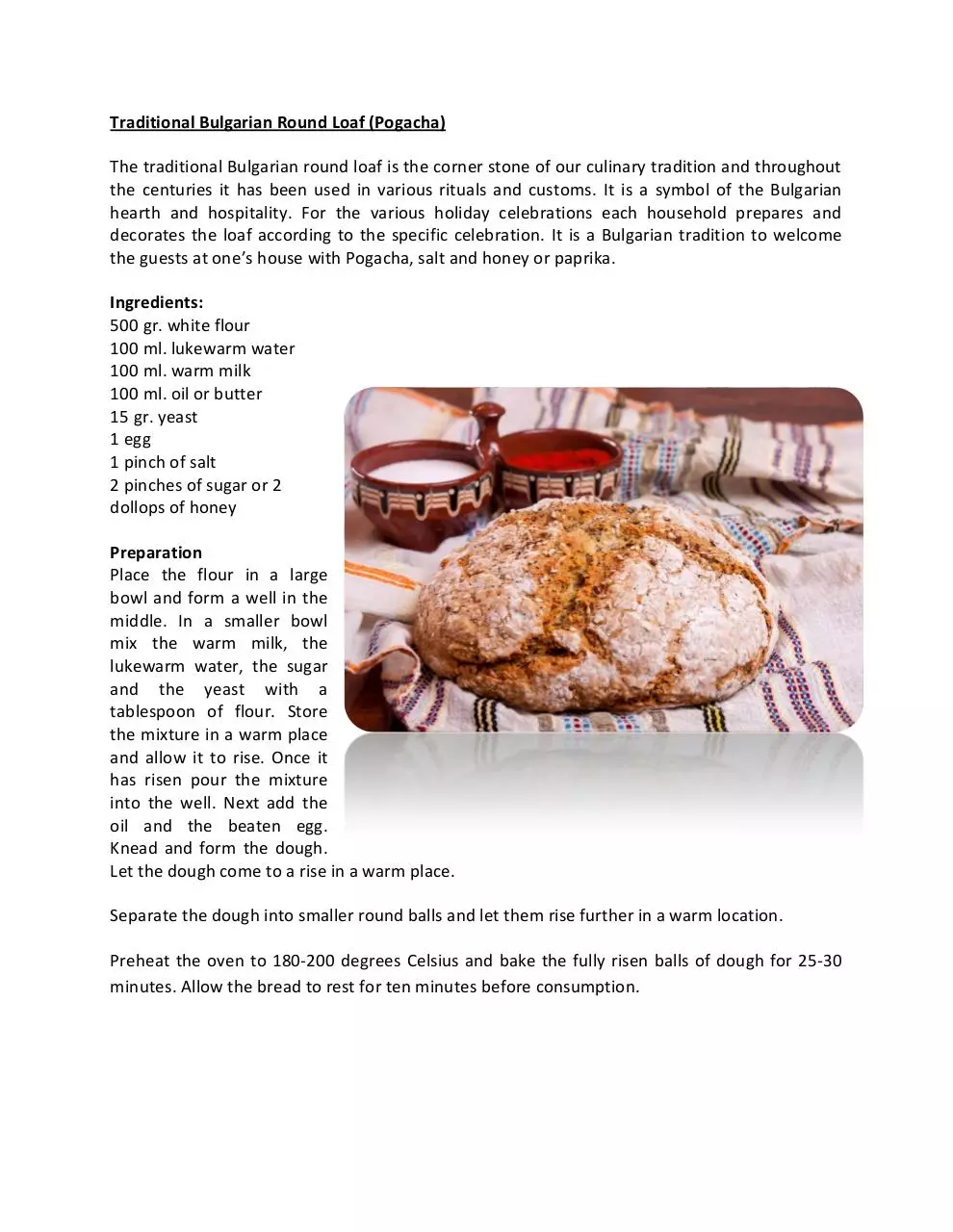
the egg then roll it in flour or breadcrumbs and fry in the oil for about 2 minutes on each side,
turning only once.
BANITZA
A Type Of Bulgarian Dessert
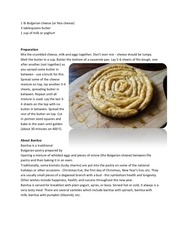
This traditional Bulgarian pastry is first prepared by
stacking up layers of filo pastry dough, mixture of
whisked eggs, and pieces of Bulgarian cheese and
then baked until it gets a golden crust. Eat this
with a glass of ayran or boza.
Ingredients
1 pack of filo dough
3 eggs
�
1 lb Bulgarian cheese (or feta cheese)
3 tablespoons butter
1 cup of milk or yoghurt
Preparation
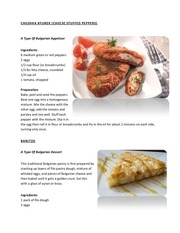
Mix the crumbled cheese, milk and eggs together. Don't over mix - cheese should be lumpy.
Melt the butter in a cup. Butter the bottom of a casserole pan. Lay 5-6 sheets of filo dough, one
after another (not together) as
you spread some butter in
between - use a brush for this.
Spread some of the cheese
mixture on top, lay another 3-4
sheets, spreading butter in
between. Repeat until all
mixture is used. Lay the last 34 sheets on the top with no
butter in between. Spread the
rest of the butter on top. Cut
in portion sized squares and
bake in the oven until golden
(about 30 minutes on 400 F).
About Banitza
Banitsa is a traditional
Bulgarian pastry prepared by
layering a mixture of whisked eggs and pieces of sirene (the Bulgarian cheese) between filo
pastry and then baking it in an oven.
Traditionally, some kismets (lucky charms) are put into the pastry on some of the national
holidays or other occasions - Christmas Eve, the first day of Christmas, New Year's Eve, etc. They
are usually small pieces of a dogwood branch with a bud - this symbolizes health and longevity.
Other wishes include happiness, health, and success throughout the new year.
Banitsa is served for breakfast with plain yogurt, ayran, or boza. Served hot or cold, it always is a
very tasty meal. There are several varieties which include banitsa with spinach, banitsa with
milk, banitsa with pumpkin (tikvenik), etc.
�
Traditional Bulgarian Round Loaf (Pogacha)
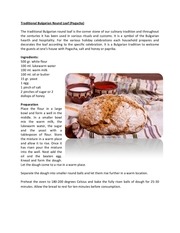
The traditional Bulgarian round loaf is the corner stone of our culinary tradition and throughout
the centuries it has been used in various rituals and customs. It is a symbol of the Bulgarian
hearth and hospitality. For the various holiday celebrations each household prepares and
decorates the loaf according to the specific celebration. It is a Bulgarian tradition to welcome
the guests at one’s house with Pogacha, salt and honey or paprika.
Ingredients:
500 gr. white flour
100 ml. lukewarm water
100 ml. warm milk
100 ml. oil or butter
15 gr. yeast
1 egg
1 pinch of salt
2 pinches of sugar or 2
dollops of honey
Preparation
Place the flour in a large
bowl and form a well in the
middle. In a smaller bowl
mix the warm milk, the
lukewarm water, the sugar
and the yeast with a
tablespoon of flour. Store
the mixture in a warm place
and allow it to rise. Once it
has risen pour the mixture
into the well. Next add the
oil and the beaten egg.
Knead and form the dough.
Let the dough come to a rise in a warm place.
Separate the dough into smaller round balls and let them rise further in a warm location.
Preheat the oven to 180-200 degrees Celsius and bake the fully risen balls of dough for 25-30
minutes. Allow the bread to rest for ten minutes before consumption.
�
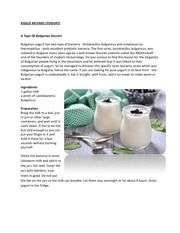
KISELO MLYAKO (YOGURT)
A Type Of Bulgarian Dessert
Bulgarian yogurt has two type of bacteria - lactobacillus bulgaricus and streptococcus
thermophilus - both excellent probiotic bacteria. The first stran, lactobacillus bulgaricus, was
isolated in Bulgaria many years ago by a well-known Russian scientist called Ilya Metchnikoff one of the founders of modern immunology. He was curious to find the reason for the longevity
of Bulgarian people living in the mountains and he believed that it was linked to their
consumption of yogurt. So he managed to discover this specific lactic bacteria strain which was
indigenous to Bulgaria, hence the name. If you are looking for pure yogurt in its best form - the
Bulgarian yogurt is undoubtedly it. Eat it straight, with fruits, add it on meals or make ayran or
tarator.
Ingredients
1 gallon milk
a pinch of Lactobacteria
Bulgaricus
Preparation
Bring the milk to a boil, put
in jars or other large
containers, and wait until it
cools down. It has to be hot
but cold enough so you can
put your finger in it and
hold it there for a few
seconds without burning
yourself.
Dilute the bacteria in some
lukewarm milk and add it to
the jars. Stir well. Cover the
jars with blankets, tuck
them in good. Do not put
the lids on the jars so the milk can breathe. Let them stay overnight or for about 8 hours. Store
yogurt in the fridge.
�
About kiselo mlyako
Kiselo mlyako (kiselo mliako) is the Bulgarian yogurt (Bulgarian yoghurt). Kiselo mlyako is one of
the things that make Bulgarians proud to call themselves Bulgarians; it is their exclusive
invention and heritage that dates back many centuries. A mildly sour-tasting yogurt, kiselo
mlyako is undoubtedly the best and the healthiest
of all dairy products that are available to
consumers nowadays.
The western world calls it Bulgarian yogurt but in
its homeland, Bulgaria, it’s called sour milk.
Whatever the name, this wonderful probiotic food
has impeccable ancestry - it is believed to have
been known for at least 4000 years.
The Bulgarian yogurt comes under the general
category of yogurts which contain live bacteria. For
yogurt to be considered of the Bulgarian variety, it
needs to be made with two specific starter bacteria, Lactobacillus delbrueckii subspecies
bulgaricus (often simply called Lactobacillus bulgaricus) and Streptococcus salivarius subspecies
thermophilus (often shortened to Streptococcus thermophilus). Most yogurts contain these two
as they are such excellent starters but most "ordinary" yogurt has other good bacteria added as
well.
RAKIA
The Bulgarian national drink
Rakia is as rooted in Bulgarian history and existence as is
bourbon in American. It has aided the nation in surviving its
hardest years and has helped bring many bright ideas to live.
In case you haven't tried it yet, rakia is hard liquor from the
brandy family. It is made from fermented grapes, plums, or
virtually any fruit with sugars in it. Its alcohol content varies
from 40% for the commercially sold liquor to 70-80% of pure
firewater for the home-produced rakia. Drink it ice cold,
preferably straight up (no rocks), and have a Shopska salad,
lukanka or at least a few pickles standing by (meze).
�
 Historical archive . public document