COMPARATIVE ANALYSIS OF GENDER ON TWITTER IN RELATION TO
UK POLITICS JOURNALISTS
OCTOBER 2017
�
COMPARATIVE ANALYSIS OF GENDER ON TWITTER IN RELATION TO
UK POLITICS JOURNALISTS
Contents
Section
Page
Summary
1–8
Background
9 – 11
Work carried out
12 – 13
UK Politics journalists demographics on Twitter
14 – 15
Potential gender bias in follower activity
16 – 21
Potential gender bias in retweet activity
22 – 28
Implications – glass ceiling effect
29 – 31
Implicatons – comparison to PoliticsUKTD GE2017 analysis
32 – 33
Conclusion
34 – 35
Potential actions and areas for further investigation
36 – 37
Appendix 1 – regression results
38 – 43
Appendix 2 – PoliticsUKTD GE2017 analysis blog post
44 – 53
Acknowledgements
54
�
COMPARATIVE ANALYSIS OF GENDER ON TWITTER IN RELATION TO
UK POLITICS JOURNALISTS
Summary
Background
PoliticsUKTD GE2017 Analysis
In late June 2017 Lissted produced an analysis of influential Twitter users in relation to the UK
General Election 2017 (Appendix 2). The analysis was based on tweets featured on the
@PoliticsUKTD (Politics UK Distilled) Twitter account. This account is powered by Lissted’s
Tweetsdistilled system which estimates and ranks the apparent influence of tweets and then
retweets those it ranks the highest.
The PoliticsUKTD study was based on over 3 million tweets by influential Twitter users between 18th
April 2017 and 7th June 2017. These tweets included retweets and replies to over 200,000 other
accounts.
The Tweetsdistilled application tracked every tweet in real time, using its proprietary algorithm to
seek out the ones that looked to have the most potential for influence.
Out of these 3 million tweets over 27,000 were rated of high significance. Based on an analysis of
key terms used over 14,000 tweets from 2,756 different Twitter accounts were assessed as directly
or indirectly related to the General Election campaign. Between them these tweets were retweeted
or liked over 21.2 million times. These 14,000+ high rated tweets were summarised into three Top
100 lists.
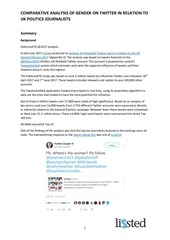
All-Male Journalist Top 10
One of the findings of the analysis was that the top ten journalists featured in the rankings were all
male. The overwhelming response to the tweet stating this was one of surprise.
1
�
COMPARATIVE ANALYSIS OF GENDER ON TWITTER IN RELATION TO
UK POLITICS JOURNALISTS
Summary (continued)
Background (continued)
All-male Journalist Top 10 (continued)
As is often the case, the resulting Twitterstorm didn’t involve a great deal of discussion about the
underlying analysis. In fact evidence from the response suggests people mistakenly thought the list
had been curated, when in fact it was based on objective engagement criteria.
In response we tweeted an explanation of the basis of the findings and suggested some possible
underlying causes.
Some observers did engage with the work, including researcher Laura Jones who highlighted a study
on gender bias on Twitter and wrote this post Authority, Influence and the Twitter Glass Ceiling,
which we strongly recommend reading.
The analysis carried out looks at the issues raised by Laura’s post and the suggestions we made
about potential sources of bias.
Data and work performed
The analysis was based on the tweets and retweets of 829 UK journalists (518 male, 311 female)
between 18th April 2017 – 7th June 2017 – the same period as the previous PoliticsUKTD GE2017
analysis.
Journalist populations: 518 male journalists and 311 female journalists identified based on a
combination of appearance in the GE2017 analysis; crowdsourced suggestions and Lissted’s
database of 4 million influencers.
Tweets identified: 62,192 tweets by the journalists selected for the analysis based on having been
retweeted at least once by one of the tens of thousands of influencers tracked by Lissted. These
tweets were retweeted 198,798 times by 10,774 influencers and retweeted or liked over 17 million
times by Twitter users as a whole.
NB: Influencer retweets and Retweets and Likes across Twitter as a whole were the main focus of
the research as engagement of this nature amplifies the voice and message of the individual
concerned. Replies to a tweet and quote tweets, may also do this, but can equally be variable in the
extent to which they promote the user concerned.
Gender classification: influencer gender identified based on a combination of name and/or manual
verification.
Analysis of the follower relationships of a sample of these influencers in connection with the
journalists.
Key findings
Male UK politics journalists received 4.3x more retweets from influencers than female journalists.
They received 4.9x more retweets and likes combined across Twitter as a whole.
2
�
COMPARATIVE ANALYSIS OF GENDER ON TWITTER IN RELATION TO
UK POLITICS JOURNALISTS
Summary (continued)
Key findings (continued)
Implying male UK politics journalists voices were considerably more likely to be heard than female
journalists.
The analysis identified five of the factors that contributed to this disparity:
-
demographics;
following behaviour of influencers;
retweeting behaviour of influencers;
opinions in tweets; and
frequency of tweeting.
Demographics
Summary: Male UK politics journalists on Twitter outnumber female. Around 5 male journalists for
every 3 female journalists. On average they have more followers and tweet more often.
The gender imbalance towards male representation in the wider UK political community is an added
factor due to male influencers having an even greater propensity to favour following and retweeting
male journalists than female influencers do.
Demographics would appear to be one of the most significant area of inherent disadvantage for
female UK politics journalists on Twitter. We found less of them with the minimum criteria we set of
1,000 followers (ratio 1.67 male to female). The accounts included in the analysis had less followers
on average (ratio 1.18 male to female, based on median followers) and tweet less often (ratio 1.23
male to female based on status updates and profile age).
Third party feedback and additional research after this analysis was carried out highlighted some
gaps in the populations totalling 104 more journalists. If these journalists had been included the
relative male to female ratio would have fallen to 1.54x from 1.67x. However this feedback was
mostly focussed on identifying additional female journalists therefore the 1.67x factor has been
maintained within the analysis. Analysis was also carried out on these 104 additional journalists
which established that their inclusion in the full analysis would not have materially impacted the
reports key findings.
The demographics of the UK political community as a whole would also appear to be a factor. This is
illustrated by the make-up of the influencer group. The ratio of male to female influencers was 69
per cent to 31 per cent. This is broadly consistent with studies of gender representation in UK
politics. For example in the current UK parliament women account for 32 per cent of MPs.
This representation imbalance is a factor in both following and retweeting behaviour (see below) as
male influencers have an even higher degree of propensity to follow and retweet male journalists
over female than female influencers do.
3
�
COMPARATIVE ANALYSIS OF GENDER ON TWITTER IN RELATION TO
UK POLITICS JOURNALISTS
Summary (continued)
Key findings (continued)
Following behaviour of influencers
Summary: Both male and female influencer groups analysed exhibited an overall tendency to follow
male journalists more frequently than female journalists. Even after adjusting for demographics the
ratio was 57:43.
The additional amplification influential Twitter users can give to a tweet can be a causal factor in a
tweet gaining greater reaction across Twitter as a whole. Our own tweet that started this
conversation is anecdotal evidence of this.
Being followed by influencers is clearly of some advantage when it comes to being retweeted by
them. This finding was underlined by regression analysis which showed follower levels were
statistically significant as a predictor of retweets and likes.
Analysis of samples of male and female influencers looking at the relative number of male and
female journalists they followed found that even after adjusting for the demographic 518:311 split,
82 per cent of the male sample and 66 per cent of the female sample followed more male journalists
than female. The overall ratios being 57 per cent male, 43 per cent female for the influencers as a
whole and 58:42 for male influencers and 53:47 for female influencers respectively.
To illustrate the impact of this only three female journalists (Laura Kuenssberg, Isabel Hardman and
Sophy Ridge) ranked in the top 20 most followed accounts for both male and female influencers.
This compares to 11 for the male journalists (Faisal Islam, Michael Crick, Robert Peston, Jon Snow,
Fraser Nelson, Paul Waugh, Nick Robinson, Nick Sutton, Andrew Neil, Daniel Finkelstein and David
Aaronovitch).
Retweeting behaviour of influencers
Summary: Both male and female influencers as groups showed an overall tendency to retweet male
journalists more frequently than female. Even after attempting to adjust for demographics, following
preference and tweet volume (see below) the ratio was 63:37.
This tendency was more pronounced in the male influencer group by approximately 7-9 per cent.
Our analysis of retweets by influencers showed that female journalists received less amplification of
their tweets by influencers (ratio 81:19 male to female). Even after adjusting for the demographics,
following bias issues noted above, and the higher tweet volumes of male journalists, the ratio was
63:37.
This observation was more pronounced in the male influencer group with the analysis indicating
approximately a 7-9 per cent increase in the male:female ratio of retweets for male influencers.
The gender split of the influencers themselves was 69 per cent male, 31 per cent female. As
discussed above, despite progress in recent years towards greater balance within the UK Politics
community evidence such as the relative number of UK MPs - 68 per cent male, 32 per cent female –
4
�
COMPARATIVE ANALYSIS OF GENDER ON TWITTER IN RELATION TO
UK POLITICS JOURNALISTS
Summary (continued)
Key findings (continued)
Retweeting behaviour of influencers (continued)
indicates a significant gender imbalance still exists. The gender split of the influencers observed in
the analysis appears to reflect this.
Combined with the greater likelihood of male influencers to retweet male journalists, this further
demographic bias also exacerbates the retweeting effect.
Opinions in tweets
Summary: Tweets where the author themselves expressed an opinion correlated with greater
retweets and likes.
A high proportion of both male and female journalists’ tweets included opinions. However male (57
per cent) journalist tweets included opinions more frequently than female (48 per cent).
Regression analysis on the tweet data indicated that tweets that include opinions are more likely to
correlate with greater retweets and likes across Twitter.
In the samples analysed male journalists’ tweets included opinions more frequently (57.0 per cent
versus 48.0 per cent).
Clearly this demonstrates that many female journalists in the analysis frequently express opinions.
The lower level compared to the male journalists is therefore a further contributing factor to the
ultimately lower level of engagement received during the period.
However when quantifying the impact of this factor it appears to be significantly less than the other
four. The analysis predicts that if the same proportion of female journalist tweets had been
opinionated it would have resulted in an increase of only 0.5 per cent in total retweets and likes.
It’s important to note that the analysis didn’t look at the replies to tweets, focussing on the extent to
which a journalist’s tweets were amplified. A recent study by Amnesty International looked at the
extent to which politicians are harassed or abused on Twitter. It found that women politicians
received a much greater level of such response. This apparent bias in online abuse could be a
contributing factor to the lower level of opinionated tweets by the female journalists in the analysis.
This requires further study to validate.
Frequency of tweeting
Summary: Male journalists tweet more frequently than female journalists. This increases the
likelihood that they will be retweeted, enhancing their aggregate Twitter engagement.
Regression analysis on the aggregated journalist results indicated that being male and tweeting
more frequently were both positively correlated with having a greater number of tweets that were
retweeted at least once by an influencer in the period.
5
�
COMPARATIVE ANALYSIS OF GENDER ON TWITTER IN RELATION TO
UK POLITICS JOURNALISTS
Summary (continued)
Key findings (continued)
Frequency of tweeting (continued)
The first observation is consistent with the finding regarding influencers being more likely to retweet
men and the second demonstrates how the higher apparent update frequency of the male group
lead to a greater reaction in the aggregate.
Summary
The relative importance of the four main factors identified above (excluding opinions) in explaining
the disparity in amplification between the male and female journalists are summarised below.
The demographics of the UK political journalist community (36.8 per cent) and retweeting behaviour
(38.5 per cent) are the two most significant factors identified that lead to UK Politics female
journalists’ voices being less prominent in Twitter conversation.
Each of these factors is three times more important than either following preference (12.1 per cent)
or the extent to which male journalists tweet more (12.6 per cent).
Implications
Summary: A glass ceiling effect is observed when ranking the influence of female journalists,
meaning Twitter conversation in relation to UK Politics is potentially biased in favour of the opinions
and reporting of male journalists.
The combination of the factors above has the potential to make male journalists rank significantly
higher in analysis of Twitter reaction. This is consistent with what was observed in the PoliticsUKTD
6
�
COMPARATIVE ANALYSIS OF GENDER ON TWITTER IN RELATION TO
UK POLITICS JOURNALISTS
Summary (continued)
Implications (continued)
GE2017 analysis, effectively producing a glass ceiling effect where the representation of female
journalists reduces as you get higher up the rankings.
Whilst there are many female journalists who have high followings and receive a significant level of
reaction on Twitter, the factors identified mean there are less of them and they are less likely to
achieve the level of aggregate engagement and exposure as their male colleagues.
Twitter conversation in relation to UK Politics therefore potentially suffers from a significant degree
of bias in favour of the opinions and reporting of male journalists. As Twitter can often be a source
of stories and commentary for the wider media, this may also impact wider political coverage and
discourse in general.
Potential action to address the issue
Summary: A more mindful approach to retweeting by a relatively small number of influencers could
have a considerable impact.
A shift of 17 per cent in the retweet ratio of the 1,076 (one in ten) influencers who were most active
retweeters, and had a male retweet ratio of 50 per cent or more, would have led to a 44 per cent
improvement in the relative amplification of female journalists.
As changes in demographics generally take a significant amount of time, the analysis suggests the
quickest route to reduce the observed gender imbalance would be a more mindful approach by
influencers – male and female – to their following and retweeting behaviour.
Based on the analysis, a change of following and retweeting behaviour of influencers towards female
journalists could have a material impact, due to their disproportionate ability to amplify voices. It
was interesting to note the heavily male biased retweet ratio of some of those who were most
7
�
 Historical archive . public document