Problem Set 17
Ryan Pennell
March 5, 2018
Jackson 10.1
(a) Show that for aribitrary initial polarization, the scattering cross section of
a perfectly conducting sphere of radius a, summed over outgoing polarizations,
is given in the long wavelength limit by
5
1
dσ
(�0 , n0 , n) = k 4 a6 [ − |�0 · n|2 − |n · (n0 × �0 )|2 − n0 · n]
dΩ
4
4
Where n0 and n are the directions of the incident and scattered radiations,
respectively, while �0 is the (perhaps complex) unit polarization vector of the
incident radiation (�∗0 · �0 = 1; n0 · �0 = 0).
(b) If the incident radiation is linearly polarized, show that the cross section
is
dσ
5
3
(�0 , n0 , n) = k 4 a6 [ (1 + cos2 θ) − cos θ − sin2 θ cos 2φ]
dΩ
8
8
Where n · n0 = cos θ and the azimuthal angle φ is measured from the direction of the linear polarization.
(c) What is the ratio of scattered intensities at θ = π2 , φ = 0, θ = π2 , φ =
Explain physically in terms of the induced multipoles and their radiation
patterns.
π
2?
1
�
[Solution]
Let:
The
The
The
µr = �ˆr = 1
incident direction ≡ nˆ0
incident polarization vector ≡ �ˆ0
incident fields are
−−→
Einc = E0 eiknˆ0 ·ˆx
−−→
Einc
−−→
Hinc = nˆ0 ×
Z0
The scattered fields in the radiation zone are found from the equations
ck 2
eikr
→
−
−
H =
(ˆ
n×→
p)
4π
r
→
−
→
−
E = Z0 H × n
ˆ
also, the electric field for a magnetic dipole source is the negative of Z0 times
→
−
−
the magnetic field for an electric dipole, with →
p → m
c is given by the equations
eikr
1
ik
1 2
→
−
−
−
−
[k (ˆ
n×→
m) × n
ˆ
+ [3ˆ
n(ˆ
n·→
m−→
m]( 3 − 2 dikr ]
H =
4π
r
r
r
eikr
1
Z0
→
−
−
E = − k 2 (ˆ
n×→
m)
(1 −
)
4π
r
ikr
With these equations, we can find our scattered radiated fields
→
−
m
k 2 eikr
→
−
−
E sc =
[(ˆ
n×→
p)×n
ˆ−n
ˆ× ]
4π�0 r
c
→
−
E sc
→
−
H sc = n
ˆ×
Z0
Where n
ˆ is the unit vector in the direction of observation and r is the distance
away from the scattering.
The differential scattering cross section is the power radiated in the direction
n
ˆ with polarization �ˆ, per unit solid angle Ω is found through the ratio
→
−
· E sc |2
→
−
· E inc |2
→
−
r2 |ˆ
�∗ · E sc |2
=
→
−
|�ˆ0 ∗ · E inc |2
dσ
=
dΩ
=
r2 |ˆ
�∗ ·
=
r2
�∗
2Z0 |ˆ
∗
1
2Z0 |�ˆ0
k2 eikr
−
n×→
p)×n
ˆ
4π�0 r [(ˆ
∗
ik
n
ˆ
·ˆ
x
0
|�ˆ0 · E0 e
|2
→
− 2
−n
ˆ× m
c ]
→
−
ˆ
k4
−
∗·→
ˆ∗ ) · m |
|
�
p
+
(ˆ
n
×
�
(4π�0 E0 )2
c
2
�
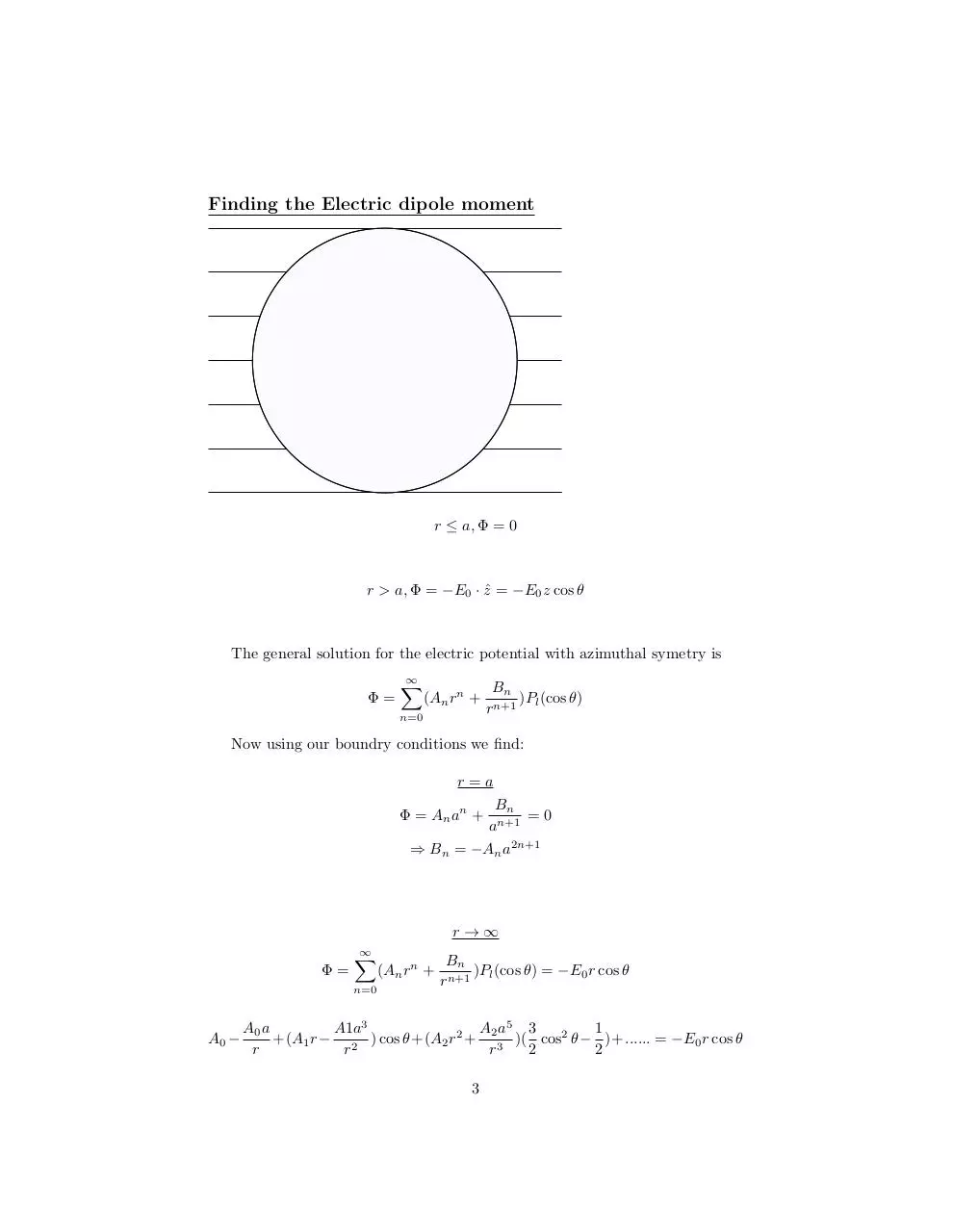
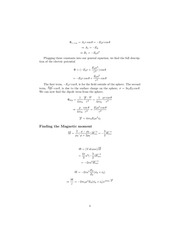
Finding the Electric dipole moment
r ≤ a, Φ = 0
r > a, Φ = −E0 · zˆ = −E0 z cos θ
The general solution for the electric potential with azimuthal symetry is
Φ=
∞
X
(An rn +
n=0
Bn
)Pl (cos θ)
rn+1
Now using our boundry conditions we find:
r=a
Φ = An an +
Bn
=0
an+1
⇒ Bn = −An a2n+1
r→∞
Φ=
∞
X
(An rn +
n=0
A0 −
Bn
)Pl (cos θ) = −E0 r cos θ
rn+1
A0 a
A1a3
A2 a5 3
1
+(A1 r− 2 ) cos θ+(A2 r2 + 3 )( cos2 θ− )+...... = −E0 r cos θ
r
r
r
2
2
3
�
Φr→∞ = A1 r cos θ = −E0 r cos θ
⇒ A1 = −E0
⇒ B1 = −E0 a3
Plugging these constants into our general equation, we find the full description of the electric potential
Φ = (−E0 r +
E0 a3
) cos θ
r2
E0 a3
cos θ
r2
The first term, −E0 r cos θ, is for the field outside of the sphere. The second
3
term, Er02a cos θ, is due to the surface charge on the sphere, σ = 3�0 E0 cos θ.
We can now find the dipole term from the sphere,
= −E0 r cos θ +
Φdip =
⇒
−
−
1 →
1 pr cos θ
p ·→
r
=
3
4π�0 r
4π�0 r3
p cos θ
E0 a3 cos θ
=
2
4π�0 r
r2
→
−
p = 4π�0 E0 a3 �ˆ0
Finding the Magnetic moment
3 −−→
2 µ − µ0 −−→
−
→
(
)Hinc = − Hinc
M=
µ0 µ + 2µ0
2
−
→
→
−
m = (V olume)M
=
4π 3 3 −−→
a (− )Hinc
3
2
3 −−→
= −2πa Hinc
E0
→
−
m = −2πa3 (nˆ0 × �ˆ0 )
Z0
⇒
→
−
→
−
m
= −2π�0 a3 E0 (nˆ0 × �ˆ0 )eiknˆ0 · x
c
4
�
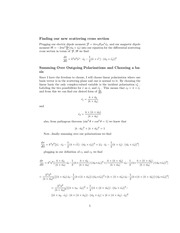
Finding our new scattering cross section
−
Plugging our electric dipole moment,→
p = 4π�0 E0 a3 �ˆ0 , and our magnetic dipole
3 E0
→
−
moment m = −2πa Z0 (nˆ0 × �ˆ0 ) into our equation for the differential scattering
−
−
cross section in terms of →
p ,→
m we find:
dσ
1
= k 4 a6 |�ˆ∗ · �ˆ0 − (ˆ
n × �ˆ∗ ) · (nˆ0 × �ˆ0 )|2
dΩ
2
Summing Over Outgoing Polarizations and Choosing a basis
Since I have the freedom to choose, I will choose linear polarization where one
basis vector is in the scattering plane and one is normal to it. By choosing the
linear basis the only complex-valued variable is the incident polarization �∗0 .
Labeling the two possibilities for �ˆ as �ˆ1 and �ˆ2 . This means that �2 = n
ˆ × �ˆ1
dσ
.
and from this we can find our disired form of dΩ
�ˆ1 =
n
ˆ × nˆ0
|ˆ
n × nˆ0 |
and
�ˆ2 =
n
ˆ × (ˆ
n × nˆ0 )
|ˆ
n × nˆ0 |
also, from pathagean theroem (sin2 θ + cos2 θ = 1) we know that
|ˆ
n · nˆ0 |2 + |ˆ
n × nˆ0 |2 = 1
Now...finally summing over our polarizations we find
1
dσ
ˆ · (nˆ0 × �ˆ0 )|2 + |�ˆ2 · �ˆ0 − 1 (ˆ
= k 4 a6 [|�ˆ1 · �ˆ0 − (ˆ
n × �1)
n × �ˆ2 ) · (nˆ0 × �ˆ0 )|2 ]
dΩ
2
2
plugging in our definition of �1 and �2 we find
dσ
n
ˆ × nˆ0
1
n
ˆ × nˆ0
n
ˆ × (ˆ
n × nˆ0 )
1
n
ˆ × (ˆ
n × nˆ0 )
= k 4 a6 [|
·�ˆ0 − (ˆ
n×
)·(nˆ0 ×�ˆ0 )|2 +|
·�ˆ0 − (ˆ
n×
)·(nˆ0 ×�ˆ0 )|2 ]
dΩ
|ˆ
n × nˆ0 |
2
|ˆ
n × nˆ0 |
|ˆ
n × nˆ0 |
2
|ˆ
n × nˆ0 |
=
k 4 a6
1
1
[|(ˆ
n × nˆ0 )·�ˆ0 − (ˆ
n×(ˆ
n × nˆ0 ))·(nˆ0 ×�ˆ0 )|2 +|ˆ
n × (ˆ
n × nˆ0 )·�ˆ0 − (ˆ
n×(ˆ
n × (ˆ
n × nˆ0 ))·(nˆ0 ×�ˆ0 )|2 ]
|ˆ
n × nˆ0 |2
2
2
=
k 4 a6
1
[|(ˆ
n × n0 · �ˆ0 )|2 + |(ˆ
n × (ˆ
n × nˆ0 )) · (nˆ0 × �ˆ0 )|2 −
2
|ˆ
n × nˆ0 |
4
|(ˆ
n × n0 · �ˆ0 ) · (ˆ
n × (ˆ
n × nˆ0 )) · (nˆ0 × �ˆ0 ) + |ˆ
n × (ˆ
n × nˆ0 ) · �ˆ0 |2
5
�
1
+ |(ˆ
n×(ˆ
n × (ˆ
n × nˆ0 ))·(nˆ0 ×�ˆ0 )|2 −|(ˆ
n × (ˆ
n × nˆ0 )·�ˆ0 )·((ˆ
n×(ˆ
n × (ˆ
n × nˆ0 ))·(nˆ0 ×�ˆ0 )|
4
=
5
k 4 a6
1
[( − nˆ0 n)(|ˆ
n · (nˆ0 × �ˆ0 )|2 + |�ˆ0 · n
ˆ |2 − |ˆ
n · (nˆ0 × �ˆ0 )|2 − |�ˆ0 · n
ˆ |2 ]
2
|ˆ
n × n0 | 4
4
dσ
5
1
= k 4 a6 [ − |�ˆ0 · n
ˆ |2 − |ˆ
n · (nˆ0 × �ˆ0 )|2 − nˆ0 · n
ˆ]
dΩ
4
4
(b.)
As stated before n
ˆ · nˆ0 = cos θ and n
ˆ × nˆ0 = sin θ. I will break up the incident
vector components as parallel and perpendicular to the scattering plane:
�ˆ0 = sin φ�ˆ0 + cos φ�ˆ0
5
1
dσ
= k 4 a6 [ − |(sin φ�ˆ0 + cos φ�ˆ0 ) · n|2 − |n · (n0 × (sin φ�ˆ0 + cos φ�ˆ0 )|2 − n0 · n]
dΩ
4
4
5
1
= k 4 a6 [ −2 sin2 φ cos2 φ−(sin2 φ+cos2 φ)− (cos θ×(sin2 φ+cos2 φ+2 sin2 φ cos2 φ))−cos θ]
4
4
dσ
k 4 a6
=
[5(1 + cos2 θ) − 8 cos θ − 3 sin2 θ cos 2φ]
dΩ
8
(c)
The ratio of scattered intensities at
π
π
π
θ = , φ = 0, θ = , φ =
2
2
2
is
dσ
dΩ
dσ
dΩ
=
2 π
k 4 a6
π
2 π
8 [5(1 + cos ( 2 )) − 8 cos( 2 ) − 3 sin ( 2 ) cos 2(0)]
2 π
k4 a6
π
π
2 π
8 [5(1 + cos ( 2 )) − 8 cos( 2 ) − 3 sin ( 2 ) cos(2 · 2 )]
[5 − 3]
1
= 85 83 =
4
[8 + 8]
When φ = 0, the polarization of the incident wave is in the scattering plane.
At θ = π2 we are measuring along the axis of the induced electric dipole moment,
that means that the scattered radiation is completely due to the magnetic dipole.
Conversely, when φ = π2 , the incident polarization is normal to the scattering
plane. At θ = π2 we are measuring along the axis of the induced magnetic dipole
moment. In this case, the radiation must be complete due to the oscillating
electric dipole. This means that the maximum strength of magnetic dipole
scattering is one quarter as strong as electric dipole scattering.
6
�
 Historical archive . public document