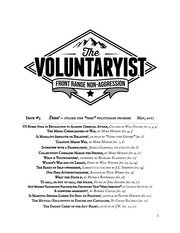
Issue #3
Free! — unlike the “free” politicians promise
May, 2017
US Bombs Syria in Retaliation to Alleged Chemical Attack, Column by Will Porter (pg. 2, 3, 4)
The Media Cheerleaders of War, by Mike Morris (pg. 4, 5)
Is Morality Absolute or Relative?, article by "Gned the Gnome" (pg. 6)
Taxation Means War, by Mike Morris (pg. 7, 8)
Interview with a Praxeologist, Jessica Carswell on utility (pg. 8)
Collectivist Comrades March the Springs, by Mike Morris (pg. 9, 10)
What is Voluntaryism?, answered by Richard Ellefritz (pg. 11)
Wilson’s War and its Legacy, Essay by Will Porter (pg. 12, 13, 14)
The Basics of Self-ownership, Liberty 101 column by J.C. Simpson (pg. 14)
Dog Park Authoritarianism, Article by Nick Weber (pg. 15)
What the State is, by Murray Rothbard (pg. 16)
To call, or not to call, the police, Story by Joel Aigner (pg. 16, 17)
How Modern Vaccination Practices Are Destroying True “Herd Immunity”, by Graham Smith (pg. 18)
A confused anarchist?, by Robert Castle (pg. 19)
Is Manitou Springs Losing Its Soul to Politics?, article by Paotie Dawson (pg. 20)
The Mutual-Exclusivity of Fascism and Capitalism, By Chase Rachels (pg. 21)
The Fascist Creep of the Alt-Right, article by J.W. (pg. 21, 22)
1
�
US Bombs Syria in Retaliation to
Alleged Chemical Attack, A World of
War Column by Will Porter
Trump gave in to pressures that his predecessor
was able to resist in 2013.
In response to allegations of the use of chemical
weapons by the Syrian government in the country’s
ongoing civil war, President Trump has ordered a series
of airstrikes on Syrian targets in what could be an
overture to regime change.
The strikes were carried out late Thursday night, hours
after Russian deputy Ambassador Vladimir Safronkov
warned
of
"negative
consequences"
if
the
administration chose to go through with prior threats.
Though the Russians were informed of the strike in
advance, this small gesture likely will not mitigate the
damage done to US-Russian relations by the attack.
“We describe that attack as a flagrant violation of
international law and an act of aggression,” Safronkov
said at an emergency session of the UN Security Council
(UNSC) on Friday.
This takes place just one week after the Trump
administration announced that it would no longer seek
to remove Syrian President Bashar al-Assad from
power, claiming that the Obama administration missed
the opportunity to do so. “There is a bit of political
reality with respect to where we are now, and where we
were in the last administration,” Press Secretary Sean
Spicer said at a briefing, adding that the US goal in
Syria is now to defeat the Islamic State.
That didn't last long, as we’re back again to the same
mad scheme to overthrow the Syrian government. The
prior administration flirted with the idea, but never
fully it carried out—and for good reason. America’s
recent record with regime change is dismal, with the
violent consequences of the US-led regime changes in
Iraq and Libya still grinding on today.
The Obama administration, of course, did for some
time arm and train Syrian rebels in an effort to hasten
Assad’s defeat, but never carried out a full-scale assault
on the regime. This became especially difficult after
direct Russian involvement began in the conflict in
2015, risking a confrontation between the world’s two
largest nuclear powers.
At one particularly crucial moment in the summer of
2013, however, President Obama did precisely what
Trump just failed to do: he waited.
After a chemical weapons attack on rebel-held areas in
Ghouta, a suburb east of Damascus, a chorus of outrage
erupted from all quarters of respectable society to
demand action against Assad. Obama had set down a
“red line” in a 2012 speech, one year to the day before
the Ghouta attack, which warned Assad that the use of
chemical or biological weapons would trigger direct US
action in Syria. That ultimatum contributed to the
pressure exerted on the president in the wake of the
attack.
John Kerry, then Secretary of State, in a speech soon
after the incident claimed absolute certainty of the
Assad regime's guilt. Kerry uttered the words “We
know...” no less than 35 times in that speech--but he
didn’t know! Later revelations would cast serious
doubts on the Assad regime’s responsibility for the
attack.
Carla del Ponte, a former Swiss attorney-general and
member of the UN Independent International
Commission of Inquiry on Syria, told Swiss TV three
months before the Ghouta attack that there were
“strong, concrete suspicions but not yet incontrovertible
proof” that the rebels were responsible for chemical
weapons attacks in Syria, specifically the use of sarin
gas.
Sarin was also allegedly used in the recent April 4
chemical attack in the town of Khan Sheikhun which
prompted US retaliation Thursday.
Investigative journalist Seymour Hersh, in two pieces
published in the London Review of Books, gives
substantial evidence to suggest that the rebels carried
out the Ghouta attack in order to cross Obama's "red
line" and trigger US intervention against Assad. First,
the conclusions of American intelligence agencies:
“In the months before the attack, the American
intelligence agencies produced a series of highly
classified reports, culminating in a formal Operations
Order – a planning document that precedes a ground
invasion – citing evidence that the al-Nusra Front, a
jihadi group affiliated with al-Qaida, had mastered the
mechanics of creating sarin and was capable of
manufacturing it in quantity.”
Hersh cites a high-level intelligence officer who said
the attack “was not the result of the current regime” in
Syria. (continued on pg. 3)
2
�
(continued from p. 2)
Another former senior intelligence official said that the
Obama administration actually altered information “to
enable the president and his advisers to make
intelligence retrieved days after the attack look as if it
had been picked up and analyzed in real time.”
A chemical weapons expert formerly of the Iraqi
military, Ziyaad Tariq Ahmed, was also known by US
intelligence to be affiliated with the al-Nusra Front rebel
group and to be operating in Ghouta at the time,
according to Hersh's reporting. Tariq was regarded a
high-profile target by the American military, and was
suspected to be involved in the production of sarin.
Moreover, in spring of 2013, US intelligence learned
that the Turkish government was working with
al-Nusra, the Syrian al-Qaeda affiliate, to develop a
chemical weapons capability. “Stepping up Turkey’s role
in spring 2013 was seen as the key to its problems
there,” another retired intelligence official told Hersh.
“Erdoğan’s hope was to instigate an event that would
force the US to cross the red line,” the former official
said, referring to a rebel chemical attack which would be
blamed on the regime. This would not be the first time
Turkey would have considered covert intervention in
Syria. In March of 2014 a leaked recording was
publicized wherein high-level Turkish officials,
including Turkey's foreign minister, Ahmet Davutoglu,
are heard discussing an idea to stage an attack on the
Tomb of Suleyman Shah, a shrine in Syria which by
treaty is Turkish territory.
The staged attack would justify an escalation in
Turkish involvement in the Syrian war. “We’re going to
portray this [as] al-Qaeda,” Feridun Sinirlioğlu, a
Turkish diplomat, said in the recordings (translation of
the transcript). “There’s no distress there if it’s a matter
regarding al-Qaeda. And if it comes to defending
Suleiman Shah Tomb, that’s a matter of protecting our
land.”
While the Obama administration maintained Assad's
culpability in the Ghouta attack, instead of ordering
military retaliation Obama struck a deal with Assad,
brokered by the Russians, for Syria to hand over its
entire chemical weapons stockpile. This was completed
in the summer of 2014 to the satisfaction of the State
Department. Until the April 4 gas attack, all indications
were that Syria no longer possessed such weapons.
The former president's decision not to bomb may have
had something to do with the ultimately flimsy case
against Assad for the Ghouta attack. Then director of
national intelligence James Clapper once even
interrupted the president's daily intelligence briefing to
tell him the Syrian intel was “not a slam dunk” (a
reference to George Tenet, CIA director under the Bush
administration, who vouched for faulty intelligence in
the lead up to the Iraq War).
Obama, despite his public claims to the contrary, at
some point may have concluded he simply did not have
the evidence that would justify full-scale military action
in Syria.
President Trump is now asserting the same level of
certainty regarding the recent chemical attack that was
put forth by the Obama administration in 2013. “There
can be no dispute that Syria used banned chemical
weapons,” Trump said at a briefing after the incident.
We've heard this before— not only in relation to
Syria—and in this case the administration barely waited
48 hours before launching a bombing raid in retaliation,
hardly enough time to conduct a thorough investigation.
By April 6, the United Nations was still finalizing the
decision to even begin a probe into the attack.
While the perpetrator of the sarin strike is yet
unknown, there are at least some plausible reasons to
be skeptical about Assad's responsibility.
Former CIA and DIA officer Phil Giraldi claims to have
military and intelligence sources on the ground in Syria
who tell him the Assad regime did not carry out the
April 4 attack. “Apparently the intelligence on this is
very clear,” Giraldi told radio host Scott Horton in an
interview. “People in both the [Central Intelligence]
Agency and in the military who are aware of the
intelligence are freaking out about this.”
Giraldi's sources say the Syrian military struck a cache
of sarin gas controlled by the rebels in the town of Khan
Sheikhun, an account also put forward by the Russians.
“There was indeed an attack, but it was an attack with
conventional weapons, with a bomb,” Giraldi said.
Another strange aspect of this incident is its timing.
Assad would seemingly have little incentive to carry out
such an attack just as the US announced its intention to
abandon plans for regime change. Some commentators
have suggested Assad was “testing” the Trump
administration with a provocative act, but this seems a
reckless gamble from which little could be gained.
(continued on p. 4)
3
�
(continued from p. 3)
Overall, the war in Syria has
been going well for Assad, raising additional questions
about motive. What tactical or strategic benefit could
the use of chemical agents have for the regime at this
point?
Fortunately, some lawmakers are voicing skepticism
toward the administration's quick rush to judgment
about the April 4 sarin attack, and some of Giraldi's
sources said they would like to come forward publicly
with what they know, but that may not be enough to
prevent further military action against the Syrian
regime.
At Friday's emergency UNSC session, Ambassador to
the UN Nikki Haley said more strikes were still on the
table. "We are prepared to do more, but we hope it will
not be necessary," Haley said. The Pentagon also said it
was investigating the possibility of Russian complicity
in the gas attack, ratcheting up tensions yet further.
In a dark irony, at least nine civilians, including
children, were killed in Thursday's attack, a barrage of
nearly 60 Tomahawk missiles. It is a stark illustration of
the futility of “humanitarian” intervention, where
civilians must die for the sake of their own protection.
Welcome to the fifth term of the Bush administration;
the swamp is here to stay.
[Will Porter is an independent journalist and
contributor at antiwar.com]
The Media Cheerleaders of War, by
Mike Morris
If you’re lucky enough to avoid television, you wouldn’t
have to bear the mainstream media’s unrelenting, daily
cheerleading for war. While it’s all awful, garbage
reporting, the Fox News barrage embodies the macho,
hyper-masculinity of the military, and heartlessly adjust
their voices to an enthusiastic tone of war when they get
excited about the thought of ravaging others’ lives.
They speak of the next war as if it’s inevitable (and
with states it is), and all we can do is prepare for it. War,
to them, is a given—a cause everyone should be behind.
They promote it like it’s as simple as an upcoming
anticipated victory by the local football team. They show
bombings, dying children, maps of airfields they claim
harbor enemy weapons, and try to get average citizens
on board with their war-hype to get us sort of
psychologically on the same page of world events.
Constant nuclear scares with North Korea are aired;
Russophobia continues tension with our old Cold War
enemy; alternative news sources like Wikileaks (and
this one?) are “non-state hostile intelligence services”
(according to Pompeo), and exposing state-crimes is
painted as treasonous. Overall, endless fear mongering
reigns throughout their programming, naming off every
make-believe boogeymen to justify their own existence.
They fervently speak of how weak and vulnerable the
enemy is, and what a cakewalk it would be to stomp all
over them; or how cool their war-toys are, showing off
battleships cruising in looped videos, and the awesome
powers of their state vs. the others, who would be
“obliterated”, “crushed”, or “annihilated”, or some other
exaggerated word were they to face off with the U.S.A.
It’s completely unashamed American exceptionalism.
It’s just fine when we bomb someone – and “we” is the
whole mistaken view that the people are the same as
“their” government – and it is terrorism when they do
it. They’re [Hannity] shouting, “America’s Back!”,
“America’s Back!” Apparently wars of aggression,
intervening hegemonically around the world, inserting
the Empire into every nook and cranny of the globe,
etc., is “American.” Would they know, as its so-called
representatives, that if anything is “American” it would
be non-interventionism, maintaining a peaceful civilian
life, free-trade with other nations, opposition to
standing armies, resistance to taxation, etc?
Pundits waste time arguing who’s biased and who isn’t,
when none of them are biased for liberty. They’re all
statists of different stripes, disagreeing only on the
minutiae of government operations, but proposing no
principled opposition to its foundation. The State is
taken for granted; “democracy” is a must-spread.
They speak of how innovative and advanced “we” are;
the wasteful, wonderful things done with the property
stolen from us; the refashioning of our money into
bombs and bullets. One talking head at Fox, Greg
Gutfeld, had the audacity to call the recent Afghanistan
cave-bombings “beautiful.” It’s truly sickening to see
these people get-off on war, as they clearly do, and to
know that millions tune in to follow their take on
foreign military activity. Any American rebelliousness
has been replaced by unquestioned allegiance to the
State. They say things like “we’re going to find you, kill
you, you can’t hide, run.” This militarized-talk is even
used by local police departments, like the Lake County
Sheriff’s Office...
(continued on p. 5)
4
�
...has done in a recent video threatening drug users in
Florida, which subsequently went viral for its showing
of force fit for a police state.
Smaller local papers like the Gazette get in on it too.
They report on events such as the Space Symposium last
month and are completely comfortable pushing the
same fallacious narratives as the statists and
warmongers. As the Gazette’s Tom Roeder reports at
the Space Symposium, “locals were buzzing about…how
they could offer a financial boom in Colorado Springs.”
Here come the economic fallacies used to support the
idea that taxing people and redistributing the funds to
unprofitable “private” military-industrial companies
“creates jobs” and makes us richer. So full of it they are.
The American Empire – if it ever hasn’t been – looks
to be ramping-up for war. Trump is showing that he’s
willing to make use of the military, as can be expected
when you give a government monopoly powers over
“defense,” and that he has less tolerance for America’s
supposed enemies than his predecessor.
After dropping the largest non-nuclear conventional
weapon in the U.S. arsenal—dubbed “the mother of all
bombs” (MOAB)—for the first time on the already
war-torn Afghanistan in what was said to be a
persuasive demonstration to the regime controlling the
northern part of the Korean Peninsula, President
Trump said, to paraphrase, that “North Korea is a
problem…and will be taken care of.”
The exceptionalism is flagrant: “North Korea is a
prison camp,” but America must have no people locked
in cages; Assad gassed his own people, but forget about
U.S. use of Agent Orange or other chemicals; they killed
a few babies, but forgot about the number of women
and children killed by Americans in the past decade
across the Middle East. Need I say more? We’re given
names, pictures, and stories about the fallen American
soldiers to invoke anger; the foreigners remain the
nameless, of lesser value than the American lives lost in
the alleged “fight for freedom.”
It’s the U.S. Government committing these atrocities,
not the American people—the hapless taxpayer who is
forced to participate in wars he finds unjust. What we’re
seeing is the “blowback” of U.S. foreign policy: the
creation of terrorists around the world, others who are
tired of being punked around by the U.S., etc. The only
way out of the mess is to stop military-interventionism
around the world, but such remains their solution to
preserving the Empire’s reach and domination.
The deep state appears in panic that the public isn’t
buying into their lies anymore. The new CIA Director,
Mike Pompeo, nominated by Trump, spoke to reaffirm
that the CIA is not an agency that engages in its own
agenda, such as foreign regime change, but one that has
the American people’s interests in mind; they should
have their hearts too, because they’re the good guys.
As Pompeo blasts Julian Assange in his first speech
(against free-speech) to the public as CIA Director,
saying he is “not the slightest bit interested in
improving civil liberties or enhancing personal
freedom,” as if they are, seemingly everyone’s an enemy
of the State. They’re trying hard to maintain an image
different than the popular, accurate depictions of these
agencies as unchecked, legalized murderers. He tells us,
"regardless of what you see on the silver screen, we do
not pursue covert action on a whim without approval...”
“I know there will always be skeptics and we need to
build trust in them,” Pompeo said, also citing the Office
of Inspector General as something that reigns them in.
But we all know, there are no “checks and balances” in
government. The once relatively-limited executive
branch has become a “murder dispensary,” as my friend
Pete calls it, intent on operating outside of the system
that supposedly imposes boundaries on their power.
Pompeo, like others, thinks we’re doing these things in
the “national interest,” “just doing our jobs.” They
appear concerned their credibility is being damaged,
knowing they exist solely because the people tolerate it,
so paint the Mannings, Assanges, and Snowdens of the
world as traitors deserving of capital punishment.
But there is some hope. Evidenced by the comment
sections of local police departments across the country,
the tides might be turning on their unchecked
legitimacy as monopolists who have a special right to
rule us. People that aren’t even ideologically motivated
libertarians who hold specific principles of liberty can
be seen denouncing their crimes through their own
common sense logic toward the absurdities of caging
men for any number of laws growing on the books daily.
Governments rule by fear and must instill that fear in
their subjects to stay afloat—since all states require at
least passive public approval. Hence the fearful reaction
of “but without government…” as a seemingly natural
reflex among the slaves. Peaceniks long for a day when
government struggles to maintain its perceived
essentiality among the public. To some extent, it’s
happening.
5
�
Is Morality Absolute or Relative?, article by "Gned the Gnome"
Religious conservatives and liberals often argue
over whether morality is absolute (universal) or
relative. Conservatives believe that morality can
only come from their favorite religion, which must
be accepted 100% or else the world degenerates
into hopeless global immorality and chaos, which
then justifies the conservatives' use of force to
"save" civilization. Many liberals believe that there
are no objective or universal moral principles, that
anything goes and it's all a matter of individual
choice. This justifies anything, including the
conservatives' paranoia, reinforcing the vicious
circle.
1. The Non-Aggression Principle (NAP): Do not
initiate force or fraud upon anyone else's person or
property.
2. The Equal Rights Principle (ERP): We all have
equal Inherent Rights, no privileged classes, no
Divine Right of Kings.
3. The Individual Sovereignty Principle (ISP): We
each have the right to do whatever we want as long
as we do not violate NAP or ERP; and, individuals
create organizations (including governments) and
endow them with specified limited privileges, not
the other way around; such organizations do NOT
have Inherent Rights.
Inherent Rights can only be Negative Rights, not
Positive
Rights. That is, you are not obligated to do
How do we resolve these conflicting positions and
anything good for me, but you must not do
avoid falling into more worldwide holy war?
anything bad to me. Positive Rights must be
obtained by consent as Contract Rights, e.g. by
Very simple - as often happens, both sides are
purchase, barter, or other arrangement. Thus, the
partially right. There is a very small absolute core of
right to Life can only be properly understood as a
Universal Common Law aka Natural Law aka
Negative Right - I cannot force you to provide me
Objective Law, which consists of the musts (actually
with food, health insurance, shelter, or anything
the must nots). The rest of the various "moral"
else I need to live; I can only insist that you must
principles proposed by different religions, cultures,
not murder me.
nations, etc. are all relative and are just a matter of
That's the gist of it. Much more detail is at
cultural beliefs and norms; these are only shoulds,
http:
//nap.nfshost.com and there's an email link
not musts. Conservativesdon't know the difference;
they can't even distinguish between God's Law (the for comments, feedback, etc. There's room for
musts) and man's law (the shoulds). They think that improvement, so I'd really appreciate constructive
to save the world they must convert everyone at suggestions by those who really understand and
gunpoint and force them to follow all the laws of agree with these Principles. Thank you.
their religion. In forcing their shoulds (their laws)
upon everyone else, they are violating the musts
(God's Law). They are thus supporting "Satan"
(coercion) and rejecting God.
["Gned the Gnome" is an activist in the
libertarian/patriot community in Colorado
Springs and Texas.]
Liberals simply need to learn that there are some
things (like stealing) which are inherently and
objectively wrong (the must nots), regardless of
what people think. This should be easy for them to
agree to in exchange for no longer having anyone's
shoulds imposed upon them.
“The right to private property is an indisputably
valid, absolute principle of ethics and the basis for
continuous ‘optimal’ economic progress. To rise from
the ruins of socialism and overcome the stagnation
of the Western welfare states, nothing will suffice
but the uncompromising privatization of all
socialized, that is, government, property and the
establishment of a contractual society based on the
recognition of the absoluteness of private property
rights.” - Hans-Hermann Hoppe
So, what are these absolute, universal core
principles of Universal Common Law, the musts?
6
�
Taxation means War, by Mike Morris
Well, not war in the sense that the people are finally
fed up with their compulsory contributions to the
death-cult that is the U.S. Government, but in that
aggressively-appropriated tax-funds are likely to go
toward further aggressive uses.
Giving an institution built on aggression and invasion
of property rights the sole legal authority to steal, which
is accurately the definition of the State—a territorial
monopolist of force—will lead to an expansion and
concentration of power, as we have witnessed in this
failed, though perhaps noble, utopian American
experiment in “limited-government.”
As Murray Rothbard has said, “government is
inherently inflationary.” Give government all the guns,
and they will point them at you. Give central banks the
power to make money with their monopoly over it, and
they will do just that.
If all our taxes were paid directly from our checks, or
better yet, a check you had to write to the government at
the end of the year, it’s unlikely that our tolerance
would be as high as they’ve gotten away with anyway.
Therefore they utilize the old trick of inflation to get us
with the more insidious and illusory inflation-tax, where
rather than needing to tax us from income withholding,
they create money from thin air and steal resources
from the economy anyway for themselves.
Money is no exception to the laws of supply and
demand though, in which an increase in the supply (the
definition of inflation) will lower the price of money. An
increase in money units thus raises money-prices, i.e.,
lowers the purchasing power of money in regard to
other goods and services in the economy.
The U.S. government is now unrestrained in how much
resources it wishes to rob from the private markets, of
which production is for consumer needs, and redirect
and divert those resources toward building up the war
machine.
It is the very purpose of taxation to produce things (for
government purposes) that we otherwise might not
voluntarily fund, such as Trump’s call to increase the
U.S. nuclear arsenal, of which I believe a fraction of the
supply could obliterate mankind.
One rejection of a market for defense is that it would
be provided in insufficient quantity. We must have a
State to decree, violently, what it is we must pay for our
own protection. Only collectivists who believe
production should be in the name of “society”, i.e., for
the State’s ends, would anyone wish to take away the
ends of individual’s subjective preferences. Stating that
no one would supply these people with as much
resources, i.e., million-dollar tomahawk cruise missiles,
if not coerced is an argument against statism.
Others are foolish enough to say things like “we should
be able to choose where our tax dollars go”, without
realizing, precisely, that achieving this would be no
taxation whatever; everyone decides, voluntarily, how
they wish to use their property; the engage in the..
..democracy of the market; “voting with their dollars”,
so to speak.
Thus, it’s much easier to make war when you can
externalize the costs onto the taxpaying public; much
harder when the losses are your own. Hence why a
stateless society would mean less, not more, war. It is
the difference between conjectural bandit gangs and the
absolute genocides and prolonged conflicts seen
between states.
As anyone should be able to see at this point, the DOD
is an outright gang of aggression. It should have been
called the Department of Offense long ago.
Creating enemies are the world, refugee crises, etc., all
serve to make us insecure; the plundering of resources,
and “lost” money by the Pentagon make us poorer; the
military’s consumption of capital, yet production of
nothing in return for those resources, serves to make us
poorer as a whole.
If the service of defense was beholden to market forces,
like profit and loss, supply and demand, etc., rather
than being a coercive monopoly and provision of the
State, then there’s much greater chance that people
would find it intolerable and cancel their support and
membership for it. Such is not a possibility under the
State to boycott it.
As of now, hapless taxpayers like myself, who are
threatened with violence and cages should we resist
funding their wars, are unable to discontinue payments
once we see how the “defense” department uses such
funds. I won’t even begin to list the atrocities of the U.S.
Military. Needless to say they are many.
Reports on the recent strike in Syria, killing children,
for instance, would not be condoned (at least by me),
and less likely conducted, security were private.
So, being horrified upon seeing children being sprayed
with water after being attacked with chemical weapons,
as the news dramatically showed, and with a narrative
all ready to go that it was President Bashar-al Assad
against his own people (think: the accusations of
Saddam Hussein and WMDs which justified the Iraq
invasion in 2003; or the instant blame on Osama Bin
Laden for the September, 11th attacks which he denied),
Trump called in an airstrike which is already reporting
civilian casualties, including children.
The same disgusting, vile, warmongering neocons from Sean Hannity, Bill O'Reilly, John McCain, etc. have been on the tube since I was a teen now. Hannity
exclaims proudly that “America’s back”, to refer to the
President shedding blood; an old pastime tradition of
his predecessors, I suppose. I guess Obama’s 26,000+
bombs-dropped in 2016 wasn’t good enough for the
warhawks; “we” need to step up our game and spread
the our military hegemony even further.
The supposed Party of “small government” is about
growing the military, and has been for some time. There
is no more anti-war, anti-New Deal “Old Right”, but
they’ve accepted the whole government package at this
point, from Social Security to the socialist military.
7
�
As long as there are states, and territorially large ones
at that which have more resources to exploit, there will
be a tendency to make war and limit liberties.
Of course we must ask: why do states get to go
ungoverned? Why do they get to be anarchists but not
us? Thus, the logical conclusion of centralization in
general is to have a world government. If one doesn’t
find that terrifying, and the end of humanity (though,
some environmentalists might think it will be the
protection of Earth at last), then I have no words for
you. And if they don’t think we should have a world
government, why do they stop at national borders in
their decentralization? Why not decentralize as far as
possible, down to the individual?
The centralization of power needs to be reversed for a
total decentralization. Anyone on board with that, if not
accepting anarchist conclusions, is an ally in the
ideological battle to beat back the rise of statism.
Starting with regions, onward to cities and
neighborhoods, we could achieve individual liberty.
As our columnist Will Porter believes, and is the the
position of many prominent libertarians, war is the
primary issue to oppose as it is in war which the State
goes stronger and domestic liberties are taken away at
home, and in which a reversal in the post-war peacetime
almost never comes; it even gives us the
centrally-planned state like the programs of the New
Deal seen in the interwar period, or the post-9/11
surveillance state we live in today.
So while I meant taxation means war in the sense that
people who are able to tax will build powerful militaries
with the funds, and use this armies to stand over us,
taxation should mean war on our end too: that we resist
the slavery that is taxation and stop aiding, though
involuntarily, the crimes of the U.S. government.
If the service of defense was beholden to market forces,
like profit and loss, supply and demand, etc., rather
than being a coercive monopoly and provision of the
State, then there’s much greater chance that people
would find aggression intolerable, and the aggressors
would be out of business.
I’d submit that all defense spending would be just that
in a market for security: defense spending. With a State
such as the U.S., it’s always preparation for another
blunder overseas.
While it’s true we need to secure property rights as a
prerequisite for economic prosperity and personal
liberty, it does not logically follow that it must be
monopolistic. We see where this has gone: from a
“limited government” experiment to the biggest State
the world has ever seen; an Empire of unprecedented,
epic proportions that threatens the world-over,
including its own citizens. We see today, a century that
was dominated by the casual-correlated existence of
central-banking and total-war; one that replaced gold, a
restraint
on
their
revenue-growth,
with
permanently-depreciated paper-monies states use to
expand their budgets, debts, and military excursions.
[Mike Morris makes The Voluntaryist happen]
[Questions to a praxeologist]
The Voluntaryist:
What is the significance of
emphasizing that our subjective preferences are ordinal
and not cardinal?
Jessica Carswell:
It means that you can't make
interpersonal utility comparisons and therefore can't
objectively prove that any forced exchange or
redistribution is for the "common good". To do that,
you'd have to be able to measure total utility: i.e. utility
gained minus utility lost. To measure, utility would have
to be cardinal.
It also explains why people exchange. Because each
party ranks the goods or services received more than the
goods given up. Which has implications on where prices
come from - that it's subjective value, not some
"objective" or inherent value that set prices.
The fact that you can't make interpersonal utility
comparisons is basically the case against the state in its
entirety. Even if you want it to do "good" things through
violent intervention/redistribution, you can't prove
objectively that these things are "good" overall.
You might personally believe that it's "moral" to steal
from the very rich to help the very poor, or to violate
someone's rights to some small extent to prevent a
severely bad outcome (e.g. borrowing a gun against a
person's will to prevent a mass murder). But you can't
prove objectively or scientifically that by doing so you
are achieving a common good outcome. These are
win-lose cases and you can't objectively measure the
win against the lose to ascertain whether you have a
positive net outcome.
The Voluntaryist:
Beautiful response which
basically refutes socialism and the labor theory of value
in short order. So, to get it straight, viewing rankings as
cardinal would allow for a sort of utilitarian
common-good justification for theft in seeing Person A
valued his 1st-ranked preference only 1.1x more than the
2nd, and so therefore it would be just and moral, and
not a loss of "social utility", then, to transfer this to
Person B who supposedly values it more, and therefore
this is why preferences must be seen as ordinal – 1st,
2nd, 3rd – as opposed to 1st being valued 1.5x more
than the 2nd, and so forth? Is that a way to put it?
Jessica Carswell:
Yeah basically cardinal utility
would allow for some kind of objective measurement.
Ordinal does not.
It's not an assumption. Preferences are ordinal.
8
�
Collectivist Comrades
March the Springs, Mike
Morris
Since Trump has taken office,
socialists of all types have taken to
the streets of the Springs for various
causes. Among the accurate military
- megachurch - ultra-conservative image Colorado Springs retains can
be found ponds of leftism, too.
A few groups in town are Colorado
Springs Socialists, comprised of
revolutionary Marxists; Colorado
Springs Antifa, the “anarcho
communists” who associate with
them; Unite Colorado Springs, the
progressives; and Showing Up for
Racial Justice; etc.
They’re mad too, but one must be
careful as such groups often offer as
a solution many of the causes to our
very problems: statism. Their idea of
justice, as well as the conception of
liberty, for any of these groups is
opposite the libertarian conception
of both; and is that of having the
[positive] “right” to other people’s
property, rather than to be free from
such aggression. “Justice” is when
we aren’t free to exclude people
from our property (discriminate)
and our private lives as we see fit; or
when people are punished for the
non-crime of tax-evasion; liberty is
when “rights are guarantees” to
other people’s property (as Bernie
Sanders puts it) to be provided by
government, rather than the
freedom from giving up your
property to government. Freedom is
slavery — you know the rest.
They hopelessly ask for justice
from a monopolist state, which
economic theory tells us will rise in
price and deteriorate in quality over
time. Like Keynesian central
bankers attempt with economic
magic tricks, they ask of statism
something it will never deliver.
They can’t be trusted with these
words. “Progress” is when there’s
more violations of property rights
than last year; when there are more
taxes, more regulations, and more
crony government. Additionally,
“social-justice” exceeds questioning
the State in importance.
It is no wonder we are in conflict:
millions of many preferences are
forced to accept the rule of one
centralized government. But we’ve
almost forgotten that’s why. “Social
justice”
issues,
that
place
transgender bathrooms rights above
criticizing the more heinous actions
of states, shows the problem.
Just as the anti-immigration crowd
wants to use government to restrict
immigration when it’s in that
government’s interest to come at the
expense of nations, cultures, tribes,
families, and destroy liberty, most
remain
proponents
of more
government.
Since the “Hands Off Syria”
protest put on by Unite CS was
pertinent to the issue of Trump
bombing Syria, we decided to go
down too, wishing to join the
anti-war chorus, ourselves holding
signs reading “the U.S. Government
is a death cult.” Rather than talk to
us, we were instead immediately
treated as enemies.
A few voluntaryists including
myself were standing ahead of the
protesters before they crossed the
street, who were made up in large
part by covered-faced “anarcho
communists” waving their black and
red flag. We kept our message
simple, which one would think
they’d have found unobjectionable.
They however were instantly
triggered upon seeing us, eerily
giving
up
their
sheep-like
group-chant to frame us as “fascists”
(which defined by them is anything
they don’t like, which is everything).
“Good-night,
alt-right!”,
they
repeated to drown-out anything we
had to say, somehow equating us as
fascists for holding a “taxation is
theft” sign, to which they shoved us
for when verbalizing. Would they
know National Socialism was
socialism, and not capitalism, which
is a lack of political authority?
The tension was the sentiment of
the population, also seen in punk
subculture: national socialism bad,
international socialism good. Che
Guevara and Hammer and Sickles
are acceptable and cool; Hitler
paraphernalia and we stomp your
skull in. (Many “Antifa” are punks).
I am not apologizing for the former,
but pointing out the double
standard. While our utmost cause is
individual liberty, nationalism is
preferable to communism or a world
government; many countries are
preferable to a single, global one.
They think Bernie Sanders’ are
preferable to Ron Paul’s, though.
An online manual on forming a
local Antifa group says “most
activists are anarchist, although a
few are Maoist...the movement is
predominantly Marxist.” Maoists!?
That’s too funny to even rebut. But
we,
the
people
who
want
collectivists to leave us alone, are
the fascists, right? Got it.
Funny the “anti-fascist anarchists”
hang out with the socialists in an
“alliance of the left in Colorado
Springs”, as the Colorado Springs
Socialists have called for. If a
democrat’s idea for what they want
to do to a population are for those
under a specific state’s territory (as
Bernie Sanders is not offering free
education to the world), and not
those outside it, how is this not
national socialism? The New Deal,
widely hailed and cited as a leftist
success against the market they
think caused the Depression, was
essentially
America’s
National
Socialism, i.e., fascism. At best, the
U.S. is a severely hampered market
economy; at worst, it’s fascist. We
agree. But it certainly isn’t the
bastion of capitalism it’s thought to
be, as they repeatedly speak of it as.
While there is the recent rise of the
so-called “alt-Right” upon Trump’s
entry, who even claim libertarianism
at times, there appears a resurgence
of the radical, discontent, violent
anti-capitalist left, no longer
contained to the big cities known for
it. Though Trump supporters and
right-wing socialism should be
found intolerable too, they appear as
well intolerant and hostile to any
ideas outside their own, though
holding no real principles; and
despite maintaining the contrary as
an inclusive, diverse bunch. As with
us, they persistently demonstrate
their unwillingness to engage in
reasonable argumentation, opting
for yelling things instead.
9
�
 Historical archive . public document