Automated Knowledge Base Management: A Survey
Jorge Martinez-Gil
Software Competence Center Hagenberg (Austria)
email: jorge.martinez-gil@scch.at, phone number: 43 7236 3343 838
Keywords: Information Systems, Knowledge Management, Knowledge-based Technology
Abstract
A fundamental challenge in the intersection of Artificial Intelligence and Databases consists of developing methods to automatically manage Knowledge Bases which can serve as a knowledge source for
computer systems trying to replicate the decision-making ability of human experts. Despite of most of
tasks involved in the building, exploitation and maintenance of KBs are far from being trivial, significant progress has been made during the last years. However, there are still a number of challenges that
remain open. In fact, there are some issues to be addressed in order to empirically prove the technology
for systems of this kind to be mature and reliable.
1
Introduction
Knowledge may be a critical and strategic asset and the key to competitiveness and success in highly
dynamic environments, as it facilitates capacities essential for solving problems. For instance, expert
systems, i.e. systems exploiting knowledge for automation of complex or tedious tasks, have been
proven to be very successful when analyzing a set of one or more complex and interacting goals in order
to determine a set of actions to achieve those goals, and provide a detailed temporal ordering of those
actions, taking into account personnel, materiel, and other constraints [9].
However, the ever increasing demand of more intelligent systems makes knowledge has to be captured, processed, reused, and communicated in order to complete even more difficult tasks. Nevertheless,
achieving these new goals has proven to be a formidable challenge since knowledge itself is difficult to
1
�
explicate and capture. Moreover, these tasks become even more difficult in fields where data and models
are found in a large variety of formats and scales or in systems in which adding new knowledge at a later
point is not an easy task.
But maybe the major bottleneck that is making very difficult the proliferation of expert systems is
that knowledge is currently often stored and managed using Knowledge Bases (KBs) that have been
manually built [11]. In this context, KBs are the organized collections of structured and unstructured
information used by expert systems. This means that developing a system of this kind is very expensive
in terms of cost and time. Therefore, most current expert systems are small and have been designed for
very specific environments. Within this overview, we aim to focus on the current state-of-the-art, problems that remain open and future research challenges for automatic building, exploiting and maintaining
KBs so that more sophisticated expert systems can be automatically developed and practically used.
The rest of this work is structured as follows: Section 2 presents the state-of-the-art concerning
automated knowledge-base management. Section 3 identifies the problems that remain open. Section
4 propose those challenges that should be addressed and explain how their solution can help in the
advancement of this field. Finally, we remark the conclusions.
2
State-of-the-art
Although the challenge for dealing with knowledge is an old problem, it is perhaps more relevant today
than ever before. The reason is that the joint history of Artificial Intelligence and Databases shows that
knowledge is critical for the good performance of intelligent systems. In many cases, better knowledge
can be more important for solving a task than better algorithms [38].
It is widely accepted that the complete life cycle for building systems of this kind can be represented
as a three-stage process: creation, exploitation and maintenance [14]. These stages in turn are divided
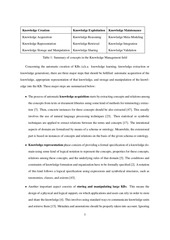
into other disciplines. In Table 1 we can see a summary of the major disciplines in which the complete
cycle of knowledge (a.k.a. Knowledge Management) is divided1 .
1
In general, there is no agreement about the nomenclature used in the literature, but we will try to explain these discrepancies. In general we will use the expression a.k.a. (also knows as) for the same discipline receiving different names
2
�
Knowledge Creation
Knowledge Exploitation
Knowledge Maintenance
Knowledge Acquisition
Knowledge Reasoning
Knowledge Meta-Modeling
Knowledge Representation
Knowledge Retrieval
Knowledge Integration
Knowledge Storage and Manipulation
Knowledge Sharing
Knowledge Validation
Table 1: Summary of concepts in the Knowledge Management field
Concerning the automatic creation of KBs (a.k.a. knowledge learning, knowledge extraction or
knowledge generation), there are three major steps that should be fulfilled: automatic acquisition of the
knowledge, appropriate representation of that knowledge, and storage and manipulation of the knowledge into the KB. These major steps are summarized below:
• The process of automatic knowledge acquisition starts by extracting concepts and relations among
the concepts from texts or document libraries using some kind of methods for terminology extraction [7]. Then, concrete instances for these concepts should be also extracted [47]. This usually
involves the use of natural language processing techniques [23]. Then statistical or symbolic
techniques are applied to extract relations between the terms and concepts [17]. The intentional
aspects of domain are formalized by means of a schema or ontology. Meanwhile, the extensional
part is based on instances of concepts and relations on the basis of the given schema or ontology.
• Knowledge representation phase consists of providing a formal specification of a knowledge domain using some kind of logical notation to represent the concepts, properties for these concepts,
relations among these concepts, and the underlying rules of that domain [5]. The conditions and
constraints of knowledge formation and organization have to be formally specified [2]. A notation
of this kind follows a logical specification using expressions and symbolical structures, such as
taxonomies, classes, and axioms [43].
• Another important aspect consists of storing and manipulating large KBs. This means the
design of a physical and logical support, on which applications and users can rely in order to store
and share the knowledge [4]. This involves using standard ways to communicate knowledge units
and retrieve them [15]. Metadata and annotations should be properly taken into account. Ignoring
3
�
the inherent inferential capability given by KBs each KB is also a database in the sense that there
is a schema, i.e. the concepts and roles, and a set of instances. Therefore, adopting database
technology as key method to address this issue is an idea adopted by most of the solutions.
Concerning the automatic exploitation of KBs (a.k.a. knowledge exploitation or knowledge application) can be divided in two subgroups: knowledge utilization and knowledge transfer. At the same
time, the utilization of knowledge can be used for knowledge reasoning or for knowledge retrieval (in
the way the Question and Answering (Q & A) systems work [44]). Meanwhile, the purpose of knowledge sharing (a.k.a. knowledge exchange) is the process through which explicit or tacit knowledge is
communicated to others.
• Knowledge reasoning consists of inferring logical consequences from a set of asserted facts or
axioms [27]. The notion of a reasoner generalizes that of an inference engine, by providing a
richer set of mechanisms to work with [46]. Formal specification is required in order to be able
to process ontologies and reasoning on ontologies automatically. By reasoning, it is possible to
derive facts that are not expressed in the KB explicitly. Some of the facts that can be automatically
derived could be:
– Consistency of ABox with respect to TBox, determine whether individuals in ABox do not
violate descriptions and axioms described by TBox
– Satisfiability of a concept, determine if a description of the concept is not contradictory
– Subsumption of concepts, determine whether concept A subsumes concept B
– Retrieval of individuals, find all individuals that are instances of a concept
– Realization of an individual, find all concepts which the individual belongs to, especially the
most specific ones
• Knowledge retrieval aims to help users or software applications to find knowledge that they
need from a KB through querying, browsing, navigating and/or exploring [36]. The goal is to
return information in a structured form, consistent with human cognitive processes as opposed to
4
�
plain lists of items [41]. It is important to remark that traditional information retrieval organize
information by indexing. However, knowledge retrieval aims ti organize information by indicating
connections between different elements [40].
• Knowledge sharing consists of exchanging knowledge units between entities so that each entity
gets access to more than the knowledge it has been able to build up [28]. Obviously, each entity
is then more prepared to make the correct choices in their field. In this way, unprecedented situations can be resolved satisfactorily. However, knowledge is currently exchanged inefficiently.
This means that exchange mechanisms are restricted to very specific domains. This fact reduces
knowledge propagation in space and time. To address this problem, the Knowledge Interchange
Format (KIF) was designed [16]. KIF is a language designed to be used for exchange of knowledge between different expert systems by representing arbitrary knowledge units using the first
order predicate logic.
Concerning the automatic maintenance of KBs (a.k.a. knowledge maintenance or knowledge retention), there are three important phases: knowledge meta-modeling, i.e. modeling knowledge about
the KB, knowledge integration which consists on merging past and new knowledge, and knowledge
validation to assure the correctness of the new knowledge added to the KB.
• Knowledge meta-modeling can be considered as a process for adding explicit descriptions (constructs and rules) of how a domain-specific KB is built [24]. In particular, this comprises a formalized specification of the domain-specific notations, a centralized repository about data such as
meaning, relationships to other data, origin, usage, and format. This repository is mainly accessed
by the various software modules of the KB itself, such as query optimizer, transaction processor
or report generators.
• Knowledge integration is considered to be the process of incorporating new information into a
body of existing knowledge with an interdisciplinary approach [18]. A possible technique which
can be used is semantic matching [29]. This process involves determining how the new information and the existing knowledge interact, how existing knowledge should be modified to ac5
�
commodate the new information, and how the new information should be modified in light of the
existing knowledge [32]. These techniques can be used for going beyond the literal lexical match
of words and operate at the conceptual level when comparing specific labels for concepts (e.g.,
Finance) also yields matches on related terms (e.g., Economics, Economic Affairs, Financial Affairs, etc.). As another example, in the healthcare field, an expert on the treatment of cancer could
also be considered as an expert on oncology, lymphoma or tumor treatment, etc.
• Knowledge validation is a critical process in the maintenance of the KBs. Validation consists
of ensuring that something is correct or conforms to a certain standard. A knowledge engineer is
required to carry out data collection and data entry, but they must use validation in order to ensure
that the data they collect, and then enter into their systems, fall within the accepted boundaries of
the application collecting the data [1]. Therefore, the ultimate goal of this process is to make the
KB satisfy all test cases given by human experts [20]. This is further complicated by factors such
as temporal validity, uncertainty and incompleteness. Most of current expert systems incorporate
simple validation procedures within the program code. After the expert system is constructed, it
is usually maintained by a domain expert.
Concerning explanation delivery, the purpose is that expert systems may be able to give the user
clear explanations of what it is doing and what it has deduced. The most sophisticated expert systems
are able to detect contradictions [3] in user information or in the knowledge and can explain them clearly,
revealing at the same time the expert’s knowledge and way of thinking, what makes the process much
more interpretable.
3
Open problems
From the state-of-the-art, we can deduce that a lot of successful work have been done in the field of
automated knowledge-base management during the last years. However, despite of these great advancements, there are still some problems that remain open. These problems should be addressed to support
a more effective and efficient knowledge-base management. Therefore, the gist of these problems is to
6
�
support the complete life cycle for large KBs so that computer systems can exploit them to reflect the
way human experts take decisions in their domains of expertise. These tasks are often pervasive because
large KBs must be developed incrementally, this means that segments of knowledge are added separately to a growing body of knowledge [6]. Satisfactory results in this field can have a great impact in
the advancement of many important and heterogeneous disciplines and fields of application. However,
there are a number of challenging questions that should be successfully addressed in advance. These
problems which are summarized as follows:
• The first problem concerns the automatic generation of large KBs. Every expert system has
a major flaw: knowledge collection and its interpretation into rules is quite expensive in terms
of effort and time [10]. Most expert systems have no automated methods to perform this task.
Instead it is necessary to work manually, increasing the likelihood of errors and the costs in terms
of money and time. In order to develop new methods for automatic knowledge learning, it is
important to have a strong methodology for their evaluation and comparison. This problem is even
more critical in environments working with large KBs, as it is not viable to manually evaluate the
inclusion of new knowledge.
• The second problem concerns the efficiency of methods for exploiting KBs. These methods
include: knowledge reasoning, knowledge sharing and knowledge retrieval (e.g. Question & Answering tools [48]). Beside quality, the efficiency of this kind of methods is of prime importance
in dynamic applications, especially, when it is not possible to wait too long for the system to respond or when memory is limited. Current expert systems are mostly design-time tools which are
usually not optimized, this means that many useful systems cannot be practically used mainly due
to the lack of scalability.
• The third problem concerns automatic selection, combination and/or tuning of methods for KB
maintenance. These methods include knowledge integration, meta-modeling or new knowledge
validation. For example, the vital task of knowledge integration (inclusion of external knowledge in the KBs) requires complex methods for identifying semantic correspondences in order to
7
�
proceed with the merging of past and new knowledge [22]. For the detection of semantic correspondences, it is necessary to perform combination and self-tuning of algorithms that identify
those semantic correspondences at run time [30]. This means that efficiency of the configuration of different search strategies becomes critical. As the number of available methods for KB
maintenance as well the knowledge stored in the KB increases, the problem of their selection will
become even more critical.
• The fourth problem concerns explanation delivery in order to improve the expert systems, thereby
providing feedback to the system, users need to understand them. It is often not sufficient that a
computational algorithm performs a task for users to understand it immediately. In order for expert systems to gain a wider acceptance and to be trusted by users, it will be necessary that they
provide explanations of their results to users or to other software programs that exploit them. This
information should be delivered in a clear and concise way so that it cannot be any place for
misunderstanding.
4
Future challenges
In view of the state of the art and the open problems that need to be investigated, it is possible to identify
four major future research challenges that should be addressed:
4.1
Challenge 1: methodology for the comparison and evaluation of KBs which have
been automatically built.
We know that evaluation of KBs refers to the correct building of the content of a KB, that is, ensuring
that its definitions correctly implement requirements or perform correctly in the real world. The goal
is to prove compliance of the world model (if it exists and is known) with the world modeled formally.
From the literature, we have found that the problem of evaluating an automatically-built KB involves six
criteria:
8
�
• Accuracy which consists of determining the precision of the extracted knowledge and its level of
confidence.
• Usefulness which consists of determining the relevancy of the knowledge for target tasks, its level
of redundancy, and its level of granularity.
• Augmentation which consists of determining if the new knowledge added something new to the
past knowledge.
• Explanation which consists of determining the provenance of the knowledge [12], and if there is
something contradictory.
• Adaption which consists of determining if current knowledge could be adapted to new languages
and domains and how much effort should be made to do that.
• Temporal qualification which consists of determining the temporal validity of the knowledge.
One possible way to evaluate these criteria could consists of treating the KB as a set of assertions,
and use set-oriented measures such precision and recall to determine the accuracy of the recently built
KB. Treating each assertion as atomic avoids the need to perform alignment between the expert system
output and ground truth. Comparing the expert system and ground truth KB should require encoding the
assertions in compatible or mappable ontologies. Identifying the differences should take into account
the logical dependencies between assertions for not over-penalizing an expert systems for missing assertions from which many others are derivable [13]. Evaluation of temporal qualification can be partially
handled by treating the KB as a sequence of fixed sets of assertions over time. Augmentation can also
be examined by performing ablation studies over the assertions in the KB.
The TAC KBP 2013 Cold Start Track2 could serve as a base for this research. The idea behind
this workshop is to test the ability of proposed methods to extract specific knowledge from text and
other sources and place it into a KB. The schema for the target KB is specified a priori, but the KB is
otherwise empty to start. Expert systems should be able to process some sources, extracting information
2
http://www.nist.gov/tac/2013/KBP/ColdStart
9
�
 Historical archive . public document