Maintenance of Profile Matchings in Knowledge
Bases?
Jorge Martinez Gil1 , Lorena Paoletti1 , G´abor R´acz2 , Attila Sali2 ,
Klaus-Dieter Schewe1
1
Software Competence Center Hagenberg, Softwarepark 21, 4232 Hagenberg, Austria
jorge.martinez-gil|lorena.paoletti|kd.schewe@scch.at
2
Alfr´ed R´enyi Institute of Mathematics, P.O.B.127, 1364 Budapest, Hungary
gabee33@gmail.com, sali@renyi.hu
Abstract. A profile describes a set of properties, e.g. a set of skills a
person may have or a set of skills required for a particular job. Profile
matching aims to determine how well a given profile fits to a requested
profile. The research taken in this paper uses a knowledge base grounded
in description logic to represent the knowledge about profiles. Thus, profiles can be defined by filters in the underlying lattice of the concepts in
the TBox of the knowledge base. Matching can be realised by assigning
values in [0,1] to pairs of such filters: the higher the matching value the
better is the fit. Conversely, given a set of filters together with matching values determined by some human expert, the question is, whether a
matching measure can be determined such that the computed matching
values preserve the rankings given by the expert. In the paper plausibility constraints for the values given by an expert are formulated. If
these plausibility constraints are satisfied, the problem of determining
an appropriate matching measure can be solved in an order-preserving
way.
1
Introduction
A profile describes a set of properties, and profile matching is concerned
with the problem to determine how well a given profile fits to a requested
one. Profile matching appears in many application areas such as matching
applicants for jobs to job requirements, matching system configurations
to requirements specifications, etc.
?
The research reported in this paper was supported by the Austrian
Forschungsf¨
orderungsgesellschaft (FFG) for the Bridge project “Accurate and Efficient Profile Matching in Knowledge Bases” (ACEPROM) under contract [FFG:
841284]. The research reported in this paper has further been supported by the
Austrian Ministry for Transport, Innovation and Technology, the Federal Ministry
of Science, Research and Economy, and the Province of Upper Austria in the frame
of the COMET center SCCH. [FFG: 844597]
1
�
Taking the profile just as a set of unrelated items is usually not appropriate for the problem, even though many distance measures between
sets such as Jaccard or Sørensen-Dice [10] have proven to be useful in
ecological applications. The reason is that many dependencies between
the properties have to be taken into account. Therefore, in the human
resources application area many taxonomies for skills, competences and
education such as DISCO [2], ISCED [8] and ISCO [9] have been set
up. On the grounds of these application-oriented dictionaries for profile
matching a lattice structure for the individual properties can be assumed.
This has been exploited by Popov and Jebelean in [14] defining a different
asymmetric matching measure on the basis of filters in such lattices.
However, it can well be argued that the hierarchical dependencies
in lattices are still insufficient for capturing the exact meaning of the
properties in a profile. For instance, it is not common to request just
“programming in Java” as a required skill, but it is more likely that further attributes are given such as years of experience associated with the
skill, level of complexity of problems addressed with the skill, etc. Therefore, it appears favourable to not only assume a lattice structure, but
to exploit sophisticated knowledge representation features for semantic
matching problems as advocated by Falk, Mochol and others [3, 12]. In
our research we adopt this basic assumption how to represent knowledge
about properties. That is, we exploit description logics [1] as the basis
for knowledge representation using a rather expressive language similar
to SROIQ(D). With this the automatic classification of properties such
as skills and competences can be supported, which is necessary in view
of the frequent changes to such a knowledge base, which makes manual
management of dependencies almost impossible.
This raises first the question how matching can be generalised from
filters in lattices to knowledge bases. Using just the lattice defined by the
named concepts can be used as a starting point, but it would ignore the
fine-tuning of the knowledge that is obtained through the roles. Therefore, we exploit “blowing-up” roles, which means to enrich the concept
lattice by inverse images defined by the roles [13]. In Section 2 we give
a brief account on our general approach to profile matching in knowledge bases, formally defining a knowledge representation language and
matching measures based on filters.
The second question, which is the core problem handled in this paper concerns the relationship of rankings obtained through the matching
measures and the judgements of human experts. An initial idea based on
formal concept analysis [6, 5, 4] was already presented in [11] aiming to
2
�
enrich the knowledge base by additional concepts that would justify the
judgement of the human expert. Here we investigate the learning of the
matching measure. Start from the set of filters together with matching
values or simply rankings determined by some human expert. Some plausibility constraints should nonetheless be satisfied to exclude unjustified
bias that is grounded in the valuation of facts not represented in a knowledge base. We then use formal concept analysis on a family of binary
relations on the set of filters determined by the expert rankings. We show
that all these rankings permit to determine a suitable matching measure.
This key contribution will be presented in Section 3. We conclude with a
brief summary.
2
Profile Matching in Knowledge Bases
In this section we present the formal definitions underlying our approach
to profile matching in knowledge bases. We will start with the general
approach to knowledge representation, proceed with the representation
of profiles, and discuss filter-based matching.
2.1
Knowledge Representation
For the representation of knowledge we adopt the fundamental distinction
between terminological and assertional knowledge that has been used in
description logics since decades. For the former one we define a language,
which defines the TBox of a knowledge base, while the instances define a
corresponding ABox.
A TBox consists of concepts and roles. In addition, we will permit the
denotation of individuals as supported by SROIQ(D) [1] and OWL2 [7].
For this assume that C0 , I0 and R0 represent not further specified sets of
basic concepts, individuals and roles, respectively. Then concepts C and
roles R are defined by the following grammar:
R
=
R0 | R0− | R1 ◦ R2
A
=
C0 | > | ≥ m.R (with m > 0) | {I0 }
C
=
A | ¬C | C1 u C2 | C1 t C2 | ∃R.C | ∀R.C
Definition 1. A TBox is a finite set T of assertions of the form C1 v C2
with concepts C1 and C2 as defined by the grammar above.
Each assertion C1 v C2 in a TBox T is called a subsumption axiom.
Note that Definition 1 only permits subsumption between concepts, not
3
�
between roles, though it is possible to define more complex terminologies
that also permit role subsumption. As usual, we use several shortcuts:
–
–
–
–
C1 ≡ C2 can be used instead of C1 v C2 v C1 .
⊥ is a shortcut for ¬>.
{a1 , . . . , an } is a shortcut for {a1 } t · · · t {an }.
≤ m.R is a shortcut for ¬ ≥ m + 1.R, and = m.R is a shortcut for
≥ m.R u ≤ m.R.
The semantics of a TBox is defined by structures.
Definition 2. A structure S for a TBox T consists of a non-empty set
O together with subsets S(C0 ) ⊆ O and S(R0 ) ⊆ O × O for all basic
concepts R0 and basic roles R0 , respectively, and individuals a
¯ ∈ O for
all a ∈ I0 . O is called the base set of the structure.
We first extend the interpretation of basic concepts and roles and
to all concepts and roles as defined by the grammar above, i.e. for each
concept C we define a subset S(C) ⊆ O, and for each role R we define a
subset S(R) ⊆ O × O as follows:
S(R0− ) = {(y, x) | (x, y) ∈ S(R0 )}
S(R1 ◦ R2 ) = {(x, z) | ∃y.(x, y) ∈ S(R1 ) ∧ (y, z) ∈ S(R2 )
S(>) = O
S({a}) = {¯
a}
S(≥ m.R) = {x ∈ O | #{y | (x, y) ∈ S(R)} ≥ m}
S(¬C) = O − S(C)
S(C1 u C2 ) = S(C1 ) ∩ S(C2 )
S(C1 t C2 ) = S(C1 ) ∪ S(C2 )
S(∃R.C) = {x ∈ O | (x, y) ∈ S(R) for some y ∈ S(C)}
S(∀R.C) = {x ∈ O | (x, y) ∈ S(R) ⇒ y ∈ S(C) for all y}
Definition 3. An ABox for a TBox T is a finite structure S, such that
S(C1 ) ⊆ S(C2 ) holds for all assertions C1 v C2 in T .
For the following we always consider a concept C in a TBox as representation of abstract properties, e.g. “knowledge of Java”, and individuals
in the ABox as concrete properties such as the “Java knowledge of Lara”.
Therefore, given an ABox a profile is simply a subset of the base set O.
4
�
2.2
Profiles as Filters
Obviously, the concepts in a TBox define a lattice with u and t as operators for meet and join, and v for the partial order. So let us abstract
for a moment from the specific definition of the knowledge base by TBox
and ABox and assume to be given a lattice (L, ≤).
Definition 4. A filter in a lattice (L, ≤) is a non-empty subset F ⊆ L,
such that for all C, C 0 with C ≤ C 0 whenever C ∈ F holds, then also
C 0 ∈ F holds.
If P ⊆ O is a profile, then P defines in a natural way a filter F of the
lattice L of concepts:
F = {C ∈ L | ∃p ∈ P. p ∈ S(C)}
Therefore, for determining matching relations we can concentrate on
filters F in a lattice.
2.3
Filter-Based Matching
In the following let (L, ≤) be a lattice, and let F ⊆ P(L) denote the set
of filters in this lattice.
Definition 5. A relative weight measure on L is a function m : P(L) →
[0, 1] satisfying
(1) m(L) = 1, and
P
S
(2) m( i∈I Ai ) = i∈I m(Ai ) for pairwise disjoint Ai (i ∈ I).
A matching measure is a function µ : F × F → [0, 1] such that
µ(F1 , F2 ) = m(F1 ∩ F2 )/m(F2 ) holds for some relative weight measure
m on L.
Note that the definition implies that also m(L − A) = 1 − m(A) must
hold for a relative weight measure on L and any A ⊆ L.
Example 1. The matching measure µpj defined in [14] uses simply cardinalities:
µpj (F1 , F2 ) = #(F1 ∩ F2 )/#F2
Thus, it is defined by the relative weight measure m on L with m(A) =
#A/#L.
5
�
It is easy to see that every matching measure µ is defined by weights
w(C) = m({C})P
∈ [0, 1] for the elements C ∈ L. With this we immediaely
obtain m(F) = C∈F w(C) and thus
−1
µ(F1 , F2 ) =
X
w(C) ·
C∈F1 ∩F2
X
w(C)
.
C∈F2
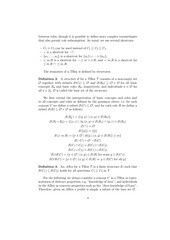
Example 2. Taking a simple lattice L with only five elements: L =
{C1 , C2 , C3 , C4 , C5 }. The lattice structure is shown in Figure 1.
C1
Filters F:
C2
hC1 i = {C1 }
hC2 i = {C1 , C2 }
hC3 i = {C1 , C3 }
hC2 , C3 i = {C1 , C2 , C3 }
hC4 i = {C1 , C3 , C4 }
hC2 , C4 i = {C1 , C2 , C3 , C4 }
hC5 i = {C1 , C2 , C3 , C4 , C5 }
C3
C4
C5
Fig. 1. A simple lattice and its filters
Then we obtain seven filters for this lattice, each generated by one or
two elements of the lattice. These filters are also shown in Figure 1.
3
1
, w(C2 ) = 10
, w(C3 ) = 51 ,
If we now define weights w(C1 ) = 10
3
1
w(C4 ) = 10 , w(C5 ) = 10 , then we obtain the matching measure values µ(F, G shown in Table 1. In the table the row label is F and the
column label is G.
Note that in general matching measures are not symmetric. If µ(F1 , F2 )
expresses how well a given profile F1 matches a required profile F2 , then
µ(F2 , F1 ) measures what is “too much” in the given profile F1 that is not
required in profile F2 [13].
Example 3. Take the filter L from Example 2 shown in Figure 1. Let
G = hC2 , C3 i be the filter that represents the requirements. If we take
filters F1 = hC3 i and F2 = hC4 i representing given assets, then we have
µ(F1 , G) = µ(F2 , G) =
6
1
,
2
�
hC1 i hC2 i hC3 i hC2 , C3 i hC4 i hC2 , C4 i hC5 i
hC1 i
1
1
4
hC2 i
1
1
1
3
1
3
hC3 i
1
1
4
1
1
6
2
3
1
2
hC2 , C3 i
1
1
1
1
1
6
1
6
1
2
1
2
hC4 i
1
1
4
1
1
2
1
1
9
4
9
1
3
2
3
2
3
hC2 , C4 i
1
1
1
1
1
1
1
10
2
5
3
10
3
5
2
5
9
10
hC5 i
1
1
1
1
1
1
1
Table 1. A matching measure µ on the lattice L
i.e., both given filters match the requirements equally well. However,
if we also consider
µ(G, F1 ) = 1
and
µ(G, F2 ) =
1
,
2
then we see that F1 matches “better”, as F2 contains C4 , which is not
required at all.
2.4
Role-Enriched Filter-Based Matching
The matching measures introduced so far are based solely on filters in
a lattice, but a TBox is more than its concept lattice. In order to fully
exploit the knowledge represented in a TBox we integrate the TBox by
blow-up operators. Formally, if C is a concept, for which C v ∃R.C 0
holds, then for any subconcept C 00 v C 0 we can define the subconcept
blR,C 00 (C) = C u ∃R.C 00 of C, which is called the result of the blow-up of
R with respect to C 00 on the concept C.
In particular, this becomes relevant, if C 00 is defined by individuals, say
C 00 = {a1 , . . . , an }. Any subsumption between subconcepts of C 0 naturally
induces subsumption on these blown-up subconcepts of C, i.e. we have
C1 v C2 ⇒ blR,C1 (C) v blR,C2 (C) .
By means of the blow-up operators we bring the information carried
by the roles into additional concepts, to which the matching measures as
discussed before can be applied.
At this point a few pragmatic remarks concerning the matching process in practice are due. In particular, in the model application area dealing with matching between candidate profiles (represented by filters F)
7
�
and requested job profiles (represented by filters G) first very few roles
are used. That is, the matching will be based first only on lattices of
named concepts plus their intersections and unions. Such lattices arise
from the taxonomies given by DISCO [2], ISCED [8], ISCO [9] and others
by adding the missing joins and meets.
In a second step a more fine-tuned matching may be required such as
considering years of experience with a particular skill, level of application
knowledge, etc. For this a slightly enlarged knowledge base containing
roles may be exploited. Matching on top of such a knowledge would exploit
the concepts resulting from the blow-up operators, but most likely the
concept C 0 defining the co-domain of the role R to be blown-up on concept
C, i.e. C v ∃R.C 0 , will be defined by a finite set of individuals, say
C 0 = {a1 , . . . , an }. Consequently, the enrichment of the knowledge base
will mainly contain such blown-up subconcepts of C.
In a third step the “overqualification” may be considered as emphasised in Example 3. That is, profiles that equally (or almost equally) well
match the requirements, may be subjected to a second ranking with respect to the inverted matching. However, it might as well be the case that
concepts in the given profiles that do not appear in the requirements may
as well be considered as secondary assets instead of being considered not
to be needed. That is, an additional secondary matching may be based
on extensions to the requested profile G. Such a process can be repeated
with tertiary and in general nth-ary matchings as long as needed.
Finally, a certain personal bias can never be fully excluded. This can
be captured by additional concepts – let us call them biases B1 , . . . , Bk –
that are added to the required profile. Bias concepts may also be added to
some of the given profiles to ensure that the resulting matching coincides
with expectations.
3
Matching Analysis
Let L be a lattice with profiles defined by filters. Let F denote the set of all
filters. Note that each filter F ∈ F is uniquely determined by its minimal
elements, so we can write F = hC1 , . . . , Ck i. The matching knowledge of a
human expert can be represented be a partial mapping h : F × F → [0, 1].
Though human experts will hardly ever provide complete information, we
will assume in the sequel that h is total.
The general question is whether there exists a matching measure µ
on F as defined before such that µ(F, G) = h(F, G) holds for all pairs
of filters. As the matching values as such are merely used to determine
8
�
rankings whereas their concrete value is of minor importance, this problem can be weakened to find a ranking-preserving matching measure µ on
F, i.e. the matching measure should imply the same rankings.
Definition 6. A matching measure µ on F is called ranking-preserving
with respect to h : F × F → [0, 1] iff
(1) for all filters µ(F1 , G) ≥ µ(F2 , G) holds, whenever h(F1 , G) ≥ h(F2 , G)
holds, and
(2) for all filters µ(F, G1 ) ≥ µ(F, G2 ) holds, whenever h(F, G1 ) ≥ h(F, G2 )
holds.
3.1
Plausibility Constraints
We are looking for plausibility constaints for the mapping h that should
be satisfied in the absence of bias, i.e. the assessment of the human expert is not grounded in hidden concepts. If such plausibility conditions
are satisfied we explore the existence of a ranking-preserving matching
measure µ. First we show the following simple lemma.
Lemma 1. Let µ be a matching measure on F. Then for all filters F, F1 ,
F2 , G ∈ F the following conditions hold:
(1)
(2)
(3)
(4)
µ(F, G) = 1 for G ⊆ F.
µ(F, G) ≤ µ(F, G − {C}) holds for C ∈
/ F.
µ(F, G) ≤ µ(F ∪ {C}, G ∪ {C}).
If F ∩ F1 ∩ G = F ∩ F2 ∩ G holds, then
µ(F1 , G) > µ(F2 , G) ⇔ µ(F, F1 ∩ G) < µ(F, F2 ∩ G).
Proof. Property (1) is obvious from the definition of matching measures
(Definition 5), as in this case F ∩ G = G holds.
For property (2) let C ∈ G without loss of generality. Then we have
µ(F, G) =
m(F ∩ (G − {C}))
m(F ∩ (G − {C}))
≤
= µ(F, G − {C}) .
m(G − {C}) + w(C)
m(G − {C})
For property (3) the case C ∈
/ F is trivial. In case C ∈ G − F holds,
we get
µ(F, G) =
m(F ∩ G) m(F ∩ G) + w(C)
≤
= µ(F ∪ {C}, G ∪ {C}) .
m(G)
m(G)
9
�
 Historical archive . public document