2012 16th Panhellenic Conference on Informatics
TheMa: An API for Mining Linked Datasets
Chrysostomos Tsoukalas, Dimitris Dervos
Department of Information Technology
A.T.E.I of Thessaloniki
57 400 Thessaloniki, P.O BOX 141, Greece
tsukalasCh@gmail.com, dad@it.teithe.gr
Jorge Martinez-Gil, Jose F. Aldana-Montes
Department of Computer Science
University of Malaga
29071 Malaga, Spain
jorgemar@acm.org, jfam@lcc.uma.es
(API) suitable for calculating useful information related to
the Linked Datasets available on the WWW. This
information includes the identification of the most
prestigious nodes, the key predicates, the reachability of the
nodes, and more statistics concerning the linked datasets. In
this first version of the TheMa API, a simple, yet useful set
of methods from the field of the network theory have been
included. To the best of our knowledge, this API comprises
one of the first reported attempts to provide a set of useful
methods for analyzing and mining Linked Datasets available
on the Web.
The remainder of this paper is organized as follows:
Section 2 presents the state-of-the-art relating to data mining
techniques for dealing with Linked Data. Section 3
describes our contribution, including the preliminary
notions of the concepts involved, the design decisions and
the development details taken into account when developing
TheMa. In Section 4, we evaluate our implementation using
a linked dataset extracted from DBPedia. In section 5, we
summarize on the work presented and suggest future lines of
research.
Abstract—Linked Open Data is a paradigm for linking the
data available on the Web in a structured format in order to
make it accessible for computers and people. This leads to
having more people and services publish their data on the web
and as a result the graph that contains all this information is
getting bigger. This paper proposes the usage of some network
analysis algorithms on a Linked Dataset in order to extract
useful information which in turn leads to a better
understanding/interpretation of the data involved, plus
comprises a first step in the direction of mining hidden
information from the dataset.
Keywords: Linked Open Data, Graph Mining, Network
Theory
INTRODUCTION
Linked Open Data (LOD) is an emerging paradigm for
connecting the data available on the World Wide Web
(WWW) in a well defined way so that it could be accessible
for computers and people [1]. Nowadays, the amount of
linked data available on the WWW is growing very quickly.
The data reflect a wide range of resources like institutional
data, user-generated content, and so on. With more and
more sources publishing their content in the form of linked
data, this amount of data is exploding, and therefore very
difficult to process. Therefore, the development of new
techniques and tools for facilitating this task comprises a
challenging task for the research community.
More specifically, dealing with this huge amount of
linked data content can be seen to comprise a challenge for
many analysts. For example, exploiting implicit information
from the linked datasets can lead to improved effectiveness
of information retrieval operations. Also, the extraction of
useful knowledge that is not explicit in its current form [3]
can lead to important competitive advantages. To the best of
our knowledge, only a few software tools for mining
information from this kind of datasets have been reported in
the literature, today [2].
In this paper, we present TheMa (derived from
Thessaloniki and Malaga: author-city affiliations in the
current project) , an Application Programming Interface
978-0-7695-4825-8/12 $26.00 © 2012 IEEE
DOI 10.1109/PCi.2012.58
STATE-OF-THE-ART
The great amount of linked data in the form of RDF triples
on the Web can be considered an important step forward in
the direction of establishing a structured web which may
allow not only to humans, but also computers to process and
interpret data, information or knowledge available on the
WWW. In fact, today, a number of software applications
benefit from billions of triples available in repositories like
DBpedia (www.dbpedia.org) [4]. At the same time, experts
specializing in areas like finance, medicine or
bioinformatics, demand the existence of more formal and
expressive knowledge models for their data.
Therefore, an important challenge for linked data mining
relates with the problem of mining structured datasets,
where entities are linked in some way. Links among entities
belonging to the same dataset may exhibit certain patterns,
which can be useful for many mining tasks and they are
449
�
For the rest of this section we are going to explain the
design and the development details of TheMa.
usually hard to reveal using traditional statistical models
over conventional databases.
Such type of problems have been traditionally studied by
the link mining community who collectively label them as
“data mining techniques that explicitly consider links when
building predictive or descriptive models of the linked data”
[6].
Commonly addressed link mining tasks include object
ranking, group detection, collective classification, link
prediction and sub graph discovery [5]. Therefore, mining
Linked Data can be useful in a number of analogous
situations, some of which are explained below.
A. Design of TheMa
We have found inspiration in network theory in order to
design our API. The reason is that network theory provides
the foundations concerning the study of graphs as a
representation of relations between discrete objects; this is
direct correspondence with the proposed data model.
In this first version of our API, we have decided to
implement only basic operations like: the computation of the
prestige measure for each one node, the discovery of bridges,
and the computation of the reachability for a given node. All
these methods are overloaded, thus, they are offered under
different versions so that users can select the most
appropriate function for each application. We are going to
explain the details for these operations now.
A. Use Cases
The problem of mining linked data on the Web is becoming
relevant as more and more information is made available
online. Some of the most popular mining tasks focus on
• The identification of customer networks [9]. Mining
Linked Datasets can help provide a better understanding
one has on a dataset. This can be very useful from the
point of view of the organizations who want to cluster
people on the basis of a given common profile.
• The identification of crime or fraud networks [10].
Mining Linked Datasets can help experts who want to
identify possible fraud scenarios by discovering fraud
indicators and connections between nodes. Obviously, it
is supposed that criminals are not going to publish their
data on the WWW, but for example, institutional data on
public funds spending are usually published and many
misuses can be discovered using computer algorithms.
These are only a few examples, but we are confident that
over time, users and practitioners are likely to propose more
areas of application for this type of software.
1) Prestige: The prestige of node in a given
dataset relates to the reputation or importance that a node
has in a dataset. To represent this measure, we count the
links that converge on, and those that originate from this
node. The larger the number of links that converge on or
originate from the node, the more prestigious the node is.
Two types of node prestige measures are calculated: the outgoing prestige and in-coming prestige. The two concepts are
defined more formally as follows:
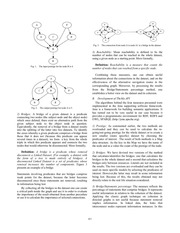
Definition: The input prestige of a node n is the
number of predicates terminating at n ( Figure 1).
Definition: The output prestige of a node n is the number
of predicates beginning at n (Figure 2).
Out-going prestige measures the links in which this node
is a subject pointing to other nodes. A very prestigious node
is one that appears as a subject in many triples in the dataset.
One may claim that the node in question is the source to a
considerable amount of information in the dataset.
Consequently, using a prestigious node as a starting point in
order to retrieve information present in the dataset is likely
to lead to a more reliable result.
In-going prestige measures the links that points to a
specific node. Equivalently, the number of links the node in
question comprises the object of. A node with a high ingoing prestige value tends to be an important node for the
dataset because it represents useful information for most of
the nodes in the dataset. This in turn implies that following
the links to high in-going prestige nodes in the graph, one is
able to efficiently discover information originally hidden in
the dataset.
CONTRIBUTION
Firstly, we are going to outline the formal aspects of our
model. Next, we are going to explain the design and
evaluation of our API.
A Linked Dataset is a set of triples LD = (S, P, O) where
• S is a concept which is called subject
• O is a concept or a literal data which is called object
• P is an ordered pair which includes S and O. It is called
predicate
A predicate p = (S, O) is always directed from S to O; O is
also called the head and S is called the tail of the predicate;
O is said to comprise a direct successor of S, and S is said to
comprise a direct predecessor of O. If a path leads from S to
O, then O is said to be a successor of S and reachable from
S, and S is said to be a predecessor of O.
On the other hand, a Linked Dataset (LD) is called
symmetric if, for every predicated in LD, the corresponding
inverted predicated also belongs to LD.
450
�
Fig. 3. The connection from node A to node A1 is a bridge in the dataset.
3) Reachability: Mean reachability is defined to be the
number of nodes that can be reached in the whole dataset,
using a given node as a starting point. More formally,
Definition: Reachability is a measure that counts the
number of nodes that can reached from a specific node.
Fig. 1. The input prestige for the node B is 4.
Combining these measures, one can obtain useful
information about the connections in the dataset, and on the
effectiveness of the alternative navigation routes in the
corresponding graph. Moreover, by processing the results
from the Bridge/Statements percentage method, one
establishes a better view on the dataset and its cohesion.
Fig. 2.
B. Development of TheMa API
The algorithms behind the four measures presented were
implemented in the Jena supporting software framework.
Jena is a framework for building semantic applications. It
has turned out to be very useful in our case because it
provides a programmatic environment for RDF, RDFS and
OWL, SPARQL (http://jena.apache.org).
The output prestige for node A is 5.
2) Bridges: A bridge of a given dataset is a predicate
connecting two nodes (the subject node and the object node)
which once deleted, there exist no alternative path from the
given subject node to the object node in question.
Equivalently, the removal of a bridge from a dataset results
into the splitting of the latter into two datasets. To identify
the cases whereby a given predicate comprises a bridge from
those that it does not (because this predicate can appear
several times in a dataset), we form a key from the whole
triple in which this predicate appears and connects the two
nodes that would otherwise be disconnected. More formally,
1) Prestige: As commented earlier, the two methods are
overloaded and they can be used to calculate the ingoing/out-going prestige for the whole dataset or to create a
new smaller (more specific) dataset by choosing the
predicates of interest . The result of both methods is a Map
data structure. As the key in the Map we have the name of
the node and as a value the count of the prestige of the node.
Definition: A bridge is a predicate whose removal
disconnects a Linked Dataset. (For example, a dataset with
the form of a tree is made entirely of bridges). A
disconnected Linked Dataset is a set of predicates whose
removal increases the number of components. Figure 3
presents an example of a bridge.
2) Bridges: We have devised two versions of the method
that calculates/identifies the bridges: one that calculates the
bridges in the whole dataset and a second that calculates the
bridges only between resources. Literals are not included in
the results. The two versions are overloaded and they can be
used on more specific models by selecting the predicates of
interest. However,the latter may result in some information
being lost. Because of this, the results obtained may not
directly relate to the real life situation considered.
Statements involving predicates that are bridges comprise
weak points for the dataset, because the latter becomes
disconnected once these statements are removed, resulting
in information being lost.
By collecting all the bridges in the dataset one can create
a critical path inside the graph and use it in order to evaluate
the importance of the result obtained from another procedure
or use it to calculate the importance of selected connections.
3) Bridge/Statements percentage: The measure reflects the
percentage of statements that comprise bridges. It represents
useful information in relation to the cohesion of the dataset.
Applying the classic graph technique on cohesion in
directed graphs is not useful because statement removal
implies information. In linked data, the links that
interconnect nodes represent information instances. In this
451
�
Reachability
• Using #Brazil as the start node, the total number of
nodes that could be reached was 8. Thus, the reachability
of the #Brazil node was measured to be equal to 8.
respect, the algorithm that calculates the percentage of
statements that act as bridges in the graph comprises a better
approach, and a useful statistical measure. A high value of
the bridge/statements percentage implies a loosely
connected dataset, one that can easily become disconnected.
When the percentage is low, most of our nodes
interconnected to each other more than once. This in turn
implies a strongly connected dataset, one that is hard to split
it and (consequently) lose information.
Mean reachability
• The mean reachability of the dataset was calculated to be
equal to 257.159
4) Reachability/Mean Reachability: Reachability is a
measure that counts the number of nodes that can be
reached from a specific node. Mean reachability is the
average reachability value across the entire dataset. By
combining the two measures one can obtain useful
information about the connections in the dataset and on how
one can navigate through it. Moreover, if the above are
combined/considered in parallel with the aforementioned
Bridge/Statements percentage method in parallel, one
establishes a clearer view on the dataset and its cohesion.
CONCLUSION
We report on a new API involving algorithms used for
extracting implicit information from Linked Datasets. The
API incorporates basic network analysis algorithms applied
to graphs representing relations between discrete objects,
and includes methods for identifying the most prestigious
nodes, bridges, as well as for calculating useful statistics,
like reachability and mean reachability. The results indicate
that this set of algorithms can be useful in extracting
implicit information from datasets in the Web of Data.
RESULTS
In order to evaluate our approach, we created a linked
dataset on South American countries. The dataset was
extracted from DBpedia. The TheMa API was tested against
this dataset, giving the results summarized below.
In the future stages of our research, we intend to extend
the TheMa API in the direction of calculating a richer set of
measures. Measure like the number of cycles in the dataset
the closure of a node in a given dataset, etc.. The main idea
is to not only support basic network theory operations, but
also more involved statistics. For example, we wish extend
the API to calculate path similarity, as well as to
identify/predict missing links.
Lastly, we intend to devise a set of benchmarking linked
datasets to be used for comparing the TheMa API to other,
analogous, API’s that will be proposed by other researchers
in the near future.
Input prestige:
•
The most prestigious node was found to be #Argentina
with a value of 2001. That means that the node
#Argentina appeared as an object in the dataset’s
statements for 2001 times, the highest input prestige
value across the dataset.
Output prestige:
• The most prestigious node was found to be #Suriname
with a value of 182. This meant that the node #Suriname
appeared to be the subject in 182 statements, achieving
the highest output prestige value across the entire
dataset.
ACKNOWLEDGMENTS
This work has been funded by the Spanish Ministry of
Innovation and Science project ICARIA: From Semantic
Web to Systems Biology, Project Code: TIN2008-04844, and
by the Regional Government of Andalucía Pilot Project for
Training and Developing Applied Systems Biology
Technology, Project Code: P07-TIC-02978.
Bridges/Statements Percentage
• The dataset consisted of 16038 statements, 12418 of
which represented bridges. Consequently, the
bridges/statements percentage value was calculated to be
0.774.
• From the 12418 bridges, 11735 were found to be the
instances of bridges pointing to resources and not to
literal values. Thus, the percentage of statements-bridges
that did not point to literals was calculated to be 0.732.
REFERENCES
C. Bizer (2009), The Emerging Web of Linked Data, IEEE
Intelligent Systems, Vol. 24(5), pp. 87-92.
[2] V. Narasimha Pavan Kappara, R. Ichise, O.P. Vyas (2011),
LiDDM: A Data Mining System for Linked Data, http://ceurws.org, Vol. 813
[3] S. Auer, J. Lehmann (2010), Creating knowledge out of
interlinked data, Semantic Web, Vol. 1, pp. 97-104.
[1]
452
�
D. Gibson, Jon M. Kleinberg, and P. Raghavan, Inferring
Web Com-munities from Link Topology, Proceedings of the
9th ACM Conference on Hypertext and Hypermedia, pp. 225234.
[9] J. Hopcroft, O. Khan, and B. Selman (2003), Tracking
evolving communities in large linked networks, Proceedings
of the SIGKDD International Conference on Knowledge
Discovery and Data Mining, Vol. 101, pp. 5249-5253.
[10] W. Baker and R Faulkner (1993) The social organization of
conspiracy: illegal networks in the heavy electrical equipment
industry. Am. Social. Rev., Vol. 58, pp. 837-860.
C. Bizer, J. Lehmann, G. Kobilarov, S. Auer, C. Becker, R.
Cyganiak, S. Hellmann (2009), DBpedia - A crystallization
point for the Web of Data, J. Web Sem., Vol. 7(3), pp. 154165.
[5] D. Chakrabarti, C. Faloutsos (2006), Graph Mining: Laws,
Generators, and Algorithms, ACM Comput. Surv., Vol. 38(1).
[6] L. Getoor (2003), Link mining: A new data mining challenge,
SIGKDD Exploration, Vol. 5.
[7] H. White and K. McCain (1989) Bibliometrics. Annual
Review of Information Science and Technology, Vol. 24, pp.
119-186.
[8]
[4]
453
�
 Historical archive . public document