Journal of Universal Computer Science, vol. 18, no. 2 (2012), 194-217
submitted: 29/9/10, accepted: 16/12/11, appeared: 28/1/12 © J.UCS
MaF: An Ontology Matching Framework
Jorge Martinez-Gil, Ismael Navas-Delgado, and
Jos´
e F. Aldana-Montes
(Department of Computer Science, University of M´
alaga
Boulevard Louis Pasteur 35, PC 29071, M´alaga, Spain
jorgemar@acm.org, {ismael, jfam}@lcc.uma.es)
Abstract: In this work, we present our experience when developing the Matching
Framework (MaF), a framework for matching ontologies that allows users to configure
their own ontology matching algorithms and it allows developers to perform research
on new complex algorithms. MaF provides numerical results instead of logic results
provided by other kinds of algorithms. The framework can be configured by selecting
the simple algorithms which will be used from a set of 136 basic algorithms, indicating exactly how many and how these algorithms will be composed and selecting the
thresholds for retrieving the most promising mappings. Output results are provided in
a standard format so that they can be used in many existing tools (evaluators, mediators, viewers, and so on) which follow this standard. The main goal of our work is not
to better the existing solutions for ontology matching, but to help research new ways
of combining algorithms in order to meet specific needs. In fact, the system can test
more than 6 · 136! possible combinations of algorithms, but the graphical interface is
designed to simplify the matching process.
Key Words: Ontology Matching; Knowledge Integration; Software Tools
Category: M.1, M.3
1
Introduction
The notion of ontology is important as a form of representing real world facts.
Ontology matching1 is a key aspect of knowledge management [Wen, 2009]; it
allows organizations to model their own knowledge without having to stick to
a specific standard. In fact, there are two good reasons why most organizations
are not interested in working with a standard for modeling their own knowledge:
(a) it is very difficult or expensive for many organizations to reach an agreement
about a common standard, and (b) these standards do not often fit to the specific
needs of the all participants in the standardization process.
Ontology matching is perhaps the best way to solve the problems of heterogeneity. There are a lot of techniques for aligning ontologies very accurately
[Noy, 2004], but the complex nature of the problem to be solved makes it difficult for these techniques to operate satisfactorily for all kinds of data, in all
domains, and as all users expect [Kiefer et al., 2003]. As a result, techniques that
combine existing methods have been proposed as a feasible solution. The goal
1
We call ontology matching to the task of finding correspondences between ontologies
and ontology alignment to the result of this task
�
Martinez-Gil J., Navas-Delgado I., Aldana-Montes J.F.: MaF: An Ontology ...
195
of these techniques is to obtain more accurate matching algorithms. The way to
combine these matching algorithms is currently being exhaustively researched.
The reason is that obtaining satisfactory ontology alignments is a key aspect for
such fields as:
– Semantic integration [Bernstein and Melnik, 2004]. This is the process of
combining metadata residing in different sources and providing the user with
a unified view of these data. This kind of integration should be done automatically, because manual integration is not viable, at least not for large
volumes of information.
– Ontology mapping [Ehrig and Sure, 2004]. This is used for querying different
ontologies. An ontology mapping is a function between ontologies. The original ontologies are not changed, but the additional mapping axioms describe
how to express concepts, relations, or instances in terms of the second ontology. They are stored separately from the ontologies themselves. A typical
use case for mapping is a query in one ontology representation, which is then
rewritten and handed on to another ontology. The answers are then mapped
back again. Whereas alignment merely identifies the relationship between
ontologies, mappings focus on the representation and use of the relations.
– The Web Services industry, where Semantic Web Services (SWS) are discovered and composed [Cabral et al., 2004] in a completely unsupervised
manner. Originally SWS alignment was based on exact string matching of
parameters, but nowadays researchers deal with issues of heterogeneous and
constrained data matching.
– Data Warehouse applications [Fong et al., 2009]. These kinds of applications
are characterized by heterogeneous structural models that are analyzed and
matched either manually or semi-automatically at design time. In such applications matching is a prerequisite of running the actual system.
– Similarity-based retrieval [Sistla et al., 1997]. Semantic similarity measures
play an important role in the information retrieval field by providing the
means to improve process recall and precision. These kinds of measures are
used in various application domains, ranging from product comparison to
job recruitment.
– Agent communication [Kun et al., 2010]. Current software agents need to
share a common terminology in order to facilitate the data interchange
between them. Using ontologies is a promising technique to facilitate this
process, but there are several problems related to the heterogeneity of the
ontologies used by the agents which make the understanding at semantic
level difficult. Ontology matching can solve this kind of problem.
�
196
Martinez-Gil J., Navas-Delgado I., Aldana-Montes J.F.: MaF: An Ontology ...
All this means that the business and scientific communities are seeking to
develop automatic or semiautomatic techniques to reduce the tedious task of
creating and maintaining the ontology alignments manually. However, the nature of the problem is complex because finding good similarity functions is, data,
context, and sometimes even user-dependent, and needs to be reconsidered every
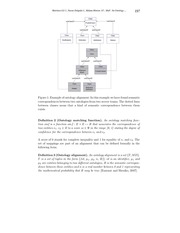
time new data or a new task is inspected [Kiefer et al., 2003]. Figure 1 shows an
example of this fact; it is an example of alignment between ontologies representing players from two football teams. This alignment between ontologies could
be true for some cases and for some people, but probably not for all. Therefore,
we need mechanisms to make ontology matching as independent as possible of
data, context and users.
The main contribution of this work is the presentation of a new ontology
matching tool which we have called Matching Framework (MaF), therefore, we
describe detailed accounts of completed software-system projects which can serve
as ’how-to-do-it’ models for future work in the same field. Our approach is based
on distance and similarity methods instead of frameworks based on the definition
of theoretical aspects of matching. These systems are generally accomplished by
considering the underlying Description Logics (DL) on which the ontologies are
founded [Kalfoglou and Schorlemmer, 2003].
The rest of this work is organized as follows: Section 2 describes the Stateof-the-Art related to ontology matching and its associated problems. Section 3
describes the general characteristics for MaF framework. Section 4 shows two
practical examples for MaF, the first example is focused on end users and the
second is focused on algorithm developers. Section 5 describes a case study in
which we solve common cases using the framework. Finally, we discuss the conclusions and the possible future improvements for the framework.
2
Problem Statement
An ontology is “a specification of a conceptualization” [Gruber, 1993], i.e. an
abstract representation of the world like a set of objects. In this work, we are
going to use the intuitive notion of ontology as a set of terms with relationships
among them. On the other hand, as stated in [Euzenat and Shvaiko, 2007], the
process of aligning ontologies can be expressed as a function where given a pair
of ontologies, an (optional) input alignment, a set of parameters and a set of
resources, returns an alignment.
Definition 1 (Ontology matching task). Let O be the set of ontologies and
A the set of alignments. An ontology matching task omt : O × O �→ A maps two
input ontologies o1 , o2 ∈ O to an alignment a ∈ A using a matching function.
�
Martinez-Gil J., Navas-Delgado I., Aldana-Montes J.F.: MaF: An Ontology ...
197
Figure 1: Example of ontology alignment. In this example we have found semantic
correspondences between two ontologies from two soccer teams. The dotted lines
between classes mean that a kind of semantic correspondence between them
exists
Definition 2 (Ontology matching function). An ontology matching function omf is a function omf : E × E �→ R that associates the correspondence of
two entities e1 , e2 ∈ E to a score sc ∈ � in the range [0, 1] stating the degree of
confidence for the correspondence between e1 and e2 .
A score of 0 stands for complete inequality and 1 for equality of e1 and e2 . The
set of mappings are part of an alignment that can be defined formally in the
following form.
Definition 3 (Ontology alignment). An ontology alignment is a set {T, M D}.
T is a set of tuples in the form {(id, µ1 , µ2 , n, R)}. id is an identifier, µ1 and
µ2 are entities belonging to two different ontologies, R is the semantic correspondence between these entities and n is a real number between 0 and 1 representing
the mathematical probability that R may be true [Euzenat and Shvaiko, 2007].
�
198
Martinez-Gil J., Navas-Delgado I., Aldana-Montes J.F.: MaF: An Ontology ...
The entities that can be related are the concepts, properties, individuals
and, even axioms of the ontologies. On the other hand, M D is metadata (date,
time consumption and so on) related to the matching process for information
purposes and it is only relevant for collecting statistical data like the computational efficiency of the process. We have focused on concepts, properties and
individuals.
On the other hand, n can represent equivalence, generalization, subsumption,
disjointness and, so on. Without explanation here, it is going to state equivalence
only.
There are a lot of matching functions. Most of them are used to obtain an
ontology alignment. These functions exploit a wide range of information, such
as ontology characteristics (i.e. metadata, element names, data types, and structural properties), characteristics of individuals, as well as background knowledge from dictionaries, thesauri, even web resources. Most authors tend to categorize simple matchers in three groups defined by [Rahm and Bernstein, 2001]:
Element-Based matchers, Structure-Based matchers, and Hybrid matchers. These kinds of matchers are described and their representative implementations are
discussed in the next subsection.
Definition 4 (Alignment evaluation). An alignment evaluation ae is a function ae : A×AR �→ precision×recall, where precision and recall are real numbers
ranging over the unit interval [0, 1].
Precision states the fraction of retrieved correspondences that are relevant
for a matching task. Recall is the fraction of the relevant mappings that are
obtained successfully in a matching task. In this way, precision is a measure
of exactness and recall a measure of completeness. The problem here is that
techniques can be optimized either to obtain high precision at the cost of the
recall or, alternatively, recall can be optimized at the cost of the precision. For
this reason a measure, called f-measure, is defined as a weighting factor between
precision and recall. In this work, we use the most common configuration which
consists of weighting precision and recall equally.
2.1
Element-Based Matching Algorithms
Element-Based Matching Algorithms are methods that take into account only
textual information about the entities (instead of their relations to other entities). This textual information can be exploited in many ways: comparing the
identifiers of the entities, their associated comments, the identifiers of their children, their associated individuals, and so on. In general, there is a common
agreement for grouping these methods. These are the most notable categories:
�
Martinez-Gil J., Navas-Delgado I., Aldana-Montes J.F.: MaF: An Ontology ...
199
– Text similarity methods. Text similarity methods are string based techniques
for identifying similar elements [Euzenat and Shvaiko, 2007]. Such a method
may be used to identify identical classes of two ontologies based on their
similar label or description [Stoilos et al., 2005]. This includes global namespaces, too. In [Navarro, 2001] a survey can be seen.
– Keyword extraction algorithms. This kind of algorithm consists of identifying
keywords that can be used to detect some kind of meaning and therefore to
identify the semantics of a class and its relation to other classes. This is
performed by looking for proper nouns [Vazquez and Swoboda, 2007] or by
analyzing the frequency of common terms [Cilibrasi and Vitanyi, 2007].
– Language-based algorithms. Language-based methods such as removing unnecessary words (stop-words) or performing text stemming can be used to
handle class or attribute names [Ji et al., 2006]. For example, they can be
used in order to detect that the class “lift” and “elevator” represents the
same object in the real world. This also means considering typical language based prefixes or suffixes as well as other text pattern matching tools
[Ierusalimschy, 2009].
– Identification of word relations. This involves the inclusion of linguistic resources such as lexicons and thesauri in order to identify synonyms. It is
also common to use a lexical database such as WordNet [Wordnet, 2009]
to identify relationships between concepts. In recent times, web knowledge
extraction techniques are being used in this field too.
2.2
Structure-Based Matching Algorithms
Structured-Based Matching Algorithms are computational methods that take
into account the structure of the ontology (instead of textual information about
them). These are the most outstanding categories:
– Class inheritance analysis (is-a). This method considers the inheritance between classes in order to identify “is-a”-relationships. For example, we might
consider two ontologies A and B. Ontology A might contain a “car”, while
B contains “vehicle”. The class inheritance analysis tries to find inheritance
relationships between the concepts of A and B (a “car” -is-a-“vehicle”).
– Structural analysis / Taxonomic structure. The structural analysis identifies
identical classes by looking at their attributes and related classes. The main
idea behind algorithms of this kind is that two classes of two ontologies are
similar or identical if they have the same attributes and the same neighbor
classes.
�
200
Martinez-Gil J., Navas-Delgado I., Aldana-Montes J.F.: MaF: An Ontology ...
– Data interpretation and analysis of key properties. Since instances are often
included, it is possible to identify similar classes by looking at their instances.
If two classes have the same instances, then they will most likely match each
other. In some cases, it might be possible to identify the meaning of an
attribute by looking at an instance. For example, if a string contains “years
old” then it represents an age related attribute.
– Graph-Mapping. This kind of algorithm can be used to identify similar structures in two ontologies by looking for identical parts [Ziegler, 2006]. Unlike
the structural analysis, the graph based mapping method interprets only
the graphical representation of the ontology structure and looks at paths,
children and leaves.
2.3
Semantic Matching Algorithms
According to Euzenat and Shvaiko [Euzenat and Shvaiko, 2007], semantic matching algorithms handle the input based on its semantic interpretation. It is assumed that if two entities are the same, then they share the same interpretations.
Thus, they are well grounded deductive methods. Most outstanding approaches
are propositional satisfiability and description logics reasoning techniques. The
problem of these techniques is that “pure deductive methods do not perform
very well alone for an essentially inductive task like ontology matching”. Hence
they need a preprocessing phase which provides entities which are declared, for
example, to be equivalent [Ehrig, 2007].
2.4
Contribution to the State-of-the-art
Despite the large number of existing techniques, experience tells us that finding
an appropriate solution is far from being trivial. As we commented earlier, the
heterogeneity and ambiguity of data description makes it unavoidable that optimal mappings for many pairs of entities will be considered as best results by none
of the existing ontology matching algorithms. For this reason, researchers have
introduced the notion of composite matchers which are aggregations of simple
matching algorithms.
The main idea of this kind of matchers is to combine similarity values predicted by multiple matchers to determine correspondences between ontology
elements. In this way, it is possible to benefit from both the high degree of
precision of some algorithms and at the same time the broader coverage of others [Eckert et al., 2009]. Some of the most outstanding proposals following this
paradigm are COMA [Do and Rahm, 2002], COMA++ [Aumueller et al., 2005],
�
Martinez-Gil J., Navas-Delgado I., Aldana-Montes J.F.: MaF: An Ontology ...
201
FOAM [Ehrig and Sure, 2005], OntoBuilder [Roitman and Gal, 2006] and RiMOM [Li et al., 2009], to name a few. COMA was the first proposal for combining strategies when matching ontologies and, COMA++ improved on COMA
with a nicer graphical user interface and an extension of the set of matchers. Despite these tools are the pioneers, even today, they are still considered the point
of reference in the field because they showed practitioners and researchers the
possibilities of matcher combination. FOAM approach began to give importance
to the heuristic selection of the weights for basic matchers; they proposed using
a sigmoid function to appropriately weight matchers emphasizing good matchers
and de-emphasizing the worst ones. The OntoBuilder introduced the notion of
top-k mappings in order to provide an alternative for a single best matching.
And finally, the RiMOM framework has shown a really good performance in the
past OAEI contests [Caracciolo et al., 2008]. A detailed description of these approaches is out of the scope of this work. However, these and other approaches
have been reviewed in depth by Euzenat & Shvaiko[Euzenat and Shvaiko, 2007].
To the best of our knowledge, MaF is the system with the largest number of basic
matchers, with the largest number of possible matcher combinations, and along
with COMA [Do and Rahm, 2002] and DIKE [Papoli et al., 2003], one of the
first to be described from a software experience perspective, which is one of the
main challenges addressed by Shvaiko and Euzenat [Shvaiko and Euzenat, 2008].
On the other hand, several tools provide the user with semi-automatic mechanisms in order to obtain perfect mappings. Nevertheless we agree with Euzenat
and Shvaiko [Euzenat and Shvaiko, 2007] when they say that “Many applications require submitting matching results to user scrutiny and control before
using them, but the better the automated part of the task, the easier the control”. In this way, our approach considers that the output results will be the
input to such tools as correctors, evaluators, mediators, viewers and, so on, as
we show in Section 4. The main goal of MaF is to provide reasonable results
to the users and third party applications, and the objective of this work is to
describe how to do so.
3
MaF Description
The Matching Framework (MaF) is an ontology matching framework that includes the common features that users may need. MaF uses classic algorithms,
instead of those based on logics algorithms. MaF allows users to aggregate algorithms and combine them in order to operate with the input ontologies and
generate the output alignment. The framework has been designed to accept
OWL (DL, Lite or Full) ontologies as input, while the output will be basically
represented as lists of pairs with a similarity value between 0 and 1 associated,
indicating no probability to represent the same real object for the value 0 and
�
202
Martinez-Gil J., Navas-Delgado I., Aldana-Montes J.F.: MaF: An Ontology ...
Figure 2: Screenshot from the main form. We can see the loaded ontologies in a
taxonomic way in order for users to locate what they are interested in
total probability for the value 1. This output is compliant with the standard format from the Ontology Alignment Evaluation Initiative (OAEI) [OAEI, 2008].
Figure 2 shows a screenshot from the initial form of MaF where two ontologies
have been renderized in a taxonomic way in order to be presented to the user.
On the other hand, major characteristics for MaF are:
– MaF allows both schema and instance matching. All of the matching algorithms provided can work with concepts, object properties, datatype properties and individuals. Do not confuse instance matching with matching based
on instances. MaF provides both kinds but the first one consists of the use
of element-based methods to compare ontology instances, and the second
consists of the comparison of concepts using their associated instances.
– MaF allows both element and structure matching. The matching algorithms
can be used not only for aligning the individual elements of the ontology,
but also ontology structures, too. It is possible to combine the two kinds of
algorithms in order to obtain a third kind that is even more powerful and
that we have called a hybrid algorithm.
�
 Historical archive . public document