Optimizing Ontology Alignments by Using
Genetic Algorithms
Jorge Martinez-Gil, Enrique Alba, and Jos´e F. Aldana-Montes
Universidad de M´
alaga, Departmento de Lenguajes y Ciencias de la Computaci´
on
Boulevard Louis Pasteur s/n 29071 M´
alaga (Spain)
{jorgemar,eat,jfam}@lcc.uma.es
http://www.lcc.uma.es
Abstract. In this work we present GOAL (Genetics for Ontology Alignments) a new approach to compute the optimal ontology alignment function for a given ontology input set. Although this problem could be solved
by an exhaustive search when the number of similarity measures is low,
our method is expected to scale better for a high number of measures.
Our approach is a genetic algorithm which is able to work with several
goals: maximizing the alignment precision, maximizing the alignment recall, maximizing the f-measure or reducing the number of false positives.
Moreover, we test it here by combining some cutting-edge similarity measures over a standard benchmark, and the results obtained show several
advantages in relation to other techniques.
Key words: ontology alignment; genetic algorithms; semantic integration
1
Introduction
The Semantic Web is a new paradigm for the Web in which the semantics of
information is defined, making it possible for the web to understand and satisfy
the requests of people and machines to use the web resources. Therefore, most
authors consider it as a vision of the Web from the point of view of an universal
medium for data, information, and knowledge exchange [1].
In relation to knowledge, it is very important the notion of ontology as a
form of representation about a particular universe of discourse or some part of
it. Ontology alignment is a key aspect in order to the knowledge exchange in
this extension of the Web may be real; it allows organizations to model their
own knowledge without having to stick to a specific standard. In fact, there are
two good reasons why most organizations are not interested in working with a
standard for modelling their own knowledge: (a) it is very difficult or expensive
for many organizations to reach a agreement about a common standard, and (b)
these standards do not often fit to the specific needs of the all participants in
the standarization process.
Altought ontology alignment is perhaps the most valuable way to solve the
problems of heterogeneity and, even there are a lot of techniques for aligning
�
2
Martinez-Gil et al.
ontologies in a very accurate manner, experiences tells us that the complex
nature of the problem to be solved makes difficult that these techniques operate
in a satisfactory way for all kinds of data, in all domains, and as all users expect.
This problem has been studied in [2].
As a result, techniques that combine existing methods have appeared. The
goal of these techniques is to obtain more complex and accurate matching algorithms. The way to combine these matching algorithms is under an exhaustive
research now. The most promising mechanisms are reviewed in the Section 6,
but we can advance that the use of Genetic Algorithms (GAs) has been studied
in little depth by researchers. Therefore, the main contributions of this work are:
– The proposal of an efficient mechanism, other than those that already exist,
to compute the optimal function for aligning arbitrary sets of ontologies.
– The additional possibility to obtain goal-driven results, thus optimize some
of the characteristics of an output alignment.
– We provide results following a standard benchmark to enable the comparison
with other approaches.
The rest of this work is structured in the following way: Section 2 describes
the problem statement. Section 3 presents the technical preliminaries which are
neccesary to our approach. Section 4 discusses our aproach. Section 5 findings
extracted from several experiments, including the use of a benchmark provided
by the Ontology Alignment Evaluation Initiative [3]. Section 6 compares our
results with other proposals. Finally, we remark the strengths and flaws of our
proposal and discuss the future work in Section 7.
2
Problem Statement
The process of aligning ontologies can be expressed as a function f where given
a pair of ontologies o and o0 , an partial (and optional) input alignment A, a set
of parameters p and a set of resources r, returns a new alignment A0 :
A0 = f (o, o0 , A, p, r)
A0 is a set of mappings. A mapping is an expression that represents a semantic
correspondence between two entities. A mapping is the atomic component of an
alignment and is a formalism that allows to share knowledge models created
separately.
However, experience tells us that getting f is far from trivial. As we commented earlier, the heterogeneity and ambiguity of data descriptions makes unrealistic the scenario in which that optimal mappings for many pairs of entities will
be considered as ”best mappings” by any of the existing matching algorithms.
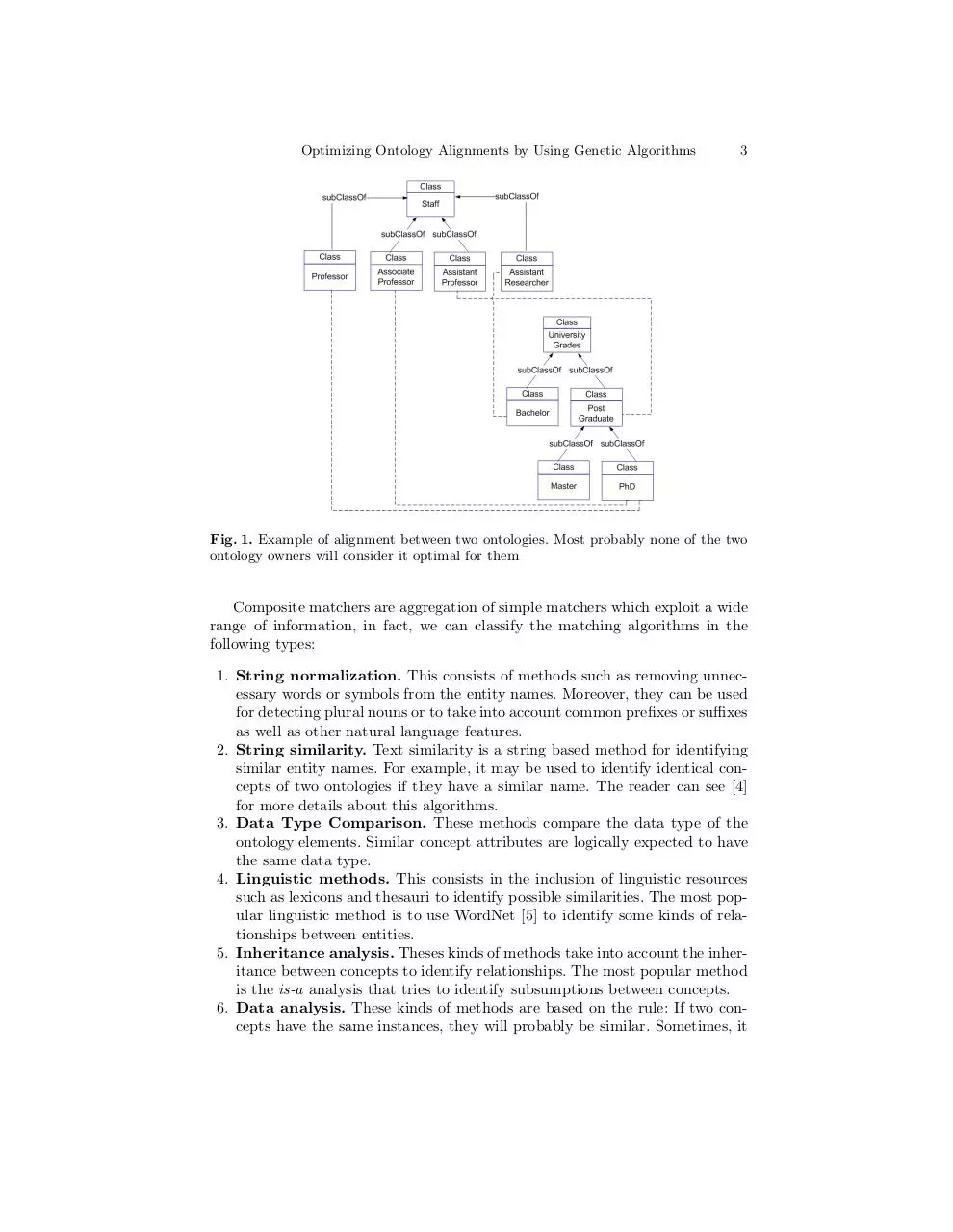
For instance, the Fig. 1 shows an alignment that is valid for users from some
countries, but not for some others. The current trend is to diversify (and possibly weight) the matching algorithms. To do it, it is neccesary to use composite
ontology matchers.
�
Optimizing Ontology Alignments by Using Genetic Algorithms
3
Fig. 1. Example of alignment between two ontologies. Most probably none of the two
ontology owners will consider it optimal for them
Composite matchers are aggregation of simple matchers which exploit a wide
range of information, in fact, we can classify the matching algorithms in the
following types:
1. String normalization. This consists of methods such as removing unnecessary words or symbols from the entity names. Moreover, they can be used
for detecting plural nouns or to take into account common prefixes or suffixes
as well as other natural language features.
2. String similarity. Text similarity is a string based method for identifying
similar entity names. For example, it may be used to identify identical concepts of two ontologies if they have a similar name. The reader can see [4]
for more details about this algorithms.
3. Data Type Comparison. These methods compare the data type of the
ontology elements. Similar concept attributes are logically expected to have
the same data type.
4. Linguistic methods. This consists in the inclusion of linguistic resources
such as lexicons and thesauri to identify possible similarities. The most popular linguistic method is to use WordNet [5] to identify some kinds of relationships between entities.
5. Inheritance analysis. Theses kinds of methods take into account the inheritance between concepts to identify relationships. The most popular method
is the is-a analysis that tries to identify subsumptions between concepts.
6. Data analysis. These kinds of methods are based on the rule: If two concepts have the same instances, they will probably be similar. Sometimes, it
�
4
Martinez-Gil et al.
is possible to identify the meaning of an upper level entity by looking at a
lower level entity. For example, if instances contain a string such as years
old, it probably belongs to an attribute called age.
7. Graph-Mapping. This consists in identifying similar graph structures in
two ontologies. These methods use known graph algorithms to do so. Most
of times this involves computing and comparing paths, adjacent nodes and
taxonomy leaves.
8. Statistical analysis. It consists of the extraction of keywords and textual
descriptions for detecting the meaning of the entities in relation to other
entities.
9. Taxonomy analysis. It tries to identify similar concepts by looking at their
related concepts. The main idea is that two concepts belonging to different
ontologies have a certain degree of probability of being similar if they have
the same neighbours.
The main idea of composite matchers is to combine similarity values predicted
by multiple simple algorithms to determine correspondences between entities
belonging to different ontologies. The most popular proposals in this field are
COMA [6], COMA++ [7], QuickMig [8], FOAM [9], iMAP [10] and OntoBuilder
[11]. But these proposals use, in the best of the cases, weigths determined by an
expert. Our work does not use weights from an expert, but compute those for
obtaining the optimum alignment function so that the problem can be solved
accuarately and without requiring human intervention.
3
Technical Preeliminaries
Definition 1 (Similarity measure). A similarity measure sm is a function
sm : µ1 × µ2 7→ < that associates the similarity of two input ontology entities
µ1 and µ2 to a similarity score sc ∈ < in the range [0, 1], where a similarity
score of 0 stands for complete inequality and 1 for complete equality of the input
ontology entities µ1 and µ2 .
Definition 2 (Weighted similarity measure). Let A be a set of well-known
similarity measures and w a numeric weight vector, and let O1 , O2 be two input
ontologies, then we can define wsm as a weighted similarity measure in the
following form:
Pi=n
wsm(O1 , O2 ) = x ∈ [0, 1] ∈ < → ∃ hA, wi , x = max( i=1 Ai · wi )
Pi=n
subject to i=1 wi ≤ 1
From an engineering point of view, this function leads to an optimization
problem for calculating the numeric weight vector, because the number of candidates from the solution space (in this case an arbitrary continous interval) is
infinite. Hence, exact techniques are of low help here, and we are interested in
methods such metaheuristics (e.g.g genetic algorithms) that find quasi optimum
�
Optimizing Ontology Alignments by Using Genetic Algorithms
5
results in such solution spaces.
Definition 3 (Ontology alignment). An ontology alignment oa is a set of
tuples {(id, e, e0 , n, R)}. Where id is an unique identifier of the mapping, e and
e0 are entities belonging to two different ontologies, R is the relation of correspondence between these entities and n is a real number between 0 and 1 that
represents the mathematical probability that R is true. The entities that are related are the concepts, roles, rules, and even axioms of the two ontologies.
Definition 4 (Ontology matching function). An ontology matching om is
sm
a function om : O1 × O2 → A that associates two input ontologies O1 and O2
to an alignment A using a similarity measure (or a weighted similarity measure).
Definition 5 (Alignment evaluation). An alignment evaluation ae is a function ae : A × AR 7→ precision × recall that associates an alignment A and an
reference alignment AR to two real numbers in the interval [0, 1] stating the precision and recall of A in relation to AR .
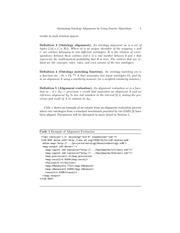
Code 1 shows an example of an output from an alignment evaluation process
where two ontologies from a standard benchmark provided by the OAEI [3] have
been aligned. Parameters will be discussed in more detail in Section 5.
Code 1 Example of Alignment Evaluation
<?xml version=’1.0’ encoding=’utf-8’ standalone=’yes’?>
<rdf:RDF xmlns:rdf=’http://www.w3.org/1999/02/22-rdf-syntax-ns#’
xmlns:map=’http://.../projects/ontology/ResultsOntology.n3#’>
<map:output rdf:about=’’>
<map:input1 rdf:resource="http://.../benchmarks/101/onto.rdf"/>
<map:input2 rdf:resource="http://.../benchmarks/204/onto.rdf"/>
<map:precision>1.0</map:precision>
<map:recall>0.6288</map:recall>
<fallout>0.0</fallout>
<map:fMeasure>0.7721</map:fMeasure>
<map:oMeasure>0.6288</map:oMeasure>
<result>0.6288</result>
</map:output>
</rdf:RDF>
�
6
Martinez-Gil et al.
4
Genetics for Ontology ALignments (GOAL)
We are beginning our research. First, we are going to consider GAs. Later, we
may consider other approaches. GAs are often used to search along very high
dimensional problems spaces. For example, if we want to find the maximum
value of the function wsf with three independent variables w0 , w1 and w2 :
wsf (O1 , O2 ) =
w0 · datatype(O1 , O2 ) + w1 · normalization(O1 , O2 ) + w2 · synonyms(O1 , O2 )
where w0 , w1 and w2 are weights to determine the importance of the three
respective similarity measures, which belong, for instance, to the continuous
interval [0, 1]. The problem that we want to solve consists of finding a good
value of w0 , w1 and w2 to find the largest possible value of wsf .
While this problem can be solved trivially by a brute force search over the
range of the independent variables w0 , w1 and w2 , the GA method scales very
well to similar problems of a higher dimensionality; for example, we might have
functions using a large number of independent variables w0 , w1 , w2 ,..., wn . In
this case, an exhaustive search would be prohibitively expensive.
Fig. 2. General schema for our proposal
The methodology of the application of a GA requires defining the following
strategies:
– Characterize the problem by encoding in a string of values the contents of a
tentative solution.
�
Optimizing Ontology Alignments by Using Genetic Algorithms
7
– Provide a numeric fitness function that will allow to rate the relative quailty
of each individual tentative solution in a population.
That is what we are going to do with GOAL. Our first task is to characterize
the search space as some parameters. We need to encode several parameters
in a single chromosome, so we have designed a method for converting a bit
representation to a set of floating-point numbers in the real range [0, 1].
Later, we haved designed a fitness function to determine which chromosomes
in the population are most likely to survive and reproduce using genetic crossover
and mutation operations.
Related to the fitness function, we can choose any parameter provided for
the alignment evalution process. In this way, we are providing the possibility to
select one of these goals.
–
–
–
–
Optimizing the precision (f itness := precision)
Optimizing the recall (f itness := recall)
Optimizing the f-measure (f itness := f − measure)
Reducing the number of false positives (f itness := f all − out)
The fitness function consist of selecting one of the parameters retrieved by
an Alignment Evaluation (see Definition 5). All of these parameters are concepts
used in Information Retrieval [12] for measuring the quality of a retrieval task.
Precision is the percentage of items returned that are relevant. Recall is the
fraction of the items that are relevant to a query (in this case, to a matching task).
F-measure is a harmonic mean from precision and recall. Finally, false positives
are relationships which have been provided to the user although they are false. In
some domains, (for instance in Medicine) false positives are absolutely unwanted.
Our algorithm works under the paradigm of a single goal programming strategy, but optimizing the F-Measure (a weighted sum of precision and recall) has
an effect similar to a multi-objetive strategy. However, a brief discussion about
using a multi-objetive algorithm will be presented as future work.
5
Empirical Evaluation
In this section, we provide an empirical evaluation of our approach. To do that,
we have worked with the well-known benchmark provided by the OAEI [3].
Firstly, we have performed a preeliminary study to choose the parameters and
then we have performed the main experiment.
5.1
Preeliminary Study
We are going to do a preeliminary study of the parameters for the algorithm.
– For the number of genes per chromosome we have selected such values as 5,
10 and 20. A study using a t-Test distribution has shown us that that the
differences between samples are not statistically significant. Therefore, we
have selected 20 genes per chromosome.
�
8
Martinez-Gil et al.
– For the number of individuals in the population, we have selected such values
as 20, 50 and 100. Again, a t-Test statistical distribution has shown that the
differences between these samples are not statistically significant. So we have
selected a population of 100 individuals.
– Related to crossover and mutation fraction, we have choosen a high value for
the crossover between genes and, a little percentage for mutations, because
we wish a classical configuration for the algorithm.
– After ten independent executions, we noticed that the genetic algorithm does
not improve the results beyond the fifth generation, so we have set a limit
of five generations.
5.2
Main Experiment
Related to the conditions of the experiment, we have used:
– As similarity measure vector:
{Levhenstein[13], SIFO[14], Stolios[15], QGrams[16]}
– The GA has been configured having into account the following parameters1 :
• 20 genes per chromosome
• Each gene is encoded in a 10-bit representation
• A population of 100 individuals
• 0.98 for crossover probability
• 0.05 for mutation probability
• We allow 5 generations
– The platform characteristics: Intel Core 2 Duo, 2.33GHz and 4GB RAM.
The way that we have choosen for providing the dynamic evaluation of the
alignment uses the following formulas:
P recision =
Recall =
{relevant mappings} ∩ {retrieved mappings}
{relevant mappings}
{relevant mappings} ∩ {retrieved mappings}
{retrieved mappings}
F M easure =
F allout =
2 · precision · recall
precision + recall
{non relevant mappings} ∩ {retrieved mappings}
{non relevant mappings}
Now, let us discuss the results we have obtained. Table 1 shows a brief description about the purpose of each test of the benchmark.
Table 2 shows the results from a Precision-Driven test, the Table 3 shows the
results from a Recall-Driven test, the Table 4 shows results from a F-MeasureDriven test and, finally Table 5 shows the empirical data from a Fall-out-driven
test.
1
Fitness and search space have been explained in the previous section
�
Optimizing Ontology Alignments by Using Genetic Algorithms
Ontology
Brief explanation
101
Strictly identical ontologies
102
A regular ontology and a null ontology
103
A regular ontology and other with a language generalization
104
A regular ontology and other with a language restriction
201
Ontologies without entity names
202
Ontologies without entity comments
203
Ontologies without entity names and comments
204
Ontologies with different naming conventions
205
Ontologies whose labels are synonymous
206
Ontologies whose labels are in different languages
221
A regular ontology and other with no specialisation
222
A regular ontology and other with a flatenned hierarchy
223
A regular ontology and other with a expanded hierarchy
224
Identical ontologies without instances
225
Identical ontologies without restrictions
301
A real ontology about bibliography made by MIT
Table 1. Explanation of the performed tests
Ontology
Comment
Best Precision
101
Reference alignment
1.00
102
Irrelevant ontology
N/A
103
Language generalization
1.00
104
Language restriction
1.00
201
No names
1.00
202
No names, no comments
1.00
203
No comments (was missspelling)
1.00
204
Naming conventions
1.00
205
Synonyms
1.00
206
Translation
1.00
221
No specialisation
1.00
222
Flatenned hierarchy
1.00
223
Expanded hierarchy
1.00
224
No instance
1.00
225
No restrictions
1.00
301
Real: BibTeX/MIT
0.90
Table 2. Precision-Driven test
Generations
1
1
1
1
1
1
1
1
2
2
2
3
2
1
2
5
9
�
 Historical archive . public document