Knowledge and Information Systems
Evaluation of Two Heuristic Approaches
to Solve the Ontology Meta-Matching
Problem
Jorge Martinez-Gil and Jos´e F. Aldana-Montes
Department of Computer Languages and Computing Sciences, University of M´
alaga, Spain
Abstract. Nowadays many techniques and tools are available for addressing the ontology matching problem, however, the complex nature of this problem causes existing
solutions to be unsatisfactory. This work aims to shed some light on a more flexible way
of matching ontologies: Ontology Meta-Matching which is a set of techniques to configure optimum ontology matching functions. In this sense, we propose two approaches
to automatically solve the Ontology Meta-Matching problem. The first one is called
MaSiMe, which is based on a greedy strategy to compute efficiently the parameters
which configure a composite matching algorithm. The second approach is called GOAL
and is based on a Genetic Algorithm which scales better for a large number of atomic
matching algorithms in the composite algorithm and is able to optimize the results of
the matching process.
Keywords: Ontology Meta-Matching, Knowledge Management, Information Integration
1. Introduction
The Semantic Web is a promising paradigm for the Web in which the semantics of
information is defined, making it possible for the Web to understand and satisfy
all of the requests from people and machines using the web resources. Therefore,
most authors consider the Web as an universal medium for data, information,
and knowledge exchange (Berners-Lee et al, 2001).
In relation to knowledge, it is very important the notion of ontology as a
form of representation about a particular universe of discourse or some part of
it. Ontology matching is fundamental so that appropriate knowledge exchange
Received Dec 12, 2008
Revised Jul 21, 2009
Accepted Nov 08, 2009
�
2
Martinez-Gil and Aldana-Montes
in this extension of the Web can be possible; it allows organizations to model
their knowledge without having to stick to a specific standard. In fact, there are
two good reasons why most organizations are not interested in working with a
standard for modeling their own knowledge: (a) it is very difficult or expensive
for many organizations to reach agreement about a common standard, and (b)
those standards which do exist often do not fit in with the specific needs of all
the participants.
Although automatic matching is perhaps the most appropriate way to align
ontologies, it has the disadvantage that finding good similarity functions is, data,
context, and sometimes even user-dependent, and needs to be reconsidered every
time new data or a new task is inspected (Kiefer et al, 2007). Moreover, dealing
with natural language often leads to a significant error rate. This last statement
is very important for those authors who do not easily allow interpretation of the
intellectual nature of a given concept by a machine (Doerr, 2001). However, they
admit that automatic methods are far cheaper and can detect relations of which
humans are unaware. We are convinced that the future lies in the coordinated
combination of intellectual and automatic methods. But in this work, we are
going to try to find customized similarity functions (CSF) in order to obtain the
best ontology alignment for each situation.
On the other hand, functions for calculating alignments can be divided into
similarity measures and distance measures.
– A similarity measure is a function that associates a numeric value with a pair
of objects, based on the idea that a higher value indicates greater similarity.
– A distance measure is a function that associates a non-negative numeric value
with a pair of objects, based on the idea that a short distance means greater
similarity. Distance measures usually satisfy the mathematical axioms of a
metric.
In practice, there are long-standing psychological objections to the axioms
used to define a distance metric. For example, a metric will always give the same
distance from a to b as from b to a, but in practice we are more likely to say
that a child resembles their parent than to say that a parent resembles their
child (Widdows, 2004). Similarity measures, however, give us an idea about the
probability of compared objects being the same (Pfitzner et al, 2009), but without falling into the psychological objections of a metric. So from our point of
view, working with similarity measures is more appropriate for detecting correspondences between different ontologies belonging to same domain. In this sense,
Ontology Meta-Matching could be considered a technique that automatically selects the appropriate similarity measures and their associated weights in the case
where similarity measures need to be composed. It tries to avoid the research
work which depends heavily on human thought. Ontology Meta-Matching can
be performed in several ways. We have designed one greedy and one genetic algorithm. The greedy algorithm allows us to obtain reasonable results with a low
computational cost and, the advantages inherent to the second strategy are its
great accuracy and scalability. The main contributions of this work are:
–
–
–
–
An introduction to the problem of Ontology Meta-Matching.
A greedy algorithm for solving the problem automatically and efficiently.
A genetic algorithm for optimizing the solutions to the problem.
An empirical evaluation of the proposed algorithms and a discussion of their
advantages.
�
Evaluation of Two Heuristic Approaches to Solve the Ontology Meta-Matching Problem
3
The remainder of this article is organized as follows. Section 2 describes the
problem statement related to the Ontology Meta-Matching problem, describes
the preliminary definitions and properties that are necessary for understanding
our proposal and and compares our proposal to the other approaches that try to
solve the problem. Section 3 discusses a greedy strategy and a way to effectively
compute it. Section 4 describes a genetic strategy and a way to implement it.
Section 5 shows the empirical data that we have obtained from some experiments,
including results obtained from a standard benchmark for ontology matching.
Section 6 includes the related work section which compares our work with other
approaches. And finally, in Section 7 the conclusions are discussed.
2. Problem Statement
The process of aligning ontologies can be expressed as a function f where given
a pair of ontologies O and O0 , an input alignment A, a set of parameters p and
a set of resources r, an alignment 0 A is returned::
A0 = f (O, O0 , A, p, r)
Where A0 is a set of mappings. A mapping1 is an expression that can be
written in the form (id, e, e0 , n, R). Where id is an unique identifier for the mapping, e and e0 are entities belonging to different ontologies, R is the relation of
correspondence and n is a real number between 0 and 1, which represents the
mathematical probability that R may be true (Ehrig, 2007). The entities that
can be related are the concepts, roles, rules and, even axioms of the ontologies.
However, experience tells us that finding f is far from being trivial. As we
commented earlier, the heterogeneity and ambiguity of data description makes it
unavoidable that optimal mappings for many pairs of entities will be considered
as ”best mappings” by none of the existing ontology matching algorithms which
are usually called matchers. For this reason, it is necessary to compose these
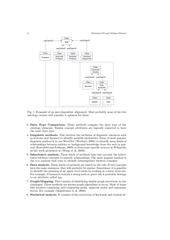
simple matchers. Figure 1 shows an example of an user-dependent alignment
between ontologies, because this alignment is not valid for all the countries in
the world.
Composite matchers are an aggregation of simple matching algorithms, usually called matchers. Matchers exploit a wide range of information, such as ontology characteristics (i.e. metadata, such as element names, data types, and
structural properties), characteristics of data instances, as well as background
knowledge from dictionaries and thesauri.
1. String normalization. This consists of methods such as removing unnecessary words or symbols from the entity names. Moreover, they can be used for
detecting plural nouns or to take into account common prefixes or suffixes as
well as other natural language features.
2. String similarity. Text similarity is a string based method for identifying
similar entity names. For example, it may be used to identify identical concepts
of two ontologies if they have a similar name. The reader can see (Navarro,
2001) for a classical approach to the problem or (Woon and Wong, 2009) for
a more modern point of view.
1
Output tuples from an alignment are called mappings. But using ontology alignments for
query purposes is called ontology mapping.
�
4
Martinez-Gil and Aldana-Montes
Fig. 1. Example of an user-dependent alignment. Most probably none of the two
ontology owners will consider it optimal for them
3. Data Type Comparison. These methods compare the data type of the
ontology elements. Similar concept attributes are logically expected to have
the same data type.
4. Linguistic methods. This involves the inclusion of linguistic resources such
as lexicons and thesauri to identify possible similarities. Some of most popular
linguistic method is to use WordNet (Wordnet, 2008) to identify some kinds of
relationships between entities or background knowledge from the web in general (Rosenfeld and Feldman, 2009) or from more specific sources as Wikipedia
as the work presented in (Wang et al, 2009).
5. Inheritance analysis. These kinds of methods take into account the inheritance between concepts to identify relationships. The most popular method is
the is-a analysis that tries to identify subsumptions between concepts.
6. Data analysis. These kinds of methods are based on the rule: If two concepts
have the same instances, they will probably be similar. Sometimes, it is possible
to identify the meaning of an upper level entity by looking at a lower level one.
For example, if instances contain a string such as years old, it probably belongs
to an attribute called age.
7. Graph-Mapping. This consists of identifying similar graph structures in two
ontologies. These methods use known graph algorithms to do so. Most of times
this involves computing and comparing paths, adjacent nodes and taxonomy
leaves. For example (Maguitman et al, 2006).
8. Statistical analysis. It consists of the extraction of keywords and textual de-
�
Evaluation of Two Heuristic Approaches to Solve the Ontology Meta-Matching Problem
5
scriptions for detecting the meaning of the entities in relation to other entities.
For example (Martinez-Gil et al, 2008).
9. Taxonomy analysis. It tries to identify similar concepts by looking at their
related concepts. The main idea is that two concepts belonging to different
ontologies have a certain degree of probability of being similar if they have the
same neighbours.
10. Semantic methods According to (Euzenat and Shvaiko, 2007), semantic
algorithms handle the input based on its semantic interpretation. One supposes
that if two entities are the same, then they share the same interpretation. Thus,
these are well grounded deductive methods. Most outstanding approaches are
description logics reasoning techniques.
However, choosing from among this variety of algorithms is far from being
a trivial task. Firstly, more and more are constantly being developed, and this
diversity in itself complicates the choice of the most appropriate for a given
application domain. Secondly, recent empirical analysis shows that there is no
(and may never be) single dominant matcher that performs best, regardless of
the data model and application domain (Kiefer et al, 2007). In fact, due to
effectively unlimited heterogeneity and the ambiguity of data description used
in the ontology development, it seems unavoidable that optimal mappings for
many pairs of correspondences will be considered as best mappings by none of
the existing matchers. For this reason, it is necessary to use composite matchers.
Using composite matchers has the advantage that all matching algorithms are
considered as black boxes in order to select the most appropriates. In this way,
automatically methods are able to tighten or loosen the matching function automatically if necessary. This means that it is not necessary for users to decide
which algorithms have to be used.
The main idea of composite matchers is to combine similarity values predicted
by multiple similarity measures to determine correspondences between ontology
elements. The most outstanding proposals in this area are COMA (Do and Rahm,
2002), COMA++ (Amueller et al, 2005), QuickMig (Drumm et al, 2007) and
OntoBuilder (Gal et al, 2005), but these proposals use weights determined by an
expert. Meta-Matching does not use weights from an expert, but selects those
that would solve the problem according to a training benchmark, which is a set
of ontologies that have been previously aligned by an expert.
2.1. Technical Background
Definition 1 (Similarity Measure). A similarity measure sm is a function
sm : µ1 × µ2 7→ R that associates the similarity of two input terms µ1 and µ2 to
a similarity score sc ∈ < in the range [0, 1]. This definition has been taken from
(Kiefer et al, 2007)
Moreover, we need to know that a similarity score of 0 stands for complete inequality and 1 for equality of the input terms µ1 and µ2 .
Definition 2 (Customizable Similarity Measure). A Customizable Similarity Measure is a similarity measure that can be parametrized. Example 1 shows
a function of this type.
�
6
Martinez-Gil and Aldana-Montes
~ be a vector of similarity
Example 1 (Weighted Similarity Measure). Let A
measures and w
~ a weight vector and let O1 , O2 be two input ontologies, then we
can define wsm as a weighted similarity measure in the following form:
D
E
Pi=n
~ w
wsm(O1 , O2 ) = x ∈ [0, 1] ∈ < → ∃ A,
~ , x = max( i=1 Ai · wi )
Pi=n
with the following restriction i=1 wi ≤ κ
But from an engineering point of view, this function leads to an optimization
problem for calculating the weight vector, because the number of candidates
from the solution space (in this case an arbitrary continuous and real interval) is
infinite. For this reason, a brute force strategy would clearly be inefficient. It is
necessary to look for better computational mechanisms that allow the problem
of computing weighted measures to be solved more efficiently.
Definition 3 (Ontology Matching). An ontology matching om is a function
sm
om : O1 × O2 → A that associates two input ontologies O1 and O2 to an alignment A using a similarity measure (or a customizable similarity measure).
Definition 4 (Ontology Alignment). An ontology alignment oa is a set
{t, M D}. t is a set of tuples in the form {(id, e, e0 , n, R)}. Where id is a unique
identifier, e and e0 are entities belonging to two different ontologies, R is the
relation of correspondence between these entities and n is a real number between
0 and 1 representing the mathematical probability that R may be true. The entities than can be related are the concepts, roles, rules and, even axioms of the
ontologies. On the other hand, MD is some metadata related to the matching
process for statistical purposes.
Definition 5 (Alignment Evaluation). An alignment evaluation ae is a function ae : A × AR 7→ precision ∈ < ∈ [0, 1] × recall ∈ < ∈ [0, 1] that associates
an alignment A and a reference alignment AR to three real numbers stating the
precision, recall and fall-out of A in relation to AR .
Definition 6 (Meta-Matching Function). A Meta-Matching Function mmf
is a function mmf : SC 7→ < that defines how previously calculated similarity
score sci ∈ SC. The result is an optimized similarity score sco ∈ <. We call
optimized similarity score to the best possible value, thus, the similarity score
closest to 1 that we can achieve.
2.2. Meta-matching Techniques
What exactly is ontology Meta-Matching in practice? It is the technique of selecting the appropriate algorithms, weights and thresholds in ontology matching
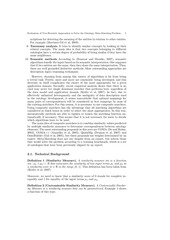
scenarios in order to obtain a satisfactory alignment between ontologies. Figure
2 shows a diagram for modeling the actions in a Meta-Matching process.
Note that algorithms do not need to be reconsidered. The idea is to provide
all possible algorithms initially and then automatically associate a weight of 0 to
those that are not useful for solving the problem. How the algorithms are used or
the weights and the threshold recalculated are what makes one Meta-Matching
strategy better than another, in terms of accuracy and time consumption.
�
Evaluation of Two Heuristic Approaches to Solve the Ontology Meta-Matching Problem
7
Fig. 2. General model for Meta-Matching
In general, we can describe the following as characteristics of a Meta-Matching
task:
– It is not necessary for it to be done at runtime. Functions are computed and
can be reused.
– It must be an automatic process, because it is a problem with a very complex
computational nature.
– It must return the best possible matching function, thus, the function that
best mimics the behavior of a human expert user.
Moreover, Meta-matching can be seen from two points of view: (i) From the
point of view of the algorithmic techniques used to obtain the matching function:
– Aggregation. This technique (Domshlak et al, 2007) determines the upper
bound T(n) on the values obtained from a sequence of n matchers, then calculates the average value to be T(n)/n.
– Combination. The main idea is to combine similarity values predicted by
multiple matchers to determine correspondences between ontology entities.
Where combinations can be as simple as: arithmetic or harmonic means, maximum, minimum, Minkowski distances, any kind of weighted product or sum,
and so on, or more complex combinations like Linguistic Combinations (Ji et
al, 2006)
– Composition. Let f1 , f2 , ..., fn be n unique matchers, a composition is a
function f (O1 , O2 ) = f1 ◦ f2 ◦ ... ◦ fn . Thus, the idea of this mechanism is to
use simple functions to build more complicated ones
�
8
Martinez-Gil and Aldana-Montes
(ii) From the point of view of the computer science paradigm that makes the
Meta-Matching possible, i.e. the form of recalculating the parameters. Although,
this problem can be solved trivially by a brute force search when the number
of matchers to use is low, Meta-Matching scales better for a higher number of
matchers. For this reason we do not include brute force methods as a viable
technique. These are the two main groups of techniques considered:
– Heuristic Meta-Matching, where the most outstanding approaches are
Based on Genetic Algorithms meta-matching. In this case, it is said that parameters are optimized and, Greedy meta-matching, in such case, it is said
that parameters are estimated. In Genetic Strategies, solutions tend to scale
better and in Greedy techniques, solutions are obtained more quickly.
– Based on Machine Learning meta-matching, where the most outstanding approaches are Relevance Feedback and Neural networks training for metamatching. In both cases, it is said that parameters are learned.
2.2.1. Heuristic Meta-Matching.
A heuristic is a method to help to solve a problem, commonly informal. It is used
particularly for a method that may lead to a solution which is usually reasonably
close to the best possible answer.
Two fundamental goals in computer science are to find algorithms with probably good run times and with probably good or optimal solution quality. A heuristic
is an algorithm that abandons one or both of these goals; for example, it usually
finds pretty good solutions, but there is no proof that the solutions could not get
arbitrarily bad; or it usually runs reasonably quickly, but there is no argument
that this will always be the case.
Therefore, the use of heuristics is very common in real world implementations.
For many practical problems, a heuristic algorithm may be the only way to get
good solutions within a reasonable amount of time.
A lot of tools clearly implement heuristic Meta-Matching, we can see the
clearest example in the default configuration of COMA (Do and Rahm, 2002),
where an expert has initially adjusted the weights of the conceptual and structural techniques respectively. In order to avoid human interaction in this field, we
can use Genetic Algorithms for optimizing the parameters or Greedy Algorithms
to estimate them.
Based on Genetic Algorithm methods. Based on Genetic Algorithm
methods (Forrest, 1997) are adaptive heuristic search algorithms premised on
the evolutionary ideas of natural selection and genetics. The basic concept of
GAs is designed to simulate the natural evolutionary system.
This approach is able to work with several goals (Martinez-Gil and AldanaMontes, 2008): maximizing the precision, maximizing the recall, maximizing the
fMeasure or reducing the number of false positives. Moreover, it has been tested
combining some leading-edge similarity measures over a standard benchmark
and produced some good results.
Another proposal is (Wang et al, 2006), a genetic algorithm-based optimization procedure for the ontology matching problem that is presented as a featurematching process. First, from a global view, they model the problem of ontology
matching as an optimization problem of a mapping between two compared ontologies, with each ontology having its associated feature sets. Secondly, as a
�
Evaluation of Two Heuristic Approaches to Solve the Ontology Meta-Matching Problem
9
powerful heuristic search strategy, a genetic algorithm is employed for the ontology matching problem. Given a certain mapping as optimizing object for GA, a
fitness function is defined as a global similarity measure function between two
ontologies based on feature sets.
Greedy Meta-Matching Greedy (Cohen et al, 1996) Meta-Matching is a
technique which, given a particular matching task, tries to automatically tune
an ontology matching function. For that purpose, it tries to choose the best
matchers and parameters to be used, but with a short-sighted strategy. The most
popular example of this technique can be found at (Lee et al, 2001). Results from
Greedy techniques are, in general, worse than those based on Genetics, but its
computation time also tends to be much lower.
2.2.2. Based on Machine Learning Methods
Based on Machine Learning (Langey, 1994) Meta-Matching techniques considers
both schema information and instance data. This kind of Meta-Matching can be
divided into two subtypes2 (i) Relevance Feedback and (ii) Neural Networks.
Relevance Feedback. This kind of approach explores the user validation of
initial ontology alignments for automatically optimizing the configuration parameters of the matching strategies. A clear example of this kind of Meta-Matching
is (Lee et al, 2001). Using such techniques we are able to avoid the user, and
maybe the context, the dependency of the matching task, however, it implies
spending a lot of time on training the systems. To do that automatically, it is
possible to use Neural Networks.
Neural Networks Training. A neural network (Jordan and Bishop, 1997)
is an interconnected group of artificial neurons that uses a mathematical or
computational model for information processing based on a connectionistic approach to computation. In most cases a neural network is an adaptive system that
changes its structure based on external or internal information flowing through
the network. In more practical terms neural, networks are non-linear statistical
data modeling or decision making tools. They can be used to model complex
relationships between inputs and outputs or to find patterns in data.
Neural networks training for Meta-Matching consists of training a neural
network with heterogeneous enough benchmarks and then using the knowledge
to predict new similarity functions. This is the case of (Huang et al, 2007) where
authors exploit an approach to learn the weights for different semantic aspects
of ontologies, through applying an artificial neural networks technique.
Another approach consists of an automatic ontology alignment method based
on the recursive neural network model that uses ontology instances to learn
similarities between ontology concepts. Recursive neural networks are an extension of common neural networks, designed to process efficiently structured data
(Chortaras et al, 2005).
2
Although learning techniques exist such as Bayes learning, WHIRL learning, decision trees
or stacked generalization, there are no Meta-Matching proposals using them as yet
�
 Historical archive . public document