c 2010, Cambridge University Press
The Knowledge Engineering Review, Vol. 00:0, 1–24. �
DOI: 10.1017/S000000000000000 Printed in the United Kingdom
An Overview of Current Ontology Meta-Matching Solutions
´ F. ALDANA-MONTES
JORGE MARTINEZ-GIL and JOSE
University of M´
alaga, Department of Computer Language and Computing Sciences
Boulevard Louis Pasteur 35, 29071 M´
alaga, Spain
E-mail: {jorgemar, jfam}@lcc.uma.es
Abstract
Nowadays there are a lot of techniques and tools for addressing the ontology matching problem,
however, the complex nature of this problem means that the existing solutions are unsatisfactory.
This work intends to shed some light on a more flexible way of matching ontologies using ontology
meta-matching. This emerging technique selects appropriate algorithms and their associated
weights and thresholds in scenarios where accurate ontology matching is necessary. We think
that an overview of the problem and an analysis of the existing state-of-the-art solutions will
help researchers and practitioners to identify the most appropriate specific features and global
strategies in order to build more accurate and dynamic systems following this paradigm.
1
Introduction
Most existing information systems use their own schemas to represent the data they handle. In
order to obtain interoperability between agents, services or simply people that need to exchange
information, correspondences must be established.
Nowadays ontologies are used to facilitate the exchange of information. Ontologies are formal
representations of sets of concepts and relationships within a domain. But we are interested in the
fact that ontologies are considered to extend the notion of schema. The reason is that an ontology
can use more information than a traditional database schema, e.g., both hierarchical and non
hierarchical information, as well as description information. Therefore, in comparison with classic
schema matching, ontology matching has its own unique characteristics. Firstly, when comparing
database schemas, ontologies provide greater flexibility and more explicit semantics for defining
data. Secondly, database schemas are usually defined for specific databases, whereas an ontology
aims to be reusable and sharable. Thirdly, ontology development is becoming a more and more
decentralized procedure, although there are some exceptions such as the large-scale ontology
SNOMED CT (Schulz et al., 2007) which is developed centrally by only a few experts. Last but
not least, ontologies have a larger number of representation primitives like cardinality constraints,
inverse properties, transitive properties, disjoint classes, and type-checking constraints (Li et al.,
2009).
Therefore, the old problem of matching classic schemas has now evolved into an analog
problem, although it is a little more complex. The task of finding correspondences between
ontologies is called ontology matching and the output of this task is called ontology alignment
(Euzenat & Shvaiko, 2007). In fact, obtaining satisfactory ontology alignments is a key aspect
for such fields as:
•
Semantic integration (Euzenat & Shvaiko, 2007). This is the process of combining metadata
residing in different sources and providing the user with a unified view of these data. This
kind of integration should be done automatically, because manual integration is not viable,
at least not for large volumes of information.
�
2
•
•
•
•
•
martinez-gil & aldana-montes
Ontology mapping (Bernstein & Melnik, 2004). This is used for querying different ontologies.
An ontology mapping is a function between ontologies. The original ontologies are not
changed, but the additional mapping axioms describe how to express concepts, relations,
or instances in terms of the second ontology. A typical use case for mapping is a query in one
ontology representation, which is then rewritten and handed on to another ontology.
The Web Services industry, where Semantic Web Services (SWS) are discovered and
composed in a completely unsupervised manner. Originally SWS alignment was based on
exact string matching of parameters, but nowadays researchers deal with heterogeneous and
constrained data matching (Cabral et al., 2004).
Data Warehouse applications (He et al., 2005). These kinds of applications are characterized
by heterogeneous structural models that are analyzed and matched either manually or semiautomatically at design time. In such applications matching is a prerequisite of running the
actual system.
Similarity-based retrieval (Forbus et al., 1995). Semantic similarity measures play an
important role in information retrieval by providing the means to improve process recall
and precision. These kinds of measures are used in various application domains, ranging
from product comparison to job recruitment.
Agent communication (Fasli, 2007). Existing software agents need to share a common
terminology in order to facilitate the data interchange between them. Using ontologies is
a promising technique to facilitate this process, but there are several problems related to the
heterogeneity of the ontologies used by the agents which make the understanding at semantic
level difficult. Ontology matching can solve this kind of problem.
All this means that business and scientific communities seek to develop automatic or
semiautomatic techniques (known as matching algorithms or simply matchers) to reduce the
tedious task of creating and maintaining the alignments manually. However, the nature of the
problem is complex because “finding good similarity functions is, data-, context-, and sometimes
even user-dependent, and needs to be reconsidered every time new data or a new task is inspected”
(Kiefer et al., 2007). So we need mechanisms to make matching as independent as possible of
data, context and users. A promising way of doing this is to combine similarity values predicted
by multiple matchers to determine correspondences between ontology entities. In this way it will
be possible to benefit from both the high degree of precision of some algorithms and at the same
time the broader coverage of others (Eckert et al., 2009). Ontology meta-matching tries to achieve
this effectively and efficiently.
Although substantially different, this work complements the schema and ontology matching
surveys presented in (Rahm & Bernstein, 2001), (Kalfoglou & Schorlemmer, 2003b), (Noy, 2004),
(Shvaiko & Euzenat, 2005), and (Choi et al., 2006) where ontology matching methods and tools are
reviewed in detail, while the main contribution of this work is related to ontology meta-matching,
thus, related to effective and efficient use of the techniques described in these surveys, which
is one of the most important future challenges for semantic integration according to (Shvaiko
& Euzenat, 2008). Whereas in our previous paper (Martinez-Gil & Aldana-Montes, 2009) we
designed, implemented and evaluated two ontology meta-matching approaches, the current paper
focusses on the following key points:
•
•
•
•
•
An introduction to the notion of ontology meta-matching and its technical background.
An analysis of the main techniques for ontology matching and their application to metamatching.
A qualitative explanation of the differences between some matcher combinations, matcher
self-tuning and ontology meta-matching, terms that are often used inappropriately.
An analysis of the existing state-of-the-art tools in this field.
A discussion on the controversial issues concerning to meta-matching and the identification
of the problems that remain open.
�
An Overview of Current Ontology Meta-Matching Solutions
3
The rest of this work is organized as follows: Section 2 discusses the state-of-the-art related to
ontology matching and why it is necessary to take into account mechanisms for exploiting simple
ontology matchers. Section 3 describes the technical background necessary for understanding
ontology meta-matching. Section 4 discusses the techniques that are used to meta-match. Section
5 presents an overview of the state-of-the-art tools on ontology meta-matching. Section 6 discusses
the advantages and disadvantages of using meta-matching and, finally, in Section 7, we extract
the conclusions from this work.
2
Problem Statement
At the present time, there are many thousands of ontologies available on the web (Martinez-Gil
et al., 2010). These ontologies are developed for different collections of information, and different
kinds of applications. There are several reasons for the quick proliferation of ontologies, but we
consider mainly two:
•
•
It is often easier to construct a new ontology, than find an existing one which is appropriate
for a given task.
There is often a desire for direct control over the ontology for a particular domain, rather
than having the structure dictated by external forces.
The main consequence of having large numbers of ontologies available is that we will have
to integrate knowledge which is represented in different ways. Thus, in addition to the problem
of integrating knowledge from different sources, we are now faced with the challenge of coping
with different ontological representations of this knowledge. In relation to the first scenario,
we require integrating the concepts of one ontology with another. This challenge is called the
ontology matching problem and the key issue is the mapping of concepts and relationships from
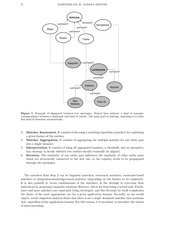
one ontology to another. Figure 1 shows an example of this scenario: there is an alignment between
two ontologies representing landmarks and vehicles.
By examining two ontologies, it can be seen that ontology matching has to deal with the
following five problems:
1.
2.
3.
4.
5.
Concepts may have different names
Concepts may only be present in one or other of the ontologies
Concepts may be similar but not identical
Concepts may have similar notations but different semantics
There may be unstated assumptions in the ontology
On the other hand, the ontology matching problem could be reduced or avoided by adopting
common ontologies. To this end, a number of efforts have been proposed with the intention of
creating top-level ontologies, or definitive ontologies for a particular domain. An example of a
top-level ontology is the IEEE Suggested Upper Merged Ontology (SUMO) (Oberle et al., 2007)
and examples of domain-specific ontologies include: the Gene ontology (Lomax, 2005), the OWLTime ontology (Pan & Hobbs, 2005), and the Standard Ontology for Ubiquitous and Pervasive
Applications (SOUPA) (Chen et al., 2004).
However, people tend to match ontologies (Falconer & Noy, 2007) and, this is performed using
(directly or indirectly) a six-step process that consists of the following steps proposed by Ehrig
(Ehrig, 2006) and which are described below:
1.
2.
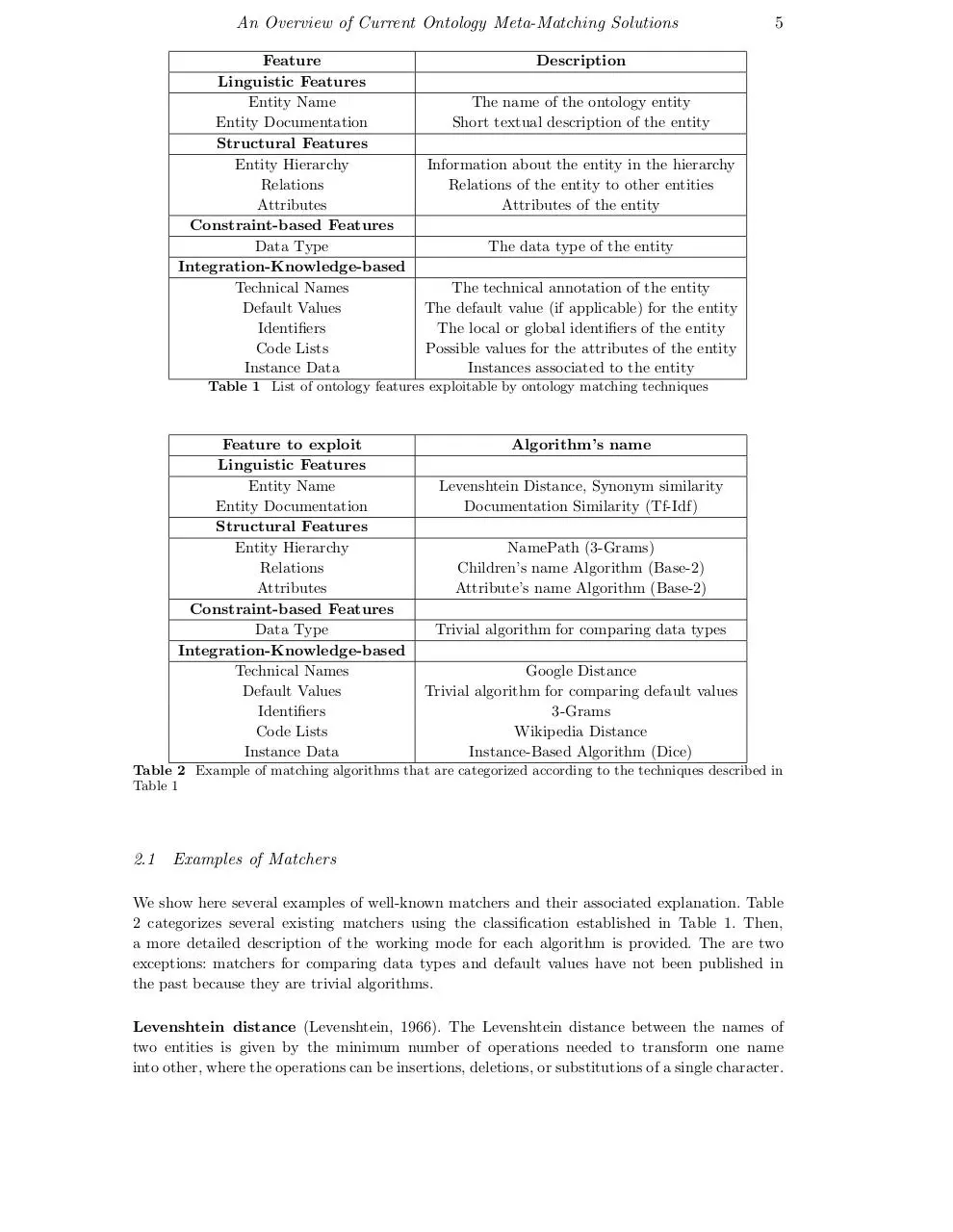
Feature Engineering. It consists of selecting excerpts of the overall ontology specification
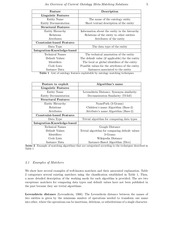
to describe a specific entity. Table 1 shows a complete list of ontology features that can be
exploited by ontology matching techniques.
Search Step Selection. It consists of choosing two entities from the ontologies to compare
them for an alignment.
�
4
martinez-gil & aldana-montes
Figure 1 Example of alignment between two ontologies. Dotted lines indicate a kind of semantic
correspondence between a landmark and kind of vehicle. The main goal of ontology matching is to solve
this kind of situation automatically
3.
4.
5.
6.
Matcher Assessment. It consists of choosing a matching algorithm (matcher) for exploiting
a given feature of the entities.
Matcher Aggregation. It consists of aggregating the multiple matcher for one entity pair
into a single measure.
Interpretation. It consists of using all aggregated numbers, a threshold, and an interpretation strategy to decide whether two entities should eventually be aligned.
Iteration. The similarity of one entity pair influences the similarity of other entity pairs
which are structurally connected to the first one, so the equality needs to be propagated
through the ontologies.
The matchers from Step 2 can be linguistic matchers, structural matchers, constraint-based
matchers or integration-knowledge-based matchers (depending on the feature to be exploited).
It is also possible to create combinations of the matchers, in the attempt to overcome their
limitations by proposing composite solutions. However, this is far from being a trivial task. Firstly,
more and more matchers are constantly being developed, and this diversity by itself complicates
the choice of the most appropriate one for a given application domain. Secondly, as one would
expect, recent empirical analysis shows that there is no a single dominant matcher that performs
best, regardless of the application domain. For this reason, it is necessary to introduce the notion
of meta-matching.
�
An Overview of Current Ontology Meta-Matching Solutions
Feature
Linguistic Features
Entity Name
Entity Documentation
Structural Features
Entity Hierarchy
Relations
Attributes
Constraint-based Features
Data Type
Integration-Knowledge-based
Technical Names
Default Values
Identifiers
Code Lists
Instance Data
5
Description
The name of the ontology entity
Short textual description of the entity
Information about the entity in the hierarchy
Relations of the entity to other entities
Attributes of the entity
The data type of the entity
The technical annotation of the entity
The default value (if applicable) for the entity
The local or global identifiers of the entity
Possible values for the attributes of the entity
Instances associated to the entity
Table 1 List of ontology features exploitable by ontology matching techniques
Feature to exploit
Linguistic Features
Entity Name
Entity Documentation
Structural Features
Entity Hierarchy
Relations
Attributes
Constraint-based Features
Data Type
Integration-Knowledge-based
Technical Names
Default Values
Identifiers
Code Lists
Instance Data
Algorithm’s name
Levenshtein Distance, Synonym similarity
Documentation Similarity (Tf-Idf)
NamePath (3-Grams)
Children’s name Algorithm (Base-2)
Attribute’s name Algorithm (Base-2)
Trivial algorithm for comparing data types
Google Distance
Trivial algorithm for comparing default values
3-Grams
Wikipedia Distance
Instance-Based Algorithm (Dice)
Table 2 Example of matching algorithms that are categorized according to the techniques described in
Table 1
2.1
Examples of Matchers
We show here several examples of well-known matchers and their associated explanation. Table
2 categorizes several existing matchers using the classification established in Table 1. Then,
a more detailed description of the working mode for each algorithm is provided. The are two
exceptions: matchers for comparing data types and default values have not been published in
the past because they are trivial algorithms.
Levenshtein distance (Levenshtein, 1966). The Levenshtein distance between the names of
two entities is given by the minimum number of operations needed to transform one name
into other, where the operations can be insertions, deletions, or substitutions of a single character.
�
6
martinez-gil & aldana-montes
Synonym similarity (WordNet) (Pedersen et al., 2004). Similarity measures quantify how
similar two entities are, this decision is based on the information contained in an ISA-hierarchy.
For this case, we are going to use the database called WordNet which organizes terms into
hierarchies of ISA-relations.
Documentation Similarity (Tf-Idf ). The documentation similarity algorithm uses the
documentation of entities optionally available in some ontology languages. This algorithm
assumes that two entities belonging to different ontologies are similar if their associated
descriptions are also similar. Tf-Idf (Term frequency-Inverse document frequency)(Aizawa, 2003)
has been chosen to compare these descriptions because it is an efficient algorithm for comparing
short texts.
3-Grams. An n-gram is a subsequence of n tokens from a given name. The tokens can
be phonemes, syllables, letters, and so on. The n-gram algorithm is used for efficient string
matching. By converting a sequence of tokens to a set of n-grams (3 characters long in this case), it
can be embedded in a vector space allowing the sequence to be compared to other sequences easily.
NamePath (3-Grams). The NamePath algorithm uses the complete path of an entity an
ontology to calculate the similarity between entities. In an ontology, the Namepath is defined as
the path from the ontology root to the given entity in this ontology.
Children’s name Algorithm (Base-2). This technique is based on the detection of
overlapping children’s names from the entities to be compared. Base-2 means here that two
entities are considered to represent the same object when two associated children overlap.
Attributes’s name Algorithm (Base-2). This technique is quite similar to the detection
of overlapping children’s names from the entities to be compared. Base-2 means here that two
entities are considered to represent the same real world object when two associated attributes
are overlapped.
Google Distance (Cilibrasi & Vitanyi, 2007). The Google distance is a measure of semantic
relatedness derived from the number of hits returned by the Google search engine for a given set
of keywords. The idea behind this measure is that keywords with similar meanings in a natural
language sense tend to be “close” in units of Google distance, while words with dissimilar
meanings tend to be farther apart.
Wikipedia Distance. Wikipedia is the largest, free-content encyclopedia on the Internet.
Wikipedia distance is similar to Google distance but we use Wikipedia content as corpus because
it represents a great wealth of human knowledge. In order to use this content, the distance
counts the hits returned by a Google search for the keywords after restricting the results with
the option site:wikipedia.org
Instance-Based Algorithm (Relative overlap). This technique is based on the detection
of overlapping instance’s names from the entities to be compared. Relative overlap represents a
value for the common instances. In the case of larger cardinality differences between instances,
the relative overlap can be quite small.
�
An Overview of Current Ontology Meta-Matching Solutions
3
7
Technical Background
In this section, we are going to define and explain the key concepts and examples that are
necessary to understand the notion of ontology meta-matching.
Definition 1 (Similarity Measure). A similarity measure sm is a function sm : μ1 × μ2 �→ �
that associates the similarity of two input entities μ1 and μ2 to a similarity score sc ∈ � in the
range [0, 1]. This definition has been taken from (Ziegler et al., 2006).
A similarity score of 0 stands for complete inequality and 1 for equality of the input solution
mapping μ1 and μ2 . Unlike a distance metric, where a similarity score of 0 stands for complete
equality and a similarity score 1 is a bound to indicate complete inequality. Some authors think
that a distance metric is not always appropriate because there are long-standing psychological
objections to the axioms used to define it. For example, a metric will always give the same distance
from a to b as from b to a, but in practice we are more likely to say that a child resembles their
parent than to say that a parent resembles their child (Widdows, 2004). These objections are not
relevant in this field because ontology matching is not directional. This means that, for example,
the similarity between “car” and “automobile” is the same as between “automobile” and “car”,
but for normalization purposes we always consider 0 for inequality and 1 for equality.
On the other hand, we are interested in a special kind of similarity measures called
configurable similarity measure. This kind of measure is a function that can be parametrized,
thus, its behavior may vary depending on some external variable defined by an user. From
the engineering point of view, configurable similarity measures share common characteristics:
the search space is very large and the decision is made involving multiple criteria. Notice that
resolving these simultaneously at run time makes the problem even harder. Example 1 shows a
measure of this type called weighted similarity measure.
�
Example 1 (Weighted Similarity Measure). Let O1 and O2 be two ontologies. Let w
� be a vector of similarity
a weight vector with wi ≤ κ, for some upper bound κ ∈ R. Let A
measures. Then, the function wsf ranging over the unit interval [0, 1] ⊂ R is defined as follows:
�i=n
wsfw,
� (O1 , O2 ) = max(
i=1 wi · Ai ).
� A
Example 1 shows a weighted similarity measure, thus, a function which leads to an
optimization problem for calculating the weight vector, because the number of candidates
from the solution space (in this case an arbitrary real interval) is infinite. For this reason, a
brute force strategy would clearly be inefficient. It is necessary to look for better computational
mechanisms that allow the problem of computing weighted measures to be solved more efficiently.
Definition 2 (Ontology Matching). An ontology matching om is a function om : O1 × O2 �→ A
that associates two input ontologies O1 and O2 to an alignment A using a similarity measure.
Now we define the output of an ontology matching function, i.e., an ontology alignment as
follows.
Definition 3 (Ontology Alignment). An ontology alignment oa is a set {t, M D}. t is a set
of tuples in the form {(id, e, e� , n, R)}. Where id is a unique identifier, e and e� are entities
belonging to two different ontologies, R is the relation of correspondence between these entities
and n is a real number between 0 and 1 representing the mathematical probability that R may
be true. The entities than can be related are the concepts, roles, rules and, even axioms of
the ontologies. On the other hand, MD is some metadata related to the matching process for
information purposes.
�
8
martinez-gil & aldana-montes
It is also necessary to have methods that help us to distinguish between good and bad
alignments. In fact, there are many ways to evaluate an ontology alignment:
•
•
•
•
Compliance measures provide some insight on the quality of identified ontology alignments.
Performance measures show how good the approach is in terms of computational resources.
User-related measures help to determine the overall subjective user satisfaction, partially
measured, e.g., through user effort needed.
There are task-related measures, which measure how good the alignment was for a certain
use case or application.
In practice, however, there is a degree of agreement to use some measures from the Information
Retrieval field (Baeza-Yates & Ribeiro-Neto, 1999). These are precision and recall.
Definition 4 (Alignment Evaluation). An alignment evaluation ae is a function
ae : A × AR �→ precision × recall, where precision and recall are real numbers ranging over
the unit interval [0, 1]. Precision states the fraction of retrieved correspondences that are relevant
for a matching task. Recall is the fraction of the relevant correspondences that are obtained
successfully in a matching task.
In this way, precision is a measure of exactness and recall a measure of completeness. Empirical
studies of retrieval performance have shown a tendency for precision to decline as cecall increases.
(Buckland & Gey, 1994) examined the nature of the relationship between precision and recall
in more depth. On the other hand, in order to obtain a way to compare systems or techniques,
an f-measure is defined as a weighting factor between precision and recall. The most common
configuration consists of weighting precision and recall equally.
On the other hand, normally the goal of a matching function is to get the best value for the
f-measure when evaluating the ontology alignment generated. But in some cases this may not
be true, because the application being built needs a well-balanced pair of precision and recall
measures instead of an optimized f-measure. In any case it is very difficult, even for an expert,
to decide on the best way to customize a similarity measure and to implement it in the form of
a matching function. This is because the number of variables and parameters to be considered is
too large. On the other hand, we have that without tuning, ontology matching systems often fail
to exploit specific characteristics. So research is focused on automatically configuring a function
and avoiding the work which depends on a lot on human heuristics.
4
Ontology Meta-Matching
The expression Ontology Meta-Matching was introduced in (Euzenat & Shvaiko, 2007) for
naming systems that try to configure automatically ontology matching functions. Although other
approaches have been proposed, only several works have dared to give an explicit definition for
ontology meta-matching; (Lee et al., 2007) use the following definition: the method “to select
the right matching components to execute, and to adjust the multiple knobs (e.g., threshold,
coefficients, weights, etc.) of the components”. In (Martinez-Gil & Aldana-Montes, 2009), metamatching is defined as “the technique of selecting the appropriate algorithms, weights and
thresholds in ontology alignment scenarios”. The second definition does not include the selection
of matching components because it assumes that all matchers are offered initially, and those
which may be associated with a weight of 0 will be automatically deselected.
In general, there are several characteristics common to all meta-matching strategies:
•
•
It is not necessary for it to be done at runtime. Matching functions can be computed in the
background and then applied at runtime.
It must be an automatic process. So it must be possible for it to be implemented by means
of a software tool.
�
An Overview of Current Ontology Meta-Matching Solutions
9
Figure 2 General model for meta-matching. Although some features can vary, most of the strategies
present a solution schema similar to that presented here
•
•
It must return the best possible matching function. If we do not know the best matching
function, we can be satisfied with a function that behaves as a human expert would do.
The evaluation of a meta-matching strategy is its returned matching function.
Moreover, Figure 2 shows a diagram for modeling the general actions in a meta-matching
process. Although some features can vary, the process of meta-matching consists of adjusting in
a smart way several parameters (algorithms, combination formula, and thresholds) in order to
replicate the results of a heterogeneous set of solved cases. The optimized function is supposed
to solve cases similar to the given ones.
4.1
Matcher combination, matcher self-tuning, and meta-matching
The expressions matcher combination, matcher self-tuning and meta-matching are often confused.
Therefore, we are going to explain the differences between them.
•
Matcher Combination. It involves the combination of individual matchers belonging to
libraries of matchers. This increases the complexity of the matching problem as several
matchers must be put together and combined appropriately. So far, only design time toolboxes
allow to do this manually.
�
 Historical archive . public document