Reverse Ontology Matching
Jorge Martinez-Gil
University of Malaga
Dept. of Computing Sciences
Boulevard Louis Pasteur 35, 29071 Malaga
jorgemar@lcc.uma.es
ABSTRACT
Ontology Matching aims to find the semantic correspondences between ontologies that belong to a single domain but that have been developed separately. However, there are still some problem areas to be solved, because experts are still needed to supervise the matching
processes and an efficient way to reuse the alignments
has not yet been found. We propose a novel technique
named Reverse Ontology Matching, which aims to find
the matching functions that were used in the original
process. The use of these functions is very useful for
aspects such as modeling behavior from experts, performing matching-by-example, reverse engineering existing ontology matching tools or compressing ontology
alignment repositories. Moreover, the results obtained
from a widely used benchmark dataset provide evidence
of the effectiveness of this approach.
1.
INTRODUCTION
In the new approaches to develop information
systems, the use of a type of formal schema called
ontology is usual. Ontologies are considered to be
semantically richer than schemas in general, and
therefore, techniques for schema matching can be
easily adapted to ontologies but not vice versa [12].
There are many ontologies available on the web
currently. These ontologies are usually developed
for different collections of information, and different kinds of applications. Nowadays, the Swoogle
search engine1 has indexed thousands of ontologies.
There are several reasons for the quick proliferation
of ontologies, but we consider mainly two:
• It is often easier to construct a new ontology,
than find an existing one which is appropriate
for a given task.
• There is often a desire for direct control over
the ontology for a particular domain, rather
than having the structure dictated by external
forces.
1
http://swoogle.umbc.edu
SIGMOD Record, December 2010 (Vol. 39, No. 4)
Jose F. Aldana-Montes
University of Malaga
Dept. of Computing Sciences
Boulevard Louis Pasteur 35, 29071 Malaga
jfam@lcc.uma.es
A direct consequence of having large numbers of
ontologies available is that it is necessary to integrate knowledge which is represented in different
ways. Ontology matching aims to produce alignments, that is, sets of semantic correspondences between elements from different ontologies. This task
is very expensive in terms of time and resource consumption. The reason is that it is necessary a lot
of work from domain experts to match ontologies
or to supervise results from existing semiautomatic
tools. Our approach is based on the extraction of
the ontology matching functions used by the agents,
experts or tools when matching ontologies, so it
is a powerful way to reuse, store and understand
their knowledge. Moreover, there are other collateral benefits as the ability to implement strategies
for ontology matching by example, reverse engineering existing ontology matching tools or compress
large ontology alignment repositories. In this way,
we think that the main contributions of our work
can be summarized as follow:
• We propose, for the first time to the best of
our knowledge, a methodology for reverse engineering an ontology alignment which tries to
find the matching function that have been used
to generate an ontology alignment.
• We perform an empirical evaluation of our approach in order to show its practical viability
in the real world.
The rest of this work is structured in the following way: Section 2 describes the problem statement
related to Reverse Ontology Matching. Section 3
presents the related works regarding other reverse
engineering proposals. Section 4 presents the core
of our approach, a methodology for reverse engineer an ontology alignment, and some real examples. Section 5 contains an evaluation that shows
the applicability of Reverse Ontology Matching in
the practice. In Section 6, we describe the conclusions extracted from this work.
5
�
2.
PROBLEM STATEMENT
f 0 ≡ f ↔ f 0 (o, o0 , A, p, r) = f (o, o0 , A, p, r)
An ontology is “a specification of a conceptualization” [9] that it is to say, an abstract representation
of the world like a set of objects. In this work, we
are going to use the intuitive notion of ontology as a
set of classes with relations among them that serves
primarily to represent formal knowledge in a way
which is understandable by people and machines.
These two basic ideas behind the notions of Reverse Ontology Matching Function and Equivalent
Ontology Matching Function allow us to formulate
the definition Equivalent Reverse Ontology Matching Function as follows.
Definition 1 (Ontology Matching Function).
Ontology Matching Function is a function f where,
given two input ontologies o and o’, an (optional)
input incomplete alignment A, a set of configuration
parameters p and, a set of external resources r, an
alignment y is returned.
Definition 5 (Equivalent Reverse Ontology
Matching Function). Let g be a reverse ontology matching function, then we define a Equivalent
Reverse Ontology Matching Function g 0 as an function which return the same result that g for the same
input. More formally
y = f (o, o0 , A, p, r)
(1)
Definition 2 (Ontology Alignment). An ontology alignment is a set of mappings, thus, a set
of tuples in the form (id, e, e’, n, R). Where id is
an unique identifier, e and e’ are entities belonging
to two different ontologies, R is the relation of correspondence between these entities and n is a real
number between 0 and 1 representing the confidence
for R.
Definition 3 (Reverse Ontology Matching Function). We define Reverse Ontology Matching as
the function g that has been used for obtaining an
alignment y using two input ontologies o and o0 , an
(optional) input incomplete alignment A, a set of
configuration parameters p and, a set of external
resources r according to the following equation:
y = f (o, o0 , A, p, r) → ∃g, g(o, o0 , A, p, r, y) = f
(2)
The computation of f is far from being trivial.
There are hundreds of algorithms to match ontologies, and everything indicates that more algorithms
will appear. Moreover, matching algorithms can be
compose so we obtain a solution space populated by
many millions of possibilities. Lastly, in alignments
created by humans it is possible to find mappings
that have been found using heterogeneous rules [13].
Therefore, we cannot be sure that we are going to
obtain the original function, but a function that is
equivalent to the original one.
Definition 4 (Equivalent Ontology Matching
Function). Let f be an ontology matching function, then we define an Equivalent Ontology Matching Function f 0 as a function which return the same
result that f for the same input. More formally
6
(3)
g 0 ≡ g ↔ g 0 (o, o0 , A, p, r, y) = g(o, o0 , A, p, r, y) (4)
Take into account, that given an alignment between two ontologies, we know nothing about the
heuristic used for the expert in order to provide the
results. However, we know two main things: firstly,
in Ontology Matching there are a limited amount
of categories for grouping algorithms with similar
behaviors, and secondly, we understand the notion
of composite matchers, that it is to say, the idea
behind to combine similarity values predicted by
multiple algorithms to determine correspondences
between ontology elements in order to benefit from
the high degree of precision of some algorithms and
at the same time the broader coverage of other algorithms [6]. For the rest of this work, we are working under the assumption that the agent, expert or
tool which generate an initial alignment always try
to maximize the precision and coverage of their solutions.
2.1 Use Cases
There are many applications where reverse ontology matching will be very useful. We are going
to show here four of them: a) Capturing behavior
from experts, b) Matching by example, c) Reverse
engineer existing tools, and d) Compressing large
volumes of ontology alignments.
2.1.1
Capturing behavior from experts.
If we ask an expert for creating mappings between
two ontologies that belong to its area of expertise
but that have been developed separately, we are going to obtain a few correspondences but nothing
else. These correspondences are only useful for the
current case and we are not going to be able to get
profit from them in the future. But, if we reverse
engineer these correspondences, we will be able to
obtain the heuristic used by the expert and apply
SIGMOD Record, December 2010 (Vol. 39, No. 4)
�
it in a lot of additional scenarios. Moreover, we
can become experts because we are not going to see
only results but the way to reach these results. Finally, but not least, we can compare heuristics from
a wide variety of experts and obtain easily a core
heuristic, thus, a common way to solve problems.
2.1.2
Matching by example.
In many ontology matching scenarios is popular
the use of a technique called matching by example.
This technique consists of given two ontologies, try
to find several samples correspondences in order to
the system may learn how to find the rest of existing correspondences between the two ontologies
automatically. In this way, the user only has to
do a little part of the work manually. The existing
techniques use methods from the machine learning
field (e.g. genetic algorithms, neural networks, and
so on). In this way, better the set of mappings provided by the user larger the quality of the automatic
matching to be performed. One of the advantages
of reverse ontology matching functions is that can
be computed in real time, so it is possible to compute the equivalent reverse matching function for a
little set of mappings in order to apply this function
to the rest of the given ontologies. If the user is able
to provide all possible cases initially, the automatic
part of the matching process will be very good.
2.1.3
Reverse engineer existing tools.
Author of the initial set of mappings is not relevant for our reverse ontology matching approach.
This means that is possible to detect, and therefore to simulate, an equivalent working mode for
the most of deterministic ontology matching tools.
Deterministic here means that for a given input,
the same output is always provided. The reason
is that our approach evaluates some sample inputs
and outputs for these tools, and then, configures a
deterministic black box which uses well-known techniques to generate the same results for the initially
given sample inputs. This technique can be useful to analyze and categorize existing tools. Larger
our knowledge of these tools larger the possibility
to find errors or improve them.
2.1.4
Compressing large ontology alignments.
There are many repositories of ontology alignments available on the web. The problem when
storing an ontology alignment is that it is necessary
to store a lot of information which a) needs much
disk space and b) is very difficult to reuse. The reason for the first fact is that it is necessary to store
the mappings, information regarding to the initial
ontologies, related overhead, and so on. Secondly,
SIGMOD Record, December 2010 (Vol. 39, No. 4)
knowledge contained in the alignment only can be
reused when comparing the same correspondences.
Storing only the function that was used to generate the alignment can save much disk space (only
a function is stored), contains the same knowledge
that the alignment (the alignment can be generated
again using the function), and is very reusable (the
function can be used in other scenarios).
3.
RELATED WORKS
The importance of ontology matching is evidenced
by the large number of related works that have been
made. Unable to cite all these works, we reference
the most important surveys in this field, [3, 5, 7, 11,
14, 16] where ontology matching methods and tools
are described. There are several improvements like
the possibility to match very large ontologies [10] or
the capability to make predictions [15].
Many authors tend to categorize simple ontology
matching algorithms in the groups defined by Ehrig
[5], thus, they try to categorize basic matching algorithms in four categories corresponding to the ontology features to exploit, i.e. Linguistic Features,
Structural Features, Constraint-based Features and
Integration-Knowledge-based features.
On the other hand, we have not found works addressing the problem of the reverse ontology matching. However, the problem has been treated in adjacent fields such as data exchange. For example,
Fagin et al [8] developed a framework for reverse
data exchange that supports source instances that
may contain nulls. This development required a
careful reformulation of all the important notions,
including the identity schema mapping, inverse, and
maximum recovery. Like in our approach, operators
originally introduced by Arenas et al.[1, 2], thus, the
composition operator and the inverse operator have
been recognized as two fundamental ones.
4.
REVERSE ONTOLOGY MATCHING
It is possible to compute an equivalent reverse
matching function for the alignments that have been
created using several of techniques surveyed previously, either they have been combined in a parallel or in a sequential way. Algorithm combination means that algorithms are considered independently of each other, instead of algorithm composition which consists of using several algorithms in
order to create a new one (hybrid algorithm). The
way to obtain this equivalent reverse matching function requires four main steps that are going to be
described now. It should be taken into account that,
although engineering details are outside the aim of
this work, these steps are susceptible to automation.
7
�
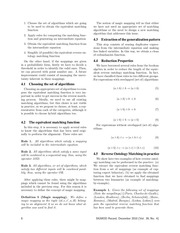
1. Choose the set of algorithms which are going
to be used to obtain the equivalent matching
function
2. Apply rules for computing the matching function and generating an intermediate equation
3. Obtain the equivalent matching function from
the intermediate equation
4. Simplify (if possible) the equivalent reverse ontology matching function
On the other hand, if the mappings are given
in a probabilistic form, firstly we have to decide a
threshold in order to identify the valid ones. Then,
we can proceed with point number one. A future
improvement could consist of managing the uncertainty inherent in these mappings.
4.1
The equivalent matching function
In this step, it is necessary to apply several rules
to know the algorithms that has been used originally to perform the alignment. There rules are:
Rule 1. All algorithms which satisfy a mapping
will be included in the intermediate equation.
Rule 2. All algorithms which satisfy a same input
will be combined in a sequential way, thus, using the
operator AND.
Rule 3. All algorithms, or set of algorithms, which
satisfy two different inputs will be combined parallely, thus, using the operator OR.
After applying these rules, there might be mappings which cannot be found using the algorithms
included in the previous step. For this reason it is
necessary to define the concept of magic mapping.
Definition 5 (Magic mapping). We define a
magic mapping as the tuple (id, e, e0 , n, R) belonging to an alignment A so we do not know what algorithm was used to find it.
8
4.3 Extraction of the generalization pattern
This step consists of erasing duplicates expressions from the intermediate equation and making
free linked variables. In this way, we obtain a clean
of redundancies function.
4.4 Reduction Properties
We have borrowed several rules from the boolean
algebra in order to reduce the length of the equivalent reverse ontology matching function. In fact,
we have classified these rules in two different groups.
For expressions with overlapped (set of) algorithms:
Choosing the set of algorithms
Choosing an appropriate set of algorithms to compose the equivalent matching function is very important in order to get success in the reverse matching process. Ideally, we need to use all existing
matching algorithms, but this choice is not viable
in practice, so we propose to choose, at least, a representative from each of the categories, although it
is possible to choose hybrid algorithms too.
4.2
The notion of magic mapping tell us that either
we have not used an appropriate set of matching
algorithms or the need to design a new matching
algorithm that addresses this issue.
(a ∧ b) ∧ b → (a ∧ b)
(5)
(a ∧ b) ∨ b → b
(6)
(a ∨ b) ∧ b → b
(7)
(a ∨ b) ∨ b → (a ∨ b)
(8)
For expressions without overlapped (set of) algorithms:
(a ∧ b) ∧ c → (a ∧ b ∧ c)
(9)
(a ∨ b) ∧ c → (a ∧ c) ∨ (b ∧ c)
(10)
4.5 Reverse Ontology Matching in practice
We show here two examples of how reverse ontology matching can be performed in the practice: (a)
We extract the equivalent reverse matching function from a set of mappings (as example of capturing expert behavior), (b) we apply the obtained
function that we have obtained to find mappings
between two lemmaries (as example of matchingby-example).
Example 1. Given the following set of mappings
(Note the mispellings) {(Paris, Charles-de-Gaulle),
(London, Heathrow), (Berlin, Schonenfeld), (Rome,
Romans), (Madrid, Barajas), (Lisboa, Lisbon)} compute the equivalent reverse matching function that
has been used to generate them.
SIGMOD Record, December 2010 (Vol. 39, No. 4)
�
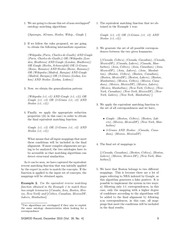
1. We are going to choose this set of non-overlapped2
ontology matching algorithms:
{Synonym, 3Grams, Stoilos, Wikip., Google }
2. If we follow the rules proposed, we are going
to obtain the following intermediate equation:
(Wikipedia (Paris, Charles-de-Gaulle) AND Google
(Paris, Charles-de-Gaulle)) OR (Wikipedia (London, Heathrow) AND Google (London, Heathrow))
OR Google (Berlin, Schonenfeld) OR (3-Grams
(Rome, Romans) AND Stoilos (Rome, Romans))
OR (Wikipedia (Madrid, Barajas) AND Google
(Madrid, Barajas)) OR (3-Grams (Lisboa, Lisbon) AND Stoilos (Lisboa, Lisbon))
3. Now, we obtain the generalization pattern:
(Wikipedia (c1, c2) AND Google (c1, c2)) OR
Google (c1, c2) OR (3-Grams (c1, c2) AND
Stoilos (c1, c2))
4. Finally, we apply the appropriate reduction
properties ((6) in this case) in order to obtain
the final equivalent matching function:
Google (c1, c2) OR (3-Grams (c1, c2) AND
Stoilos (c1, c2))
What means that all input mappings that meet
these conditions will be included in the final
alignment. If more complex alignments are going to be analyzed, the two ontologies have to
be accessible so that matching algorithms can
detect structural similarities.
As it can be seen, we have captured the equivalent
reverse matching function that was initially applied
by the expert in order to match the concepts. If the
function is applied to the input set of concepts, the
mappings will be obtained again.
Example 2. Use the equivalent reverse matching
function obtained in the Example 1 to match these
two simple lemmaries {Canada, Asia, Boston, Mexico, New-York} and {Celtics, Canadian, MexicoDF,
Lakers, Manhattan}
2
Two algorithms are overlapped if they aim to exploit
the same ontology characteristics when looking for a
correspondence
SIGMOD Record, December 2010 (Vol. 39, No. 4)
1. The equivalent matching function that we obtained in the Example 1 was:
Google (c1, c2) OR (3-Grams (c1, c2) AND
Stoilos (c1, c2))
2. We generate the set of all possible correspondences between the two given lemmaries:
{(Canada, Celtics), (Canada, Canadian), (Canada,
MexicoDF), (Canada, Lakers), (Canada, Manhattan), (Asia, Celtics), (Asia, Canadian), (Asia,
MexicoDF), (Asia, Lakers), (Asia, Manhattan), (Boston, Celtics), (Boston, Canadian),
(Boston, MexicoDF), (Boston, Lakers), (Boston,
Manhattan), (Mexico, Celtics), (Mexico, Canadian), (Mexico, MexicoDF), (Mexico, Lakers),
(Mexico, Manhattan), (New-York, Celtics), (NewYork, Canadian), (New-York, MexicoDF), (NewYork, Lakers), (New-York, Manhattan) }
3. We apply the equivalent matching function to
the set of all correspondences and we have,
• Google: (Boston, Celtics), (Boston, Lakers), (Mexico, MexicoDF), (New-York, Manhattan)
• 3-Grams AND Stoilos: (Canada, Canadian), (Mexico, MexicoDF )
4. The final set of mappings is
{(Canada, Canadian), (Boston, Celtics), (Boston,
Lakers), (Mexico, Mexico DF), (New-York, Manhattan)}
5. We have that Boston belongs to two different
mappings. This is because there are a lot of
pages referring to NBA indexed by Google, so
this algorithm generates a false positive. It is
possible to implement the system in two ways:
a) Allowing only 1:1 correspondences, in this
case, only the mapping with a higher degree
of confidence according to the algorithms will
be added to the final alignment b) Allowing
n:m correspondences, in this case, all mappings that meet the conditions will be included
in the final results.
9
�
5.
EVALUATION
We perform here an evaluation of our proposal.
Firstly, we define that way to measure the quality
of an equivalent matching function. Then, we describe and discuss the cases that we can find when
evaluating this kind of functions, and lastly, we apply our technique in several real world scenarios in
order to show that reverse ontology matching is viable in the practice.
Definition 6 (Equivalent reverse matching function evaluation). An equivalent reverse matching
function evaluation ermf e is a function ermf e :
S × S 0 7→ precision ∈ < ∈ [0, 1] × recall ∈ < ∈
[0, 1] that associates an alignment S and a reference alignment S 0 to two real numbers stating the
precision and recall of S in relation to S 0 .
Precision states the fraction of retrieved mappings that were included in the original alignment
S. Recall is the fraction of the correct mappings
that are obtained successfully in comparison with
the mappings belonging to S. In this way, precision
is a measure of exactness and recall a measure of
completeness. The problem here is that techniques
can be optimized to obtain a high precision at the
cost of the recall or, on the contrary, it is easy to optimize the recall at the cost of the precision. By this
reason a F-measure is defined as a weighting factor
between precision and recall. In this work, we use
the most common configuration which consists of
weighting precision and recall equally.
Let S the alignment provided initially, and let
emf be the equivalent matching function obtained
using reverse engineering and S 0 its output alignment. Then, we can face to these three cases:
• S 0 = S. We have a perfect equivalent matching function. The reason is that the equivalent
matching function has been able to replicate
exactly the results of the expert, technique or
tool that created the original alignment.
• S 0 ⊂ S (S 0 = S −µ, where µ is the set of magic
mappings). In this case, it has not been possible to find some of the algorithms used by
the expert, technique or tool to generate some
specific mappings. The final set of mappings
provided by the equivalent matching function
is a subset of the original set. The rest of mappings are magic mappings. A large number
of magic mappings means that either we have
not used an appropriate set of matching algorithms or that the alignment was generated
using a hitherto unknown technique.
10
Ontology
Russia12
RussiaAB
TourismAB
Sports
AnimalsAB
#Map.
85
117
226
150
24
Pr.
0.97
1.00
0.96
0.99
0.92
Rc.
0.04
0.07
0.12
0.02
0.14
F-M.
0.08
0.13
0.21
0.04
0.24
Table 1: Quality for the Equivalent Reverse Ontology Matching functions using
Web Knowledge algorithms
Ontology
Russia12
RussiaAB
TourismAB
Sports
AnimalsAB
#Map.
85
117
226
150
24
Pr.
0.86
1.00
0.93
0.94
0.75
Rc.
0.53
0.51
0.47
0.39
0.80
F-M.
0.65
0.68
0.62
0.55
0.77
Table 2: Quality for the Equivalent Reverse
Ontology Matching functions not using Web
Knowledge algorithms
• S 0 ⊃ S (S 0 = S + λ, where λ is a set of new
discovered mappings). In this case, the expert,
technique or tool used an ambiguous strategy
to create the final alignment. If the result provided by the equivalent matching function is a
superset from the original one, then, we know
that a strategy was used only for an arbitrary
set of entities. For example, (Mexico, Mexican) was included in the final alignment but
(Canada, Canadian) was not. Our technique
is able to capture the strategy, but it cannot
be applied in the same arbitrary way.
5.1 Empirical Results
In our experiment (see Table 1 and 2), we have
noticed that algorithms which use Web Knowledge
(Google and Wikipedia distance in this case) have
a big impact in our results. The reason is that such
kind of algorithms, which detect the co-occurrence
of terms in the same websites of the Web, are able
to find a lot of correspondences, and therefore the
precision is increased when using them. But these
algorithms generate a lot of false positives too, so
the recall is decreased.
We have that values for the precision are good.
This means that algorithms that we have used are
able to capture the most of the mappings from the
alignment. On the other hand, the value for the recall is lower, what means that these algorithms find
more mappings than the alignment had originally.
Therefore, F-measure, thus, the overall quality measure decreases.
SIGMOD Record, December 2010 (Vol. 39, No. 4)
�
6.
CONCLUSIONS
We have presented a novel approach for reverse
ontology matching. To the best of our knowledge,
this approach is the first attempt to extract the
functions that were originally used to create an alignment between ontologies. As we have shown, it is
very difficult to obtain the original function, but
it is possible to compute an equivalent reverse ontology matching function for all ontology matching
functions that have been created using one or several of the techniques studied, either they have been
combined in a parallel or in a sequential way.
Results show us that we have reached a reasonable quality when capturing the equivalent reverse
matching functions in the most of cases. Moreover,
we have introduced the notion of magic mapping as
a way to deal with those mappings which we do not
know how they were found. The notion of magic
mapping tells us that either we have not used an
appropriate set of matching algorithms or we need
to design a new matching algorithm that addresses
this issue. However, in practice, web knowledge algorithms limit the presence of magic mappings and
have a great impact on the results. The reason is
that such algorithms are able to find a lot of correspondences (even those that are not very frequent),
and therefore precision is increased. But these algorithms generate a lot of false positives too, so
the recall is decreased. For this reason, we propose
to use web knowledge algorithms only in domains
where a great precision is required.
As future work, we have to face some important
challenges. Firstly, it is necessary to improve the
recall of the equivalent reverse matching functions.
We think that this can be achieved either by the
incorporation of more efficient matching algorithms
either the design of a new composition model more
effective than the current model. Secondly, it is
necessary to research faster ways to reverse engineer
an alignment. Checking one by one the mappings
is a time consuming strategy, so it is necessary to
research ways to accelerate the process without loss
of quality. One possible way to do this could be
working only on a sample of mappings, for example.
Acknowledgements
We wish to thank to the anonymous reviewers for
the suggestions which have helped to improve this
work. We thank to Anne Doherty for proofreading
this document. This work has been funded by the
Spanish Ministry of Innovation & Science through
the project TIN2008-04844 and by the Dept. of Innovation & Science from the Regional Government
of Andalucia through the project P07-TIC-02978.
SIGMOD Record, December 2010 (Vol. 39, No. 4)
7.
REFERENCES
[1] Arenas, M, Perez, J., Riveros, C. (2008) The
recovery of a schema mapping: bringing
exchanged data back. Proc. of PODS 13–22.
[2] Arenas, M, Perez, J., Reutter, C. (2009)
Inverting Schema Mappings: Bridging the
Gap between Theory and Practice. PVLDB
2(1) 1018–1029.
[3] Choi, C., Song, I.,Han, H. (2006) A Survey on
Ontology Mapping. ACM Sigmod Record
35(3) 34–41.
[4] Cilibrasi, R., Vitanyi, P. (2007) The Google
Similarity Distance. IEEE Trans. Knowl.
Data Eng. 19(3) 370–383.
[5] Ehrig, M. (2006) Ontology Alignment:
Bridging the Semantic Gap. Springer-Verlag.
[6] Eckert, K., Meilicke, C., Stuckenschmidt, H.
(2009) Improving Ontology Matching Using
Meta-level Learning. Proc. of European
Semantic Web Conference ESWC 2009
158–172.
[7] Euzenat, J., Shvaiko, P. (2007) Ontology
Matching. Springer-Verlag.
[8] Fagin, R., Kolaitis, PG., Popa, L., Tan, WC.
(2009) Reverse data exchange: coping with
nulls. Proc. of PODS 23–32.
[9] Gruber, T. (1993) A translation approach to
portable ontology specifications. Knowledge
Adquisition 5(2) 199–220.
[10] Hu, W., Qu, Y., Cheng, G. (2008) Matching
large ontologies: A divide-and-conquer
approach. Data Knowl. Eng. 67(1) 140–160.
[11] Kalfoglou, Y., Schorlemmer, M. (2003)
Ontology mapping: the state of the art.
Knowledge Eng. Review 18(1) 1–31.
[12] Li, J., Tang, J., Li, Y., Luo, Q. (2009)
RiMOM: A Dynamic Multistrategy Ontology
Alignment Framework. IEEE Trans. Knowl.
Data Eng. 21(8) 1218–1232.
[13] Martinez-Gil, J., Aldana-Montes, J. (2011)
Evaluation of two heuristic approaches to
solve the ontology meta-matching problem
Knowl. Inf. Syst. 26(2) 225–247.
[14] Noy, N. (2004) Semantic Integration: A
Survey Of Ontology-Based Approaches. ACM
Sigmod Record 33(4) 65–70.
[15] Pirr´
o, G., Talia, D. (2010) UFOme: An
ontology mapping system with strategy
prediction capabilities. Data Knowl. Eng.
69(5) 444–471.
[16] Rahm, E., Bernstein, P.A. (2001) A survey of
approaches to automatic schema matching.
VLDB J. 10(4) 334–350.
11
�
 Historical archive . public document