Smart Combination of Web Measures for Solving Semantic
Similarity Problems
Jorge Martinez-Gil, Jose F. Aldana-Montes
Abstract
Purpose
Semantic similarity measures are very important in many computer related fields. Previous
works on applications such as data integration, query expansion, tag refactoring or text
clustering have used some semantic similarity measures in the past. Despite the usefulness of
semantic similarity measures in these applications, the problem of measuring similarity
between two text expressions remains a key challenge.
Design/methodology/approach
In this article, we propose an optimization environment to improve the existing techniques
that use the notion of co-occurrence and the information available on the Web to measure
similarity between terms.
Findings
Experimental results on Miller & Charles and Gracia & Mena benchmark datasets show that
the proposed approach is able to outperform classic probabilistic web-based algorithms by a
wide margin.
Originality/value
We present two main contributions:
We propose a novel technique which beats classic probabilistic techniques for measuring
semantic similarity between terms. This new technique consists of using not only a search
engine for computing web page counts, but a smart combination of several popular web
search engines.
We evaluate our approach on the Miller & Charles and Gracia & Mena benchmark datasets
and compare it with existing probabilistic web extraction techniques.
Keywords: Similarity measures, Web Intelligence, Web Search Engines, Information
Integration
�
Introduction
The study of semantic similarity between terms is an important part of a lot of computer
related fields (Zhu et al., 2010). Semantic similarity between terms changes over time and
across domains. The traditional approach to solve this problem has consisted of using manually
compiled taxonomies such as WordNet (Budanitsky et al., 2006). The problem is that a lot of
terms (proper nouns, brands, acronyms, new words, and so on) are not covered by
dictionaries; therefore, similarity measures that are based on dictionaries cannot be used
directly in these tasks (Bollegala et al., 2007). However, we think that the great advances in
web research have provided new opportunities for developing more accurate solutions.
In fact, with the increase of larger and larger collections of data resources on the World Wide
Web (WWW), the study of web extraction techniques has become one of the most active
areas for researchers. We consider that techniques of this kind are very useful for solving
problems related to semantic similarity because new expressions are constantly being created
and also new senses are assigned to existing expressions (Bollegala et al., 2007). Manually
maintaining databases to capture these new expressions and meanings is very difficult, but it
is, in general, possible to find all of these new expressions in the WWW (Yadav, 2010).
Therefore, our approach considers that the chaotic and exponential growth of the WWW is the
problem, but also the solution. In fact, we are interested in three characteristics of the Web:
It is one of the biggest and most heterogeneous databases in the world. And possibly
the most valuable source of general knowledge. Therefore, the Web fulfills the
properties of Domain Independence, Universality and Maximum Coverage proposed in
(Gracia & Mena, 2008).
It is close to human language, and therefore can help to address problems related to
natural language processing.
It provides mechanisms to separate relevant from non-relevant information or rather
the search engines do. We will use these search engines to our benefit.
One of the most outstanding works in this field is the definition of the Normalized Google
Distance (NGD) (Cilibrasi & Vitanyi, 2007). This distance is a measure of semantic relatedness
derived from the number of hits returned by the Google search engine for a given (set of)
keyword(s). The idea behind this measure is that keywords with similar meanings from a
natural language point of view tend to be close according to the Google distance, while words
with dissimilar meanings tend to be farther apart. In fact, Cilibrasi and Vitanayi (2007) state:
“We present a new theory of similarity between words and phrases based on information
distance and Kolmogorov complexity. To fix thoughts, we used the World Wide Web (WWW)
as the database, and Google as the search engine. The method is also applicable to other
search engines and databases''. Our work is about those web search engines; more specifically,
we are going to use not only Google, but a selected set of the most popular ones.
In this work, we are going to mine the Web, using web search engines to determine the degree
of semantic similarity between terms. It should be taken into account that under no
circumstances data from experiments presented in this work can be considered as a
�
demonstration that one particular web search engine is better than another or that the
information it provides is more accurate. In fact, we show that the best results are obtained
when weighting all of them in a smart way. Therefore, the main contributions of this work are:
We propose a novel technique which beats classic probabilistic techniques for
measuring semantic similarity between terms. This new technique consists of using
not only a search engine for computing web page counts, but a smart combination of
several popular web search engines. The smart combination is obtained using an elitist
genetic algorithm that is able to adjust the weights of the combination formula in an
efficient manner.
We evaluate our approach on the Miller & Charles (Miller & Charles, 1998) and Gracia
& Mena (Gracia & Mena, 2008) benchmark datasets and compare it with existing
probabilistic web extraction techniques.
The rest of this work is organized as follows: Section 2 describes several use cases where our
work can be helpful. Section 3 describes the preliminary technical definitions that are
necessary to understand our proposal. Section 4 presents our contribution which consists of an
optimization schema for a weighted combination of popular web search engines. Section 5
shows the data that we have obtained from an empirical evaluation of our approach. Section 6
discusses the related works and finally, Section 7 presents the conclusions and future lines of
research.
Use Cases
Identifying semantic similarities between terms is not only an indicator of mastery of a
language, but a key aspect in a lot of computer-related fields too. It should be taken into
account that semantic similarity measures can help computers to distinguish one object from
another, group them based on the similarity, classify a new object into the group, predict the
behavior of the new object or simplify all the data into reasonable relationships. There are a
lot of disciplines where we can get benefit from these capabilities. For example, data
integration, query expansion, tag refactoring or text clustering. Now, we are going to explain
why.
Data integration
Nowadays data from a large number of web pages are collected in order to provide new
services. In such cases, extraction is only part of the process. The other part is the integration
of the extracted data to produce a coherent database because different sites typically use
different data formats (Halevy et al., 2006). Integration means to match columns in different
data tables that contain the same kind of information (e.g., product names) and to match
values that are semantically equivalent but represented differently in other sites (e.g., “cars”
and “automobiles”). Unfortunately, only limited integration research has been done so far in
this field.
Query Expansion
Query expansion is the process of reformulating queries in order to improve retrieval
performance in information retrieval tasks (Vechtomova & Karamuftuoglu, 2007). In the
context of web search engines, query expansion involves evaluating what terms were typed
�
into the search query area and expanding the search query to match additional web pages.
Query expansion involves techniques such as finding synonyms of words (and searching for the
synonyms as well) or fixing spelling errors and automatically searching for the corrected form
or suggesting it in the results, for example.
Web search engines invoke query expansion to increase the quality of user search results. It is
assumed that users do not always formulate search queries using the most appropriate terms.
Appropriateness in this case may be because the system does not contain the terms typed by
the user.
Tag refactoring
Nowadays the popularity of tags in websites is increased notably, but its generation is
criticized because its lack of control causes it to be more likely to produce inconsistent and
redundant results. It is well known that if tags are freely chosen (instead of taken from a given
set of terms), synonyms (multiple tags for the same meaning), normalization of words and
even, heterogeneity of users are likely to arise, lowering the efficiency of content indexing and
searching contents (Urdiales-Nieto et al., 2009) . Tag refactoring (also known as tag cleaning
or tag gardening) is very important in order to avoid redundancies when labeling resources in
the WWW.
Text clustering
Text clustering is closely related to the concept of data clustering. Text clustering is a more
specific technique for unsupervised document organization, automatic topic extraction and
fast information retrieval and filtering (Song et al., 2009).
A web search engine often returns many web pages in response to a broad query, making it
difficult for users to browse or to identify relevant information. Clustering methods can be
used to automatically group the retrieved web pages into a list of logical categories.
Text clustering involves the use of descriptors and descriptor extraction. Descriptors are sets of
words that describe the contents within the cluster. Examples of text clustering include web
document clustering for search users.
Technical Preliminaries
Given two terms a and b, the problem which we are addressing consists of trying to measure
the semantic similarity between them. Semantic similarity is a concept that extends beyond
synonymy and is often called semantic relatedness in literature. According to Bollegala et al.
(2007); a certain degree of semantic similarity can be observed not only between synonyms
(e.g. lift and elevator), but also between meronyms (e.g. car and wheel), hyponyms (leopard
and cat), related words (e.g. blood and hospital) as well as between antonyms (e.g. day and
night) (Bollegala et al., 2007). In this work, we focus on optimizing web extraction techniques
that try to measure the degree of synonymy between two given terms using the information
available on the WWW.
�
These are the definitions for the concepts that we are going to use:
Definition 1 (Similarity measure). A similarity measure sm is a function sm : µ1 x µ2 R that
associates the similarity of two input terms µ1 and µ2 to a similarity score sc є R in the range [0,
1] which states the confidence for the relation µ1 and µ2 to be true .
In this way, a similarity score of 0 stands for complete inequality of the input terms and 1 for
the semantic equivalence of µ1 and µ2.
Definition 2 (Hit). Hit (also known as page count) is an item found by a search engine to match
specified search conditions. More formally, we can define a hit as the function hit: expr N
which associates an expression to a natural number which ascertains the popularity of expr in
the subset of the WWW indexed by the search engine.
A value of 0 stands for no popularity and the bigger the value, the bigger its associated
popularity. Moreover, we want to remark that the function hit has many possible
implementations. In fact, every web search engine implements it a different way.
Example 1. (Similarity measures based on web hits). If we look at the literature, we can find a
lot of similarity measures. For example, measures based on hits which are a kind of similarity
measure which are calculated based on the co-occurrence (Dagan et al., 2009) of the terms in
the WWW, thus, the number of hits for each individual term to be compared and their
conjunction. Some of the most popular measures of this kind are: Pointwise Mutual
Information (PMI) (Turney, 2001), Dice, Overlap Coefficient or Jaccard (Manning & Schütze,
1999), to cite some of them. When these measures are used on the Web, it is necessary to add
the prefix Web-; WebPMI, WebDice, and so on. All of them are considered probabilistic
because given a web page containing one of the terms a or b, these measures try to compute
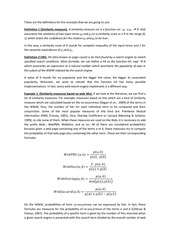
the probability of that web page also containing the other term. These are their corresponding
formulas:
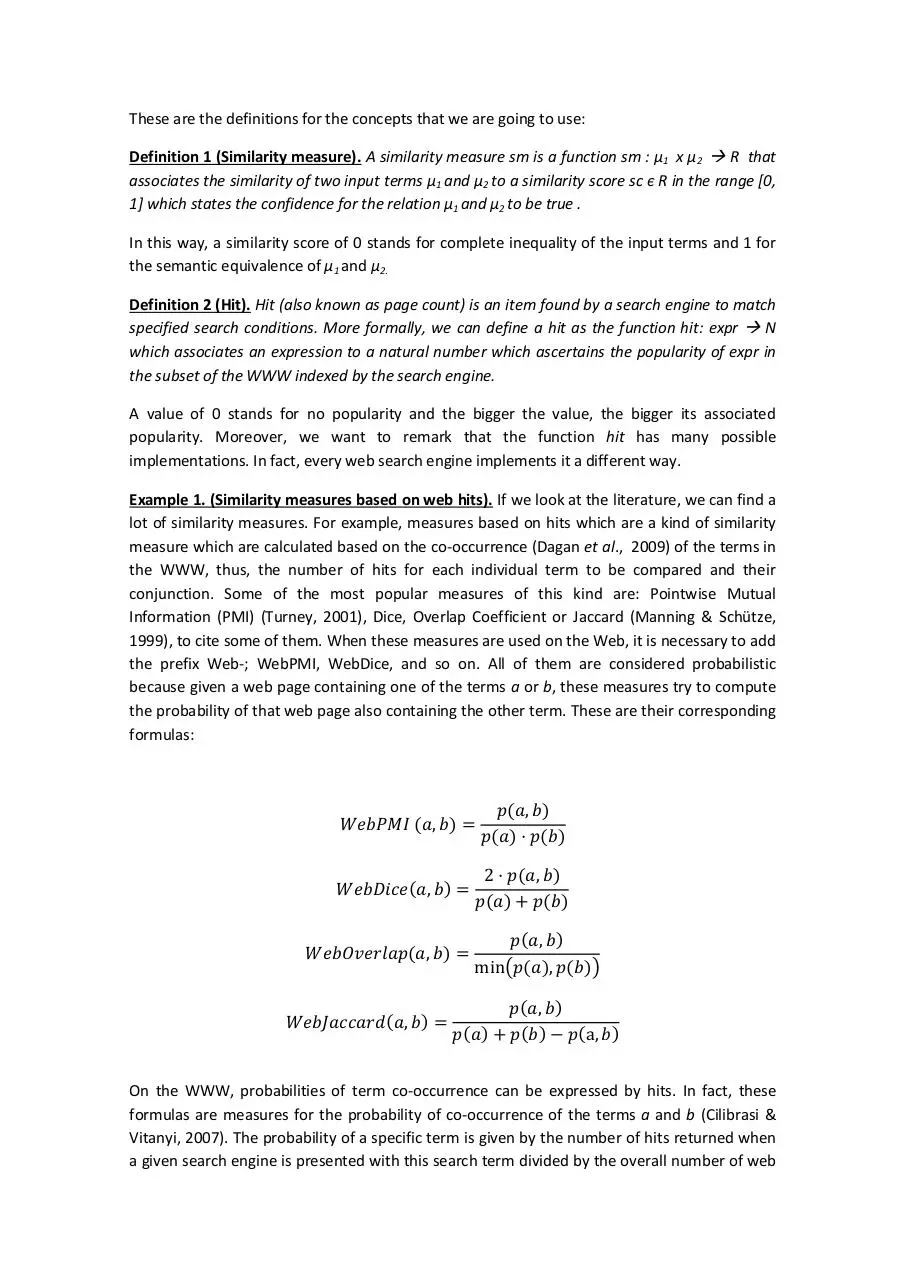
𝑊𝑒𝑏𝑃𝑀𝐼 (𝑎, 𝑏) =
𝑊𝑒𝑏𝐷𝑖𝑐𝑒�𝑎, 𝑏 =
𝑊𝑒𝑏𝑂𝑣𝑒𝑟𝑙𝑎𝑝�𝑎, 𝑏 =
𝑊𝑒𝑏𝐽𝑎𝑐𝑐𝑎𝑟𝑑�𝑎, 𝑏 =
𝑝(𝑎, 𝑏)
𝑝�𝑎 · 𝑝(𝑏)
2 · 𝑝�𝑎, 𝑏
𝑝�𝑎 + 𝑝�𝑏
𝑝�𝑎, 𝑏
min 𝑝�𝑎 , 𝑝�𝑏
𝑝�𝑎, 𝑏
𝑝�𝑎 + 𝑝�𝑏 − 𝑝�a, 𝑏
On the WWW, probabilities of term co-occurrence can be expressed by hits. In fact, these
formulas are measures for the probability of co-occurrence of the terms a and b (Cilibrasi &
Vitanyi, 2007). The probability of a specific term is given by the number of hits returned when
a given search engine is presented with this search term divided by the overall number of web
�
pages possibly returned. The joint probability p(a, b) is the number of hits returned by a web
search engine, containing both the search term a and the search term b divided by the overall
number of web pages possibly returned. Estimation about the number of web pages possibly
returned by a search engine has been studied in the past (Bar-Yossef & Gurevich, 2006). In this
work, we set the overall number of web pages as 1010 according to the number of indexed
pages reported in (Bollegala et al., 2007).
Despite its simplicity, using hits as a measure of co-occurrence of two terms presents several
advantages. It is surprisingly good at recognizing synonyms because it seems to be empirically
supported that synonyms often appear together in web pages (Cilibrasi & Vitanyi, 2007).
Moreover, if the search terms never occur (or almost never) together on the same web pages,
but do occur separately, this kind of measure will present very low similarity values.
Contribution
Traditionally web extraction techniques which are based on the notion of web hits have used a
given web search engine (frequently Google) in order to collect the necessary information for
their purposes. We thought that there was no compelling reason for considering Google the
most appropriate web search engine in order to collect information and we began to use other
search engines.
When we collected and processed the data from a wide variety of search engines, we saw that
Google was the best source. However, we discovered that the average mean of the results was
better than the results from Google. So we understood that maybe an optimized combination
of those search engines could be even better than the average means. Based on this, we
designed an experiment in order to test our hypothesis.
Figure 1 shows the solution proposed for the computation of the optimized web extraction
approaches. The key of the architecture is an elitist genetic algorithm (i.e. an algorithm which
selects the better individuals in each iteration), with a small mutation rate which generates a
vector of numerical weights and associates them to their corresponding web search engine.
The final solution can be expressed in the form of a numeric weight vector. It should be taken
into account that the output of this architecture is a function that tries to simulate the
behavior of the (group of) human(s) who solve the input benchmark dataset.
For the implementation of the function hit, we have chosen the following search engines from
among the most popular in the Alexa ranking (Alexa, 2010): Google, Yahoo!, Altavista, Bing,
and Ask. It should be taken into account that our approach does not include the automatic
selection of appropriate web search engines because it assumes that all of them are offered
initially, and those which may be associated with a weight of 0 will be automatically
deselected.
The vector of numerical weights is encoded in binary format in each of the genes belonging to
the domain of the genetic algorithm. For example, a vector of 20 bits can represent 1 weight of
20 bits, 2 weights of 10 bits, 4 weights of 5 bits, or 5 weights of 4 bits. It is necessary to
implement a function to convert each binary weight into decimal format before to calculate
the fitness for the weight vector. The number of decimal possibilities for each weight is 2bits,
for example, in case of choosing a vector of 5 weights of 4 bits, it is possible to represent 5
�
weights with 24 = 16 different values. These different values can range from 0 to 15, from 8 to 7, from 0 to 1 (where ticks have double precision) and so on. This depends of the
implementation for the conversion from binary format into decimal format.
The comparison between the benchmark datasets and our results is made using the Pearson’s
Correlation Coefficient, which is a statistical measure which allows comparing two matrices of
numeric values. Therefore the results can be in the interval [-1, 1], where -1 represents the
worst case (totally different values) and 1 represents the best case (totally equivalent values).
Figure 1. Solution proposed for the computation of the semantic similarity measure. An elitist genetic algorithm
generates a vector of numerical weights. The final solution can be expressed in the form of a numeric weight
vector.
Our approach is efficient and scalable because it only processes the snippets (no downloading
of web pages is necessary) for the result pages from the web search engines. On the other
hand, scalability is given by our genetic algorithm which allows us to expand the set of web
search engines without causing any kind of technical problem. This is would not be possible if
we would use a brute force strategy, for example.
�
It should be taken into account that problems related to the speed of the process, and more
importantly, to the restrictions on the maximum number of allowed queries per engine, are
solved by means of a preliminary phase which loads the results retrieved from the search
engines into appropriate data structures. We consider that this information is valid for a period
of 7 days, because the content indexed by the search engines growths dynamically.
Evaluation
In this section, we are going to show an evaluation of our approach. The section is divided in a)
a preliminary study to choose the appropriate parameters for configuring the optimization
environment, b) the empirical data that we have collected from the experiments, c) a study on
the quality of the optimized function, d) the effect of the operators on the final result and
finally, e) the information necessary to repeat the experiments.
Preliminary study
We are going to do a preliminary study of the configuration parameters for the environment.
-
-
-
-
For the number of genes per chromosome we have selected such values as 5, 10 and
20. A study using a t-Test distribution has shown us that that the differences between
samples obtained by means of these parameters are not statistically significant.
Therefore, we have selected 20 genes per chromosome.
For the number of individuals in the population, we have selected such values as 20, 50
and 100. Again, a t-Test statistical distribution has shown that the differences between
these samples are not statistically significant. We have selected a population of 100
individuals.
Related to crossover and mutation fraction, we have chosen a high value for the
crossover between genes and, a small percentage for mutations, because we wish a
classical configuration for the genetic algorithm.
Related to the combination formula, our preliminary study has shown us that the
weighted sum is better that the weighted product and the weighted square.
After ten independent executions, we noticed that the genetic algorithm did not improve the
results beyond the 200th generation, so we have set a limit of 200 generations for the
algorithm. The final results are computed by means of the average mean from these 10
generations. We are going to evaluate our approach using the Miller & Charles benchmark
dataset which is a dataset of term pairs rated by a group of 38 human beings (Miller & Charles,
1998). Term pairs are rated on a scale from 0 (no similarity) to 4 (complete similarity). Miller &
Charles dataset benchmark is a subset of Rubenstein & Goodenough original benchmark
dataset of 65 term pairs (Rubenstein & Goodenough, 1965). Although Miller & Charles
experiment was carried out many years later than Rubenstein & Goodenough, Bollegala et al.
(1965) state that two sets of ratings are highly correlated (Bollegala et al., 2007). Therefore,
Miller & Charles ratings can be considered as a good benchmark dataset to evaluate solutions
that involve semantic similarity measures.
Results
In this subsection we are going to present the empirical results that we have obtained from
our experiments. It should be taken into account that all figures, except those for the Miller &
�
Charles ratings, are normalized into values in [0, 1] range for ease of comparison. Pearson's
correlation coefficient is invariant against a linear transformation (Bollegala et al., 2007).
Table 1 shows the collected data using several search engines for solving the Miller & Charles
benchmark dataset. The measure that we have used is NGD (Cilibrasi & Vitany, 2007). As we
commented previously, Google is the best search engine for our purposes; however, the
average mean and the median present even better results. Other kinds of statistical measures
such as mode, maximum and minimum have been considered because their associated results
have not been better.
Table 1. Summary results for Miller & Charles benchmark using several search engines
Mil.Char.
Google
Ask
Altavista
Bing
Yahoo
Average
Median
cord-smile
0.13
0.05
0.25
1.00
0.00
0.00
0.26
0.05
rooster-voyage
0.08
0.24
1.00
0.00
0.00
0.00
0.25
0.00
noon-string
0.08
0.50
1.00
0.00
0.00
0.00
0.30
0.00
glass-magician
0.11
1.00
1.00
1.00
0.00
0.01
0.60
1.00
monk-slave
0.55
1.00
1.00
1.00
0.00
0.00
0.60
1.00
coast-forest
0.42
1.00
1.00
1.00
0.02
0.01
0.61
1.00
monk-oracle
1.10
1.00
1.00
1.00
0.00
0.00
0.60
1.00
lad-wizard
0.42
0.04
1.00
1.00
0.00
0.00
0.41
0.04
forest-graveyard
0.84
1.00
1.00
1.00
0.00
0.01
0.60
1.00
food-rooster
0.89
1.00
1.00
1.00
0.00
0.00
0.60
1.00
coast-hill
0.87
1.00
1.00
1.00
0.06
0.02
0.62
1.00
car-journey
1.16
0.17
1.00
1.00
0.01
0.00
0.44
0.17
crane-implement
1.68
0.14
1.00
0.00
0.00
0.00
0.23
0.00
brother-lad
1.66
0.18
1.00
1.00
0.00
0.00
0.44
0.18
bird-crane
2.97
1.00
1.00
1.00
0.13
0.09
0.64
1.00
bird-cock
3.05
1.00
1.00
1.00
0.07
0.07
0.63
1.00
food-fruit
3.08
1.00
1.00
1.00
0.03
0.01
0.61
1.00
brother-monk
2.82
1.00
1.00
1.00
0.11
0.04
0.63
1.00
asylum-madhouse
3.61
1.00
1.00
1.00
0.00
0.00
0.60
1.00
furnace-stove
3.11
0.46
1.00
1.00
0.00
1.00
0.69
1.00
magician-wizard
3.50
1.00
1.00
1.00
0.04
0.98
0.80
1.00
journey-voyage
3.84
1.00
1.00
1.00
0.00
0.00
0.60
1.00
coast-shore
3.70
1.00
1.00
1.00
0.02
0.08
0.62
1.00
implement-tool
2.95
1.00
1.00
1.00
0.00
0.02
0.60
1.00
boy-lad
3.76
1.00
1.00
1.00
0.18
0.02
0.64
1.00
automobile-car
3.92
1.00
1.00
1.00
0.01
0.34
0.67
1.00
midday-noon
3.42
1.00
1.00
1.00
0.07
0.00
0.61
1.00
gem-jewel
3.84
1.00
1.00
1.00
0.39
0.05
0.69
1.00
Correlation
1.00
0.47
0.26
0.35
0.43
0.34
0.61
0.54
�
 Historical archive . public document