MaSiMe: A Customized Similarity Measure and
Its Application for Tag Cloud Refactoring
David Urdiales-Nieto, Jorge Martinez-Gil, and Jos´e F. Aldana-Montes
University of M´
alaga, Department of Computer Languages and Computing Sciences
Boulevard Louis Pasteur 35, 29071 M´
alaga, Spain
{durdiales,jorgemar,jfam}@lcc.uma.es
http://khaos.uma.es/
Abstract. Nowadays the popularity of tag clouds in websites is increased notably, but its generation is criticized because its lack of control
causes it to be more likely to produce inconsistent and redundant results.
It is well known that if tags are freely chosen (instead of taken from a
given set of terms), synonyms (multiple tags for the same meaning), normalization of words and even, heterogeneity of users are likely to arise,
lowering the efficiency of content indexing and searching contents. To
solve this problem, we have designed the Maximum Similarity Measure
(MaSiMe) a dynamic and flexible similarity measure that is able to take
into account and optimize several considerations of the user who wishes
to obtain a free-of-redundancies tag cloud. Moreover, we include an algorithm to effectively compute the measure and a parametric study to
determine the best configuration for this algorithm.
Keywords: social tagging systems, social network analysis, Web 2.0.
1
Introduction
Web 2.0 is a paradigm about the proliferation of interactivity and informal annotation of contents. This informal annotation is performed by using tags. Tags
are personally chosen keywords assigned to resources. So instead of putting a
bookmark into a folder, users might assign it tags. The main aspect is that
tagging creates an annotation to the existing content. If users share these with
others, everybody benefits by discovering new sites and getting better matches
for their searches.
Tag clouds represent a whole collection of tags as weighted lists. The more
often a tag has been used, the larger it will be displayed in the list. This can be
used to both characterize users, websites, as well as groups of users.
To date, tag clouds have been applied to just a few kinds of focuses (links,
photos, albums, blog posts are the more recognizable). In the future, expect to see
specialized tag cloud implementations emerge for a tremendous variety of fields
and focuses: cars, properties or homes for sale, hotels and travel destinations,
products, sports teams, media of all types, political campaigns, financial markets,
brands, etc [1].
R. Meersman, P. Herrero, and T. Dillon (Eds.): OTM 2009 Workshops, LNCS 5872, pp. 937–946, 2009.
c Springer-Verlag Berlin Heidelberg 2009
�
�
938
D. Urdiales-Nieto, J. Martinez-Gil, and J.F. Aldana-Montes
On the other hand, although automatic matching between tags is perhaps the
most appropriate way to solve this kind of problems, it has the disadvantage
but when dealing with natural language often it leads a significant error rate,
so researchers try to find customized similarity functions (CSF) [2] in order to
obtain the best solution for each situation. We are following this line. Therefore,
the main contributions of this work are:
– The introduction of a new CSF called Maximum Similarity Measure
(MaSiMe) to solve the lack of terminological control in tag clouds.
– An algorithm for computing the measure automatically and efficiently and
a statistical study to choose the most appropriate parameters.
– An empirical evaluation of the measure and discussion about the advantages
of its application in real situations.
The remainder of this article is organized as follows. Section 2 describes the
problem statement related to the lack of terminological control in tag clouds.
Section 3 describes the preliminary definitions and properties that are necessary
for our proposal. Section 4 discusses our Customized Similarity Measure and
a way to effectively compute it. Section 5 shows the empirical data that we
have obtained from some experiments, including a comparison with other tools.
Section 6 compares our work with other approaches qualitatively. And finally,
in Section 7 the conclusions are discussed and future work presented.
2
Problem Statement
Tags clouds offer an easy method to organize information in the Web 2.0. This
fact and their collaborative features have derived in an extensive involvement in
many Social Web projects. However they present important drawbacks regarding
their limited exploring and searching capabilities, in contrast with other methods
as taxonomies, thesauruses and ontologies. One of these drawbacks is an effect
of its flexibility for tagging, producing frequently multiple semantic variations of
a same tag. As tag clouds become larger, more problems appear regarding the
use of tag variations at different language levels [3]. All these problems make
more and more difficult the exploration and retrieval of information decreasing
the quality of tag clouds.
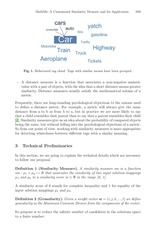
We wish to obtain a free-of-redundancies tag cloud as Fig. 1 shows, where tags
with similar means have been grouped. The most significant tag can be visible
and the rest of similar tags could be hidden, for example. Only, when a user may
click on a significant tag, other less important tags would be showed.
On the other hand, we need a mechanism to detect similarity in tag clouds.
In this way, functions for calculating relatedness among terms can be divided
into similarity measures and distance measures.
– A similarity measure is a function that associates a numeric value with a
pair of objects, with the idea that a higher value indicates greater similarity.
�
MaSiMe: A Customized Similarity Measure and Its Application
939
Fig. 1. Refactored tag cloud. Tags with similar means have been grouped.
– A distance measure is a function that associates a non-negative numeric
value with a pair of objects, with the idea that a short distance means greater
similarity. Distance measures usually satisfy the mathematical axioms of a
metric.
Frequently, there are long-standing psychological objections to the axioms used
to define a distance metric. For example, a metric will always give the same
distance from a to b as from b to a, but in practice we are more likely to say
that a child resembles their parent than to say that a parent resembles their child
[4]. Similarity measures give us an idea about the probability of compared objects
being the same, but without falling into the psychological objections of a metric.
So from our point of view, working with similarity measures is more appropriate
for detecting relatedness between different tags with a similar meaning.
3
Technical Preliminaries
In this section, we are going to explain the technical details which are necessary
to follow our proposal.
Definition 1 (Similarity Measure). A similarity measure sm is a function
sm : µ1 × µ2 �→ R that associates the similarity of two input solution mappings
µ1 and µ2 to a similarity score sc ∈ � in the range [0, 1].
A similarity score of 0 stands for complete inequality and 1 for equality of the
input solution mappings µ1 and µ2 .
Definition 2 (Granularity). Given a weight vector w = (i, j, k, ..., t) we define
granularity as the Maximum Common Divisor from the components of the vector.
Its purpose is to reduce the infinite number of candidates in the solutions space
to a finite number.
�
940
4
D. Urdiales-Nieto, J. Martinez-Gil, and J.F. Aldana-Montes
MaSiMe: Maximum Similarity Measure
In this section, we are going to explain MaSiMe and its associated properties.
Then, we propose an efficient algorithm to compute MaSiMe and finally, we
present a statistical study to determine the most appropriate configuration for
the algorithm.
4.1
Maximum Similarity Measure
An initial approach for an ideal Customized Similarity Measure which would be
defined in the following way:
Let A be a vector of matching algorithms in the form of a similarity measure
and w a weight vector then:
�i=n
M aSiM e(c1, c2) = x ∈ [0, 1] ∈ � → ∃ �A, w� , x = max( i=1 Ai · wi )
�i=n
with the following restriction i=1 wi ≤ 1
But from the point of view of engineering, this measure leads to an optimization
problem for calculating the weight vector, because the number of candidates
from the solution space is infinite. For this reason, we present MaSiMe, which
uses the notion of granularity for setting a finite number of candidates in that
solution space. This solution means that the problem of computing the similarity
can be solved in a polynomial time.
Definition 3. Maximum Similarity Measure (MaSiMe)
Let A be a vector of matching algorithms in the form of a similarity measure,
let w be a weight vector and let g the granularity then:
�i=n
M aSiM e(c1, c2) = x ∈ [0, 1] ∈ � → ∃ �A, w, g� , x = max( i=1 Ai · wi )
�i=n
˙
with the following restrictions i=1 wi ≤ 1 ∧ ∀wi ∈ w, wi ∈ {g}
˙ denotes the set of multiples of g.
where {g}
Example 1. Given an arbitrary set of algorithms and a granularity of 0.05,
calculate MaSiMe for the pair (author, name author).
M aSiM e(author, name author) = .542 ∈ [0, 1] →
�i=4
∃ �A = (L, B, M, Q), w = (0.8, 0, 0, 0.2), g = 0.05� , 0.542 = max( i=1 Ai · wi )
Where L = Levhenstein [5], B = BlockDistance [6], M = MatchingCoefficient
[6] , Q = QGramsDistance [7]
There are several properties for this definition:
Property 1 (Continuous Uniform Distribution). A priori, MaSiMe
presents a continuous uniform distribution in the interval [0, 1], that is to say, its
probability density function is characterized by
∀ a, b ∈ [0, 1] → f (x) =
1
f or a ≤ x ≤ b
b−a
Property 2 (Maximality). If one of the algorithms belonging to the set of
matching algorithms returns a similarity of 1, then the value of MaSiMe is 1.
�
MaSiMe: A Customized Similarity Measure and Its Application
941
∃Ai ∈ A, Ai (c1, c2) = 1 → M aSiM e(c1, c2) = 1
Moreover, the reciprocal is true
M aSiM e(c1, c2) = 1 → ∃Ai ∈ A, Ai (c1, c2) = 1
Property 3 (Monotonicity). Let S be a set of matching algorithms, and let
S’ be a superset of S. If MaSiMe has a specific value for S, then the value for S’
is either equal to or greater than this value.
∀S � ⊃ S, M aSiM es = x → M aSiM es� ≥ x
4.2
Computing the Weight Vector
Once the problem is clear and the parameters A and g are known, it is necessary
to effectively compute the weight vector. At this point, we leave the field of
similarity measures to move into the field of engineering.
It is possible to compute MaSiMe in several ways, for this work, we have designed a greedy mechanism that seems to be effective and efficient. In the next
paragraphs, we firstly describe this mechanism and then we discuss its associated
complexity. We are going to solve this using a greedy strategy, thus a strategy
which consists of making the locally optimum choice at each stage with the hope
of finding the global optimum.
Theorem 1 (About Computing MaSiMe). Let S be the set of all the matching algorithms, let A be the subset of S, thus, the set of matching algorithms that
we want to use, let g be the granularity, let Q the set of positive Rational Numbers, let i, j, k, ..., t be indexes belonging to the set of multiples for the granularity
˙ then, a set of rational vectors r exists where each element ri is re(denoted {g})
sult of the scalar product between A and the index pattern (i, j − i, k − j, ..., 1 − t).
All of this subject to j ≥ i ∧ k ≥ j ∧ 1 ≥ k. Moreover, the final result, called R,
is the maximum of the elements ri and is always less or equal than 1.
And in mathematical form:
˙ → ∃r, ri = A · (i, j − i, k − j, ..., 1 − t)
∃A ⊂ S, ∃g ∈ [0, 1] ∈ Q+, ∀i, j, k, ..., t ∈ {g}
with the followings restrictions j ≥ i ∧ k ≥ j ∧ 1 ≥ k
R = max (ri ) ≤ 1
Proof 1. ri is by definition the scalar product between a vector of matching algorithms that implements similarity measures and the pattern (i, j−i, k−j, ..., 1−t).
In this case, a similarity measure cannot be greater than 1 by Definition 1
and the sum of the pattern indexes cannot be greater than 1 by restriction
(i, j − i, k − j, ..., 1 − t), so scalar product of such factors cannot be greater than 1.
Now, we are going to show how to implement the computation of MaSiMe by
using an imperative programming language. Algorithm 1 shows the pseudocode
implementation for this theorem.
�
942
D. Urdiales-Nieto, J. Martinez-Gil, and J.F. Aldana-Montes
Input: tag cloud: T C
Input: algorithm vector: A
Input: granularity: g
Output: M aSiM e
foreach pair (c1, c2) of terms in T C do
foreach index i, j, k, ..., t ∈ κ × g do
result = A1 (c1, c2) · i +
A2 (c1, c2) · j − i +
A3 (c1, c2) · k − j +
A4 (c1, c2) · t − k +
...
An (c1, c2) · 1 − t ;
if result > M aSiM e then
M aSiM e = result;
end
if M aSiM e = 1 then
stop;
end
end
if M aSiM e > threshold then
merge (M ostW eigthedT erm(c1, c2), LightT erm(c1, c2));
end
end
Algorithm 1. The greedy algorithm to compute MaSiMe
The algorithm can be stopped when it obtains a partial result equal to 1,
because this is the maximum value than we can hope for.
Complexity. The strategy seems to be brute force, but it is not (n-1 loops are
needed to obtain n parameters). Have into account that the input data size is, but
the computational complexity for the algorithm according to big O notation [8] is
O(nlength
of A−1
)
In this way, the total complexity (TC) for MaSiMe is:
T C(M aSiM eA) = O(max(max(O(Ai )), O(strategy)))
and therefore for MaSiMe using the greedy strategy
T C(M aSiM eA ) = O(max(max(O(Ai )), O(nlength
4.3
of A−1
)))
Statistical Study to Determine the Granularity
We have designed the proposed algorithm, but in order to provide a specific
value for its granularity we have performed a parametric study. In this study,
we have tried to discover the value that maximizes the value for the granularity
by means of an experimental study. In Fig. 2, it can be seen that for several
independent experiments the most suitable value is in the range between 0.1
and 0.13.
�
MaSiMe: A Customized Similarity Measure and Its Application
943
Fig. 2. Statistical study which shows that the most suitable value for granularity is in
the range between 0.1 and 0.13. Cases analyzed present an increasing value of MaSiMe
for low values of granularity, and MaSiMe presents the highest value between 0.1 and
0.13. MaSiMe is a constant value for higher values of granularity.
Table 1. The statistical study shows the most suitable value for granularity is 0.10
because it provides the best results in all cases
Granularity value No-adding function Adding function
0.10
0.11
1.00
0.13
0.11
1.00
Experiment 2
0.10
0.67
0.67
0.13
0.67
0.61
Experiment 3
0.10
0.63
0.63
0.13
0.63
0.57
Experiment 4
0.10
0.67
0.67
0.13
0.67
0.61
Experiment 1
Once we have obtained the granularity range with which is obtained the best
MaSiMe value, a new statistical study is made with the same concepts to obtain
the best MaSiMe value between 0.1 and 0.13. The function used by Google to
take similarity distances [9] is introduced in MaSiMe showing better MaSiMe values using a granularity value of 0.1. Adding this function and using a granularity
of 0.13 MaSiMe values are lower than without adding this function. Then, we can
�
944
D. Urdiales-Nieto, J. Martinez-Gil, and J.F. Aldana-Montes
conclude that the suitable granularity value is 0.1. Table 1 shows a comparative
study with and without this new function.
5
Empirical Evaluation
We have tested an implementation of MaSiMe. We have used MaSiMe in the
following way: For the matching algorithms vector, we have chosen a set of well
known algorithms A = {Levhenstein [5], Stoilos [10], Google [9], Q-Gram [7] }
and for granularity, g = 0.1 (as we have determined in the previous section).
We show an example (Table 2) of mappings that MaSiMe has been able to
discover from [11] and [12]. We have compared the results with two of the most
outstanding tools: FOAM [13] and RiMOM [14].
Fig. 3. Refactorized tag cloud. Similar tags have been added to the scope of their corresponding and most significant tag. As consequence, we obtain a free-of-redundancies
tag cloud where new terms can be included.
Table 2. Comparison of several mappings from several tools
Russia1
food
drink
traveler
health risk
document
approval
monetary unit
inhabitant
adventure
building
flight
river transfer
political area
Russia2
FOAM RiMOM MaSiMe
food
1.00
0.50
1.00
drink
1.00
0.71
1.00
normal traveler
0
0
0.90
disease type
0
0.17
0.17
document
1.00
0.99
1.00
certificate
0
0.21
0.24
currency
0
0
0.29
citizen of russia
0
0.11
0.12
sport
0
0.01
0.11
public building 0.80
0.60
0.53
air travel
0
≈0
1.00
cruise
0
0.21
0.21
political region
0
0.40
0.69
�
MaSiMe: A Customized Similarity Measure and Its Application
945
Moreover, in Fig. 3 we show the appearance from the experiment where we
have obtained a free-of-redundancies tag cloud. Moreover, the refactoring process
allows us to obtain a nicer tag cloud where new terms can be included. To
obtain better results in the test, it is only necessary to expand the vector A
with algorithms to have into account aspects to compare among the tags.
6
Related Work
A first approach to solve the problem could consist of systems employing an optional authority control of keywords or names and resource titles, by connecting
the system to established authority control databases or controlled vocabularies
using some kind of techniques, but we think that it is a very restrictive technique
in relation to ours.
Other approach consists of the utilization of approximate string matching
techniques to identify syntactic variations of tags [3]. But the weakness of this
proposal is that it has been designed to work at syntactical level only. In this
way, only misspelled or denormalized tags can be merged with the relevant ones.
On the other hand, there are tag clustering approaches. Most significant work
following this paradigm is presented in [15], where a technique for pre-filtering
tags before of applying an algorithm for tag clustering is proposed. Authors try
to perform a statistical analysis of the tag space in order to identify groups, or
clusters, of possibly related tags. Clustering is based on the similarity among
tags given by their co-occurrence when describing a resource. But the goal of
this work is substantially different from ours, because it tries to find relationships
within tags in order to integrate folksonomies with ontologies.
7
Conclusions
We have presented MaSiMe, a new similarity measure and its application to
tag cloud refactoring as part of a novel computational approach for flexible and
accurate automatic matching that generalizes and extends previous proposals
for exploiting an ensemble of matchers.
Using MaSiMe to compare semantic similarities between tags needs to the user
for choosing the appropriate algorithms for comparing such aspects it could be
corrected (i.e. misspellings or typos, plurals, synonyms, informal words and, so
on). As the results show, MaSiMe seems to be an accurate, and flexible similarity
measure for detecting semantic relatedness between tags in a tag cloud and its
application has been satisfactory. Moreover, we should not forget that MaSiMe
is easy to implement in an efficient way.
Acknowledgements
This work has been funded: ICARIA: From Semantic Web to Systems Biology
(TIN2008-04844) and Pilot Project for Training and Developing Applied Systems
Biology (P07-TIC-02978).
�
 Historical archive . public document