International Conference on Complex, Intelligent and Software Intensive Systems
Comparison of textual renderings of ontologies for improving their alignment
Jorge Martinez-Gil, Ismael Navas-Delgado, Antonio Polo-Marquez and, Jose F. Aldana-Montes
University of Malaga, Department of Language and Computing Sciences, Khaos Group
Boulevard Louis Pasteur s/n, 29071 Malaga (Spain)
jfam@lcc.uma.es
Abstract
combine their ontologies with ontologies of partners in an
easy and secure way.
The reminder of this article is as follow: Next section
describes briefly the state of the art on ontology alignment,
from the point of view of the techniques and from the point
of view of the tools. Third section describes the key ideas
of a new proposal and a design of an experiment to validate it. Results section shows the empirical data that we
have obtained from the experiment. Discussion deals with
the interpretation and application of these results. And finally, Conclusions and Future work contains the strengths
and weakness of our proposal and the future improvements
that are necessary to consolidate it.
This work is about an experiment in which we have compared the textual rendering of ontologies in order to get
more accurate alignments between them. The experiments
we have performed consist on three main steps: rendering
in a textual way two ontologies, comparing the obtained
text with several algorithms for text comparing and, using
the obtained result as a factor to improve the alignments between them. As result, we got some evidences that this technique gives us a good measure of the similarity of ontologies
and, therefore can allow us to improve the effectiveness of
the alignment process.
2. State-of-the-art
1. Introduction
Related to the state-of-the-art in ontology alignment,
most of authors prefer explain it in two different ways:
From the point of view of the techniques and from the point
of view of the tools. Related to techniques and according to
[2], the equivalence between entities can be seen from three
main groups: a) based on syntactic techniques, b) based on
semantic techniques and, c) based on the structure of the
ontology.
Some of the most popular syntactic techniques are string
metrics, string normalization and/or translation, synonyms
detection and use of external resources (lexicons, thesaurus
and, so on).
Related to semantics, only a few techniques have been
developed. Most of them based on deductives methods. Besides, ”once deductive techniques have been applied, their
results might be considered as an input to inductive techniques” [2].
On structural techniques, it is important to highlight
graph-based, model-based and taxonomy-based techniques,
repositories of structures and statistical methods.
In this way, there are a lot of works trying to solve the
problem of alignment from the three points of view and,
even trying to combine them in a hybrid technique. Most
of them are implemented in the form of tool, although an
The problem of aligning ontologies consists of finding
the semantic correspondences between entities belonging to
two ontologies. In the case of more than two ontologies,
the problem is called multialignment, but it is not our case.
More formally, the process of aligning ontologies can be
expressed as a function f where given a pair of ontologies
o and o� , an input alignment A, a set of parameters p and a
set of resources r, returns an alignment A� [1]:
A� = f (o, o� , A, p, r)
Where A� is a set of mappings. A mapping is an expression that can be written in the form (e, e� , n, R). Where e
and e� are entities belonging to different ontologies, R is
the relation of correspondence and n is a real number between 0 and 1 that represents the mathematical probability
that R may be true. The entities than can be related are the
concepts, roles, rules and, even axioms of the ontologies.
We wish to solve this problem in an accurate and automatic way, because it is a key aspect for getting semantic
interoperability on the Semantic Web. It means that people
(or groups of people) can use their own ontology without
having to stick to a specific standard. It also allows them to
0-7695-3109-1/08 $25.00 © 2008 IEEE
DOI 10.1109/CISIS.2008.71
871
�
3. Problem statement
exhaustive overview of each one of these tools overcome
the boundaries of this work, we are going to show some of
the most outstanding examples:
Definition 1. Textual rendering of an ontology is the result
of printing the information contained in that ontology. It
can be expressed more formally, let e an entity from an ontology O, and let t(e) a function that prints the identifier of
an entity, then a textual rendering T from an ontology O is
an expression such:
• COMA [3]. It is a generic tool that allows finding the
correspondences between a wide range of schemas. It
provides a library of algorithms, a module for combining the results and a platform to evaluate them. One of
its strengths is the high quality of its role comparison
algorithms. It allows learning and asking to the user
too.
∀e ∈ O, ∃t(e) ⇒ T (O) = {t(e)}
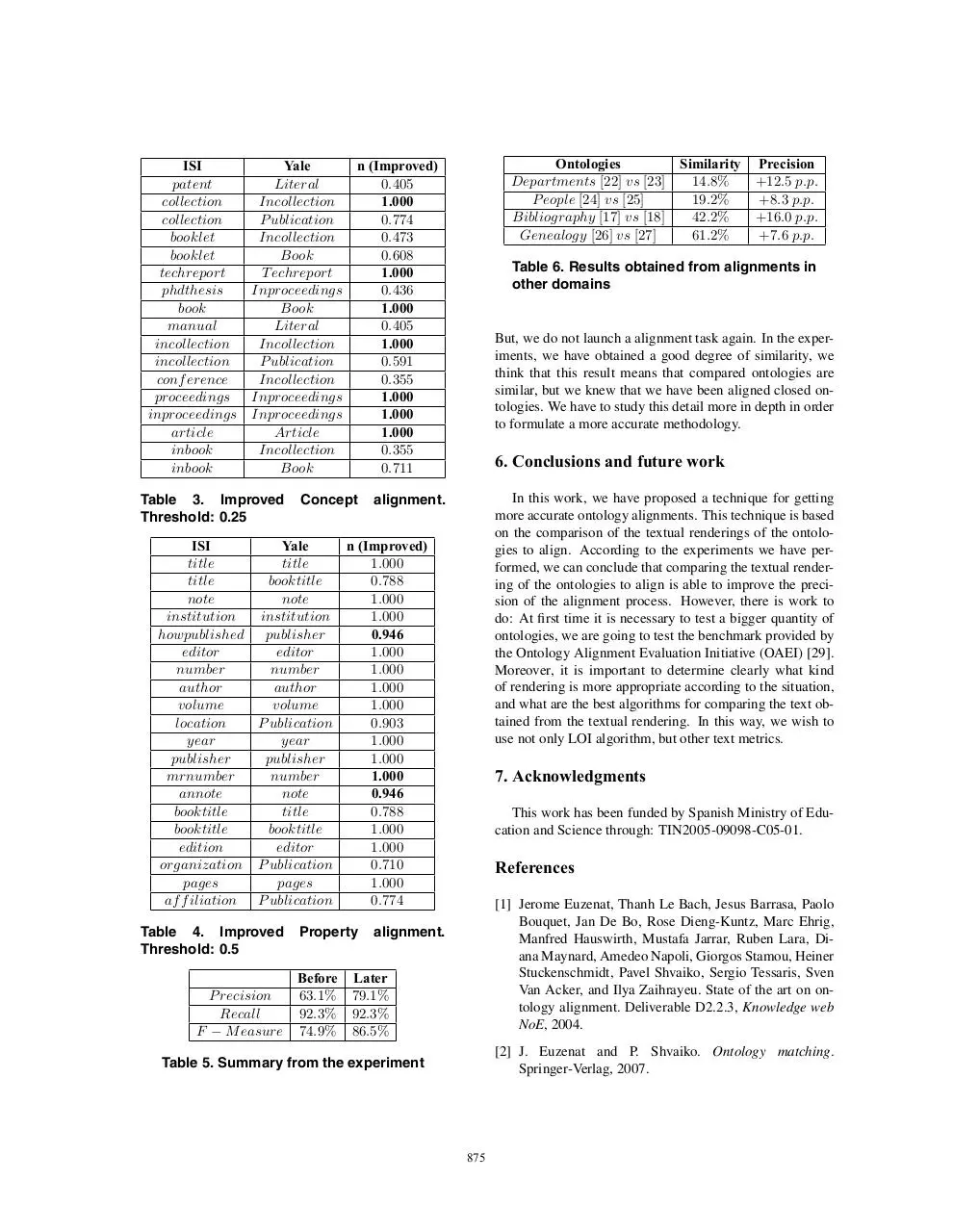
Example 1. Textual rendering for Figure 1 is A man is a
person. A woman is a person.
Now, we are going to explain why we think that textual
renderings of ontologies are interesting.
Example 2. Note Figure 1 and Figure 2; they are very simple ontologies. They are very similar, too. For example, it
is easy to align the concepts man and woman, using any
algorithm for string matching. But, what is about person
and human being? We know that both represent the same
object of the real world, but what computer algorithm can
tell us that are the same? Based on string similarity techniques cannot. Based on taxonomy algorithms can increase
the probability, but it is not enough. Based on WordNet
algorithms can, but they are dangerous; imagine such concepts as ’plane’ and ’aeroplane’, they are synonyms, but
only in some situations. We think that we can solve this
problem and we are going to make an experiment to show
it: Let’s remember the textual rendering from the first ontology: A man is a person. A woman is a person.
On the other hand, textual rendering for the second ontology sample is: A man is a human being. A woman is a
human being. Now, if we compare the two textual renderings using an algorithm as Loss of Information (LOI) [17],
we have a 76.9 percent of similarity between them. We propose to use this result as a factor to increase the probability
of the mappings in the output alignment.
• Cupid [4]. It implements an comparison scheme algorithm that combines linguistic techniques and relations
algorithms. Its operation mode consists on converting
the input schemes into graphs and then using known
graph algorithms.
• QOM [5]. Its philosophy consists in to find a balance
between the quality of correspondences and the execution time of the task. Instead of comparing each concept of an ontology with each concept of the other ontology, first it throws heuristic functions that decrease
the number of candidates. In this way, it can provide
results in a short period of time.
• Anchor-Prompt [6] tries to find relationships between
entities based on the primary relationships recognized
before. If two pairs of terms from the ontologies are
similar and there are paths connecting the terms, then
the elements in those paths are often similar as well.
• S-MATCH [7]. It allows getting semantic correspondences (similarity, specialization, generalization, disjunction and overlapping) between entities that belongs to different ontologies. The system uses the notion of plug-in for extending the existent features.
• OLA [8] is behind the idea of balancing the weight of
each component that compose an ontology. It converts
definitions of distances based on all the input structures
into a set of equations. The algorithm tries to find the
ontolgy alignment that minimizes the overall distance.
Other outstanding systems are: Asco [9] that uses a combination of linguistic and structural techniques, Buster [10]
that uses inference mechanisms, FCA-Merge [11] that applies techniques from natural language processing and formal concept analysis, Glue [12] that uses machine learning
techniques, IF-map [13] that uses the mathemathical channel theory, Multikat [14] that implements an algorithm of
comparison and integration of multiple conceptual graphs,
Rondo [15] where high-level operators to manipulate models and mappings between models are defined. And finally,
T-tree [16] that uses algorithms for analizing a kind of special taxonomies.
Figure 1. Ontology sample number 1
872
�
about the content and the structure. So it is a rendering
without loss of information. It is useful in order to compare
not only the contents, but the structures.
• Definition 3.1. Partial Full rendering prints all the
information related to a kind of entities. As we commented earlier, it is useful when concepts are closed,
but we think that there are very different instances, for
example.
• Definition 3.2. Complete rendering prints all the information of the ontology, so the process is reversible.
Crude renderings try to get a measure of the resemblance
of the vocabularies. In full renderings, the resemblance of
vocabularies is important, but each time that a entity appear
we print a more elaborated message about it. Note that the
message we print is similar for the two ontologies, so we
are increasing the similarity between the generated text, but
also reducing the importance of the vocabularies.
In order to get empirical results from our theory, we are
going to perform an experiment over two public ontologies.
We have chosen the ontology about bibliography of the Institute of Information Sciences (ISI) from California, USA
[18]. And the ontology about bibliography from the University of Yale [19], in the United States too. Originally,
both ontologies were in DAML [20] format, but we have
converted them into OWL format [21] in order to allow our
software to process them. We have chosen them because we
guess they have a high degree of commonality and, therefore the experiment could show us the merits of our proposal. Other important details we have considered are:
Figure 2. Ontology sample number 2
In this sense, we think that we can use this observation
in order to formulate a generic technique for improving ontology mappings.
The experiment that we are going to perform consists of
a previous task and then three steps. The previous task is
to launch a task to align the ontologies. It is interesting to
launch a simple algorithm in order (as a based on similarity
string algorithm) to see how much the next steps increase
the quality of the alignment. Then:
1. Rendering the ontologies.
2. Comparing the obtained text.
3. Using the result as a factor to increase the probability
of the mappings may be true.
• The argument R of the mappings (relation between the
entities) will be Equivalence only.
Although we have defined textual rendering already,
there are several ways to render the ontology in a textual
way:
Definition 2. Crude rendering is the kind of rendering that
only prints the information of the concepts and properties,
excluding the relations. So it loses information about the
structure. It is good when we wish to compare only the
content of the ontologies.
• We have determined that the degree of similarity between the textual renderings will be used for increase
the n of the mappings (probability of relation between
them be true).
4. Results
• Definition 2.1. Partial Crude rendering is a kind of
rendering used to compute the similarity rate between
a concrete kind of entities in two ontologies. It is useful in cases where concepts are very similar but other
entities (properties, relations, instances, so on) are very
different.
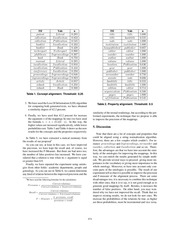
1. At first time, we have performed a syntactic alignment
of the ontologies. We have used the Levenshtein algorithm [22]. Table 1 shows the results for the concept
alignment. We have determined a low threshold for
getting a significative number of pairs. Table 2 shows
the results for the properties alignment. Many of them
are the same in both ontologies.
• Definition 2.2. Full Crude rendering is a kind rendering used to compare the contents of the whole ontologies. It seems to be useful when compared ontologies
are very closed.
2. At second time, we have performed the rendering over
ontologies from the ISI and Yale. We have used Full
Crude Rendering. In this way, we give more importance to the similarity of the vocabularies than to the
structure of the ontologies.
Definition 3. Full rendering is the kind of rendering which
allows to rebuild the ontology because it prints information
873
�
ISI
Yale
n
patent
Literal
0.285
collection
Incollection
0.833
collection
P ublication
0.545
booklet
Incollection
0.333
booklet
Book
0.428
techreport
T echreport
0.900
phdthesis
Inproceedings 0.307
book
Book
0.750
manual
Literal
0.285
incollection
Incollection
0.916
incollection
P ublication
0.416
conf erence
Incollection
0.250
proceedings Inproceedings 0.846
inproceedings Inproceedings 0.923
article
Article
0.857
inbook
Incollection
0.250
inbook
Book
0.500
ISI
title
title
note
institution
howpublished
editor
number
author
volume
location
year
publisher
mrnumber
annote
booktitle
booktitle
edition
organization
pages
af f iliation
Table 1. Concept alignment. Threshold: 0.25
3. We have used the Loss Of Information (LOI) algorithm
for comparing both generated texts, we have obtained
a similarity degree of 42.2 percent.
similarity of the textual renderings, but according to the performed experiments, the technique that we propose is able
to improve the precision of the mappings.
5. Discussion
Note that there are a lot of concepts and properties that
could be aligned using a string normalization algorithm.
However, there are a few couples which couldn’t. For instance: proceedings and Inproceedings, mrnumber and
number, collection and Incollection and so on. Therefore, the advantages are that we have into account the similarity of the ontologies for improving the mappings. In this
way, we can enrich the results generated by simple methods. We provide several ways to proceed: giving more importance to the vocabulary or giving more importance to the
whole ontology. Moreover, to have into account only concrete parts of the ontologies is possible. The result of our
experiment tell us that it is possible to improve the precision
and F-measure of the alignment process. There are some
disadvantages too; it is necessary to combine this technique
with other ones, that it is to say, it is not good enough as to
generate good mappings by itself. Besides, it increases the
number of false positives. On other hand, you may wondered why we have not improved the recall. Think that we
improve existing results, we do not look for new ones. We
increase the probabilities of the relations be true, as higher
are these probabilities, more be incremented and vice versa.
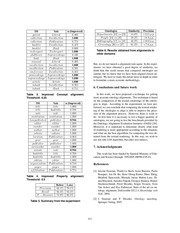
In Table 5, we have extracted a statical summary from
the results of our proposal1
As you can see, at least in this case, we have improved
the precision, we have kept the recall and, of course, we
have increased the F-Measure. But there are bad news too,
the number of false positives has increased. We have considered that a relation is true when its n argument is equal
or greater than 0.9.
Finally, we have repeated the experiment using ontologies from other fields: academic departments, people and
genealogy. As you can see in Table 6, we cannot determine
any kind of relation between the improved precision and the
have used the following formulas for the calculations:
P recision =
Recall =
Correct relations
Correct relations + Incorrect relations
Correct relations
Correct relations + N ot f ound relations
F − M easure =
n
1.000
0.555
1.000
1.000
0.667
1.000
1.000
1.000
1.000
0.636
1.000
1.000
0.750
0.666
0.555
1.000
0.714
0.500
1.000
0.545
Table 2. Property alignment. Threshold: 0.5
4. Finally, we have used that 42.2 percent for increase
the argument n of the mappings be true (we have used
the formula n = n + (0.422 · n). In this way, the
higher values are increased significatively, while lower
probabilities not. Table 3 and Table 4 shows us the new
results for the concepts and the properties respectively.
1 We
Yale
title
booktitle
note
institution
publisher
editor
number
author
volume
P ublication
year
publisher
number
note
title
booktitle
editor
P ublication
pages
P ublication
2 · precision · recall
precision + recall
874
�
Ontologies
Similarity Precision
Departments [22] vs [23]
14.8%
+12.5 p.p.
P eople [24] vs [25]
19.2%
+8.3 p.p.
Bibliography [17] vs [18]
42.2%
+16.0 p.p.
Genealogy [26] vs [27]
61.2%
+7.6 p.p.
ISI
Yale
n (Improved)
patent
Literal
0.405
collection
Incollection
1.000
collection
P ublication
0.774
booklet
Incollection
0.473
booklet
Book
0.608
techreport
T echreport
1.000
phdthesis
Inproceedings
0.436
book
Book
1.000
manual
Literal
0.405
incollection
Incollection
1.000
incollection
P ublication
0.591
conf erence
Incollection
0.355
proceedings Inproceedings
1.000
inproceedings Inproceedings
1.000
article
Article
1.000
inbook
Incollection
0.355
inbook
Book
0.711
Table 3. Improved
Threshold: 0.25
ISI
title
title
note
institution
howpublished
editor
number
author
volume
location
year
publisher
mrnumber
annote
booktitle
booktitle
edition
organization
pages
af f iliation
Concept
Table 6. Results obtained from alignments in
other domains
But, we do not launch a alignment task again. In the experiments, we have obtained a good degree of similarity, we
think that this result means that compared ontologies are
similar, but we knew that we have been aligned closed ontologies. We have to study this detail more in depth in order
to formulate a more accurate methodology.
6. Conclusions and future work
In this work, we have proposed a technique for getting
more accurate ontology alignments. This technique is based
on the comparison of the textual renderings of the ontologies to align. According to the experiments we have performed, we can conclude that comparing the textual rendering of the ontologies to align is able to improve the precision of the alignment process. However, there is work to
do: At first time it is necessary to test a bigger quantity of
ontologies, we are going to test the benchmark provided by
the Ontology Alignment Evaluation Initiative (OAEI) [29].
Moreover, it is important to determine clearly what kind
of rendering is more appropriate according to the situation,
and what are the best algorithms for comparing the text obtained from the textual rendering. In this way, we wish to
use not only LOI algorithm, but other text metrics.
alignment.
Yale
n (Improved)
title
1.000
booktitle
0.788
note
1.000
institution
1.000
publisher
0.946
editor
1.000
number
1.000
author
1.000
volume
1.000
P ublication
0.903
year
1.000
publisher
1.000
number
1.000
note
0.946
title
0.788
booktitle
1.000
editor
1.000
P ublication
0.710
pages
1.000
P ublication
0.774
Table 4. Improved
Threshold: 0.5
P recision
Recall
F − M easure
Property
7. Acknowledgments
This work has been funded by Spanish Ministry of Education and Science through: TIN2005-09098-C05-01.
References
[1] Jerome Euzenat, Thanh Le Bach, Jesus Barrasa, Paolo
Bouquet, Jan De Bo, Rose Dieng-Kuntz, Marc Ehrig,
Manfred Hauswirth, Mustafa Jarrar, Ruben Lara, Diana Maynard, Amedeo Napoli, Giorgos Stamou, Heiner
Stuckenschmidt, Pavel Shvaiko, Sergio Tessaris, Sven
Van Acker, and Ilya Zaihrayeu. State of the art on ontology alignment. Deliverable D2.2.3, Knowledge web
NoE, 2004.
alignment.
Before Later
63.1% 79.1%
92.3% 92.3%
74.9% 86.5%
[2] J. Euzenat and P. Shvaiko. Ontology matching.
Springer-Verlag, 2007.
Table 5. Summary from the experiment
875
�
[15] S. Melnik, E. Rahm, and P. Bernstein. Rondo: A programming platform for model management. In Proc.
ACM SIGMOD, San Diego (CA US), pages 193-204,
2003.
[3] H. Do and E. Rahm. Coma - a system for flexible
combination of schema matching approaches. In Proc.
VLDB, pages 610-621, 2002.
[4] J. Madhavan, P. Bernstein and E. Rahm. Generic
schema matching using Cupid. In Proc. of the 27th
VLDB Conference, pages 48-58, 2001.
[16] J. Euzenat. Brief overview of T-tree: the Tropes taxonomy building tool. In Proc. 4th ASIS SIG/CR workshop
on classification research, Columbus (OH US), pages
69-87, 1994.
[5] M. Ehrig and S. Staab. QOM - Quick Ontology Mapping. In Proc. 3rd ISWC, Hiroshima (JP), pages 683697, 2004.
[17] P. Ziegler, C. Kiefer, C. Sturm, K. R. Dittrich, A.
Bernstein. Detecting Similarities in Ontologies with the
SOQA-SimPack Toolkit. In Proc. EDBT, pages 59-76,
2006.
[6] N. Noy and M. Musen. Anchor-prompt: using nonlocal context for semantic matching. In Proc. of the
workshop on Ontologies and Information Sharing at the
International Joint Conference on Artificial Intelligence
(IJCAI), pages 63-70, 2001.
[18] Bibliography vocabulary from Yale University.
http://www.cs.yale.edu/ dvm/daml/bib-ont.daml. Visit
date: 28-dec-2007.
[19] Bibliography vocabulary from IS Institute.
http://www.isi.edu/webscripter/bibtex.o.daml.
Visit
date: 28-dec-2007.
[7] F. Giunchiglia, P. Shvaiko, and Michael Yatskevich. SMatch: an algorithm and an implementation of semantic matching. In Proc. of ESWS 2004, Heraklion (GR),
pages 61-75, 2004.
[20] DARPA Agent Markup Language (DAML).
http://www.daml.org/. Visit date: 28-dec-2007.
[8] J. Euzenat and P. Valtchev. Similarity-based ontology
alignment in OWL-lite. In Proc. 15th European Conference on Artificial Intelligence (ECAI), Valencia (SP)
pages 333-337, 2004.
[21] G. Antoniou and F. van Harmelen. Web Ontology Language: OWL. In Steffen Staab and Rudi Studer, editors,
Handbook on Ontologies, pages 67-92. Springer, 2004.
[9] B.T. Le, R. Dieng-Kuntz, F. Gandon. On ontology
matching problem (for building a corporate semantic
web in a multi-communities organization). In Proc. of
6th International Conference on Enterprise Information
Systems, pages 236-243, 2004.
[22] V. Levenshtein. Binary Codes Capable of Correcting Deletions, Insertions and Reversals. Soviet PhysicsDoklady, Vol. 10, pages 707-710, August 1966.
[10] T. Vogele, S. Hubner, and G. Schuster. Buster - an information broker for the semantic web. Knstliche Intelligenz, 3:31-34, July 2003.
[24] Ontology for computer science academic departments.
http://www.cs.umd.edu/projects/plus/DAML/onts/
cs1.0.daml. Visit date: 28-dec-2007.
[11] G. Stumme and A. Madche. FCA-merge: bottom-up
merging of ontologies. In Proc. 17th IJCAI, Seattle (WA
US), pages 225-230, 2001.
[25] Ontology
for
describing
an
individual.
http://daml.umbc.edu/ontologies/ittalks/person. Visit
date: 28-dec-2007.
[23] AKT Ontology. http://www.aktors.org/ontology/portal.
Visit date: 28-dec-2007.
[26] Ontology that describe data from a person.
http://www.cs.umd.edu/projects/plus/DAML/onts/
personal1.0.daml. Visit date: 28-dec-2007.
[12] A. Doan, J. Madhavan, R. Dhamankar, P. Domingos
and, A. Halevy. Learning to match ontologies on the
Semantic Web. The VLDB Journal, 12:303-319, 2003.
[27] Ontology about a subset of the GEDCOM data model.
http://orlando.drc.com/daml/Ontology/Genealogy/ current/. Visit date: 28-dec-2007.
[13] Y. Kalfoglou and M. Schorlemmer. If-map: an ontology mapping method based on information flow theory.
Journal of data semantics, 1:98-127, 2003.
[28] Ontology about the GEDCOM data model.
http://www.daml.org/2001/01/gedcom/gedcom. Visit
date: 28-dec-2007.
[14] R. Dieng and S. Hug. Multikat, a tool for comparing knowledge from multiple experts. In Conceptual Structures: Theory, Tools and Applications, Proc.
Of the 6th Int. Conference on Conceptual Structures
(ICCS’98), Montpellier (FR), pages 139-153, SpringerVerlag, 1998.
[29] Ontology Alignment Evaluation Initiative (OAEI).
http://oaei.ontologymatching.org/. Visit date: 28-dec2007.
876
�
 Historical archive . public document