Managing Branch Versioning in
Versioned/Temporal XML Documents�
Luis J. Arévalo Rosado, Antonio Polo Márquez, and Jorge Martínez Gil
University of Extremadura, Department of Computer Science
Avda. de la Universidad s/n 10071 Caceres (Spain)
{ljarevalo,polo,jmargil}@unex.es
Abstract. Due to the linear nature of time, XML timestamped solutions for the management of XML versions have difficulty in supporting
non-lineal versioning. Following up on our previous work, which dealt
with a new technique for the management of non-lineal versions of XML
graph documents, called versionstamp, we have gone a step forward by
adding temporal information to each version included in the document.
Not only does it allow us to query the vDocuments on a temporal and
version level but also we can manage branch versioning in the temporal
axis. Moreover, to check its functionality, we have compared our technique to a timestamped XML solution and a set of Web services has
been developed. The easy management of multiple versioning, the large
number of queries in different XML standard query languages and its implementation by using only XML technology, are some of the advantages
of the proposed technique.
1
Introduction
In this collaborative society information flows through all forms of computing,
however nobody looks at it in a static way because it changes throughout time
and its management becomes necessary to query past information, to retrieve
documents belonging to a specific version and to monitor the changes, etc. Document management has been used for years in such environments like collaborative software development, file share resources, etc and more recently, with the
appearance of XML [1], it has become necessary also to manage these documents.
Versions of an XML document can be managed through traditional procedures
like CVS [2] or subversion [3], the traditional adapted procedures based on XML
operations change (delta XML) [4,5] or integrate the different versions into a
single XML file using temporal [8,11,12,13,14] or version [9,15] technique. We
consider that whatever XML versioning system should have the following main
features: it should be able to, validate all XML versions of the document to
its schema (the first two solutions do not take into account this fact), support
branch versioning (temporal solutions do not do this) and, have the possibility to
�
This work has been financed by Spanish CICYT projects “TIN2005-09098-C05-05”
and “TIN2005-25882-E”.
D. Barbosa et al. (Eds.): XSym 2007, LNCS 4704, pp. 107–121, 2007.
c Springer-Verlag Berlin Heidelberg 2007
�
�
108
L.J.A. Rosado, A.P. Márquez, and J.M. Gil
query the XML versioned documents using some XML standard query languages
such as XQuery and XPath (the first solution does not do this).
To get these characteristics, we have used the technique shown in [9] that consists of marking the document with a versionstamp instead of using a timestamp.
In this work we have gone even further by adding temporal information to each
version allowing us to query the document either on temporal or/and version
level. We have also defined the basic updated operations common to whatever
XML document, describing them by means of an XML document called XML
transactional document which allows us to manage changes for any markup language based on the XML specification. Moreover, to check its functionality, we
have compared our technique to a timestamped XML solution as well as developing a set of Web Services.
The remainder of this paper is organized as follows: we begin by summarizing
the current solutions for the management of XML versions. Then, we continue
showing the foundations of this paper based on [9], extending it with temporal
information and describing later the basic updated operations. We then follow
up this by showing several queries made on a temporal and version level. After
that, some implementation details and the achieved results are discussed and
finally, we offer our conclusions and a look at our future work.
2
State-of-the-Art
The problem of XML document version management combines the issues of document version management [4,5,6,7] and temporal databases [22]. Document version management has been used for years mainly in collaborative environments.
These traditional techniques [2,3] are based on diff lined-based algorithms to locate the differences between two versions of a text. For XML documents, where
the organization in lines can be neglected, line-based approaches are inappropriate since the structure of the document is lost. The necessity to manage XML
versions not only is important in XML databases but also in XML document
management because nowadays more and more applications use it to store their
configurations, data, etc, such as OpenOffice and Microsoft Office.
XML solutions have been centered mainly in some of the following ideas.
Delta XML management is based on traditional change operation procedures
adapted to XML [4,5]. It consists of obtaining and storing the XML differences
between two versions (delta XML). An exhaustive study of XML diff approaches
is made in [10] where the authors use an C++ implementation of [4] to manage
XML OpenOffice document versions. However delta XML solutions have the
same problems than traditional techniques, it means, neither XML validation
nor XML query cannot be carried out in these solutions.
Multiversion XML [6,7] define an indexing technique for branched versioning which they called BT-Tree and BT-ElementList respectively, however they
cannot be used in XML Standard Query languages (XQuery or XPath[2]).
Temporal XML Representation based on temporal database topics [21] representing and managing historical information in XML. In [11] a technique for
�
Managing Branch Versioning in Versioned/Temporal XML Documents
109
managing temporal web documents is shown using an XML/XSLT infrastructure. A data model is proposed for temporal XML documents [14] where leaf data
nodes can have alternative values; however supporting different structures for
non-leaf nodes is not discussed. Extensions of XPath data model are exposed in
[13,12] to represent and query transactional and valid time respectively, by means
of the addition of several temporal dimensions. A temporally-grouped data model
is shown in [8] that gives us a way to represent the content database evolution
using XML timestamps, however non-lineal versioning is not supported.
The integration of time and version concepts to manage dynamic information
has been studied recently in [15,16] for XML and object-oriented databases respectively. In [15] the authors defined temporal delta (tDelta) and introduces
version time in it, however query support is not discussed.
Due to the linear nature of time, XML timestamped solutions for the management of XML versions have difficulty in supporting non-lineal versioning. In
collaborative scenario, due to the fact that users can update any version of the
document generating a new version either from the current one or discard it and
reuse an old version, branched versioning is necessary. Using our solution, called
as versionstamp or vstamp [9], this feature can be modeled in a easy way.
3
XML Versioned Documents
In this section we present how to manage changes in XML document in a branch
way. Firstly the foundations our work is based on [9] is shown. Then we extend
it to incorporate temporal information and finally we describe a taxonomy of
changes for XML documents.
3.1
Versionstamp Technique
An XML versioned graph data model, called as V-XML data model, was shown
in [9] to represent versions in XML graph documents by means of adding versionstamp information in the graph document obtaining a new XML document
which we called as vXML Document or vDocument. This is formed by two sections: The first one which stores all information about the included versions
and the relationship between them and the second one being, each element in
the document is transformed into a versioned element by means of defining its
version validity, that is, for which version/s of the document it is valid.
In order to store the included versions, we decided to map by means of an
XML document, which we called as version_tree, how the versions have been
made over time. Each included version is an element and represents the different snapshots of the document. If there is an parent-child relationship from Vi
element to Vj element, it means that, Vj is created by updating Vi .
Once the included versions have been represented, it is necessary for each
versioned element to represent its version validity. To do it, we use a versionstamp
technique, which we called as Version Region [9], that is defined as a set of version
identifiers from the version tree indicating for which versions of the tree it is valid
�
110
L.J.A. Rosado, A.P. Márquez, and J.M. Gil
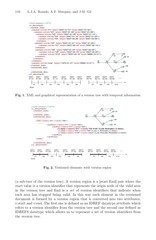
Fig. 1. XML and graphical representation of a version tree with temporal information
Fig. 2. Versioned elements with version region
(a sub-tree of the version tree). A version region is a [start-End] pair where the
start value is a version identifier that represents the origin node of the valid area
in the version tree and End is a set of version identifiers that indicate when
each area has stopped being valid. In this way each element in the versioned
document is formed by a version region that is converted into two attributes,
v:start and v:end. The first one is defined as an IDREF datatype attribute which
refers to a version identifier from the version tree and the second one defined as
IDREFS datatype which allows us to represent a set of version identifiers from
the version tree.
�
Managing Branch Versioning in Versioned/Temporal XML Documents
111
In figure 1 and 2 a vDocument is shown. On the one hand in figure 1 the version
tree with several versions of an XML document is shown: i.e: from the version
identified by V2 several changes have been made (identified by V3 , V5 , V6 ). On
the other hand in figure 2 several versioned elements are shown. i.e: the first author element is valid from V1 and stops being valid in V9 , this means that it is
valid for all descendants-self of the V1 version except all V9 descendant-self versions. Another example is the first v:data child for author element which is valid
from [V1 , {V3 ,V10 }] so it is valid in the versions identified by V1 ,V2 ,V5 ,V7 ,V6
and V8 since all descendant-self of V3 and V10 are not included meanwhile the
second v:data of this author is only valid for all descendants versions of V3
except descendants-self of V9 . The special value "now" in the attribute v:end
indicates "no changes until now", in other words, the version region is formed
by all version descendants from the v:start attribute. Obviously, we have to take
into account that an element cannot exist without its ancestor elements.
3.2
Temporal Time in vDocuments
When a new version of the document is generated in a vDocument, these changes
happen at some point in time. Until now, we have only represented the relationship between the versions in vDocuments without taking into account when these
changes occurred, this means that, the temporal validity information associated
to each version is lost. In this section we show how to integrate the valid-time
axis in a vDocument calling as VTstamp.
Temporal database researchers have focused on three principal dimensions of
time [22]: valid time, transactional time and user-defined time. In this work,
we have decided to model the valid-time axis, although the other axes can be
managed in the same way. The valid time of a fact is defined [22] as the time
when the fact is true in the modeled reality, in our case, the valid time of a
version is when the version is true. We have decided to include the valid time
by means of a time interval, a pair of two time instants [t1 ,t2 ] that is turned
into two attributes for each version defined in the document as shown in figure
1. The following restrictions must be carried out: 1) For each version defined in
the version tree, the value of t1 instant must always be less than t2 2) Any two
time intervals from the version tree cannot overlap and 3) We assume that time
is bounded.
On the other hand it is also necessary to define the valid time for each tag
included in the document, that is when this tag is valid. Using the version region
used in our technique, we can define its temporal validity easily. Due to the fact
that a specific tag is valid in a set of versions from the version tree, this means
that, this tag will also be valid in each period of time for each valid version. For
example in figure 2 the temporal validity of a specific v:data tag which is valid
in the following version: [V1 , {V3 ,V10 }] is shown, therefore it will be valid in the
following time intervals {[01-01,01-05], [01-06,01-08], [01-21,01-23], [01-24,02-05],
[02-10,02-14], [02-15,02-25]} (shown with a thick line above in the figure). Notice
that some of these time intervals can be joined forming a continuous period of
�
112
L.J.A. Rosado, A.P. Márquez, and J.M. Gil
time (coalesce) i.e: [02-10,02-25], however, this is not advisable since they are
placed in different branches from the version tree.
3.3
Changing and Updating a VXML Document
As has been said, XML documents are not static, so it is necessary to manage
inserts, deletes or updates that can modify them [20]. Beginning at the initial
state of the document (version 0), new versions are then established by applying
a number of changes to whatever version defined in the document. Once we know
how to represent versions in XML documents, the following questions will be:
what kind of change operations can generate a new version? And, how to update
the XML versioned document from a change operation?.
In order to answer the first question, we have analyzed which items can be
changed in an XML document and which operations can be performed on them.
However, before this, it is necessary to identify thoroughly those elements which
have been changed from the current version. Among the different possibilities
shown in [4], we have decided to add an attribute idf to each element in the document in order to identify it in a vDocument, with the exception of v:data, v:attrib
and v:isref because those elements are identified by its parent element. Thus, the
basic structural XML operations, common in whatever document based on the
XML specification, are shown in table 1.
Although move operation can be represented as a delete and an insert operation
we have decided to include it as one of our basic operation since it is a very frequent
change in XML documents. According to the consistency principle, to accept the
execution of each primitive a restriction must be satisfied, that is, the document
obtained must be well-formed, and each version of the document must be valid in
accordance to the specifications of its XML-Schema. To guarantee this, a whole set
Table 1. XML changes primitives
�
Managing Branch Versioning in Versioned/Temporal XML Documents
113
of pre-conditions to be fulfilled have been defined for each single operation before
producing a new version of the document. For example: 1) the “idf” parameter for
all operations must exist for the version we want to update, 2) the name of the attribute in IA operation implies that another attribute for this element cannot exist
from the current version (there cannot be two attributes with the same name) and
3) the DC operation cannot be carried out if there isn’t any PCDATA information
for the required identifier.
These basic updated operations can be obtained mainly by means of two
techniques. On the one hand, obtaining the XML operational differences between two versions by means of several approaches such as [4,18,19] or on the
other hand from a certain version specifying which changes we want to carry out.
The technique proposed in this work is based on both solutions, needing, therefore, a mechanism to integrate them. This consists of representing each update
operation exposed previously in an XML format.
In this way if an approach based on differences is chosen, then an XSLT
stylesheet, which transforms this XML document with differences to our XML
representation, is defined. From [10], where several XML diff approaches are
analyzed, we have decided to choose JXydiff [25] which is a Java tool for detecting
changes in XML documents based on Cobena’s work shown in [4]. We chose this
for the following reasons: 1) It has the main features to retrieve XML differences:
can manage all kind of XML nodes, can detect move and update operations and
is based on a tree oriented algorithm, 2) It is written in Java, so its integration
in our implementation is immediate and 3) It is very easy to export its output
XML differences to our XML representation by means of an XSLT stylesheet. As
a future work, our idea is to use a relational-based approach [17] for detecting
changes in XML documents due to scalability problem that suffers the mainmemory Diff algorithms mainly in Java. On the other hand, if we decide to
change the document manually, the change editor has only to generate a batch
document with update operations in our XML representation.
In this way, the creation of a new version is defined by a set of the aforementioned operations represented in an XML document with changes, which
we call an XML transaction document, as is with the concept of transaction in
databases, the vDocument is updated if and only if all changes are executed.
This transaction is carried out in the following three phases:
Phase 1 ) Retrieval of the version to modify. The document to work on will
be the version of the XML document obtained from the vDocument, to which
the XML change transaction will be applied.
Phase 2 ) Modification of the retrieved XML document.
Phase 3 ) Updating of the versioned document. a). Obtain the XML transaction document b). Execute each operation from this XML to the vDocument
and c). The new version and its associated temporal information is added to the
version tree.
In figure 3 the XML transaction schema is shown as well as a practical example. As we can see, an XML transaction document may be formed by several
versions where each version may be formed either by a sole operation or by
�
114
L.J.A. Rosado, A.P. Márquez, and J.M. Gil
Fig. 3. Schema and an example of an XML transactional document
means of several of them (the parameters of each operation from table 1 are
defined as attributes). For example, the first DA operation shown in figure 3
is formed by two attributes: idf that stores the parent identifier (d1eE4) and
name (articleCode) that is the name attribute to delete. Another example is the
IE operation, InsertElement, that can be formed by one or several IE/IA/IC
operations as is shown in the same figure. In that case, the first IE operation
inserts an element which has a child element which contains an attribute (IA)
and a PCDATA content (IC).
Related to the second question about how to update a VXML document when
a basic change operation is produced the following actions are carried out. When
an insert operation is made, the new element/attribute/content is inserted in its
position setting the v:start attribute to the new identifier version and the v:end
attribute to ”now” value. In the case of a delete operation, it is only necessary to
change the v:end attribute of all affected items setting them to the new identifier
version. For update operations the v:end attribute for the current item is set to
the new identifier version and the new element/attribute/content is added and
its version region attribute is set as in the insert operation. In the case of a move
operation, the affected items are modified as in the update operation.
One of the most important advantages of using an XML document to define
the update operations, is that it allows us to manage changes for any markup
language based on the XML specification, since these update operations are
common to all of them. Thus, to specify the changes of a certain XML language,
it would be only necessary to define it by means of these primitives. In this way,
as a future work we will use this technique to manage versions of XSLT and SVG
document. Moreover, this technique can be also used to represent the version
history of an XML schema document.
�
Managing Branch Versioning in Versioned/Temporal XML Documents
4
115
Retrieval in vDocuments
One of the main advantages of this proposal is the wide set of queries we can
specify both using version and temporal axis. In this way, classical temporal XML
queries can be made such as temporal projection, snapshot, etc and also version
queries such as version projection, snapshot version, etc. Here, we will show some
of them that are used in the following section to measure our technique.
Q1: Version snapshot query
In order to retrieve the valid labels for a given version it will be necessary to
analyze which versions are included in a version region and check if the requested
version belongs to them. This occurs only if 1) the given version is among the
descendants in the "start" version identifier in the version tree or even is itself
and 2) the given version is not among the descendants or is itself in all version
identifiers for "end" attribute. To do this effectively, we have to obtain which
versions are in a version region and check if they contain the requested version.
We use the id() function provided by XPath to obtain the versions by means
of dereference the version/s in the version tree which v:start and v:End refer to
(they are defined as IDRef and IDRefs datatypes respectively) and thereby we
can easily obtain their descendants and check the constraints said before.
We have defined a version operator called Vmeets as a user-defined function
(line 1) that check (line 4) if the given version belongs only to the v:start attribute (line 2) and not to the v:End attribute (line 3). That query retrieves all
nodes valid for V8 version (line 6). In the same way, other version operators are
able to been defined as: Vancestors, Vparent, Vcontains, etc.
1.
2.
3.
4.
5.
6.
7.
8.
declare function f:Vmeets($p,$v) as xs:boolean{
let $start:=$p/id($p/@v:start)/descendant-or-self::version/@xml:id
let $end:=$p/id($p/@v:end)/descendant-or-self::version/@xml:id
return (($start=$v) and (not($end=$v))) };
<data>{
for $s in //versioned_doc//*[f:Vmeets(.,’V8’)]
return $s
}</data>
Q2: Count the number of the title element valid for version V8 using Xpath
Using the id() function, we can query the vDocument using another XML standard query language such as XPath. In the following query all title elements
valid for version V8 are counted.
count (//*title[not(id(./@v:end)/descendant-or-self::version/@xml:id=’V8’ ) and
(id(./@v:start)/descendant-or-self::version/@xml:id=’V8’)]
Q3: Temporal snapshot query
Since temporal information has been added to our vDocuments, we can retrieve it by means of the valid-time axis. To do this, it is necessary to find out in
which version the given time belongs to. If a time instant is given, a user-defined
�
 Historical archive . public document