DigitalResources
Language and Culture
Documentation and Description 16
®
Iñupiatun Eskimo Dictionary
Wolf A. Seiler
�
Iñupiatun Eskimo Dictionary
Compiled by
Wolf A. Seiler
SIL International®
2012
�
Language and Culture Documentation and Description
16
©
2012 SIL International
ISSN 1939-0785
Fair Use Policy
Documents published in the Language and Culture Documentation and
Description series are intended for scholarly research and educational use.
You may make copies of these publications for research or instructional
purposes (under fair use guidelines) free of charge and without further
permission. Republication or commercial use of Language and Culture
Documentation and Description or the documents contained therein is
expressly prohibited without the written consent of the copyright
holder(s).
�
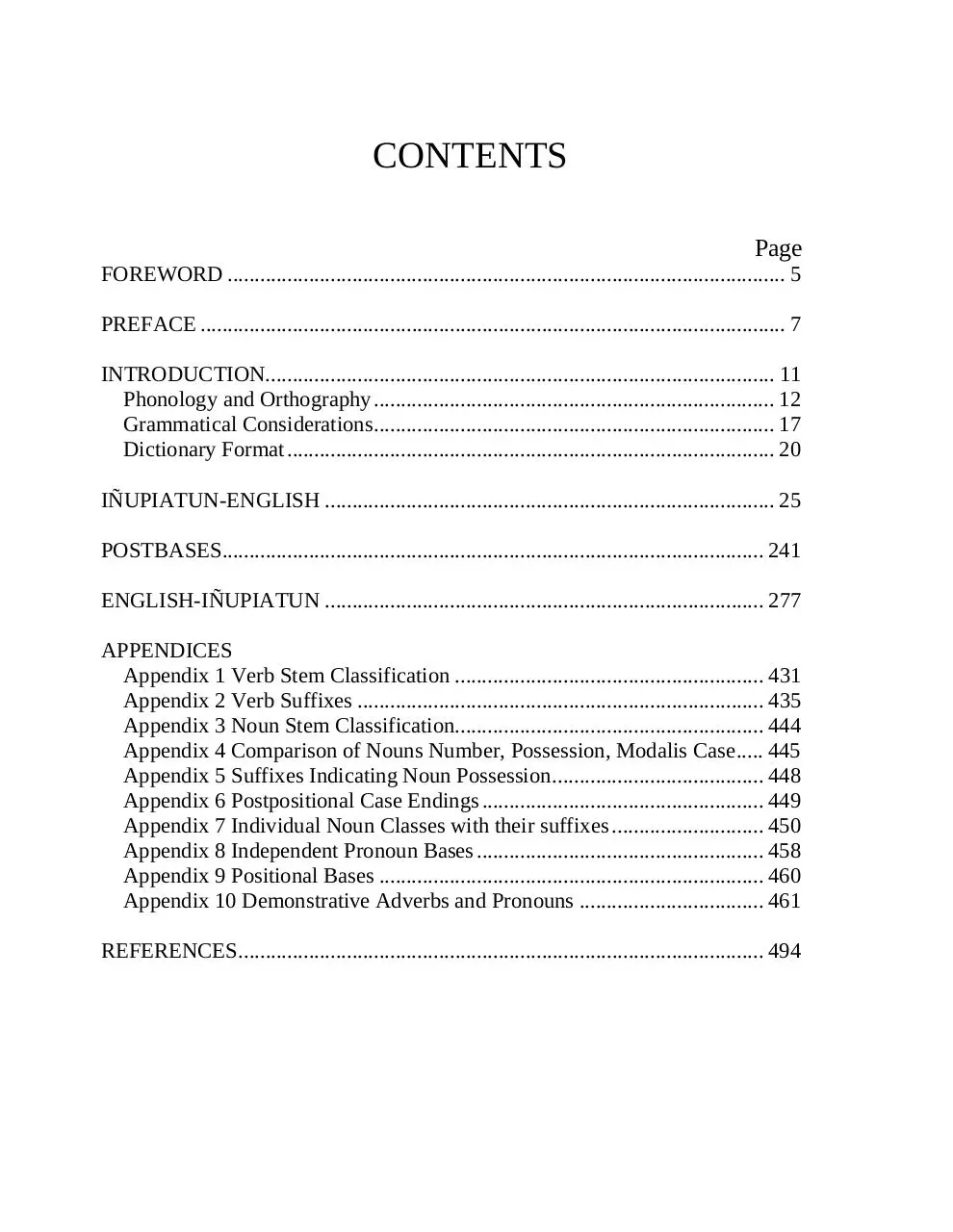
CONTENTS
Page
FOREWORD ....................................................................................................... 5
PREFACE ............................................................................................................ 7
INTRODUCTION.............................................................................................. 11
Phonology and Orthography .......................................................................... 12
Grammatical Considerations.......................................................................... 17
Dictionary Format .......................................................................................... 20
IÑUPIATUN-ENGLISH ................................................................................... 25
POSTBASES.................................................................................................... 241
ENGLISH-IÑUPIATUN ................................................................................. 277
APPENDICES
Appendix 1 Verb Stem Classification ......................................................... 431
Appendix 2 Verb Suffixes ........................................................................... 435
Appendix 3 Noun Stem Classification......................................................... 444
Appendix 4 Comparison of Nouns Number, Possession, Modalis Case..... 445
Appendix 5 Suffixes Indicating Noun Possession....................................... 448
Appendix 6 Postpositional Case Endings .................................................... 449
Appendix 7 Individual Noun Classes with their suffixes ............................ 450
Appendix 8 Independent Pronoun Bases ..................................................... 458
Appendix 9 Positional Bases ....................................................................... 460
Appendix 10 Demonstrative Adverbs and Pronouns .................................. 461
REFERENCES................................................................................................. 494
�
4
�
FOREWORD
It is with great pleasure and pride that we present this Iñupiaq dictionary to you.
The words and meanings of this dictionary represent our unique world view which
has evolved over thousands of years, as our ancestors have struggled to survive in
order to leave this legacy to us.
The number of Iñupiaq language speakers has been decreasing since English was
introduced over a century ago. The NANA Regional Corporation has been involved
through the Iñupiat Ilitqusiat Program to promote an important Iñupiaq value:
Knowledge of Language. This dictionary is one tool that will help both fluent
speakers and learners to maintain and study the language and the ideas it represents.
It will also support the efforts of the newly re-established Iñupiaq Language
Commission, whose goal is to promote the use of the Iñupiaq language in everyday
life. In addition, this project was supported by the NANA Iñuuniaâiqput Committee
and the NANA Regional Elders Council, who have been concerned about the
development of resources for Iñupiaq language learning.
The timely publication of this dictionary fulfills a need that has been repeatedly
addressed by shareholders who live in Alaska and outside of Alaska, by staff
members in our schools, hospital and local offices, by university personnel and
students, by young people, by tourists and by many other individuals. Our hope is
that this dictionary will encourage our young people to study and maintain the
Iñupiaq language and to take pride in their Iñupiaq heritage.
Special thanks goes to Amaàuq, Wolf Seiler, who has spent many years studying
our language carefully and collecting and editing the words in this dictionary. Our
appreciation also goes to all the individuals who contributed to this publication. We
are glad that it was published while we have some Iñupiaq speakers to help us, in
our efforts to maintain our language. Quyaanna.
Kasaänaaluk
Marie N. Greene, President
NANA Regional Corporation
July 2005
5
�
6
�
PREFACE
“In the beginning was the Word,” we read on the first pages of one of the most important books
known to mankind. That book says that the word of God is the origin of all creation. Is it not true, in
another sense, that the word is the origin of all that we really are as humans? Our ability to think in
notions and to communicate the same is part of God’s creation. The word is truly a key to our own
being and to our communication with other humans and so to our place in history.
Words have a history. Each word contains not only the meaning that the dictionary assigns to it; it
contains at the same time, metaphorically speaking, the person who speaks it, as well as the situation
in which the speaking occurs and the reason why the person speaks the word.
In this way, this collection of words creates a sense of connectedness to the Iñupiaq history and
forefathers who lived it and to their way of life. For thousands of years words have been needed to
describe situations and reasons in the life of the Iñupiaq people. Many of these words live on in
speakers today.
This collection of words represents the cultural heritage of the Iñupiaq people. It began more than
forty years ago. Many elders contributed their word(s) to this collection. A good number of these
have died since the collection began.
When different languages come in contact, changes are inevitable. At such times, it becomes clear
that words have a mysterious nature: they can be like light that enhances life, and they can be like
lightning that destroys life. More than one hundred years ago, “White Men” came to Northwestern
Alaska. They introduced a foreign language and worldview to the people of the NANA region.
Hence, the number of Iñupiatun speakers has been decreasing since then because of the influence of
English. However, one might view the remaining speakers like the stump of a tree: it is possible for
new life to grow up. In the same way, the next generation can bring Iñupiatun back to life.
So, why is it important to know the words of the Iñupiatun language? The reason is this – the
language of a people is the soul of the people. With a history of forefathers who have survived harsh
conditions of life for thousands of years, who cannot be proud? The Iñupiaq way of life and the
Iñupiatun language are unique in this world. It would really be a shame to “lose one’s soul.”
Meaning in the Dictionary
One function in a dictionary stands out more than any other: it intends to define the meaning of
words. Although definitions are central to a dictionary and obviously involved with semantics (the
study of meaning), they deal primarily with individual words in isolation from other words. They
largely ignore the syntax (the study of grammar) and the relations above sentence level of the
language. Although I have studied the semantics and syntax for more than thirty years, I do not know
nearly enough about the language and all its intricacies.
Perhaps the first thing we need to remind ourselves of is that ‘meaning’ is an artificial, though
highly useful, concept. Meaning does not truly reside in the word, but in the minds of those who hear
or read it. The meaning of a word is as much without form as the soul of a person is; everyone knows
of its existence, but cannot grasp it. It is elusive because no two people have had exactly the same
7
�
experience with the meaning to which the word refers. That means that the meaning of the word will
be slightly or greatly different for each user of this dictionary. As the editor of this dictionary, I rely
on the fact that each word has a certain ‘field of meaning’ and that a great deal of people share this
understanding.
Because ‘meaning’ is so elusive, I would urge you, the user of the dictionary, to be tolerant when
looking up words and finding that a definition does not agree with your understanding. Rather, I
encourage you to mark each word and to send your comments to the next editor at the office of the
NANA Regional Corporation in Kotzebue, Alaska.
I have attempted to be as complete in this collection as possible. Missing words were not
intentionally omitted. If the reader feels certain words are missing, it is because of lack of time and
resources. I am aware that you, the reader, will find errors in this dictionary. My team and I were not
able to check every item with as many people as we would have liked. As a result, it could be that the
information about a word may not be as complete as needed, or that I documented the word
incorrectly. The responsibility for omissions and errors is solely mine.
Acknowledgements
The vocabulary presented in this dictionary was collected over a period of more than forty years.
Under the auspices of the Summer Institute of Linguistics, first Wilfried Zibell (from 1962 to his
sudden death in 1971) and later I (from 1972 until 1998) worked in the NANA region on translating
the content of the New Testament into the language. Bible translation was our focus, though it is a
special kind of communication. One result of that work is a list of words for common as well as for
specialized use.
I have made use of the “Iñupiat Eskimo Dictionary,” published by Wilfried Zibell and Don
Webster for the Alaska Rural School Project in 1970. It ordered words mostly under “semantic
domains” (by categories, such as the body and its parts, all fish and their parts, hunting, etc). I have
had help from the “Abridged Iñupiaq and English Dictionary,” compiled by Edna MacLean, 1980,
and from the “Yu’pik Eskimo Dictionary,” compiled by Steven A. Jacobson, 1984, both published
through the Alaska Native Language Center, Fairbanks. I have also used unpublished materials from
ANLC. I am thankful for all such help. Finally, I have consulted “North Slope Iñupiaq Grammar,”
published by Edna MacLean through the Alaska Native Language Center.
This dictionary would not have been possible without the very valuable help that Tatqaviñ Ruth
Sampson gave to this project. Over twenty years she has given of her time to answer questions
patiently. Her ability in both Iñupiatun and English was a tremendous help. A special thank you is
due her.
I am also indebted to many other speakers of Iñupiatun who have contributed to the present
collection and who helped define the meanings of the words. These include Elsie Adams, Rachel
Adams, Barbara Armstrong, Janet Barr, Billy Black, Harriet Blair, Douglas and Esther Brown, Joe
Carter, Robert Cleveland, Truman Cleveland, Lena Coffin, Leslie Coffin, Louis Commack, Esther
Curtis, Florence Douglas, Tommy and Elsie Douglas, Ivan and Ramona Field, Joe and Pauline Field,
Daniel and Lucy Forster, Hanna Gallahorn, Pauline George, Ruth George, Cora Gooden, Arthur and
Minnie Gray, Fletcher and Lila Gregg, Pauline and Bert Harvey, Ned Howarth, Clarence Jackson,
Amy Jones, Helen Kagoona, Clara Lee, Charlie Lie, Hannah Loon, George and Maggie Melton, Ethel
8
�
Mills, Walter and Minnie Morris, Beatrice Mouse, Angeline Newlin, Robert Newlin, Juanita Norton,
Viola Norton, Ruth Outwater, Willard Outwater, Robert Patterson, Jack and Cora Pungalik, Violet
Pungalik, Thomas and Edith Pungalik, Jonas Ramoth, Steve and Mildred Sampson, James Savok,
Polly Schaeffer, Albert and Minnie Sheldon, Billy Sheldon Sr., Enoch Sherman, Rachel Sherman,
Tommy and Hazel Snyder, Joe Sun, Nita Towarak, Helen Wells, Russell Williams Sr., and Whittier
and Lorena Williams. All of these speakers of the language, and many unnamed speakers as well, are
the true authors of this book.
Two other groups of people deserve a thank you. Geri Adams-Jones, Ruth Downey, Cheryl
Sampson, and Donna Westdahl typed the hand-written collection into the computer. This was a
formidable task, and I want to thank them. I also want to express thanks to Chet Dyche, Mary Norton,
Millie Ragland, Ina Gabriele Seiler, and Carsten Michael Seiler who checked the English side for
correct expression and other details.
This dictionary would not have been possible without the generous financial help of the NANA
Regional Corporation. A special thank you is due their president, Marie Greene, and their board of
directors.
My grateful thanks are also due to Dr. Calvin Rensch of the Summer Institute of Linguistics for
reading carefully parts of this dictionary and making valuable suggestions.
Last, but not least, I want to thank my wife Hildegard for her constant encouragement. We spent
countless hours discussing terms and definitions, and this dictionary is a better product because of it.
I hope that this book will inspire the renewed use of the Iñupiatun language and that the Iñupiat
Ilitqusiat Committee will publish a revised edition of this book in the future.
Amaàuq
Wolf A. Seiler
August 2005
9
�
10
�
GENERAL INTRODUCTION
There are several Eskimo languages in Alaska. A major division exists between Yupik and Inuit.
Siberian Yupik is spoken on St. Lawrence Island and in Russian Far East, Central Yupik in southwestern
Alaska, and Alutiiq on Kodiak Island, the Kenai Peninsula and around Prince William Sound.
Inuit is spoken by people groups from Eastern Greenland to Northern Alaska. In Greenland, the
language is known as Kalaaâisut. The designations Inuvialuktun, Inuttut, and Inuktitut are used in
Canada. In Northern Alaska, the language is known as Iñupiatun.
Iñupiatun is comprised of four major dialects: Bering Strait, Qawairaq, Malemiut, and North Slope.
The people who live in the villages between Deering and Kivalina and between Kotzebue and Kobuk, in
the NANA region, speak the dialect called Malemiut. This dictionary covers mainly this Malemiut
dialect. There are subdialects in the region, which I have tried to incorporate without specifically
marking any of them. (The designation “Malemiut” is used in linguistic descriptions, and thus a
technical term.)
The map below shows the villages where Iñupiatun is spoken in Northern Alaska, including all
villages designated by number.
11
�
PHONOLOGY AND ORTHOGRAPHY
The modern writing system (orthography) of Iñupiatun utilizes writing symbols that are based on
Latin and thus the common English orthography. It was called the “new alphabet” some years back; it
has been called “atchagat” for some time. The following alphabet chart shows all writing symbols of
Iñupiatun that are used in the NANA region.
ATCHAGAT (ALPHABET CHART)
Consonants (Chart 1)
stops
voiceless
fricatives
labial
p
alveolar
palatal
t > ch
â >
ã
s*
retroflex
sr
velar
k
uvular
q
glottal
h
voiced
l** >
á
fricatives
v
y
r
g
à
nasals
m
n > ñ
ä
* Although s is phonetically alveolar, it sometimes appears as palatatalized t.
** The sounds l and á do not have audible friction, but they function as voiced continuants.
Vowels (Chart 2)
front central back
high
low
i
u
a
Stop Consonants
Stops are the consonants in the first row of the alphabet chart. These sounds are produced when the
flow of air through the mouth is temporarily stopped, by either the lips or when the tongue is held
against the palate. Stops in Iñupiatun are voiceless and unaspirated, i.e. without a puff of air (except at
the end of a word).
Atchagat
p
t
ch
k
q
Iñupiatun word(s) with the sound
English word containing equivalent
or similar sound
spill (without a puff of air)
putu ‘hole’
talu ‘door’; putu ‘hole’
still (without a puff of air)
church
iñuich ‘people’
This /ch/ is a palatalization of /t/, as indicated by the symbol > on the chart above
skill (without a puff of air)
kukik ‘fingernail’
aqpik ‘cloud berry’; taaq ‘dark’
no equivalent
The /q/ is produced farther back in the mouth than /k/.
12
�
Fricatives
Fricatives are the consonants in the second and third row of the sound chart. These sounds are
produced in the same places as the stop sounds in the corresponding columns. Audible friction is
produced by holding one’s lower lip or tongue against the teeth or the palate and allowing the air to
escape. These fricatives are continuing sounds, or continuants, in contrast to the stops. When the vocal
cords vibrate while the sound is produced, the fricative is voiced, while it is voiceless when the vocal
cords do not vibrate.
Atchagat
â
ã
s
s
sr
h
v
l
á
y
r
g
g
à
à
Iñupiatun word(s) with the sound
English word containing equivalent
or similar sound
plow (only more ‘breathy’)
iâuaqtuq ‘good for him’
no equivalent
sikãaq ‘pickaxe’
This second /ã/ is a palatalization of /â/, as indicated by the symbol > on the chart above
soon
siku ‘ice’; kisaq ‘anchor’
qaisaäa ‘that which he gave’
say
This second /s/ is a palatalization of /t/, as indicated by the symbol > on the chart above
no equivalent
iqsraq ‘cheek’; siksrik ‘ground squirrel’
This /sr/ is produced by lightly curling the tip of the tongue as it is raised close to the
alveolar ridge right behind the teeth. It sounds like /r/ and /sh/ pronounced together at
the same time, for some it is more like /hr/
aahaaliq ‘oldsquaw duck’
resembles English ‘h’
love, victory
kiviruq ‘it sank’
ulu ‘woman’s knife’
low
million, peculiar
kiááiq ‘cut’, niàipáuni ‘he while eating’
This second /á/ is a palatalization of /l/, as indicated by the symbol > on the chart above
yes
qayaq ‘kayak’
iri ‘eye’; argaich ‘hand, fingers’
This /r/ is produced by lightly curling the tip of the tongue as it is raised close to the
alveolar ridge right behind the teeth. It sounds like /r/ and /z/ pronounced together at
the same time
piglet (/g/ before another consonant)
aglaun ‘pencil’
no equivalent (after a consonant)
ivgun ‘towel’, aarigaa ‘fine!, nice!’
This /g/ is the voiced counterpart of the stop /k/ above. Between vowels, the friction is
even less audible than in other environments
aàra ‘ashes’; kiñuvàuruq ‘he mourns’
no equivalent
maààaq ‘mud’; niàiruq ‘he is eating’
no equivalent
This /à/ is the voiced counterpart of the stop /q/ above. Between vowels, the friction is
even less audible than in other environments
Nasals
Nasals are produced by the passage of air through the nose. Like fricatives, nasals are continuants.
Atchagat
m
n
Iñupiatun word(s) with the sound
English word containing equivalent
or similar sound
man
noon
mannik ‘egg’
nuna ‘land’
13
�
ñ
ä
iñuk ‘person’
onion
This second /ñ/ is a palatalization of /n/, as indicated by the symbol > on the chart above
ring
aäun ‘male being’
Vowels
Iñupiatun vowels /a, i, u/ may occur short (written as single symbol) or long (written as double
symbol). In addition, two unlike vowels may form a vowel cluster.
Short /a/ has the sound of u in English fun, but long /a/ has the sound of /a/ in English father. The
diphthongs /ai/ and /ia/ have the sound of /a/ in bake. The diphthongs /au/ and /ua/ have the sound of /oa/
in /oak/. The diphthong /iu/ has the sound of /ee/ in English, as in /baleen/. The diphthong /ui/ has the
sound of /ooey/ as in /gooey/.
However, the sound quality of a vowel changes when it occurs in a closed syllable (vowel(s) between
consonants) or is followed by the back consonant /q/ or /à/. The vowel /i/ when alone or when following
another vowel before /q/ or /à/ has the sound of /i/ in /sit/. Similarly, the vowel /u/ when alone or when
following another vowel before a /q/ or /à/ has the sound of /u/ in /pull/. The diphthongs /ai/ and /ia/
before /q/ of /à/ have the sound of /a/ as in /back/. The diphthongs /au/ and /ua/ before /q/ or /à/ have the
sound of /aw/ as in /raw/. Finally, the vowel /u/ in the diphthong /iu/ before /q/ or /à/ has the sound of /u/
in /pull/.
The pronunciation of the vowels before back consonants (q and à) and elsewhere are summarized in
the following chart:
Atchagat
a
i
i(q/à)
u
u(q/à)
Iñupiatun word(s) with the sound
amiq ‘animal hide’; aatqan ‘mitten’
ini ‘place’; uqpik ‘willow’
siqiñiq ‘sun’; piiàiñ ‘go away’
ulu ‘woman’s knife’
uqaq ‘tongue’; amaruàlu ‘and a wolf’
English word containing equivalent
or similar sound
fun
baleen
sit
stool
pull
There are three long vowels (clusters of two like vowels):
/aa/
/ii/
/ii/(q/à)
/uu/
/uu/(q/à)
English word containing equivalent or
similar sound
aapa ‘father’; amaaq ‘root’
father
baleen
iqiitchuq ‘he is not lazy’
pit
Ataniiq ‘Lord!’; piiqsirruä ‘take it away’
smooth, rule
kuuk ‘river’
tuuq ‘ice chisel’
pull
There are six diphthongs (clusters of two unlike vowels):
/ai/
/ia/
/ai/(q/à)
/ia/(q/à)
/au/
English word containing equivalent or
similar sound
bake
aiviq ‘walrus’; qaiqpaich ‘big waves’
nalliat ‘which of these’
qaiqpaich ‘big waves’
umiaq ‘boat’; niaquq ‘head’
paula ‘soot’; mauyaànaq ‘soft spot in snow’
14
back
oak
�
/ua/
/au/(q/à)
/ua/(q/à)
/iu/
/iu/(q/à)
/ui/
/ui/(q/à +Cons)
ukuak ‘these [dual] here’
tauqsiqãugu ‘he bought it’; qauq ‘forehead’
quaq ‘frozen food’; piyuaqtuq ‘he attacks’
kiugaa ‘she answered him’
uqaqmiuq ‘he also said’; aäuyyiuqti ‘soldier’
uiga ‘my husband’; uiàualaplutiä ‘they hollered’
niaquiàñiàaa ‘he beheaded him’
raw
baleen
pull
gooey
ruin
Palatalization
The arrows on the chart above show the process of palatalization (the tongue is moving toward or
touching the hard palate when making a sound that is normally produced behind the teeth). This process
involves changes from /t/ to /ch/ or /s/, /â/ to /ã/, /l/ to /á/, /n/ to /ñ/. Alveolar sounds will be palatalized
when they follow an /i/ if such /i/ occurs after two consonants (for example, /tapsiñ/ your belt) or occurs
as the second of two vowels (for example, /tuiñ/ your shoulder). In some cases a single consonant and /i/
will produce palatalization, for example, in /saääiñ/ your strength. Some have referred to this /i/ as a
“strong I.”
Impact of Grammar on the Alphabet
There are more spoken consonants in Iñupiatun than the Chart 1 above shows, but not all of these
need to be represented as writing symbols on that chart. Some sounds occur in only one environment and
always in the same manner; they are predictable.
Two notable examples are the [x] pronunciation of /kh/ and the [X] pronunciation of /qh/. This
combination occurs when the final sound of a base or a postbase is a /k/ and the intransitive coordinative
(dependent mood) suffix is added. The resulting consonant cluster is /kh/, pronounced as [x]. A similar
sound pattern occurs when the same suffix is added to a base or postbase ending in /q/. Technically, these
sounds are the phonectic pronunciation of a sequence of two sounds, and, consequently, they don’t need to
appear in the inventory of writing symbols. For example,
Unnuaàaàikman siñikhuni suli uvluàaàikman makitluni savaaqaqtuq.
He goes to bed at night and gets up by day to work.
Iáisautiaqsiñiàai nipliqhuni,
He started teaching them and said,
Although [x] and [X] are pronounced as one sound, they represent sequences of two sounds. Each of
these actually represents parts of two different morphemes. Chart 3 shows that the /h/ in [-huni] belongs
to the set of suffixes of the intransitive coordinative. As the above two examples and Chart 3 show
(examples only for 3rd person singular), the grammar differentiates between realized action and
unrealized action. It also shows that there is variation of form.
15
�
Chart 3
Base ending in Realized Action Unrealized Action
a, i, u
-pluni
-luni
-t(i)
t-luni
l-luni
-k
k-huni
g-uni
-q
q-huni
à-uni
The suffix –huni is part of the set of suffixes of the intransitive coordinative, which also functions as
mild imperative:
Chart 4
sg
du
pl
First
-luäa
-lunuk
-luta
Second
-lutin
-lusik
-lus(r)i
Third
-luni
-lutik
-lutiä
This distinction between realized and unrealized action, as evidenced by voiced and voiceless initial
consonants of the coordinative intransitive suffixes, is further confirmed by the same distinction in the
transitive coordinative suffixes, i.e. –âugu/âugik/âugich vs. –lugu/lugik/lugich (see Appendix 2). The fact
that [x] is really a sequence of /k/ plus /h/ and that [X] is really a sequence of /q/ plus /h/ is an example
of the grammar determining the orthography (correct spelling of words).
The following examples further verify the correctness of this analysis, each example illustrating one
possible suffix in chart 3:
Action realized:
Aäayukâiq nuliaqtuaq tuqupluni qitunàaitáuni.
The oldest brother married and died having no children.
Tautuäniàaa Putu nalaruaq uunaqâuktitluni.
He saw Putu lying [in bed] and having a fever.
Siqiñiq nipianikhuni.
When the sun had already set or, after the sun had set.
Tavra makitiqhuni niqâiuàutiaqsiñiàai.
Then getting up she began serving them food.
Action unrealized:
Agaayulusri ataramik.
Pray at all times.
Kiñapayaaq isrumaniàumi makitaniáuni payaäaiááuni,
If anyone thinks that he is standing unshakably,
16
�
Quviasrugusri takku piqaqtusri niàiukkamik.
Be happy because you have hope.
Aggiäitchuq savautipkaàiaàuni, aglaan savautrityaqhuni.
He didn’t come to be served, but to serve.
Orthography needs to be directed by grammar, the morphology.
Syllable Patterns
Iñupiatun syllables have the following types (where V represents a vowel and C represents a
consonant): V, VV, CV, CVV, VC, VVC, CVC, CVVC, so that the formula for the syllable in Iñupiatun
looks like (C)V(V)(C); a symbol in parenthesis is optional. A syllable needs at least one vowel, but can
have two vowels and one consonant at either end. A syllable is open if it has this pattern: V, VV, CV,
CVV; it ends in a vowel. A syllable is closed if it has this pattern: VC, VVC, CVC, CVVC; it ends in a
consonant.
A syllable never begins or ends with two consonants. However, some postbases begin with two
consonants. If such a postbase is added to a base ending with a consonant, then the base-final consonant
is dropped. For example, if the postbase –llautaq- ‘good, fine’ is added to uvluq ‘day’ it results in
uvlullautaq ‘good day’. If a long word needs to be broken at the end of a line, and such word has a
postbase that begins with two consonants (as in above example), the division falls between the
consonants, i.e. uvlul-lautaq.
Similarly, if two vowels precede a base-final consonant, which will drop out when followed by a
vowel-initial postbase, then a consonant is added to prevent a three-vowel cluster. For example, if the
postbase –uraq- ‘small, soft’ is added to umiaq ‘boat’ it results in umiaäuraq ‘small boat’. If a long word
needs to be broken at the end of a line, and a postbase that begins with a vowel is added, then the
division follows the vowels so that the inserted consonant stays with the following syllable, i.e. umiaäuraq.
GRAMMATICAL CONSIDERATIONS
The grammar of each language is unique, so one would expect that Iñupiatun is vastly different from
English. It is not the purpose of this introduction to summarize its complete grammatical structure.
However, an awareness of certain differences between Iñupiatun and English is particularly helpful for
users of a lexicon of this type.
In English, word order is a dominant factor in determining meaning. In Iñupiatun, word order is not
essential. In Iñupiatun, the use of inflectional endings is very important in order to determine the
function or meaning. In English, the subject of a transitive and an intransitive sentence are alike
(nominative). In Iñupiatun, the subject (or ‘topic’) of the transitive sentence is called ergative or relative
case. Subsequently, there is a parallel between the object of a transitive and the subject of an intransitive
sentence, which are both in the absolutive case. In English, important distinctions are made based on
gender – whether a thing or a person is male, female, or neuter. Such gender does not exist in Iñupiatun,
and suffix inflection for third person always refers to ‘he/she/it.’ In English, a noun usually has an article
17
�
associated with it (non-specific: ‘a’ or specific: ‘the’). In Iñupiatun, such an article is not used. In
English, grammatical tense (past, present, future) is important. In Iñupiatun, there is no past tense;
rather, events are classified as to whether the action is realized or not realized yet and are expressed on
the surface level by additional morphemes. In English, tense is referring to the time of the action. In
Iñupiatun, aspect refers to the type of the action (its beginning, duration, completion, or repetition and
without reference to its position in time; these aspect modifications are expressed by postbases, see
below). In English, word classification is different. The rules that govern the structure of a sentence and
its many components (syntax) are very complex. In Iñupiatun, a single verb is (almost) always equivalent
to an entire sentence in English. So, where English has a very complex sentence structure, Iñupiatun has
a very complex verb structure. In Iñupiatun, there is no clear-cut dichotomy between nouns and verbs.
For example, one might hear, “Did they go boating?” for “Did they use a boat to ride around?” This
process is called incorporation, which changes a noun stem to function as verb by adding a postbase to
the noun stem (see –taq in example 2 or –si in example 4 below). Such incorporation affects the
transitivity of the resulting word. Iñupiatun uses intransitive inflection on a transitive verb with a nonspecific object, and then marks it with the modalis-case. There is no equivalent for that in English.
English uses prepositions (such as, to, into, up, above, etc) whereas Iñupiatun uses post-positional cases
(see Appendix 6). Almost all of the English prepositions are included within the semantic areas of these
six cases.
The Iñupiatun language is a polysynthetic language. It has three types of words – the expandableinflective, the inflective, and the non-inflective. The expandable-inflective words make up the largest
group; this group includes noun and verb stems, positional base words, personal and indefinite pronouns,
and demonstrative adverbs. The inflective group of words is the group of demonstrative pronouns. The
third group comprises conjunctions, the interjections, and the enclitics (a word that is treated in
pronunciation as forming a part of a preceding word and that is often unaccented or contracted; for
examples, see below).
All stems of the expandable-inflective type (verbs, nouns, and post-bases) behave in the same manner.
They are divided into seven classes (see Appendix 7) based on whether a stem ends in a vowel (“V”) or
a double vowel (“VV”), in the consonant –n (with the underlying form of –ti), or in –q or –k.
Some stems name things and are commonly referred to as nouns; some other stems name events and
are commonly referred to as verbs. For example, nanuq ‘polar bear’ names an animate and umiaq ‘boat’
names an inanimate thing, while tautuk- ‘see’, tuqqut- ‘kill’, tuqu- ‘die, be dead’, or uvakäauti- ‘take
something from here’ refer to an event. Iñupiatun allows morphemes (smallest grammatical unit of a
language) to enter between a stem (base) and its ending (suffix); they are called ‘postbases’ and cannot
stand alone. The ending (or suffix) indicates the relationship between words, which is the grammatical
information about person, number, tense, mood, and voice (for verbs) or about the post-positional case or
possession (for nouns). These endings are commonly referred to as inflection, thus the designation
“expandable-inflective” for these words.
A special comment about transitivity is needed here. Verbs are used in language to describe an
action (i.e. tuqqut- ‘kill’), a state of being (i.e. tuqu- ‘die, be dead’), or a change of being (process, i.e.
tuquliäa- ‘wilt’). The person or thing that does the action is called the actor. If there is someone or
something that receives the action, he/she/it is called the goal. If a verb does have a goal, it is called a
transitive verb, because the action passes over from the actor to the goal; one might say, the action
“transits.” For example, in the English sentence, “Putu hits his brother,” Putu is the actor, the brother is
18
�
the goal, and the hitting is the action that passes (transits) from the actor to the goal. (A transitive
sentence shows the subject/actor in the relative/ergative case and the object/goal in the absolutive case.)
Verbs that do not have a goal are called intransitive verbs. An English example could be, “Putu sleeps.”
Putu is the actor, sleeping is the “action,” but there is no goal at all.
A person does not use isolated items of the vocabulary. In real life, words are connected into coherent
speech, using all available components of the language. A single word in Iñupiatun may be the
equivalent to an entire sentence in English, for example,
Example 1
Base Ending
Base Ending
Base
Postbase
Ending Enclitic
Putu -(ä)(u)m Akâaq
-q
Tuqqut-(s)uk
+-(k)aa +-guuq
Putu Rel/Erg Bear
Abs
to kill to want to
3s/3s
it is said
Putum
akâaq
tuqqutchukkaa-guuq
Putu
bear
(he) wants to kill (it), they said.
Example 2
Base
P-b
Ending Enclitic
Base
P-b
P-b
P-b
P-b
Ending
Aànaq -(ä)uraq
-q
+guuq
qiruk
-taq
-niaq +-(k)aqsi
-niq
tuq
woman
little
Abs
it is said firewood go after intent
begin
evident
3s
Aànauraà-àuuq
qiruktaàniagaqsiñiqsuq.
Once a little woman
began to go out to look for firewood.
Example 3
Base
Postbase
Postbase Ending
tupiq
-(à)ik
-niq
tutin
house to have s-t good evident
2s
Tupiàiäñiqsutin.
You have a nice house.
Example 4
Base
P-b
P-b
P-b
Ending
Umiaq -(q)pak -si -(s)uk
tuq
boat
big
buy want
3sg
Umiaqpaksisuktuq.
He wants to buy a big boat.
The postbases in the four examples above show first a modal auxiliary or “helping verb,” here -(s)uk‘to want’. The second example shows a number of different postbases. The first of these modifies a noun
and leaves it a noun, here –uraq- ‘small, soft’. The second word in the second example includes a
postbase that changes a noun into a verb, -taq- ‘go after’, and other postbases that allow the new stem to
remain a verb, such as –niaq- ‘inceptive’ (planned action to start soon), -(k)aqsi- ‘begin,’ and –niq‘evidential’ again. The third example demonstrates first a modal auxiliary, here -(à)ik- ‘to have
something good’ and second a comment, here –niq ‘evidential’. The fourth example shows first a
postbase that modifies the noun -(q)pak- ‘big’, and then a postbase that changes a noun stem into a verb
–si- ‘buy, get’ and the modal auxiliary -(s)uk- ‘want’ again.
19
�
The examples above also show inflectional endings (or suffixes). These are grouped in charts,
showing possession or position for nouns, and showing transitive and intransitive endings for verbs
(see Appendix 2). All nouns fall into seven classes (see Appendix 7). If a noun functions in
the subject/topic position, it must display the marker -(ä)(u)m, the ending (suffix) for the relative/
ergative case. All charts show the relative/ergative either as –m or as –um. The additional –ä is needed
when this ending attaches to a foreign name. For example, the whole ending is needed when adding it to
a name ending in a consonant that does not normally end a word in Iñupiatun, such as Judas-äum.
The second group of Iñupiatun words is labeled “inflective” because they are inflected in various
ways, but they cannot be expanded. This group includes personal pronouns, which are used for emphasis
mainly, also all demonstrative pronouns. See Appendix 8 and 10.
The last group of Iñupiatun words is non-inflective. Interjections and conjunctions, for example,
cannot be inflected. This group also includes enclitics. These particles are often added to a word, which
usually translates into an entire English sentence. The first of the four example of Iñupiatun sentences
above includes the enclitic -guuq ‘it is said’. Another such enclitic is -lu ‘and’ in the example Matulig-lu
aniqatni-áu iñuuniaàuuruask Qikiqtaàruämi ‘Matulik and her brother used to live in Kotzebue’. Notice
that the -lu is added to the name and the following noun. A number of these enclitics are listed in the
lexicon. Another enclitic is –suli ‘still, yet’ in the sample, Niàiuktuksrauvisa-suli atlamik? ‘Should we
wait for another one?’
DICTIONARY FORMAT
Iñupiatun words are listed in alphabetical order, with homonyms listed separately and given numbers.
The Standard English order of alphabetization is followed, except that digraphs such as /ch/ and /sr/ are
alphabetized as if the letters were single writing symbols. The order of the Iñupiatun alphabet is: a, ch,
g, à, h, i, k, l, á, â, ã, m, n, ñ, ä, p, q, r, s, sr, t, u, v, and y.
Iñupiatun entries consist of stems. For example, iàñq is a root for the stem iàñiq ‘son’; a vowel is
inserted to change the root into an acceptable stem. A stem can be expanded by a postbase. For example,
the stem saluma- ‘to be clean’ can be expanded by the postbase –it- ‘to be/have not’; the resulting new
stem carries its own meaning, salumait- ‘to be dirty’. Derived words, on the other hand, are listed as
subentries and are indented under the word from which it is derived. The stem of the demonstrative
adverb piñña ‘in backward direction’ can be modified by positional case endings. For example, piñuäa
‘toward back there’ (more variations on these demonstrative adverbs in charts in Appendix 10). I used
only one degree of indentation to show derivation in this dictionary, for example piñuäaq- vi. to go
toward back there’ (focus: actor) and piñuäauti- vt. ‘to take toward back there’ (focus: goal).
Conventions
A main entry in this dictionary is printed in bold and larger type than the English definitions. Entries differ
from each other:
1. Nouns are entered without addition, for example aapa ‘father’. After the main entry, an ‘n’
designates this entry as a noun.
20
�
2. Verbs are entered by adding a hyphen, for example aaq- ‘to raise one’s head’. A ‘vi’ or ‘vt’
follows the entry, which informs the user that a particular verb stem is either intransitive
(without object) or transitive (with object). Every entry with a hyphen is automatically a verb.
(I have followed other dictionaries in this convention.) The hyphen indicates that this entry is
not a full word, but that an inflectional suffix is needed to complete the word.
3. All verb definitions start out with ‘to …’, which is the traditional way to designate an action in
a dictionary.
4. Many verbs have a definition ‘to be …’ and describe a state, for example maptu- ‘to be thick’.
Iñupiatun uses these stative verbs to fulfill the function of an adjective, with the correct
inflectional suffixes.
5. All enclitics show a hyphen before the letters of the enclitic, such as –guuq ‘it is said’
6. This dictionary lists words mainly for the NANA region. However, some words seem to be
specific to the coastal area of this region. These entries have a (C) for ‘coastal’ behind them.
These words are often very similar to the North Slope dialect in Barrow.
7. If an entry has more than one meaning, each is marked with a number.
Definitions
The English definitions in this dictionary have been carefully chosen to reflect the meaning of the
Iñupiatun word as well as possible. Many different speakers of the language have contributed to this
dictionary over many years. A user might find a definition that does not totally agree with his/her
understanding of the entry. Many other speakers have given their opinion about the meaning of the
words. It is possible that other (older) speakers had or have knowledge of the term that some of us do
not have anymore; it is equally possible that I (the editor) have misunderstood the meaning these older
speakers associated with the word. The user of this dictionary is encouraged to be tolerant with the
insight of other people, and learn another meaning of a word, if it differs from his/her own.
I have tried to add a sample sentence (or two) to the definition to show how the word is used.
Moreover, I have used variant: to show variations of the entry. Likewise, with Syn: I point to synonyms.
When there are other entries that are related in meaning, the term See: is used. For example, agga ‘across
there, moving/extended’ has two synonyms ikka (itcha) and akma. The user will find that these two
entries also inform about ‘across there’ but with a different focus. The user is also encouraged to See:
aani, auäa, aakäa, and auna. Each of these terms relates back to agga, but with a post-positional case
ending. The user will find subentries to each term under each of these entries, which are extensions of
the entries. For example, under aakäa ‘from across there’ two subentries are listed: aakäaq- ‘to come
from across there’ and aakäauti- ‘to bring from across there (focus:goal)’.
The best way to use the dictionary is to experiment with it. I encourage you, the user, to look up an
entry and let yourself be guided through the wealth of words. You may learn about new things, you may
learn new meanings for a word that you thought you knew, or you may simply be happy that you were
confirmed in your understanding of the word.
Abbreviations in the Dictionary
abl
adj
ablative case (location from where, or comparison [i.e. ‘bigger than …’])
adjective (a modifier of a noun or pronoun)
21
�
adv
abs
base
conj
dem.adv
dem.pron
der.af
disc
du/dual
encl
excl
gram
lit
loc
mod
n
pl/plur
pos.adv
pos.base
prefix
pron
rel
quest
sg/sing
sim
ter
vi
via
voc
vt
adverb (a modifier of a verb, another adverb or an adjective, expressing some
relation of manner or quality, place, time, degree, number, cause, opposition,
affirmation, or denial)
absolutive case (noun or pronoun in the object position in a transitive sentence,
or in the subject position in an intransitive sentence)
root for certain words: for personal pronouns, for positional words, and for three ‘proverbs’
conjunction (used to connect two parts of a sentence, for example aglaan ‘but’)
demonstrative adverb (see Appendix 10)
demonstrative pronoun (see Appendix 10)
derivational affix – this is the label for each postbase. It is derivational in that it
derives a new word or expanded meaning; it is an affix in that it attaches to a stem.
discourse (a linguistic unit, as a conversation or a story, larger than a sentence);
here: especially marking what result the entry elicits, for example amaàaa ‘right,
isn’t it so?’ which expects a yes/no answer in the conversation.
dual (two people acting or receiving the action)
enclitic, a particle, which is phonologically bound to the preceding host. For
example, -ami ‘I mean’ in Paniàuma-ami ‘I am saying, if I get thin’. The enclitic is
separated by a hyphen in some dictionaries or grammars.
exclamation (sometimes referred to as interjection)
grammar, here especially marking postbases according to form, i.e. “n-v”
literally
locative case (location where)
modalis case (marks a non-specific object, or an instrument)
noun
plural (three or more people acting or receiving the action)
related to positional bases (cf.). These words express location or direction.
positional bases are a group of nouns, which do not normally appear without a
possessed ending (or special postbase for this kind of base). Despite the fact that
the system of positional bases parallels that of the demonstratives to a large degree,
positional bases are not related in form to the demonstratives.
referring to the only prefix, ta-, which is used for emphasis before demonstratives
pronoun, used for personal pronouns, for example iluqata ‘all of us’, as well as
indefinite pronouns, for example, atla ‘another’.
relative/ergative case – marks the subject/topic of a transitive sentence
question word, for example suvaata? ‘why?’
singular (a single person acting or receiving the action)
similaris case (comparison, i.e. like …, in the manner of …)
terminalis case (location to where, or marking subject of subordinate clause)
verb intransitive
vialis case (location through which, or means by which)
vocative (a form to address a person)
verb transitive
22
�
IÑUPIATUN-ENGLISH
23
�
24
�
aa
aanàuaài-
A - a
aa
excl. yes; oh! aagaluaq yes, probably aavaluk
yes, maybe Syn: ii.
aa
excl. expression of surprise.
aa- (C) vi. 1) to hold one's breath. Aniqammiuraq
aaraàaqtuq qiaâallakami-takku. The
newborn always holds its breath when it cries so
much, that's why. Syn: ui-. 2) to convulse
(baby).
aachigaaä excl. expression of fear. Variant:
aachikkaaä.
aachikkaaä! excl. danger! fear expression. Variant:
aachigaaä.
aagaluaq excl. yes, certainly. Syn: iigaluaq.
aagruuk n. 1) morning star. 2) two adjacent stars in
winter.
aagun n. knife used for skinning animals starting at
the mouth, without cutting through the hide.
Syn: iqquliñ. Variant: aaksiñ.
aaàaaääuaq- vt. to imitate a loon's call. See:
qalàusraaq-.
aaàaaq- vi. to call (of a loon).
aaàaayiq (C) n. elf, goblin (in Eskimo legends,
little person with a big head who travels by
bouncing on hips and whose cry scares people;
foreshadows bad event for person who hears it).
Syn: iàaaq; naaluääiaq.
aaàiak n. upper back. Syn: quliik. See: kaisrik;
kiasrik. Variant: aaàirrak.
aaàirrak n. 1) depression between shoulders. Syn:
pikuk; pikusuk; pikusruk. See: aaàiak.
2) mountain pass. See: itivliq; itivyaaq.
aaàlu n. 1) tack. 2) killer whale.
aaàluq- vi. to look up, raise head or chin. Syn: aaq-.
aahaaliq n. oldsquaw duck. Clangula hyemalis.
Variant: aaqhaalliq; ahaaliq.
aak- (C) vt. to skin an animal (starting at the mouth
without cutting into the hide). Syn: amiiq-;
amiiqsi-; iqquli-; nayuk-.
aaka n. mother. Variant: aana.
aakaksraq n. stepmother.
aakaruaq n. mother-in-law. Variant: aanaruaq.
aakatchiaq (C) n. older sister. Variant: aakauraq;
aakiyaaq.
aakauraq n. older sister. Variant: aakatchiaq;
aakiyaaq; atauraq.
aakiyaaq n. older sister. Variant: aakatchiaq;
aakauraq.
aakkuu n. skill game (involving two teams in which
one team chants a tune, while one person holds
25
an object, swinging it and daring one of their
opponents to take it without laughing). Syn:
iglaqusraaq; maàauraq.
aakkuuq- vi. to play a game of aakkuu.
aakäa dem.adv. from across there. See: agga.
Variant: aaääa.
aakäaq- vi. to come from across there.
aakäauti- vt. to bring from across there (focus:
goal).
aaksiñ n. knife used to skin an animal from the
mouth. Syn: iqquliñ. Variant: aagun.
aaktaq n. skin (removed from an animal by skinning
it from the mouth, without cutting hide).
aalàu- vi. to menstruate. See: aunaaqsruq-.
aaâhuuq- (C) vi. to swing. Syn: aäaâhisaaq-.
Variant: aasrhuuq-.
aaâhuuqtaq- to swing continuously, to swing
uninterrupted for some time. Variant:
aasrhuuqtaq-.
aana n. grandmother.
aanannak- to "gain" a grandmother (through
adoption, or kindness). Variant: aananik-.
aana n. mother. Variant: aaka.
aanaakâiq (C) n. large round-nosed whitefish. Syn:
qaalàiq; qalupiaq; qalusraaq; qausriáuk;
quptik; siraatchiaq; tipuk.
aanaakâiqsiun n. net (with large holes for whitefish).
Syn: qausriáuksiun.
aanaalik n. dried salmon with eggs included.
aanaksraq n. cooked fish (ingredient used in
akutuq).
aanalik n. mixture of fat, fish or meat added to
akutuq.
aanaluk (C) n. old woman, spinster. Syn:
uiáuaqtaq; uiñiäniàiáaaq.
aanaruaq n. 1) grandmother. 2) mother-in-law.
Variant: aakaruaq.
aanaruiñ kiviruq n. water ouzel (small thrush-like
bird that dives into water for insects; also called
dipper). Lit: 'your grandmother sank'. Cinclus
mexicanus.
aanaruiñ suliuqpa n. savannah sparrow. Lit: 'what
is your grandmother doing?'. Passerculus
sandwichensis.
aanauraq n. mother duck (with chicks). Lit: 'little
grandmother'.
aanàuaài- vt. to have as an object of worship.
Putum siqiñiq aanàuaàigaa. Putu worships
the sun.
�
aanàuaq
aanàuaq n. 1) amulet, charm. Aäutim aanàuani
qaaäiqsitkaa nakuaàmikkaàmiñun. A man
passed on his amulet to the one he favored
(children). Syn: tupitkaq. 2) idol. Syn:
agaayyutiääuaq.
aanàuaq- vt. to worship, have as an idol. Putu
aanàuaqtuqtuq uyaàamik. Putu worships a
stone. Variant: aanàuaài-.
aanàuaqtuqti n. idolator. Syn: sayuäari.
aanàurri- vt. to make an idol. Aäun aanàurriruq
iñuämik. A man made an idol of a person.
aani dem.adv. located across there in general. See:
agga.
aaniaäagun through the general area across
there (vialis).
aaniaäani located in the general area across
there (locative).
aaniaäaniñ from the general area across there
(ablative).
aaniaäanun toward the general area across there
(terminalis).
aannagutaaq- (C) vt. to delay; to procrastinate.
Syn: aqagutaaq-; ayuuqi-; maatnagutaaq-;
uvlaakkutaaq-. Variant: aatnagutaaq-.
aannik- (C) vt. 1) to contract a communicable
disease. Syn: tigupquti-. 2) to take someone's
possession because of greed or jealousy.
Variant: aatnik-.
aañaaäaa! (C) excl. how cute! Variant: anaäaa!
aañaäaaq- (C) vt. to flatter someone, to wow
someone. See: igligutchak-. Variant:
anaäaaq-.
aañuäuuraaä! (C) voc. My dear One! (Vocative,
addressing someone). Syn: paniiä; tutiiä.
Variant: anaäauraaä!
aaäa- vi. to be obstinate; to be stubborn, to be
haughty, to act against better advice. Variant:
aaäaaq-; aaäaraq-.
aaäaaq- vi. to be troublesome. Syn: aggaäa-;
iâuirrutau-.
aaäasriàaq- vi. to be proud, to be haughty, to be
arrogant. Syn: kamasraaq-.
aaäit- vi. to be arrogant, to be haughty, to act against
better advice. Syn: kamasraaq-;
kamanausruk-.
aaääa (C) dem.adv. from across there. See: agga.
Variant: aakäa.
aaääaq- vi. to come from across there.
aaääauti- vt. to bring from across there (focus:
goal).
aapa n. father. Variant: taata.
aapaiáaq n. illegitimate child. Variant: taataiáaq.
aapaksraq n. stepfather. Variant: taataksraq.
aaparuaq n. father-in-law.
aasruak
aapiyaq n. older brother. Variant: aniäa.
aapyaäaaq- vi. to be slightly retarded, to behave
awkwardly. Aànaq aapyaäaaqtuq. The
woman is slightly retarded.
aaq- vi. to raise one's head. Aaàuä niaqun! Raise
your head! Variant: aaàluq-.
aaqanuq (C) excl. guess so, maybe so.
aaqhaalliq n. oldsquaw duck. Clangula hyemalis.
Variant: aahaaliq.
aaqqaa! excl. it stinks!
aaqqaala- vi. to speak about offensive odor, to
notice bad odor. Aaqqaalanak! Don't say "it
stinks!"
aaqqaaäu- vi. to be odorous, to be smelly.
Ittakkuvik aaqqaaäuruq. The garbage dump
stinks! See: kimnaq-; tipliq-; ikisuänit-.
aaqsallaiq- (C) vi. to laugh uncontrollably. Syn:
ipputigi-.
aaqsiutchiq- vt. to put [broken arm] in sling for rest.
aaqsiuttaq n. arm-sling, arm-splint. Putum
aaqsiutchiqãugu talaiqtuaq. Putu put his
broken arm in a sling. Variant: aaqsuuttaq.
aaqtit- vt. to raise someone's head. Ki, aaqtillugu
niaqua. Go ahead, raise his head up. See:
aaàluq-.
aaquaksraatchiaq n. old woman. See:
utuqqanaaq; aäugaatchiaq.
aaquaksraluuraq n. game played in moonlight,
where children sit in two lines of equal number
while one child plays 'the old woman' and asks
members of one line what they would like from
the moon, which the other line must provide.
aaquaksraq n. old woman. Variant: aaquk;
aaquaksraatchiaq.
aaquaq- vi. to grow old (of a woman).
Aaquagaqsiruäa. I am becoming an old
woman. See: aaquk.
aaquk n. old woman. Variant: aaquaksraq.
aarigaa! excl. expression of pleasure: nice!
aarigaaäu- vi. to be fine, nice, good.
aasivak n. spider. See: akâauraq.
aasrhuuq- (C) vi. to swing. Syn: aäaâhisaaq-.
Variant: aaâhuuq.
aasrhuuqtaq- to swing continuously, to swing
uninterrupted for some time. Variant:
aaâhuuqtaq-.
aasriiñ conj. and, and_then. Variant: aasiiñ. [Disc:
used consecutively]
aasriiñ-uvva conj. and then this. Variant:
aasiiñ-uvva. [Disc: introduces a change of
subject]
aasrivak n. spider. Syn: akâauraq. Variant:
aasivak.
aasruak n. spider. Syn: akâauraq. Variant:
26
�
aat-
agaayyiaqtuqaasrivak.
aat- vt. to accompany, to deliver. Putum iàñiäa
aanniaàaa. Putu accompanies his son.
Aallakpiñ amuäa. Let me bring you over
there.
aatai! excl. exclamation of disapproval.
Aataikuqsiiñ, suuraaqpich? What's the
matter, what are you doing?
aatauraq (C) n. older sister. Variant: aakauraq;
aakiyaaq.
aatchaq- vi. to open one's mouth, to open a trap, to
open (of a crack).
aatchaqtit- vi. to pant. Tuttut qimaktuat
aatchaqtittut paäalikamiä. Fleeing caribou
are panting from running.
aatchaqtu- (C) vi. to be wide. Imiq
aatchaqtusiáiàñiàaa. Water (gap between land
and ice) got wider. Syn: ikiqtu-.
aatchauq- vi. 1) to yawn. 2) to hatch. Tiämiurat
autchauàniqpat? Did the birds hatch already?
Manniich aatchauyasriuraäniqsut. Bird eggs
are about to hatch.
aatchauqtuäiaq n. fledgling. Variant:
aatchauqtuäiq.
aatchauqtuäiq n. young bird, already dried.
aatchukisaaq- (C) vi. to seesaw, to jump on a
jumping board. Syn: ipuktaaq-. Variant:
aatchakisaaq-.
aatchukisaun n. jumping board, seesaw. Syn:
ipuktaaàun; ipuktaun; ipuktaq.
aatchuniàluun (C) n. curse. Syn: nipliñiqâuun;
taiyuaniqâuun; uqapiáuâiq.
aatchuq- vt. to give. Putum aatchuàniàaa
qaluämik iáannani. Putu gave his friend fish.
Putu aatchuiruq qaluänik iáannaàmiñun.
Putu gave some fish to his friend. Putum qaluk
aatchuutigigaa iáannaàmiñun. Putu gave a
fish to his friend. Variant: aatchui-;
aatchuutigi-.
aatchuun n. gift.
aatchuutai ilitqusiàiksuam gifts of the Spirit.
aatchuutauniaqtuaq n. grant.
aatiq- vt. to fight and snatch. Qipmim aatiàaa
qipmiq niqautaanik. A dog fights for the food
[that belongs to another] dog. Syn: aqsak-. See:
aatnik-.
aatautraq- to fight over s.t. and trying to take it
from each other.
aatnagutaaq- vt. to delay, to procrastinate. Syn:
aqagutaaq-; ayuqi-; maatnagutaaq-;
tikiutchiq-; uvlaakkutaaq-. Variant:
aannagutaaq-.
aatnik- vi. to contract a communicable disease.
Aäun atniàñautmik aatniktuq. The man
27
caught a disease. Syn: tigupquti-. Variant:
aannik-.
aatnik- vt. 1) to snatch. Tulugaq aatniktuq
qipmim niqautaanik. Raven snatched the
dog's food. See: aatiq-. 2) to take someone's
possession because of greed or jealosy. Aäun
aatniktuq atlam aànaatnik. A man took
someone else's wife (away). Variant: aannik-.
aatnuguqman excl. wait!, in a little while. Syn:
maatnuguqman; maatnagu. Variant:
aatnagu.
aatqatik n. mittens. Syn: aiqpak.
aavri- (C) vt. to bother, to needle, to tease, to pester
(as to distract). Syn: aäniqsruq-; iáaksia-;
maagri-; papri-; sanmikãiq-.
aayaaäa- vi. to be dizzy. Aayaaäaliqsuäa. I am
getting dizzy. Variant: aiyaaäa-.
aayuàaq n. 1) perpendicular pressure ridge in ice.
2) crack in ice (which currents continually keep
from freezing solid). Syn: quppaq.
agaayu- vi. to pray. Syn: iäiqsruq-. Variant:
aäaayu-.
agaayuliqsi n. minister, pastor, missionary; priest
(in temple service). Syn: quliaqtuaqti; uqaqti.
Variant: aäaayuliqsi.
agaayuliqsiqpak n. High Priest (Jesus). Syn:
agaayuliqsit qaukâiat.
agaayuliqsit qaukâiat n. high priest (temple); chief
priest (temple). Syn: agaayuliqsi. See:
agaayuliqsiqpak.
agaayuâiq n. prayer. Syn: iäiqsruâiq. Variant:
aäaayuâiq.
agaayumaaàvigi- vt. to worship. Aäutim
agaayumaaàvigigaa Agaayyun. The man
worshipped God. Variant: aäaayumaaàvigi-.
agaayumaaq- vt. to worship. Sivulliavut
agaayumaaàuurut uvani. Our ancestors used
to worship here. Variant: aäaayumaaq-.
agaayuniqpak n. Christmas celebration.
Agaayuniqpakmata napaaqtuq
kivaniittaqtuq. When they celebrate Christmas
the tree is way inside.
agaayuq n. boss, foreman, ruler, leader.
agaayuqaun n. 1) greatness (of God). 2) kingdom
(of God). See: aäaayuqaun.
agaayusriqiraupiaq n. God-fearing person, pious,
devout person. Variant: aäaayusiqiraupiaq.
agaayusriqirauq n. Christian, godly person. Lit:
'someone involved in prayer'. Syn:
ukpiqsrirauq.
agaayusriqiraut n. church: the believers. Syn:
ukpiqsriraut.
agaayyiaqtuq- vi. to be gone to worship. Aäutim
agaayyiaqtuqugaaäa. The man wants me to
�
agaayyun
go to church. Variant: aäaayyiaqtuq-.
agaayyun n. God. Variant: aäaayyun.
agaayyusriqi- vi. to be godly, to be devout. Syn:
agaayyutikuaqtuaq-. See: agaayyutilik.
agaayyutaiãiq n. ungodliness.
agaayyutait- vi. to be ungodly (person, attitude, etc).
agaayyutikuaàiaq n. the Christian way of life.
agaayyutikuaqtuaq- vi. to be godly. Syn:
agaayyusriqi-.
agaayyutikun atuutit n. church songs.
agaayyutilik n. godly person; devout person.
Agaayyutim Uqaâhi n. scripture, God's Word.
agaayyutiääuaq n. false god, idol. Syn: aanàuaq.
Variant: aäaayyutiääuaq.
agaayyutiääuaqti n. Anti-Christ. Syn:
akiáiááiqsuqti Christ.
agaayyutiqaâiq n. spirituality.
agaayyutiqaq- vi. to be spiritual. Lit: 'to have God'.
Syn: irrusriàiksuaq-.
agaayyutyaq- vi. to be gone to pray. Aäun
agaayutyaàniqsuq. The man has gone in order
to pray. Variant: aäaayyutyaq-.
agaayyuvigi- vi. to worship. Syn: purvigi-.
agaayyuvigiâiq n. worship service.
agaayyuvik n. church building. Variant:
aäaayyuvik.
agaayyuvikpak n. temple (Bible: place of worship
in Jerusalem). Syn: ipqitchuaq palapkaaq.
agaayyuviáiqiri n. church worker.
agak- vt. to do damage to things or reputation. Aäun
agaäniqsuq iáannaäan umiaäanun. The man
does damage to his friend's boat. Syn:
piyaquâuk-; piyaqtai-; siqupsi-.
agak- vt. 1) to provoke anger, to incite to anger, to
enrage. 2) to tease, to pester. Syn:
uumisaaqâiq-; pisaayugaq-.
agga dem.adv. across there: moving/extended. Syn:
ikka (itcha); akma. See: aani, auäa, aakäa,
auna - see charts.
aggagiitkutaq n. barrier or any device used to keep
something from slipping off.
aggaäa- vi. to be troublesome. Syn: aaäaaq-;
iâuirrutau-.
aggaäaaq n. trouble maker.
aggaäait- vi. to be gentle.
aggaq- vt. to loosen. Aäutim aggaàaa aklâunaaq
paugamiñ. The man loosened the rope from the
post.
aggaq- vi. to come loose because of rough weather.
Akâunaaq aggaàniqsuq paugaàmiñiñ
qaiáiàuqman. The rope came loose from its
post because of rough water.
aggiq- vi. to come. Syn: qaàaiñ-.
aggiqi- vt. 1) to arrive. Qanniaäan aggiqiniàaa.
aglaktitchiri
His order has arrived. 2) to return home (after
time of absence, the event causing joy). Putu
aggiqiniàaa aànaata. His wife returned home
to Putu. See: utiqtit-; utquti-.
aggisi- vt. to take someone home. Syn: aäiáàauti-.
aggiuti- vt. to bring.
aggiutruq- to keep bringing, to keep hauling.
aggun n. cause of corruption. Syn: asiäuun.
agi- (C) vi. to go home. Nukatpiat airut. The boys
came home. Syn: aäiáaaq-. Variant: ai-.
agiaàun n. file, rasp. Variant: agiun; agiaq.
agiaq n. file, rasp. Variant: agiun.
agigvigaq- vt. to launder, to wash on washboard.
agigvik n. washboard.
agi
...
 Historical archive . public document